 Write to the booksellers
-
Type
Autograph (3)
Book (37428)
Engraving (7)
Magazine (539)
Manuscript (5)
Music sheets (109)
Old papers (7)
Photographs (69)
Posters (2)
-
Latest
Last 24h (1)
Last 3 days (1)
Last month (92)
Last week (17)
-
Language
Dutch (9)
English (25)
French (38089)
German (8)
Greek (1)
Italian (3)
Latin (26)
Polish (1)
Portuguese (1)
Russian (1)
Spanish (5)
-
Century
16th (69)
17th (197)
18th (1040)
19th (4041)
20th (17497)
21st (1882)
-
Countries
Belgium (1264)
Brazil (11)
Canada (60)
China (5)
Côte d'Ivoire (72)
Denmark (661)
France (32700)
Germany (11)
Greece (6)
Italy (3)
Netherlands (2)
Switzerland (3374)
-
Syndicate
ALAC (59)
CLAM (19)
CLAQ (56)
CNE (26)
ILAB (23799)
NVVA (2119)
SLACES (2119)
SLAM (20413)
SNCAO (180)
Traité pratique d'auscultation suivi de précis de percussion
Asselin et Houzeau. 7ème édition. 1870. In-16. Cartonnage d'éditeurs. Etat d'usage, Couv. légèrement passée, Coiffe en tête abîmée, Intérieur acceptable. 689 pages. dernière page déchirée. Coiffe en tête abîmée. Titre doré sur dos.. . . . Classification Dewey : 610-Sciences médicales. Médecine
Classification Dewey : 610-Sciences médicales. Médecine


Traité pratique d’auscultation ou exposé méthodique des diverses applications de ce mode d’examens à l’état physiologique et morbide de l’économie; suivi d’un précis de percussion.3e Edition, revue et augmentée.
Paris, Labé 1850, 165x100mm, XVIII- 706 + 11pages, demi-basane de l’époque, auteur, titre et filets dorés au dos, déchirure sur une feuille de garde, tache d’encre au bas des première pages.
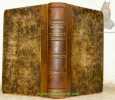
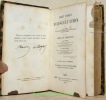
(catalogue de l’éditeur), Pour un paiement via PayPal, veuillez nous en faire la demande et nous vous enverrons une facture PayPal
Controversiae Anatomicae, & Affines Nobiliores Ac Rariores.
Goslar, Typis Nicolai Duncker, Impensis Johannis Hallevordij Rostochiensis, 1631. Small 8vo. Cont. limp vellum. (2),615,(7) pp. Some browning to leaves throughout. A few leaves with a small wormtract in upper margin.
First edition. This collection by the famous Danish anatomist contains 6 works on anatomy and physiology in form of ""Quæstiones"": 1. De homine. 2. De partibus eorumque facultatibus et functionibus. 3. De infimo ventre. 4. De thorace. 5. De capite. 6. de musculis, venis, erteriis, nervis et ossibus, and it can be considered as supplementary works to his enormously influential ""Institutiones Corporis Humani..."" from 1611.Waller No 700 - Gosch III, B.5. - Not in Wellcome. - Not in Osler.
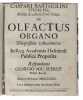
Olfactus organo Disqvisitio Anatomica. In Rg. Academia Hafniensi P. Respondente Georgio Nic. Seerup
Hafnia (Copenhagen), 1671. Small 4to. In later half vellum. Closely trimmed with slight loss of pagination numbers, otherwise fine. 20 pp. with four woodcut illustrations in text.
BARTHOLIN, CASPAR - BARTHOLIN, THOMAS. - THE JEWELLWRY OF THE ANCIENTS.
Reference : 48738
(1676)
De Inauribus veterum Syntagma. Accedit Mantissa ex Thomae Bartholini Miscellaneis Medicis De Annulis narium.
Amsterdam, henric Westenius, 1676. 12mo. Later modest hcloth. Engraved titlevignette. (16),148,(2),18,(8) pp. 7 textengravings (of which 4 are full-page), several woodcut illustrations. A small piece of corners gone on titlepage, no loss of text. Light browning to the fist leaves, a marginal dampstain to the last 12 leaves.
Second edition of caspar Bartholin's historical account of the jewellery of the Ancients together with his father's dissertation on nose-rings.Bibl. Danica II:446. - Wellcome II, 108.
Institutiones Anatomicae, Novis Recentiorum opinionibus & observationibus, quarum innumerae hactenus editae non sunt, figuris que secundo auctæ ab Authoris Thoma Bartholini.
Lugd. Batavorum (Leyden), Frants Hacke, 1645. 8vo. Cont. full calf. First hinges weakening, top of spine a little worn. Richly gilt back in 6 compartments. Red, gilt titlelabel in leather on back. Engraved titlepage (portraits of famous physicians). Engraved portrait of Thomas B. on verso of title. Foot of first few leaves browned. (14),488,(24) pp., 6 folded engraved plates and 85 engraved textplates, mostly full-and half page (all).
Second edition of Thomas Bartholin's adaptation of his fathers famous anatomy, which became hichly influential when Thomas Bartholin issued it with illustrations. PP. 443-488 is Johannis Walaeus: Epistolae Duæ: De Motu Chyli et sangvinitas. Ad Thomas Bartholinum. Editio quarta. - Wellcome II:106. - Gosch III: p. 114 - Thesaurus: 333.
Specimen Historiae Anatomicae Partium Corporis Humani (Bartholin) (+) Historia partium et oeconomiae hominis secundum naturam, sive dissertationes (Ortlob).
(Bartholin:) Copenhagen, Joh. Phil. Bockenhoffer, 1701 (+) (Ortlob:) Leipzig, Gleditsch, 1697. 4to (205 x 160 mm). In a modest contemporary half calf binding with three raised bands. Title-page with marginal repairs and some miscolouring. First and last few leaves with dampstain, otherwise a good copy. (8), 187, (5), 8, 296, (20) pp. + five plates.
First appearance of Bartholin’s important anatomical work. Blending meticulous anatomical observations, historical analysis, and scholarly commentary, the book presented a detailed overview of the development of anatomical knowledge, exploring the works of influential figures from ancient Greece to the Renaissance. Bartholi's efforts to integrate historical context with anatomical facts were unprecedented offering readers a holistic understanding of the subject.
Angina puerorum Campanieae Siciliaeque epidemica exercitationes. Accedit de Laryngotomia (von) Moreau Rena.
2 Werke in einem Band. Lutetiae Parisiorum (= Paris), Apud Olivarium de Varennes, 1646. 8°. (10) Bl., 140 S. Pergamentband der Zeit mit handschriftlichem Rückentitel.
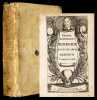
Thomas Bartholini (1616–1680), dänischer Arzt, Anatom, Mathematiker und Theologe, war ein hervorragender Schriftsteller. – Vorgebunden: Thomae Bartholini historiarum antatomicarum rariorum. Centuria I et II. (von total 4). Hagae, Comitum, O. J. (8) Bl. (inkl. gest. Titel und Porträt). 314 S., (3) Bl. Mit 9 (davon 2 gef.) Kupfertafeln und 9 Textillustr. – Papier unterschiedlich stark gebräunt und wasserfleckig. Der Einband etwas verzogen und fleckig.
Anatomia, ex Casparl Bartholini parentis institutionibus, omniumque recentiorum & proprils observationibus tertium ad sanguinis circulationem reformata.
Leiden & Rotterdam, Hacklus, 1669. 8vo. In contemporary full vellum with title in gilt lettering to spine. Binding with wear. Stamp to front free end-paper. Annotations and previous owner's name to front pasted down front free end-paper and title-page. Marginal worktract affecting the last 60 pp. and between pp. 160-260. With brownspotting thoughout. (10), 592, (12) pp.
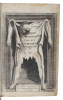
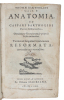
A later, much improved and expanded edition, of Thomas Bartholin's revised edition of his father's classic 'Anatomicae institutiones' (1611). Caspar Bartholins ""Anatomy"" became known all over Europe and greatly influenced the teaching of anatomy in the 17th century.Thomas Bartholin included in this revised edition of Anatomia also two letters (""Epistolae duae de Motu chyli et sanguinis"" - accompanied by 3 plates) on the relation between the lymphatic system and the thoracic duct.Krivatsy 780 Wellcome 11, 107. Waller 714 Choulant-F. 245 Kestner 86.
Antiquitatum veteris puerperii synopsis a filio Casparo Bartholino commentario illustrata. Cum Thomae Bartholini ad filium epistola.
Amsterdam, Wettstein, 1676. 12mo. In recent full vellum binding with brown leather titlelabel with gilt lettering to spine. Lightly miscoloured to margins. (28), 179, (4) pp. (including 9 engraved plates (4 folded)).
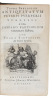
Later edition of Bartholin's work on reproduction in antiquity. (first published in Copenhagen in 1646).Wellcome II, 108 Graesse I, 302.
Cista Medica Hafniensis eller Det medicinske fakultets Brevkiste...En kortfattet beskrivelse af Anatomihuset i København. Udg.påny af Niels W.Bruun og Hans-Otto Loldrup.
Kbhvn., 1982. Folio. 279 pp. Rigt illustr. Med dedi,. og vedlagt brev.
De Nivis Usu Medico Observationes Varie (+) De Figura Nivis Dissertatio (+) Historiarum Anatomicarum et Medicarum Rariorum Centuria V et VI. (+) Thomas Bartholin: Responsio de Experimentis Anatomicis Bilsianis. (+) [J. Rohde:] Mantissa Anatomica ad Th... - [""THE FIRST WORK AFTER AVICENNA TO DISCUSS THE USE OF SNOW AS AN ANESTHETIC""]
Hafniæ (Copenhagen), Matthias Godiche, 1661. 8vo. In contemporary full calf with gilt lettering to spine. Gilt lettering to spine and tooled frames to boards. Leather to spine cracked. Small repair and previous owner's name to title-page. Light foxing throughout. (22), 232, (12), 42, (30), 386, (14), 40, 32 pp. + engraved plate.
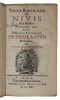
First edition of Bartholin's important work on anesthetic: ""The first work after Avicenna to discuss the use of snow as an anesthetic."" (Garrison & Morton). ""Chapter XXII of this historically important book makes the first known mention of the use of mixtures of ice and snow for freezing to produce surgical anesthesia. The author states that the technique was taught to him by one Marco Aurelio Severino of Naples. In order not to kill the tissues and cause gangrene, the ice-snow mixture was to be applied on the parts in narrow parallel lines. After a quarter of an hour feeling would be deadened and the part could be cut without pain. This may be the first mention of such a technique since the time of Avicenna."" (Heirs of Hippocrates 326). Thomas Bartholin (1616-1680) was one of the leading physicians of his time, now remembered, among many other things, as the discoverer of the lymphatic system. He ""was the most celebrated physician of his period in Denmark and perhaps in all of Europe"". (Kronick, p. 81). He is considered ""a typical representative of the ""Curiosi naturae"" of the 17th century with all their learning, diligence and insatiable spirit of curiosity... He belonged with all his heart to the learned period, and yet he made an anatomical-physiological discovery of high mark when he found, and demonstrated, a hitherto entirely unknown vascular system in animals, and later in man - the lymphatic."" (Meisen, p. 25). He was a hugely influential and extremely productive man. Apart from his seminal discovery of the lymphatic system, he wrote a number of highly influential treatises, published a series of very influential anatomical papers, published his vast correspondence with other scientists, which has the character of a scientific archive at a time when there were not yet periodicals of natural science, provided us with the most extensive information about medicine in Denmark and about the conditions of the physicians, called attention to the significance of pathological anatomy, etc., etc., Heirs of Hippocrates 326.Osler 1933.Wellcome II, p. 107.Garrison & Morton 5645.90
De sanguine vetito disquisitio medica, cum Cl. Salmasii.
Frankfurt, ex officina Hafniensi, Petri Haubold, 1673. Small8vo. In contemporary full calf with five raised bands. Hindges weak. A few marginal annotations to title-page. First few leaves lightly miscoloured, otherwise fine. (8), 104 pp
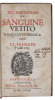

The rare first edition of Bartholin's work on bloodtransfusion.
Dispensatorium Hafniense, Jussu Superiorum á Medicis Hafniensibus adornatum.
Hafniæ, 1658. Lille 4to. Opapbd. Faksimile fra 1966, nr. 261 of 500 ekspl.
Paralytici N.T. Medico et Philologico.
Leipzig, J. C. Wohlfahrt, 1685. 8vo. In later red half calf with gilt lettering to spine. Title-page slightly browned, otherwise a good copy. (4), 103, (1) pp.
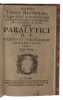
Third edition of Bartholin's work on paralysis.
BARTHOLIN, THOMAS (Edt.) - STENO, NICOLAUS [NIELS STEENSEN] et al.
Reference : 53613
(1673)
Acta Medica & Philosophica Hafniensia. Ann. 1671&16721673 1674.1675.1676." 1677.1678. 1679. Cum aeneis figuris/Figuris aeneis illustrata. 5 vols (all). - [ONE OF THE FIRST MEDICAL PERIODICALS]
Copenhagen, Peter Haubold, 1673-80. 4to. A very nice recent full calf pastiche binding with four raised bands and gilt red title-label to spine. blindstamped borders to boards. Old owner's inscription (""Sven Borgh/Lund 1840"") to title-page. A very nice and clean copy with only a bit of brownspotting and some evenly browned leaves. A tear (with no loss) to one leaf and one leaf (vol. V, L3) with a neat marginal restoration, far from affacting text. The following two leaves with minor loss to blank upper margin (far from affecting text). The large double-page folded plate with Stensen's lymphatic glands (vol. II, p. 240) with a neat restoration to verso, no loss. Annotations and corrections in the same early, neat hand throughout. Woodcut vignettes and initials. All four title-pages (part III & IV have a joint title-page) printed in red and black. (16), 316" (20), 376 (16), 174, 216" (8), 342 pp. With ab. 60 woodcut illustrations in the text, many of them quite large, two of them full-page, and all 62 engraved plates (of which two are on a folded leaf), four of which are folded. A truly excellent, fully complete copy with all five volumes and all 62 plates.
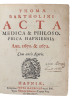
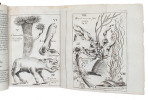
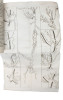
The very rare first edition of all five volumes of Bartholin's groundbreaking medical journal, which constitutes the first scientific periodical in Scandinavia and one of the very first medical periodicals in the world. Thomas Bartholin (1616-1680) was one of the leading physicians of his time, now remembered, among many other things, as the discoverer of the lymphatic system. He ""was the most celebrated physician of his period in Denmark and perhaps in all of Europe"". (Kronick, p. 81). He is considered ""a typical representative of the ""Curiosi naturae"" of the 17th century with all their learning, diligence and insatiable spirit of curiosity... He belonged with all his heart to the learned period, and yet he made an anatomical-physiological discovery of high mark when he found, and demonstrated, a hitherto entirely unknown vascular system in animals, and later in man - the lymphatic."" (Meisen, p. 25). He was a hugely influential and extremely productive man. Apart from his seminal discovery of the lymphatic system, he wrote a number of highly influential treatises, published a series of very influential anatomical papers, published his vast correspondence with other scientists, which has the character of a scientific archive at a time when there were not yet periodicals of natural science, provided us with the most extensive information about medicine in Denmark and about the conditions of the physicians, called attention to the significance of pathological anatomy, etc., etc., and ""[y]et the greatest importance is to be attached to his ""Acta medica philosophica Hafniensia"", in 5 volumes, that was published from 1673 to 1680, when he died. It is a scientific periodical, wide in its scope, one of the first of its kind."" (Meisen, p. 28). ""The Copenhagen biologists, under the quickening influence of Thomas Bartholin, produced five volumes of transactions known as the Acta medica et philosophica Hafniensia, which is now very rare."" (Hagenströmer)The leading contributors to the periodical, besides Bartholin himself, was the great Niels Steensen (Steno), Holger Jacobsen (Jacobaeus), Caspar Bartholin, Ole Borch (Borrichius), Ole Worm, Simon Paulli, Johan Rohde, Caspar Kölichen, etc., but the contributions were not confined to Danes or Scandinavians. For instance, the English anatomist Edward Tyson (1650-1708) also published here, as did several other internationally famous physicians and scientists. Interestingly, the ""Acta Hafniensia"", as it is known, has a great focus on the odd and curious, the astounding and marvelous, the unnatural and abnormal. Thorndike claims that ""Monsters and freaks of nature receive perhaps the most attention."" (vol. VIII, p. 234). However, the journal was far from limited to this. ""Thomas Bartholin describes the male mandrill illustrated by three anatomical plates (Male genitalia) and a figure of the entire animal, which had died of disease in the Royal Menagerie. Holger Jacobsen describes the scorpion, the salamander, snakes, several birds, the heron and the parrot (based on dissections and figures by Steno). He also investigated the fascinating and unique anatomical puzzle of the tongue of the black woodpecker (with plate). He gives an exceptionally interesting account of the mole cricket, Gryllotalpa, which is important as being one of the first in which the elongated segmental heart of insects is described and figured. This memoir is a commendable piece of zootomical research, and it is all the more outstanding because the subject of it was an invertebrate (Cole). The most outstanding contributions in the entire periodical, however, are the 12 by Niels Steensen (Steno), which are all printed here for the first time. Steensen was the most gifted of Bartholin's disciples, and when he returned to Denmark in 1672, he immediately took up anatomical demonstrations and dissections, the fruits of which he published here, in the first three volumes of the ""Acta Hafniensia"". His contributions constitute important finds in the fields of The Brain, The Heart, The Muscles and General Embryology. ""Steno's dissections of the muscles of the eagle, Aquila (1673) is one of the most remarkable essays in zootomy published up to his time, and it is perhaps more detailed and reliable than almost any other."" (Cole). (Gosch 24).In the paper ""Embryo monsto affinis Parisiis dissectus"" (Gosch 15), we have the first known description of the ""tetralogy of Fallot"" (Garrison & Morton no 2726.1). ""Bartholin was the most celebrated physician of his period in Denmark and perhaps in all of Europe. He was professor of anatomy at the University of Copenhagen and later became Dean of its Medical Faculty. The publication seems also to have associated with the activities of a scientific society, although there seems to be little evidence for Neuberger's statement that the ""Acta"" were the proceedings of this society. The preface to the translation of the ""Acta"" which are included in the ""Collection Académique"" gives the following account of its origins: ""The Academy of Copenhagen was founded by Frederick III, who was aware how much glory it brought to him and to Denmark by encouraging the sciences and by attracting and holding scientists in his kingdom. One finds little to clarify the history of this academy, even in the five published volumes. The editing of the memoirs was principally under the care of Bartholin, the first Dane to publish medical observations. His aim was first to make a collection which embraced all parts of science"" but, deterred by the immensity of the task, he limited himself to the different parts of medicine and to those observations that were offered to him. His sponsor was Count Griffenfeld, the grand chancellor of Denmark, who obtained an edict enjoining all Danish physicians to render exact correspondence with the Dean of the Faculty of Copenhagen and to inform him of all singularities in medicine and natural history observed in different parts of the kingdom. Bartholin had great hopes for this collection and one can truly find in the five volumes which he published many discoveries which would have been lost or perhaps not have existed if this correspondence had not brought them to light and encouraged him."" The ""Acta"" consisted primarily in short original observations on medical and natural scientific subjects, although it also contained a few abstracts of books."" (Kronick p. 81). Waller: 712 (listing only 39 plates)Wellcome: II, p. 108 (listing 61 plates)Gosch: III, pp 58-59 & I, pp. 137-38Hagströmer Library has only vols. I-IVBartholin papers: Gosch: Bartholin 30-43Steensen-papers: Gosch: Steno 15-26" Garrison&Morton: 2726.1Cole, F.J.: A History of Comparative Anatomy, pp 369-93Thorndike: History of Magic and Experimental Science, vol. VIII, Chapter 30Kronick, David A.: A History of Scientific and Technical Periodical 1665-1790, p. 57 & pp. 80-82Meisen: Prominent Danish Scientists through the Ages, pp. 25-28
BARTHOLIN, THOMAS (Edt.) - STENO, NICOLAUS [NIELS STEENSEN] et al.
Reference : 57048
(1673)
Acta Medica & Philosophica Hafniensia. Ann. 1671&16721673 1674.1675.1676." 1677.1678. 1679. Cum aeneis figuris/Figuris aeneis illustrata. 5 vols (all). - [BARTHOLIN'S GROUNDBREAKING MEDICAL JOURNAL]
Copenhagen, Peter Haubold, 1673-80. 4to. Bound in four full mottled calf bindings from ab. 1800 with five raised bands to richly gilt spines. All edges of baords gilt. Bindings with some wear, especially to capitals, hinges, and corners. Old owner's inscription ""AEM Schleisveig/ Paris 1 Juli 1889"" to front free end-papers. Some brownspotting and browned leaves. Woodcut vignettes and initials. All four title-pages (part III & IV have a joint title-page) printed in red and black. (16), 316" (20), 376 (16), 174, 216" (8), 342 pp. With ab. 60 woodcut illustrations in the text, many of them quite large, two of them full-page, and all 62 engraved plates (of which two are on a folded leaf), four of which are folded. Fully complete, with all five volumes and all 62 plates.
The very rare first edition of all five volumes of Bartholin's groundbreaking medical journal, which constitutes the first scientific periodical in Scandinavia and one of the very first medical periodicals in the world. Thomas Bartholin (1616-1680) was one of the leading physicians of his time, now remembered, among many other things, as the discoverer of the lymphatic system. He ""was the most celebrated physician of his period in Denmark and perhaps in all of Europe"". (Kronick, p. 81). He is considered ""a typical representative of the ""Curiosi naturae"" of the 17th century with all their learning, diligence and insatiable spirit of curiosity... He belonged with all his heart to the learned period, and yet he made an anatomical-physiological discovery of high mark when he found, and demonstrated, a hitherto entirely unknown vascular system in animals, and later in man - the lymphatic."" (Meisen, p. 25). He was a hugely influential and extremely productive man. Apart from his seminal discovery of the lymphatic system, he wrote a number of highly influential treatises, published a series of very influential anatomical papers, published his vast correspondence with other scientists, which has the character of a scientific archive at a time when there were not yet periodicals of natural science, provided us with the most extensive information about medicine in Denmark and about the conditions of the physicians, called attention to the significance of pathological anatomy, etc., etc., and ""[y]et the greatest importance is to be attached to his ""Acta medica philosophica Hafniensia"", in 5 volumes, that was published from 1673 to 1680, when he died. It is a scientific periodical, wide in its scope, one of the first of its kind."" (Meisen, p. 28). ""The Copenhagen biologists, under the quickening influence of Thomas Bartholin, produced five volumes of transactions known as the Acta medica et philosophica Hafniensia, which is now very rare."" (Hagenströmer)The leading contributors to the periodical, besides Bartholin himself, was the great Niels Steensen (Steno), Holger Jacobsen (Jacobaeus), Caspar Bartholin, Ole Borch (Borrichius), Ole Worm, Simon Paulli, Johan Rohde, Caspar Kölichen, etc., but the contributions were not confined to Danes or Scandinavians. For instance, the English anatomist Edward Tyson (1650-1708) also published here, as did several other internationally famous physicians and scientists. Interestingly, the ""Acta Hafniensia"", as it is known, has a great focus on the odd and curious, the astounding and marvelous, the unnatural and abnormal. Thorndike claims that ""Monsters and freaks of nature receive perhaps the most attention."" (vol. VIII, p. 234). However, the journal was far from limited to this. ""Thomas Bartholin describes the male mandrill illustrated by three anatomical plates (Male genitalia) and a figure of the entire animal, which had died of disease in the Royal Menagerie. Holger Jacobsen describes the scorpion, the salamander, snakes, several birds, the heron and the parrot (based on dissections and figures by Steno). He also investigated the fascinating and unique anatomical puzzle of the tongue of the black woodpecker (with plate). He gives an exceptionally interesting account of the mole cricket, Gryllotalpa, which is important as being one of the first in which the elongated segmental heart of insects is described and figured. This memoir is a commendable piece of zootomical research, and it is all the more outstanding because the subject of it was an invertebrate (Cole). The most outstanding contributions in the entire periodical, however, are the 12 by Niels Steensen (Steno), which are all printed here for the first time. Steensen was the most gifted of Bartholin's disciples, and when he returned to Denmark in 1672, he immediately took up anatomical demonstrations and dissections, the fruits of which he published here, in the first three volumes of the ""Acta Hafniensia"". His contributions constitute important finds in the fields of The Brain, The Heart, The Muscles and General Embryology. ""Steno's dissections of the muscles of the eagle, Aquila (1673) is one of the most remarkable essays in zootomy published up to his time, and it is perhaps more detailed and reliable than almost any other."" (Cole). (Gosch 24).In the paper ""Embryo monsto affinis Parisiis dissectus"" (Gosch 15), we have the first known description of the ""tetralogy of Fallot"" (Garrison & Morton no 2726.1). ""Bartholin was the most celebrated physician of his period in Denmark and perhaps in all of Europe. He was professor of anatomy at the University of Copenhagen and later became Dean of its Medical Faculty. The publication seems also to have associated with the activities of a scientific society, although there seems to be little evidence for Neuberger's statement that the ""Acta"" were the proceedings of this society. The preface to the translation of the ""Acta"" which are included in the ""Collection Académique"" gives the following account of its origins: ""The Academy of Copenhagen was founded by Frederick III, who was aware how much glory it brought to him and to Denmark by encouraging the sciences and by attracting and holding scientists in his kingdom. One finds little to clarify the history of this academy, even in the five published volumes. The editing of the memoirs was principally under the care of Bartholin, the first Dane to publish medical observations. His aim was first to make a collection which embraced all parts of science"" but, deterred by the immensity of the task, he limited himself to the different parts of medicine and to those observations that were offered to him. His sponsor was Count Griffenfeld, the grand chancellor of Denmark, who obtained an edict enjoining all Danish physicians to render exact correspondence with the Dean of the Faculty of Copenhagen and to inform him of all singularities in medicine and natural history observed in different parts of the kingdom. Bartholin had great hopes for this collection and one can truly find in the five volumes which he published many discoveries which would have been lost or perhaps not have existed if this correspondence had not brought them to light and encouraged him."" The ""Acta"" consisted primarily in short original observations on medical and natural scientific subjects, although it also contained a few abstracts of books."" (Kronick p. 81). Waller: 712 (listing only 39 plates)Wellcome: II, p. 108 (listing 61 plates)Gosch: III, pp 58-59 & I, pp. 137-38Hagströmer Library has only vols. I-IVBartholin papers: Gosch: Bartholin 30-43Steensen-papers: Gosch: Steno 15-26" Garrison&Morton: 2726.1Cole, F.J.: A History of Comparative Anatomy, pp 369-93Thorndike: History of Magic and Experimental Science, vol. VIII, Chapter 30Kronick, David A.: A History of Scientific and Technical Periodical 1665-1790, p. 57 & pp. 80-82Meisen: Prominent Danish Scientists through the Ages, pp. 25-28
De Cruce liber tres [Lipsi] (+) De Cruce Christi [Bartholin].
Versiliae, Hoogenhuysen, 1675. 12mo. In contemporary full vellum. Miscolouring to extremities and title in contemporary hand to spine. Ex-libris pasted on to pasted down front end-paper. A few notes and previous owner's name to front free end-paper. Inner hinges a bit weak. Internally fine. (22), 240, (22), 290, (18) pp. + 22 full page engraved plates, 2 in text and 1 frontispiece.
![De Cruce liber tres [Lipsi] (+) De Cruce Christi [Bartholin].. BARTHOLIN, THOMAS (+) JUSTI LIPSI.](https://static.livre-rare-book.com/pictures/LLX/60349_1_thumb.jpg)
![De Cruce liber tres [Lipsi] (+) De Cruce Christi [Bartholin].. BARTHOLIN, THOMAS (+) JUSTI LIPSI.](https://static.livre-rare-book.com/pictures/LLX/60349_2_thumb.jpg)
![De Cruce liber tres [Lipsi] (+) De Cruce Christi [Bartholin].. BARTHOLIN, THOMAS (+) JUSTI LIPSI.](https://static.livre-rare-book.com/pictures/LLX/60349_3_thumb.jpg)
Interesting sammelband containing two works both dealing with the crucifixion of Christ. Lipsius (in ‘De Cruce liber tres’) argues that Jesus was impaled on a single upright stake and not a cross and Bartholin (In ‘De Cruce Christi’) discusses the physiological aspects of Jesus’ body and how it probably would have reacted to a crucifixion and the wound inflicted by a Roman soldier. Some religious scholars such as Barthold Nihus found Bartholin's hypotheses about the blood and water running from the wound proposterous because they could be interpreted as if Christ did not in fact die of the crucifixtion itself.
Historiarum Anatomicarum Rariorum. Centuria I et II.
Hagæ Comitum (Den Haag), Adriani Vlacq, 1654. Small 8vo. Contemp. full vellum with a faint handwritten title on spine. A nick to vellum at the handwritten title. Some soiling to spine and lower part of upper cover. Engraved titlepage (loosening). (14),314,(4) pp., textiillustrations in woodcut (some full-page) and 9 engraved plates (some folding). Scattered brownspots, mostly at end.
First reprint, the Vlacq-print, from the same year as the original from Copenhagen, and having the same plates as this. The Copenhagen edition was followed by Centuria III-IV and V-VI. This collection of papers in various departments of medicine and anatomi, deals mainly with human and animal monsters.Gosch III,p.43. (""Denne Udgave er maaske at betragte som en Originaludgave samtidig med den kjøbenhavnske"")
Afhandling om Sydommenes Overplantning eller om den Maade paa hvilken Sygdomme overføres fra det menneskelige Legeme til andre, saavel levende, som livløse Ting. Forestillet i et Brev til den danske Læge Hermann Grube. Oversat i det Danske efter den i...
Kiøbenhavn, Sebastian Popp, 1794. Lille8vo. Indsat i et gammelt helldrbd. 126 pp. Mangler de 2 første blade (A1-2) samt pp. 55-58, 115-116. Kraftige brugsspor. De manglende blade vedlagt i nedfotograferet xerox-kopi.
Den yderst sjældne første oversættelse af Bartholin's ""De Transplantatione morborum Dissertatio epistolica"", Hafniæ, 1673, et kuriøst værk om bl.a. magisk healing.Bibl. Danica I:759.
Le Centre Départemental de Transfusion Sanguine de Marmande, antenne du centre régional de transfusions sanguine de Bordeaux. Thèse pour le Doctorat en Médecine N°79
IMP. CANLER. 1954. In-8. Broché. Très bon état, Couv. fraîche, Dos satisfaisant, Intérieur frais. 67 pages.. . . . Classification Dewey : 610-Sciences médicales. Médecine
Université de Bordeaux - Faculté de Médecine et de Pharmacie. Année 1954 Classification Dewey : 610-Sciences médicales. Médecine
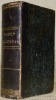
Traité pratique d’auscultation ou exposé méthodique des diverses applications de ce mode d’examen a l’état physiologique et morbide de l’économie. Suivi d’un précis de percussion. Quatrième édition, revue et augmentée. Ouvrage adopté par le Conseil de l’instruction publique pour les facultés et écoles préparatoires de médecine.
Paris, Labé, Editeur, Libraire de la Faculté de Médecine 1854, 155x110mm, XVIII - 719pages, reliure demi-basane. Plats papier marbré. Auteur, titre et filets dorés au dos, charnière supérieure craquelée, rousseurs au début et à la fin du livre.
Pour un paiement via PayPal, veuillez nous en faire la demande et nous vous enverrons une facture PayPal
Traité pratique d'auscultation suivi d'un précis de percussion
Asselin et Houzeau Cartonnage d'éditeur 1887 Cartonnage toile de l'éditeur, in-16, XVI et 872 pp., 11° édition ; menus incidents aux coiffes et aux coins, bon état. Livraison a domicile (La Poste) ou en Mondial Relay sur simple demande.
Barthèlemy P., Lefebvre D. (Sous la direction de)
Reference : RO30322735
(1994)
ISBN : 2225844836
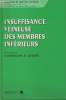
"Insuffisance veineuse des membres inférieurs (Collection ""Médecine vasculaire"")"
Masson. 1994. In-4. Cartonné. Bon état, Couv. convenable, Dos satisfaisant, Intérieur frais. 191 pages. Quelques illustrations en noir et blanc, dans le texte. Specimen.. . . . Classification Dewey : 610-Sciences médicales. Médecine
"Collection ""Médecine vasculaire"". Classification Dewey : 610-Sciences médicales. Médecine"
Le médecin des enfants hygiène et maladies - Guide des mères de famille et des instituteurs - 3e édition
J. Rothschild Editeur. 1882. In-12. Broché. Etat d'usage, Couv. légèrement passée, Manque en coiffe de pied, Quelques rousseurs. 114 pages. Petites annotations à l'encre en page de titre et sur le 1er plat.. . . . Classification Dewey : 610-Sciences médicales. Médecine

Classification Dewey : 610-Sciences médicales. Médecine

