 Write to the booksellers
-
Type
Autograph (3)
Book (37463)
Engraving (6)
Magazine (539)
Manuscript (3)
Music sheets (109)
Old papers (5)
Photographs (69)
Posters (2)
-
Latest
Last 24h (1)
Last 3 days (10)
Last month (59)
Last week (27)
-
Language
Dutch (9)
English (24)
French (38120)
German (8)
Greek (1)
Italian (3)
Latin (26)
Polish (1)
Portuguese (1)
Russian (1)
Spanish (5)
-
Century
16th (66)
17th (191)
18th (992)
19th (4033)
20th (18038)
21st (1933)
-
Countries
Belgium (1264)
Brazil (11)
Canada (60)
China (5)
Côte d'Ivoire (72)
Denmark (655)
France (32755)
Germany (11)
Greece (6)
Italy (3)
Netherlands (2)
Switzerland (3355)
-
Syndicate
ALAC (59)
CLAM (19)
CLAQ (56)
CNE (26)
ILAB (24295)
NVVA (2119)
SLACES (2119)
SLAM (20914)
SNCAO (180)
Traité d'analyses par les rayons ultra-violets filtrés
N. Maloine. 1932. In-8. Broché. Etat d'usage, Couv. partiel. décollorée, Dos satisfaisant, Papier jauni. 363 pages augmentées de nombreuses photos en noir et blanc,dans le texte. 2 étiquettes collées sur le 1er plat et 1 au dos.. . . . Classification Dewey : 610-Sciences médicales. Médecine
Préface du professeur A. d'Arsonval. Classification Dewey : 610-Sciences médicales. Médecine

La question de l'alcool : allégations et réalités
Paris, Félixc Alcan 1917 In-12 18,5 x 11,5 cm. Broché, couverture beige, auteur & titre en noir sur le dos et le premier plat, XI-288 pp., table alphabétique, table des matières. Dos cassé.
Edition originale avec "Hommage de l'auteur" imprimé sur la couverture. Au sommaire : Introduction : Un programme d'étude scientifique - L'aliment alcool - La consommation de l'alcool - Les campagnes anti-alcooliques - L'alcool et la démocratie - Législations anti-alcooliques et leurs résultats - Les monopoles - Le budget de l'alcool - Les prohibitionnistes pendant la guerre. Bon état d’occasion
THESE n°11 POUR LE DIPLOME D'ETAT DE DOCTEUR EN CHIRURGIE DENTAIRE : PATHOLOGIE INFLAMMATOIRE DU SINUS MAXILLAIRE D'ORIGINE DENTAIRE
EDITIONS BERGERET. 1976. In-4. Broché. Bon état, Couv. convenable, Dos fané, Mouillures. 31 pages.. . . . Classification Dewey : 618-Autres branches de la médecine
Classification Dewey : 618-Autres branches de la médecine
Lettres choisies de feu M. Guy patin; docteur en médecine de la Faculté de Paris et professeur au Collège royal dans lesquelles sont contenues plusieurs particularités sur la vie et la mort des sçavants de ce siècle.... A Rotterdam chez Reinier Leers 1725. Rotterdam
5 volumes in-12 reliés plein veau marbré du temps, tranches rouges. (manque une coiffe au tome 5, mais en très bonne condition et collationnés complets)
L'édition la plus complète, augmentée ici de plus de 300 lettres
Lettres choisies de feu M. Guy Patin, docteur en médecine, de la faculté de Paris, et professeur au Collège Royal.... Augmentées de plus de 300 lettres dans cette dernière édition, et divisée en trois volumes.
5 volumes in-12 reliés plein veau granité du temps, dos fleuronnés et tranches rouges (manque une coiffe et un tout petit morceau d'une pièce de titre, mais bel exemplaire)
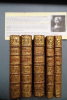
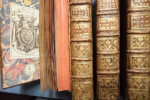
tome1 (8ff.-430pp.) tome2 (1ff.-432pp.) tome3 (1ff.-444pp.) tome 4 (2ff.-227pp.) tome 5 (1ff.-262pp.) Edition la plus complète et sans manque.
LA SANTE AU FEMININ. HYGIENE, PREVENTION ET TRAITEMENTS NATURELS DES MALADIES DE LA FEMME
DANGLES. 1991. In-8. Broché. Bon état, Couv. convenable, Dos satisfaisant, Intérieur frais. 174 pages. Quelques illustrations en noir et blanc, dans le texte et hors texte.. . . . Classification Dewey : 610-Sciences médicales. Médecine
Classification Dewey : 610-Sciences médicales. Médecine
Mémoire sur les vices de construction des Cheminées, les inconvénients et les dangers qui en résultent, et les moyens d’y remédier.
Extrait des Annales de Chimie, novembre 1807. In 8 couverture factice, 24 pp.
****
Physiologie de l'homme.
Montréal, Editions HRW Ltéé/W.B. Saunders Company, 1974. 18 x 24, 502 pp., très nombreuses figures, broché, bon état (couverture légèrement défraîchie).
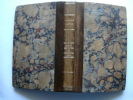
Traité des Moyens de désinfecter l'Air, de prévenir la Contagion et d'en arrêter les Progrès.
Paris, Bernard, 1802, An XI. 130 X 210 mm. relié demi-veau prune, dos lisse avec titre et faux-nerfs dorés, non rogné (reliure moderne). Frontispice- XLVIII-429 pp. 2ème édition augmentée. Le frontispice manque, quelques rousseurs, quelques coins inférieurs froissés.
Phone number : 41 021 964 60 10
Traité des moyens de désinfecter l'air de prévenir la contagion et d'en arréter les progrès.
A Paris Chez Bernard, libraire. 1805 441p+1f+XV (avertissements, notes et tables). 1 volume In8. Reliure d'époque en pleine basane racinée. Dos lisse orné avec étiquette de titre noire. Troisième édition orné de 3 planches H.T.Catalogue de la librairie Bernard (29pp en fin de volume). Bon exemplaire.
TRAITÉ DES MOYENS DE DÉSINFECTER L'AIR. Relié à la suite: L'ANTIMÉPHITIQUE, par M. Janin
Paris Chez Bernard, Libraire. An XI 1802 in 8 (19,5x13) 1 volume reliure demi basane fauve de l'époque, dos lisse très orné, riches caissons dorés, et beaux fleurons romantiques, pièce de titre de maroquin rouge, XLVIII et 429 pages. Le portrait gravé en frontispice manque. Seconde édition. Baron Louis-Bertrand Guyton de Morveau, Dijon, 1737 - Paris, 1816. Relié à la suite: L'ANTIMÉPHITIQUE, par M. Janin (Paris, De l'imprimerie de Ph.-D. Pierres, 1782), XXXII et 70 pages, et 8 pages. Bel exemplaire ( Photographies sur demande / We can send pictures of this book on simple request )
Très bon Reliure
LA SANTE N'EST PAS UN DROIT - MANIFESTE POUR UNE AUTRE MEDECINE
BE BOURIN. MARS 2007. In-8. Broché. Bon état, Couv. convenable, Dos satisfaisant, Intérieur frais. 199 pages.. . . . Classification Dewey : 610-Sciences médicales. Médecine
Classification Dewey : 610-Sciences médicales. Médecine
Hypertension artérielle n°4 : le point de vue du néphrologue - la puissance de la synergie pour gagner d'emblée dans l'HTA.
Anaes. 2000. In-8. Broché. Bon état, Couv. convenable, Dos satisfaisant, Intérieur frais. 36 pages.. . . . Classification Dewey : 610-Sciences médicales. Médecine
Classification Dewey : 610-Sciences médicales. Médecine
Discours sur l'étude de la médecine
Par le deuxième conservateur du musée Calvet d'Avignon. Broché bon Montpellier Ricard s.d. 1 plaquette in-8°
édition originale
Histoire naturelle de l'athérosclérose : Anatomie - Physiopathologie - Clinique - Thérapeutique
Laboratoires Théramex. Non daté. In-4. Relié. Bon état, Couv. convenable, Dos satisfaisant, Intérieur frais. 157 pages. Nombreux graphiques, illustrations et photos en couleurs dans le texte.. . . . Classification Dewey : 610-Sciences médicales. Médecine
Classification Dewey : 610-Sciences médicales. Médecine
ENCYCLOPEDIE DE MEDECINE NATURELLE.
DE VECCHI. 1976. In-8. Relié. Bon état, Couv. convenable, Dos satisfaisant, Intérieur frais. 387 pages - jaquette en bon état - quelques planches en couleurs - nombreuses illustrations en noir et blanc dans le texte - textes sur deux colonnes.. Avec Jaquette. . . Classification Dewey : 610-Sciences médicales. Médecine
Traduction de Janine Casevecchie. Classification Dewey : 610-Sciences médicales. Médecine
AVEC VOTRE MEDECIN, TRAITEZ VOTRE HYPERTENSION.
ROUSSEL. NON DATE. In-8. Broché. Bon état, Couv. convenable, Dos satisfaisant, Intérieur frais. 24 pages. Premier plat illustré en marron. Quelques illustrations en marron et blanc.. . . . Classification Dewey : 610-Sciences médicales. Médecine
Classification Dewey : 610-Sciences médicales. Médecine
Traité de gynécologie pratique.
Paris, G doin et cie , 1948 ; in-8, 512 pp., broché. 2eme editions.
2eme editions.
Traité d'accouchemens, de maladies des femmes, de l'éducation médicinale des enfans et des maladies propres à cet âge [4 volumes]
Paris, Crochard, Libraire 1807 4 volumes. In-8 20,5 x 12,5 cm. Reliures demi-maroquin à long grain rouge, dos lisses ornés de filets dorés, XII-589-604-564-531 pp., table des matières à la fin de chaque volume. Quelques rousseurs éparses et frottis. Ensemble en bon état.
![Traité d'accouchemens, de maladies des femmes, de l'éducation médicinale des enfans et des maladies propres à cet âge [4 volumes]. [Gynécologie - ...](https://static.livre-rare-book.com/pictures/AVE/118105_1_thumb.jpg)
![Traité d'accouchemens, de maladies des femmes, de l'éducation médicinale des enfans et des maladies propres à cet âge [4 volumes]. [Gynécologie - ...](https://static.livre-rare-book.com/pictures/AVE/118105_2_thumb.jpg)
![Traité d'accouchemens, de maladies des femmes, de l'éducation médicinale des enfans et des maladies propres à cet âge [4 volumes]. [Gynécologie - ...](https://static.livre-rare-book.com/pictures/AVE/118105_3_thumb.jpg)
Bon état d’occasion
RONTGENONDERZOEK VAN DE THORAX.
, Leuven, Acco, 1978., Gebrocheerd, originele geillustreerde uitgeversomslag z/w, 24x16cm, 36pp + 95 foto's
Die geburtshilflichen Zangen und Hebel der Medizinhistorischen Sammlung der Universität Zürich. Inaugural-Dissertation zur Erlangung der Doktorwürde der Zahnmedizin der Medizinischen Fakultät der Universität Zürich. Leitung von Prof. Dr. med. H. M. Koelbing.
Lengnau, Repro-Druck, 1984, in-8vo, 146 S., illustr. mit Fotogr. in s./w., Original-Pappband.

(SLACES, NVVA)
Phone number : 41 (0)26 3223808
Leitfaden der Hygiene. Für Studierende, Ärzte, Architekten, Ingenieure u. Verwaltungsbeamte. 6. Aufl.
Karger, Berlin 1914, gr. in-8vo, XV + 676 S., 208 Abb., stellenw. stark Unterstrichen Orig. Leinenband
Abschnitte über Atmosphäre / Wasser / Boden / Ernährung u. Nahrungsmittel / Wärmeregulation des Menschen, Kleidung u. Hautpflege / Wohnungen u. Städteanlagen / Wärmeregulierung der Wohnungen / Ventilation /Beleuchtung / Entfernung der Abfallstoffe / Leichenwesen / Schulhygiene / Gewerbehygiene /Infektionskrankheiten; Gärtner war Professor der Hygiene u. Direktor d. hygien. Institutes der Univ. Jena
(SLACES, NVVA)
Phone number : 41 (0)26 3223808
Leitfaden der Hygiene. Für Studierende, Ärzte, Architekten, Ingenieure u. Verwaltungsbeamte. 7. & 8. Aufl.
Karger, Berlin 1920, gr. in-8vo, XVI + 694 S., 214 Abb., kl. Stempel auf Vorsatz, Orig. Leinenband, schönes, sauberes Exemplar.
Abschnitte über Atmosphäre / Wasser / Boden / Ernährung u. Nahrungsmittel / Wärmeregulation des Menschen, Kleidung u. Hautpflege / Wohnungen u. Städteanlagen / Wärmeregulierung der Wohnungen / Ventilation /Beleuchtung / Entfernung der Abfallstoffe / Leichenwesen / Schulhygiene / Gewerbehygiene /Infektionskrankheiten; Gärtner war Professor der Hygiene u. Direktor d. hygien. Institutes der Univ. Jena
(SLACES, NVVA)
Phone number : 41 (0)26 3223808
Catalogue général illustré. Arsenal de l'art thérapeutique, Maison fondée en 1846. Contenant 2528 figures
Paris, Revue de l’Arsenal thérapeutique 1901 In-8 Jésus, cartonnage pleine percaline verte éditeur, 680 pp., 2 528 figures, importante table des matières. Coiffes et coins émoussés et usés, plats légèrement fanés, tranches légèrement jaunies autrement intérieur frais. Rare et bon exemplaire.
Catalogue illustré de plus de 2500 figures : articles d'hygiène, appareils médicaux et orthopédiques, instruments de chirurgie, bandages, ceintures, bas élastiques, accessoires de pharmacie et de laboratoires. Une somme sur l’art de la médecine et de la chirurgie à l’aube du XXe siècle. Recommandé aussi bien aux praticiens qu’aux historiens. Bon état d’occasion
Introduction à la théorie d'Einstein
Albin Michel | Paris 1922 | 12 x 19 cm | broché
Edition originale. Ouvrage illustré de 8 figures. Dos passé, sinon agréable exemplaire. - Photographies et détails sur www.Edition-Originale.com -

