 Write to the booksellers
-
Type
Autograph (1)
Book (5665)
Magazine (35)
Music sheets (3)
Photographs (8)
-
Latest
Last 24h (1)
Last 3 days (3)
Last month (18)
Last week (2)
-
Language
Czech (1)
English (3)
French (5695)
German (11)
Latin (1)
Spanish (1)
-
Century
17th (16)
18th (201)
19th (1165)
20th (2527)
21st (96)
-
Countries
Belgium (352)
Côte d'Ivoire (20)
Denmark (697)
France (4285)
Switzerland (358)
-
Syndicate
CLAM (2)
ILAB (3024)
NVVA (183)
SLACES (183)
SLAM (2119)
SNCAO (48)
Basic Physical Chemistry for the Life Sciences
W.H.Freeman & Co Ltd 1973 542 pages in8. 1973. Cartonné. 542 pages.
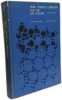
Bon état quelques frottements sur les bords intérieur propre
Traité de chimie minérale et organique comprenant la chimie pure et ses applications Tome IV : Chimie organique.
P., Masson, 1889, in 8° relié demi basane, dos lisse orné, 691 pages ; frottis à la reliure.
2ème partie de la chimie organique. PHOTOS SUR DEMANDE. ...................... Photos sur demande ...................


Phone number : 04 77 32 63 69
Traité de chimie minérale et organique comprenant la chimie pure et ses applications Tome I et II : Chimie minérale.
P., Masson, 1888-1889, 2 volumes in 8° reliés demi basane, dos lisse ornés, VI-742 et 812 pages ; très nombreuses figures et 1 planche dépliante couleurs ; mouillure marginale aux pemiers feuillets du Tome 1 ; reliures frottées.
PHOTOS SUR DEMANDE. ...................... Photos sur demande ...................
Phone number : 04 77 32 63 69
Traité de chimie minérale et organique [Ouvrage complet en 4 volumes]
G. Masson 1889 4 volumes. In-8 24 x 15,5 cm. Reliures pleine toile noir, pièces de titre cuir rouge, 742-812-623-691 pp., 2 tableaux en couleurs en début d’ouvrage, 235-78 figures. Des mouillures angulaires Vol. IV, sinon bon ensemble.
Vol. I & II : Chimie minérale - Vol. II & IV : Chimie organique Bon état d’occasion
L'analyse chromatographique et ses applications. ‘Actualités scientifiques et industrielles’, 703, Exposés de chimie biologique, 5.
Paris, Hermann, 1938, in-4°, 108 p., non coupé, brochure originale.
(SLACES, NVVA)
Phone number : 41 (0)26 3223808
Manipulations de Chimie Physique.
P., Gaultheir-Villars, 1964. In-8, br., XII-323pp.
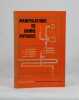
Dos légèrement insolé, bonne condition. - Frais de port : -France 6,8 € -U.E. 9 € -Monde (z B : 14 €) (z C : 24 €)
Analysis for leather and materials used in making it.
Couverture souple. Reliure toile de l'éditeur. 16 x 23 cm. 512 pages. Cachets.
Livre. New-York and London, 1931.
Die Thermolampe in Deutschland. - [FIRST GERMAN TREATISE ON GAS MANUFACTURING]
Brünn, Karl Franz Siedler, 1803. 8vo. In contemporary half calf with gilt lettering to spine. Light wear to extremities and small-paper label pasted on to top of spine. Internally very fine and clean - a very nice copy. (20), 227, (3), XX pp. + 4 folded plates.
![Die Thermolampe in Deutschland. - [FIRST GERMAN TREATISE ON GAS MANUFACTURING]. WINZLER, ZACHARIAS ANDREAS.](https://static.livre-rare-book.com/pictures/LLX/60890_1_thumb.jpg)
![Die Thermolampe in Deutschland. - [FIRST GERMAN TREATISE ON GAS MANUFACTURING]. WINZLER, ZACHARIAS ANDREAS.](https://static.livre-rare-book.com/pictures/LLX/60890_2_thumb.jpg)
![Die Thermolampe in Deutschland. - [FIRST GERMAN TREATISE ON GAS MANUFACTURING]. WINZLER, ZACHARIAS ANDREAS.](https://static.livre-rare-book.com/pictures/LLX/60890_3_thumb.jpg)
Rare first edition of this first German treatise on gas manufacturing. Winzler initially studied theology before shifting his focus to medicine, chemistry, and mineralogy. Winzler's primary interest lay in the field of chemistry which he applied to improve saltpeter production - a vital component in the manufacture of gunpowder during his time. He became known for his innovations in gas production, specifically through the charring of wood to produce combustible gas. This gas was used for heating, lighting, and other industrial applications. He conducted experiments and installations of this lamp in various locations including his own residence and public buildings such as barracks and castles. Despite facing setbacks during the Napoleonic Wars, Winzler's inventions gained recognition among government circles and found buyers across the Habsburg empire.
Regnault-Strecker’s kurzes Lehrbuch der Chemie. 2 Theilen in 2 Bde..
Braunschweig, Friedrich Vieweg und Sohn, 1877, 1874, pt. in-8vo, XXIV + 954 + in den text eingedruckten Holzstichen und einer farbigen Spectraltafel / VII + 1177 + XXXX S. + Berichtigungen + in den text eingedruckten Holzstichen, 1. Bd. mit Stempeln ‘Chemisches Universitats Laboratorium Zürich’ und ‘Prof. Dr. Viktor Merz’, Hldr (Bd. 1), rezent. HLn (Bd. 2).
1. Bd.: Anorganischen Chemie. 9. Auflage / 2. Bd. Organischen Chemie. 6. Auflage.
(SLACES, NVVA)
Phone number : 41 (0)26 3223808
RECHERCHES SUR DE NOUVEAUX COMPLEXES Pi TETRACARBONYLFER DE CYCLOOLEFINES SUBSTITUEES (THESE)
Imprimeries Réunies, Lausanne. 1983. In-12. Broché. Bon état, Couv. convenable, Dos satisfaisant, Intérieur frais. 129 pages. Illustré de nombreux schémas en noir et blanc dans le texte. Etiquette de code sur le dos. Tampons et annotation de bibliothèque sur le 1er plat et en page de titre.. . . . Classification Dewey : 540-Chimie et sciences connexes
Institut de Chimie organique de l'Université de Fribourg. Thèse (n° 856) prés. à la Faculté des Sciences de l'Univ. de Fribourg. Classification Dewey : 540-Chimie et sciences connexes
Traite pratique d'analyse chimique
Gauthier-Villars, du bureau des longitudes, de l'école imperiale polytechnique. 1865. In-12. Relié. Bon état, Coins frottés, Dos satisfaisant, Quelques rousseurs. 323 pages. Quelques illustrations en noir et blanc, dans le texte + Une planche dépliante en fin d'ouvrage ( dessins technique en noir et blanc). Contreplats jaspés + 4 nerfs + fleurons, titre et auteur dorés au dos ( un peu passés car dos frotté). Divers tampons, sans conséquence sur la lecture. 3 photos disponibles.. . . . Classification Dewey : 540-Chimie et sciences connexes
Classification Dewey : 540-Chimie et sciences connexes
HISTOIRE DE LA CHIMIE - DE L'ALCHIMIE A LA CHIMIE MODERNE / PETITE COLLECTION D'HISTORIE DE LA SCIENCE.
TECHNIQUE ET DOCUMENTATION LAVOISIER. 1988. In-12. Broché. Bon état, Couv. convenable, Dos satisfaisant, Intérieur frais. 243 pages - Quelques annotations a ucrayon a papier sur la page de titr - 1er palt illustré d'un dessin monochrome.. . . . Classification Dewey : 540-Chimie et sciences connexes
Classification Dewey : 540-Chimie et sciences connexes
Tous les nobels de chimie
Ouest éditions 1990 In-8 broché 25 cm sur 17. 340 pages. Couverture jaunie et écornée. Bon état d’occasion.
Bon état d’occasion
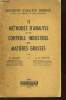
Documents d'Analyse Chimique. N°2 : Méthodes d'Analyse et de contrôle industriel des matières grasses
DUNOD. 1953. In-12. Broché. Etat d'usage, Couv. légèrement passée, Dos abîmé, Intérieur frais. 262 pages. Quelques dessins et figures en noir et blanc, dans le texte. Charnières fendues.. . . . Classification Dewey : 540-Chimie et sciences connexes
Classification Dewey : 540-Chimie et sciences connexes
Tout ce qu'Einstein n'a jamais dit : La Compil
Dunod 2010 768 pages 16x2 8x21cm. 2010. Broché. 768 pages.
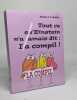
Comme neuf dans son emballage d'origine
On Platina and native Palladium from Brasil. Read March 22, 1809.
(London, W. Bulmer and Co., 1809). 4to. No wrappers as extracted from ""Philosophical Transactions"" 1809 - Part II. Pp. 189-194. Clean and fine.
First appearance of Wollaston's analysis of Platina and Palladium found in ores in Brazil, and having different composition than those found in ores from Europe. It is well known that Wollaston discovered the element palladium in 1803.
On the Identity of Columbium and Tantalum. Read June 8, 1809.
(London, Bulwer and Co., 1809). 4to. Without wrappers as extracted from ""Philosophical Transactions of the Royal Society of London."" Year 1809 - Part II. Pp. 246-252
First printing of a controversial paper in the history of chemistry.""In 1809 Dr. Wollaston analyzed both columbite and tantalite (in the paper offered). His conclusion that columbium and tantalium are identical qwas accepted by chemists until 1846, when Henry Rose....questioned it.""(Weekes in ""Discovery of the Elements"", p.83).
"WOLLASTON, WILLIAM HYDE. - CHEMICAL 'EQUIVALENTS' INTRODUCED.
Reference : 42248
(1814)
A Synoptic Scale of Chemical Equivalents. Read November 4, 1813.
(London, W. Bulmer and Co., 1814). 4to. 4to. No wrappers as extracted from ""Philosophical Transactions"" 1814 - Part I. Pp. 1-22 and 1 engraved plate. Last textleaf slightly browned, otherwise clean and fine.
First appearance of this importent paper in which Wollaston introduces the ""chemical slide rule"".""In 1814 he draw up ""A Synoptic Table of Chemical Equivalents"", wherein many ""equivalents"" (a term apparently first used in the chemical sense by him) were arranged in a logarithmic scale. Chemists found this device of great practical assistance, and it survives today in the form of the chemical slide rule."" (A Source Book in Chemistry p. 221).""The design of the scale here proposed by the author (Wollaston) is to save chemists the labour of many troublesome computations in estimating the ingredients of neutral salts, and the reagents and precipitates by whic these ingredients might be ascertained."" (Abstract).
"WOLLASTON, WILLIAM HYDE. - CYSTINE, THE FIRST AMINO ACID TO BE DISCOVERED.
Reference : 45130
(1810)
On Cystic Oxide, a new species of Urinary Calculus. Read July 5, 1810.
(London, W. Bulmer and Co., 1810). 4to. No wrappers as extracted from ""Philosophical Transactions"" 1810 - Part I. Pp. 223-230. Light browning to first leaf. Wide-margined.
First appearance of this fundamental paper in the history of organic chemistry in which Wollaston announced his discovery of ""Cystine"", the very first of the amino acids, the building blocks of protein, to be discovered.Wollaston ""in 1812 (correct 1810) identified a new and rare type of stone, which he called ""cystic oxide"" since it occurred in the bladder. This was later renamed cystine, the first of the amino acids to be discovered. Fourcroy and Vauquelin reported similar investigations, but unaccountably gave no recognition to Wollaston. This led Alexander Marcet, a physician, to set matters right in a popular work dedicated to Wollaston.""(DSB XIV, p. 492).Garrison & Morton: 668.1.
"WOLLASTON, WILLIAM HYDE. - THE DISCOVERY OF THE ELEMENT RHODIUM.
Reference : 42469
(1804)
On a new Metal, found in crude Platina. Read June 24, 1804.
(London, Bulwer and Co., 1804). 4to. Without wrappers as extracted from ""Philosophical Transactions of the Royal Society of London."" Year 1804-Part II. Pp. 419-430. Clean and fine.
First appearance of the paper in which Wollaston announced his discovery of the metallic element Rhodium.""Dr. Wollaston dissolved a portion of crude platinum in qgua regia, and neutralized the excess acid with caustic soda. He then added salammoniac to precipitate the platinum as ammonium chloroplatinate, and mercurous cyanide to precipitate the palladium as palladium cyanide. After filteringoff the precipitate, he decomposed the excess mercurous cyanide inthe filtarate by adding hydrochloric acid and evaporating to dryness. When he washed the residue with alcohol, everything dissolved except a beautiful dark red powder, which proved to be a double chloride of sodium and a new metal, which because of the rose color of its salts, Dr. Wollaston named 'Rhodium'. He found that the sodium rhodium chloride could be easely reduced by heating it in a current of hydrogen, and that after the sodium chloride had been washed out, the rhodium remained as a metallic powder. he also succeeded in obtaining a rhodium button.""(Weeks: Discovery of the Elements. p. 104-05.)
Processus en chaîne et facteurs limitatifs en biochimie et en biologie. Actualités biochimiques, 13.
Liège, Desoer/Paris, Masson, 1949. 16 x 24, 77 pp., broché, bon état.
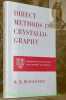
Direct Methods in Crystallography. Collection: Monographs on the Physics and Chemistry of Materials.
Oxford, At the Clarendon Press 1961, 220x140mm, VIII - 144pages, editor's binding with jacket. Name of previous owner on top of front page and brown spots on top and bottom endpapers and name of previous owner on top of front page otherwise book in good condition.
Pour un paiement via PayPal, veuillez nous en faire la demande et nous vous enverrons une facture PayPal
Experiments on some Mineral Substances. Communicated at the Desire of William Hunter. Read Nov. 19, 1778.
(London, J. Nicols, 1779). 4to. Extract from ""Philosophical Transactions, of the Royal Society of London."" Vol. 69, Year 1779 - Part I. Pp. 11-34.
First printing. In the paper Woulfe described a white tin ore and other minerals. (Partington III: p. 301).Woulfe is mainly remembered for the two-necked bottle generally known as a Woulfe’s bottle which has long been a standard item of equipment in most chemical laboratories. The apparatus has been traced back to J. R. Glauber, and its attribution to Woulfe seems to stem from his use of a vessel with two outlets in a series of distillation experiments described in 1767. His ""new method"" was designed to prevent the escape of fumes ""very hurtful to the lungs"" by passing them through a tube into water.(DSB).

