 Write to the booksellers
-
Type
Book (5348)
Magazine (35)
Music sheets (3)
Photographs (8)
-
Latest
Last 24h (1)
Last 3 days (1)
Last month (74)
Last week (1)
-
Language
Czech (1)
English (3)
French (5377)
German (11)
Latin (1)
Spanish (1)
-
Century
17th (16)
18th (200)
19th (1144)
20th (2263)
21st (78)
-
Countries
Belgium (352)
Côte d'Ivoire (19)
Denmark (687)
France (3979)
Switzerland (357)
-
Syndicate
CLAM (2)
ILAB (3006)
NVVA (183)
SLACES (183)
SLAM (2112)
SNCAO (48)
Traité élémentaire de chimie organique.
Dunod. 1872. In-8. Broché. Etat d'usage, Tâchée, Dos plié, Quelques rousseurs. 604 pages - papier jauni, mouillures sur quelques pages ne génant pas la lecture, coins des plats rognés, mors et dos fendus.. . . . Classification Dewey : 540-Chimie et sciences connexes
Classification Dewey : 540-Chimie et sciences connexes
LA GRANDE OEUVRE DE LA CHIMIE
CHIMIE ET INDUSTRIE. 1929. In-8. Relié toilé. Etat d'usage, Couv. convenable, Dos satisfaisant, Intérieur frais. 250 pages - nombreuses illustrations en noir et blanc dans et hors texte - 1 tampon sur le 1er plat, sur la page de garde, de faux-titre et de titre.. . . . Classification Dewey : 540-Chimie et sciences connexes
Illustrations de PIERRE BOUQUEREL Classification Dewey : 540-Chimie et sciences connexes
La Synthèse Chimique
Paris Félix Alcan 1903 In-8 avec un catalogue éditeur de III pp VIII-293 pp
Bon Cartonnage Percaline
Marcellin Berthelot, pages choisies.
P., Les Editions Crès (Collection "Le Florilège Contemporain"), sans date, XXXVII-201 pages ; couverture fanée.
...................... Photos sur demande ...................


Phone number : 04 77 32 63 69
Nouvelles recherches de Thermochemie.
Paris, Victor Masson et Fils, 1869. 8vo. Contemp. hcalf, raised bands, gilt spine. Light wear along edges. Small stamps on verso of titlepage. In: ""Annales de Chimie et de Physique"", 4e Series - Tome 18. 510 pp. a. 2 folded engraved plates. (The entire volume offered). Berthelot's paper: pp. 5-202.
First appearance of Berthelot's second large memoir on themochemistry, a subject in which he laid the foundation stones.""In the 1860s Berthelot was done with synthesis and turned to thermochemistry, the study of the heat of chemical reactions. In some of his work he had unknowingly been anticipated by Hess, but he went much further. He devised a calorimeter within which he could measure the heat of chemical reactions and ran hundreds of determinations. This work along with that being conducted by Thomson threw the science of thermochemistry into high gear.""(Asimov).
Science et morale par M. Berthelot sénateur secrétaire perpétuel de l'académie des sciences
Paris, Calmann Lévy, éditeur rue Auber, 3, et Boulevard des Italiens, 15 Broché 1897 RARE ÉDITION ORIGINALE TIRÉE À 30 EXEMPLAIRES SUR HOLLANDE. Un volume in-8° broché (16.5 x 24cm) 515 pages numérotées ; Berthelot était un chimiste et homme politique français connu pour le principe de Thomsen-Berthelot en thermochimie, il a synthétisé de nombreux composés organiques à partir de substances inorganiques et a réfuté la théorie du vitalisme, 30 exemplaires sur papier de Hollande ont été tiré de cet ouvrage, celui-ci étant numéroté 30 ; ouvrage non massicoté à grandes marges, intérieur et page de couverture frais, la quatrième de couverture et pratiquement détaché de l'ouvrage, emportant une partie du papier du dos, hormis cela, bon état général. Livraison a domicile (La Poste) ou en Mondial Relay sur simple demande.
Recherches de Thermochemie. Premiere-Troisieme Mémoire. (Sur la Chaleur dégagée dans les Réactions chimiques. - Sur les quantités de Chaleur dégagées dans la Formation des Composés organiques. - Sur la Chaleue animale). (3 papers).
Paris, Victor Masson et Fils, Imprimerie Gauthier-Villars, 1865. 8vo. Contemp. hcalf, raised bands, gilt spine. Light wear along edges. Small stamps on verso of titlepage. In ""Annales de Chimie et de Physique"", 4e Series - Tome VI. 512 pp. and 2 folded engraved plates. (The entire volume offered). Berthelot's papers: pp. 292-328, 329-441 a. pp. 442-464. Clean and fine.
First appearance of the three importent papers in which Berthelot founded the science of thermochemistry.""Bertholet enunciated the principle that the heat evolved or absorbed in a chemical change depends only on the initial and final states of the reactants and products, provided no external work is done. This is Bertholet's second principle analogous to Hess's law of constant heat summation. He based this principle on the assumption of an equivalence between internal work (le travail moleculaire) and heat changes in a chemical reaction (Bertholet's first principle).""(DSB II, p.69.).""In the 1860s Berthelot was done with synthesis and turned to thermochemistry, the study of the heat of chemical reactions. In some of his work he had unknowingly been anticipated by Hess, but he went much further. He devised a calorimeter within which he could measure the heat of chemical reactions and ran hundreds of determinations. This work along with that being conducted by Thomson threw the science of thermochemistry into high gear.""(Asimov).
Sur les Principes généraux de la Thermochemie. 1.- 13. Mémoire. (+) Dissolution des Acides et de Alcalis. 1. - 9. Mémoire.
Paris, Victor Masson, Imprimerie Gauthier-Villars, 1875. 8vo. Contemp. hcalf, raised bands, gilt spine. Light wear along edges. Wear to top of spine. Small stamps on verso of titlepage. Both works in ""Annales de Chimie et de Physique"", 5me Series - Tome IV. 572 pp. (The entire volume offered). Berthelot's works: pp. 5-131 a. 141-214 + pp. 445-537. Internally clean and fine.
First appearance of this collection of Berthelot's famous memoirs on thermochemistry to which he turned his attention in 1865. In these lectures he introduced the concepts of 'exothermix' and 'endothermic'. He also intorduce his famous 3 principles - equivalence between internal and heat changes in chemical reactions, heat evolved or absorbed in a chemical change depends onlyon the initial and final states of the reactans and products, provided no external work is done, and ""law of maximum work"" which says that ""every chemical change accomplished without the intervention of energy from outside tends towards the production of a body or system of bodies which produce the most heat"". The principles of Thermochemistry given here Berthelot considered himself fundamental.""In the 1860s Berthelot was done with synthesis and turned to thermochemistry, the study of the heat of chemical reactions. In some of his work he had unknowingly been anticipated by Hess, but he went much further. He devised a calorimeter within which he could measure the heat of chemical reactions and ran hundreds of determinations. This work along with that being conducted by Thomson threw the science of thermochemistry into high gear.""(Asimov).
TRAITÉ ÉLÉMENTAIRE DE CHIMIE ORGANIQUE. Tomes I-II
Paris Dunod, Editeur 1881 in 8 (23,5x15) 2 volumes reliures demi basane rouge de l'époque, dos à nerfs, fleurons dorés, XX et 483 pages et XIV [errata] et 489 pages, avec 101 figures dans le texte, rousseurs persistantes. Seconde édition, revue et considérablement augmentée. Bon exemplaire ( Photographies sur demande / We can send pictures of this book on simple request )
Bon Couverture rigide
Vie de Berthelot.
P., Plon, 1964, petit in 8) broché, 251 pages ; illustrations hors-texte ; bande-annonce.
Un des exemplaires du Service de presse, enrichi d'un envoi autographe signé sur la première garde blanche. ...................... Photos sur demande ...................
Phone number : 04 77 32 63 69
BERTHIER / BYK / STEYAERT / VANDERSTOCK.
Reference : R320017293
(1981)
ISBN : 2010078411
SCIENCES PHYSIQUES - LEP CHIMIE.
HACHETTE TECHNIQUE. 1981. In-4. Cartonné. Etat d'usage, Couv. convenable, Dos satisfaisant, Intérieur frais. 142 pages illustrées de nombreuses figures et photos en noir et blanc - 1er plat illustré d'une photo en couleurs.. . . . Classification Dewey : 540-Chimie et sciences connexes
Classification Dewey : 540-Chimie et sciences connexes
BERTHIER / BYK / STEYAERT / VANDERSTOCK.
Reference : R320017294
(1981)
ISBN : 2010078438
SCIENCES PHYSIQUES - LEP ELECTRICITE.
HACHETTE TECHNIQUE. 1981. In-4. Cartonné. Etat d'usage, Couv. convenable, Dos satisfaisant, Quelques rousseurs. 160 pages illustrées de nombreuses figures et photos en noir et blanc - 1er plat illustré d'une photo en couleurs.. . . . Classification Dewey : 540-Chimie et sciences connexes
Classification Dewey : 540-Chimie et sciences connexes
Sciences physiques. LEP. Chimie.
Couverture rigide. Cartonné. 143 pages.
Livre. Editions Hachette technique, 1981.
Mémoires et notices chimiques, minéralogiques, minéralurgiques, et géologiques publiés pendant les années 1827, 1828, 1829, 1830, 1831 et 1832 -- EDITION ORIGINALE
P., De Fain, 1833, un volume in 8, broché, couverture muette de l'époque, (rousseurs, cachet de bibliothèque, manque de papier dans l'angle supérieur du premier plat de couverture), (2), 329pp., 3 PLANCHES dépliantes
---- EDITION ORIGINALE DE CET OUVRAGE INCONNU DE DSB et de PARTINGTON dans lequel Berthier a réuni et publié en un volume les mémoires et articles qu'il avait fait paraître de 1827 à 1832 dans différentes revues ---- "Berthier was called in 1806 to the newly completed central laboratory of the Board of Mines. In 1816, he was appointed professor of assaying and chief of the laboratory at the Ecoles des Mines. Berthier pblished more than 150 papers on a wide variety of scientific subjects. Most appeared in Annales de chimie and Annales des mines. He analyzed kaolin, pioneered in locating deposits of native phosphates for use in agriculture, analyzed dozens of minerals an metalliferous ores and discovered several new mineral species. He is credited with knowing, before Mitscherlich's work on isomorphism, that substances that are chemically different may have the same crystalline form and may even cocrystallize... His importance lies in what he added to French geology, mineralogy and metallurgy...". (DSB II P. 72) - Partington IV pp. 97/98**505/A7DE
Essai De Statique Chimique. 2 vol. In-8
Paris Firmin-Didot 1803 In-8 viij+543+viij+555 pp, mouillures et rousseurs éparses, une galerie de vers sans atteinte au texte. Plats muets, dos ornés de filets simples et titres dorés. Mors fendus, manques de papier sur les coiffes, coupes et coins émoussés, épidermures de papier. Outre une foule de mémoires lus à l'Institut,Berthollet a donné en 1791 et 1804, Éléments de l'art de la teinture, à la suite de ses recherches en dans le cadre de la Manufacture des Gobelins. En 1801, il publie Recherche sur les lois des affinités chimiques et Essai de statistique chimique en 1803. Dans ce dernier livre, son oeuvre capitale : il définit pour la première fois la notion d'équilibre chimique, il y pose les lois des doubles décompositions connues depuis sous le nom de lois de Berthollet. Edition originale
Usés Pour Les Cartonnages Cartonnage Editeur
Eléments de l'art de la teinture avec une description du blanchiment par l'acide muriatique oxigéné -- 2 VOLUMES (COMPLETE SET) -- BEL EXEMPLAIRE
P., Didot, 1804, 2 volumes in 8 reliés en demi-basane à coins, dos ornés de fers et filets dorés (reliures de l'époque), (petit manque de papier d'origine dans la marge inférieure du feuillet 111-112 du tome 1, habile restauration dans la marge extérieure du feuillet 33-34 du tome 2, quelques rousseurs), T.1 : 8pp., 478pp., 2 PLANCHES DEPLIANTES, T.2 : (2), 357pp., (1pp.-errata), (1-notice des éditions stéréotypes)
---- Seconde édition REVUE, CORRIGEE ET AUGMENTEE "AVEC DEUX PLANCHES" ---- En dépit des petits défauts signalés, BEL EXEMPLAIRE ---- "THE FIRST MODERN BOOK ON DYEING AND THE FIRST GENERAL THEORY OF ITS PRINCIPLES". (Duveen p. 74 1st ed.) ---- "En 1784, BERTHOLLET est nommé à la direction des teintures aux Gobelins. S'apercevant que le chlore décolorait les substances végétales, il applique cette propriété au blanchissement des toiles. En 1789, il découvre l'action décolorante des hypochlorites. Une usine est installée à Javel, d'où le nom d'eau de Javel ; son emploi se trouve décrit dans les Eléments de l'art de la teinture (1791)". (En Français dans le texte N° 215) ---- "A systematic work on dyeing in which the author attempted to explain the process by the use of reciprocal affinities... The second edition, prepared with the assistance of his son, was enlarged and augmented with a section on bleaching by chlorine". (Cole p. 49) ---- DSB II pp. 73/82 - Partington III p. 514**506/P1
Eléments de l'art de la TEINTURE -- EDITION ORIGINALE -- 2 VOLUMES (complete set) -- BON EXEMPLAIRE
P., Didot, 1791, 2 VOLUMES in 8 reliés en pleine basane mouchetée de l'époque, dos ornés de fers dorés, tranches rouges (reliures de l'époque), (petites galeries de vers sans gravité à la partie inférieure du dos au tome 1 et à 1 mors au tome 2, mouillures pâles dans l'angle inférieure de quelques feuillets au tome 2), T.1 : 8pp.(y compris faux-titre+titre), 50pp., 336pp., T.2 : 7pp. (y compris faux-titre+titre), 404pp., (1-privilège)
---- EDITION ORIGINALE ---- BON EXEMPLAIRE BIEN COMPLET DE SES DEUX VOLUMES ---- FIRST EDITION PRINTED IN LARGE TYPE (Duveen p. 74) ---- "THE FIRST MODERNE BOOK ON DYEING AND THE FIRST GENERAL THEORY OF ITS PRINCIPLES". (Duveen p. 74 1st ed.) ---- EN FRANCAIS DANS LE TEXTE N° 215 : "En 1784, BERTHOLLET est nommé à la direction des teintures aux Gobelins. S'apercevant que le chlore décolorait les substances végétales, il applique cette propriété au blanchissement des toiles. En 1789, il découvre l'action décolorante des hypochlorites. Une usine est installée à Javel, d'où le nom d'eau de Javel ; son emploi se trouve décrit dans les Eléments de l'art de la teinture (1791)" ---- "A systematic work on dyeing in which the author attempted to explain the process by the use of reciprocal affinities... ". (Cole p. 49) ---- DSB II pp. 73/82 - Partington III p.514**51000(510)/ARM1A
Observations sur le Charbon et le Gaz hidrogènes carbonès. Lu le 26 messidor an 9 (1801) + Addition aux Observations sur le Charbon....+ Seconde Suite des Observations sur le Charbon...(3 Papers).
(Paris, Baudouin, AN XI (1803)). 4to. Without wrappers. Uncut. Extracted from ""Mémoires de L'Institut National des Sciences et Arts"", Tome Quatrieme. Pp. 269-318, 319-324 a. 325-333. Clean and fine.
First appearance of an importent paper by the famous French chemist Berthollet, published in the same year as his milestone work ""Essai de Statique Chimique"".
Recherches sur les Lois de l'Affinité.
1801 In-8, broché, couverture de papier rose d'origine, (2) f., 105 p. Paris, Baudouin, an IX [1801].
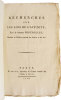
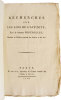
Edition originale de cet important essai que Berthollet composa à son retour de l'expédition d'Égypte sur les bases dune conférence donnée à lInstitut du Caire. Pour la première fois, il expose "les notions d'équilibre chimique et d'action de masse (): les règles dites "de Berthollet", première contribution sérieuse au problème de la prévision des réactions chimiques" (Michelle Goupil-Sadoun, in "Encyclopaedia Universalis"). Le contenu de cet ouvrage fournira la matière aux deux volumes de lEssai de Statique Chimique publié en 1803.(Cole, 130. DSB, II, 73-82. Partington, III, 496-516 et IV, 576).Très bon exemplaire, très frais, entièrement non rogné, sous sa couverture d'origine, tel que paru.
ÉLÉMENTS DE L'ART DE LA TEINTURE. Tome premier
Paris Chez Firmin Didot, Libraire 1791 in 8 (21,5x13,5) 1 volume broché, couverture muette d'attente ancienne, dos renforcée, (page de faux-titre, page de titre) VIII, L et 336 pages, rousseurs éparses, non rogné, Claude-Louis Berthollet, 1748-1822, chimiste français. Edition originale. Tome 1 seul. Bel exemplaire ( Photographies sur demande / We can send pictures of this book on simple request )
Bon Broché Ed. originale
"BERTHOLLET, CLAUDE LOUIS. - PREPARING THE WAY FOR THE ATOMIC THEORY IN CHEMISTRY.
Reference : 46023
(1801)
Recherches sur les lois de l'affinité. (+) Suite des Recherches... (+) Suite des Recherches... (+) Suite des Recherches... (+) Suite des recherches.. (5 Parts).
Paris, Chez Fuchs, An IX(1801). Boundin 3 contemp. hcalf. Gilt spuines. Light wear along edges. In: ""Annales de Chimie, ou Recueil de Mémoires concernant la Chemie"" Tome 36, 37 and 38. (Entire volumes offered). 336"330,(2)"334,(2) pp. and 5 engraved plates. Berthollet's paper: pp. 302-317, pp. 151-181, 221-252, pp. 3-29, 113-134.
Together with the memoir printed at the same time in ""Mémoires de l'Institut.."" this is the first appearance of B's groundbreaking work on the nature of chemical affinity and the fact that many factors influence chemical reactions, comparing chemical affinity to the force of gravity. The paper was at the end of the year published separately.The theory set forth here ""led directly to Prout's investigations which yielded a knowledge of definite chemical proportions and thus played a very importent part in preparing the way for the development of the Atomic Theory on which the whole modern chemistry is based.""(Duveen, p. 75).""Berthollet read a memoir on the general theory of affinities while he was still in Egypt. This was the starting point of his complete new system of chemistry, first briefly sketched in Recherches sur les lois de l’affinité (1801) and later developed into the comprehensive, two volume Essai de statique chimique. Here he attempted to provide a proper basis for chemistry, so that its experimental results could be viewed in the light of theoretical first principles. Berthollet developed a theory and a model adequate for the understanding and the interpretation of the rapidly growing body of chemical knowledge in his time. He was aware that the positive work of constructing a new theory had yet to be performed after the shock of Lavoisier’s criticism of the old chemistry.(DSB).Parkinson ""Breakthroughs"", 1801 C.
Représentation des équilibres de solubilités et utilisation des diagrammes.
P., Gauthier-Villars, 1962, grand in 8°, cartonnage illustré de l'éditeur, 271 pages.
Illustré de nombresues figures in et hors-texte. PHOTOS sur DEMANDE. ...................... Photos sur demande ...................
Phone number : 04 77 32 63 69
Les nouvelles conceptions de la matière et de l'atome
P., Doin, 1923, un volume in 8 relié en cartonnage éditeur, (cachets de bibliothèque), (2), 314pp.
---- EDITION ORIGINALE ---- Théorie électromagnétique et électronique - La théorie de la relativité et la masse - Les rayons X et le nombre atomique - La radioactivité et l'isotopie - Atome de Rutherford et la transmutation des éléments - L'atome de Bohr et la théorie des quanta - la constitution des atomes complexes et les rayons x - Constitution atomique et affinité chimique**513/M7DE
Matière et atomes
P., Doin, 1932, un volume in 8, broché, couverture imprimée, (cachets de bibliothèque), 324pp.
---- Deuxième édition revue et augmentée des Nouvelles conceptions de la matière et de l'atome ---- La théorie classique de la lumière et de l'électron - Théorie de la relativité et la masse - Les rayons x et le nombre atomique - La radioactivité et l'isotopie - L'atome de Rutherford et la transmutation des éléments - L'atome de Bohr et la théorie des quanta - Atomes complexes ; émission des rayons x et affinité chimique - Mécanique ondulatoire**514/M7DE
Précis de chimie physique.
Gauthier-Villars, 1939, in-8°, 498 pp, reliure demi-toile époque, couv. conservée, dos uniformément passé
Désormais les frais d'envoi sont de 6 € seulement pour les livres jusqu'à 1 kg (colissimo suivi), pour la France métropolitaine.

