 Write to the booksellers
-
Type
Book (5348)
Magazine (35)
Music sheets (3)
Photographs (8)
-
Latest
Last 24h (1)
Last month (73)
Last week (2)
-
Language
Czech (1)
English (3)
French (5377)
German (11)
Latin (1)
Spanish (1)
-
Century
17th (16)
18th (200)
19th (1144)
20th (2263)
21st (78)
-
Countries
Belgium (352)
Côte d'Ivoire (19)
Denmark (687)
France (3979)
Switzerland (357)
-
Syndicate
CLAM (2)
ILAB (3006)
NVVA (183)
SLACES (183)
SLAM (2112)
SNCAO (48)
[E. Mellier, Grimblot, Ve Raybois et Comp.] - MOHR, Frédéric ; (FORTHOMME, C.) ; [ MOHR, Karl Friedrich ]
Reference : 63691
(1857)
Traité d'analyse chimique à l'aide de Liqueurs titrées [ Edition originale de la traduction française ]
Traduit de l'allemand par C. Forthomme, 1 vol. in-8 reliure postérieure demi-percaline verte, E. Mellier, Paris, Grimblot, Ve Raybois et Comp., Nancy, 1857, XIV-430 pp.
![Traité d'analyse chimique à l'aide de Liqueurs titrées [ Edition originale de la traduction française ]. MOHR, Frédéric ; (FORTHOMME, C.) ; [ MOHR, ...](https://static.livre-rare-book.com/pictures/CDL/63691_thumb.jpg)
![Traité d'analyse chimique à l'aide de Liqueurs titrées [ Edition originale de la traduction française ]. MOHR, Frédéric ; (FORTHOMME, C.) ; [ MOHR, ...](https://static.livre-rare-book.com/pictures/CDL/63691_2_thumb.jpg)
![Traité d'analyse chimique à l'aide de Liqueurs titrées [ Edition originale de la traduction française ]. MOHR, Frédéric ; (FORTHOMME, C.) ; [ MOHR, ...](https://static.livre-rare-book.com/pictures/CDL/63691_3_thumb.jpg)
L'un des grands chimistes de son temps, Karl Friedrich Mohr (1806-1879) améliore la burette, développe une pince spéciale (dite "pince de Mohr") et expose ses méthodes de titrage dans le présent ouvrage, qui sera recommandé par Justus von Liebig. Bon état.
Pratique et théorie du saccharimètre-Soleil. ancien et nouveau modèle. Évaluation de la richesse d'un sucre ou d'une dissolution sucrée quelconques
Paris, Jules Duboscq, A. Franck [Imprimé par Plon frères], 1853 in-8, 48 pp., avec 2 planches dépliantes hors texte gravées par E. Wormser, broché sous couverture verte imprimée, non coupé. Rousseurs.
Unique édition, peu commune. Description et utilisation d'une des variétés de saccharimètres, celui mis au point par l'ingénieur-opticien Jean-Baptiste Soleil (1798-1849). Cet appareil utilisé en physique, pharmacie, médecine, permet de doser le sucre qui se trouve dissous dans certains liquides, notamment les urines des diabétiques.L'abbé François-Napoléon-Marie Moigno (1804-1884) fut un inlassable vulgarisateur scientifique, par ailleurs défenseur peu éclairé d'un concordisme déjà dépassé à l'époque il où rédigea ses principaux ouvrages. - - VENTE PAR CORRESPONDANCE UNIQUEMENT - LIEN DE PAIEMENT, NOUS CONSULTER.
Nouvelles recherches sur le fluor -- Détermination de quelques constantes physiques du fluor -- Action directe du fluor sur le platine. Préparation et propriétés des fluorures de platine -- EDITION ORIGINALE
P., Gauthier-Villars, sans date (circa 1890), un volume in 8, broché, couverture imprimée, 59pp., 20pp., 7pp.
---- EDITION ORIGINALE ---- BON EXEMPLAIRE ---- "MOISSAN received the Nobel Prize for chemistry in 1906. Through the originality of his research and the effectiveness of his teaching, Moissan attracted and increasing number of students and exerted a remarkable influence on the progress of inorganic chemistry ---- In 1884, Moissan began his remarkable research on the compounds of fluorine, which was to lead him to the isolation of this element". (DSB IX pp. 450/451) ---- Partington IV 911/915**37220/3722/o6ar
[ Traité de Chimie Minérale ] Epreuves corrigées de la main d'Henri Moissan, Prix Nobel de Chimie 1906. 3 Volumes : Vol. I : Soufre - Mercure ; Vol. II : Fer - Manganèse - Molybdène - Tungstène - Chrome - Plomb - Outremers - Céramique ; Vol. III : Bismuth - Vanadium - Noibium - Cantale - Bore - Uranium - Thallium - Or - Métaux du Platine.
3 vol. dont 1 vol. in-4 et deux vol. petit in-4 reliés demi-chagrin rouge, dos à 5 nerfs dorés, contenant les épreuves corrigées ou avant impression des sections suivantes figurant dans le "Traité de Chimie Minérale" publié chez Masson & Cie de 1904 à 1906 : Vol. I : Soufre - Mercure ; Vol. II : Fer - Manganèse - Molybdène - Tungstène - Chrome - Plomb - Outremers - Céramique ; Vol. III : Bismuth - Vanadium - Noibium - Cantale - Bore - Uranium - Thallium - Or - Métaux du Platine
![[ Traité de Chimie Minérale ] Epreuves corrigées de la main d'Henri Moissan, Prix Nobel de Chimie 1906. 3 Volumes : Vol. I : Soufre - Mercure ; Vol. ...](https://static.livre-rare-book.com/pictures/CDL/24610_thumb.jpg)
![[ Traité de Chimie Minérale ] Epreuves corrigées de la main d'Henri Moissan, Prix Nobel de Chimie 1906. 3 Volumes : Vol. I : Soufre - Mercure ; Vol. ...](https://static.livre-rare-book.com/pictures/CDL/24610_2_thumb.jpg)
![[ Traité de Chimie Minérale ] Epreuves corrigées de la main d'Henri Moissan, Prix Nobel de Chimie 1906. 3 Volumes : Vol. I : Soufre - Mercure ; Vol. ...](https://static.livre-rare-book.com/pictures/CDL/24610_3_thumb.jpg)
Exceptionnel ensemble d'épreuves en partie corrigées par Henri Moissan, premier français Prix Nobel de Chimie, en 1906 (5 ans avant Marie Curie). Directeur de la publication du "Traité de Chimie Minérale", publié chez Masson vers 1906, Henri Moissan accorde le "bon à mettre en pages" enrichi de ses dernières corrections manuscrites sur diverses épreuves des textes rédigées par les nombreux collaborateurs à ce monumental traité. Le premier volume recueille les extraits du traité relatif au Soufre (extraits publiés, sans correction manuscrite) et les épreuves (imprimés uniquement au recto) du très long développement consacré au Mercure, corrigées par l'auteur et abondamment annotées par Henri Moissan. A propos des propriétés chimiques du mercure, il insère par exemplaire ce commentaire manuscrit "Le fluor l'attaque à la température ordinaire. Lorsque ce gaz se dégage bulle à bulle à travers une masse de mercure de faible épaisseur, on voit nettement se former à la surface du métal une couche jaune de flurorure de mercure anhydre". Le second volume recueille les épreuves avant ou après mise en page relatives aux éléments suivants : Fer - Manganèse - Molybdène - Tungstène - Chrome - Plomb - Outremers - Céramique, avec quelques corrections des auteurs et de rares annotations d'Henri Moissan, notamment à propos des propriétés chimiques du molybdène. Le troisième volume recueille les épreuves avant ou après mise en page relatives aux éléments suivants : Bismuth - Vanadium - Noibium - Cantale - Bore - Uranium - Thallium - Or - Métaux du Platine. Ensemble unique, en bel état, d'une partie des épreuves du Traité de Chimie Minérale, annoté notamment par Henri Moissan (1852 - 1907), lauréat du Prix Nobel de Chimie 1906 pour ses travaux sur le fluor et pour le développement du four à arc électrique inventé par William Siemens. Le Traité de Chimie Minérale fut la dernière contribution d'importance d'Henri Moissan, qui devait décéder brutalement le 20 février 1907, à 54 ans, peu de temps après son retour de Stockholm où il venait de recevoir son Prix Nobel.
"MOISSAN, HENRI - ONE OF THE MAJOR PROBLEMS IN CHEMISTRY SOLVED - THE ISOLATION OF FLUORINE
Reference : 44236
(1887)
Recherches sur L'Isolement du Flour.
Paris, G. Masson, 1887. 8vo. Contemp. hcalf, raised bands, gilt spine. Light wear along edges. Small stamps on verso of titlepage. In: ""Annales de Chimie et de Physique"", 6e Series - Tome 12. 576 pp. (Entire volume offered). Moissan's paper: pp. 472-537. Many textillustrations of apparatus in woodcut.
First appearance of the paper in which Moissan describes his isolation and observation of the properties of fluorine gas and his succes in producing diamond with his pectacular arc method. Fo these achievements he was the first French to be awarded the Nobel Price in chemistry (1906).The existence of the element fluorine had been well known for many years, but all attempts to isolate it had failed and some experimenters had died in the attempt.""Moissan eventually succeeded in preparing fluorine in 1886 by the electrolysis of a solution of potassium hydrogen difluoride (KHF2) in liquid hydrogen fluoride (HF). The mixture was needed because hydrogen fluoride is a non-conductor. The device was built with platinum/iridium electrodes in a platinum holder and the apparatus was cooled to -50 °C. The result was to completely isolate the hydrogen produced from the negative electrode from the fluorine produced at the positive one.This is essentially still the way fluorine is produced today."" (Wikipedia).Partington IV, p. 912. - Weeks ""Discovery of teh Elements"", p. 272 ff. - Parkinson ""Breakthroughs"" 1885 C.
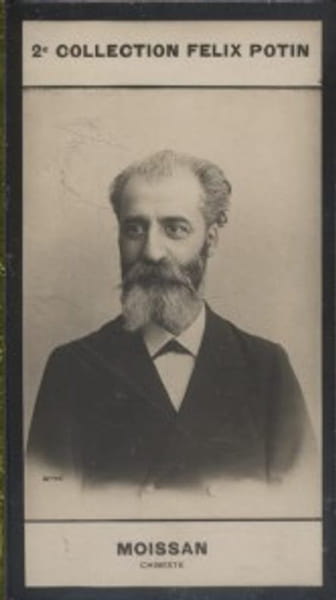
MOISSAN (Henri) - (Photo de la 2e collection Félix Potin) Photo Hoffer.
Reference : 50708
(1900)
Photographie de la collection Félix Potin (4 x 7,5 cm) représentant : Henri Moissan, chimiste.
- Photographie 4 x 7, 5 cm. Notice biographique collée au dos.
Photo. Prix Nobel de chimie né à Paris (1852-1907). Photo Hoffer. Félix Potin, Début XXe. Vers 1900.
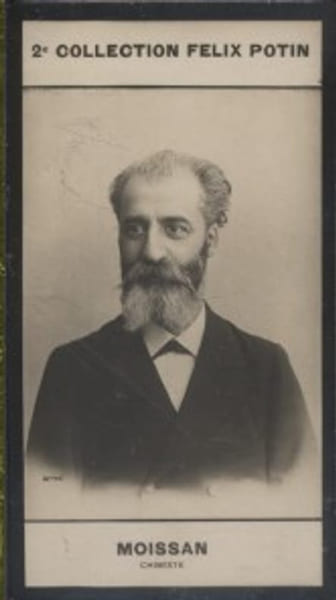
MOISSAN (Henri) - (Photo de la 2e collection Félix Potin) Photo Hoffer.
Reference : 52683
(1900)
Photographie de la collection Félix Potin (4 x 7,5 cm) représentant : Henri Moissan, chimiste.
- Photographie 4 x 7, 5 cm. Notice biographique collée au dos.
Photo. Prix Nobel de chimie né à Paris (1852-1907). Photo Hoffer. Félix Potin, Début XXe. Vers 1900.
Comment on obtient un cliché photographique : notions de chimie photographique, technique et pratique du développement.
Gauthier-Villars, Bibliothèque Photographique, sans date, 188 p., broché, une signature sur le premier plat et la page de titre, bon état.
Merci de nous contacter à l'avance si vous souhaitez consulter une référence au sein de notre librairie.
Explosifs. Les Ecplosifs modernes et leur applications. deuxieme Edition.
Paris, Larousse, (1916). Contemporary hcloth with orig. printed wrapper pasted on frontboard. Stamp on title. 63,(1) pp., textillustrations.
Also a chapter on Pyrotechnics.
Pflanzenphysiologie als Theorie der Gärtnerei. Für Botaniker, Gärtner, Landwirte, Forstleute und Pflanzenfreunde. 2., neubearb. Aufl.. Mit 137 Abb. im Text.
Jena, Gustav Fischer, 1918, in-8vo, XI + 324 S., Orig.-Hldr. Rücken mit Autor und Titel in Goldschrift.
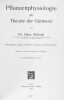
Image disp.

(SLACES, NVVA)
Phone number : 41 (0)26 3223808
De l'action de l'insuline sur l'équilibre azoté du chien normal
Imprimerie -librairie de l'université 1932 110 pages in8. 1932. Relié. 110 pages.
4e plat légèrement salie
Volume factice, en grande partie des contributions à la Société industrielle du Nord de la France. Altogether 18 publications by Jean de Mollins (docteur ès sciences of the univ. of Zurich), in the field of chemistry some of which are applied to balneology, sewage, agriculture, industry, etc.: Recherches sur l'acide ferrique. Diss. Zurich (e.a. des recherches sous la dir. du Prof. J. Wislicenus). / Mémoire sur l'épuration chimique des eaux d'égout de Roubaix. / La fabrication de la diphénylamine. / La fabrication des huiles et graisses de résine et leurs falsifications. / Un nouvel appareil contrôleur d'évaporation. / La fabrication des bleus d'aniline et de la diphénylamine. (130 p. + 9 gravures d’instruments et machines) / La genèse des eaux minérales ferrugineuses de Spa. (13 p.) / Les eaux d'égout industr. et ménagères. Leur épuration chimique et agricole, dangers des irrigations. (131 p.) / etc.
Lausanne (e.a.), 1872-1892, gr. in-8vo, env. 300 p., envoi de l’auteur ‘Don de Mme Jean de Mollins, Spa, Belgique, Nov. 1919’, + cachet de bibl., reliure en d.-cuir, bel exemplaire
(SLACES, NVVA)
Phone number : 41 (0)26 3223808
LES DROGUES CHIMIQUES.
Octave Doin, éditeur, 1888. In-12, br., VII-259 p.
Couverture défraîchie. [3585]
MONCKHOVEN D. V. - LIEBERT G. A. - COLSON R. - TRANCHANT L. - SCHNEEBERGER H.
Reference : 104573
(1989)
Les procédés au charbon.
Couverture souple. Broché. 150 pages. Mouillure sur la tranche et en marge des premières pages.
Livre. Editions Jean-Michel Place (Collection : Résurgences photographie), 1989.
[Encyclopédie méthodique. Dictionnaire de physique. Tome 1 [seul : Abaissement - Buffon].
P., [Panckoucke], 1793. fort in-4, cartonnage ancien modeste, à toutes marges, [2] ff., 404-240 pp.
Plats usés, dos frotté et fendillé, couture solide, intérieur propre, état convenable. - Frais de port : -France 8,4 € -U.E. 10 € -Monde (z B : 15 €) (z C : 33 €)
Précis-Pratique sur les Eaux de Bourbonne-Les-Bains.
Langres, Pierre Defay, 1810. Small 8vo. Orig. blank wrappers. 36 pp. Clean and fine, printed on good paper.
Analyse des Eaux Thermales de Borcette, Suivie de l'examen du gaz acote sulfuré dégagé des sources sulfureuses tant d'Aix-la-Chapelle que de Borcette.
Aix-La-Chapelle, Schwarzenberg, 1811. Orig. blank wrappers. VIII,63 pp. Clean and fine on good paper. On top of titlepage ""A La Societe des Sciences de Plissingue/ hommage de l'auteur.""
COURS DE CHIMIE ET ELEMENTS DE CHIMIE NUCLEAIRE
Dunod. 1961. In-8. Relié. Bon état, Couv. légèrement passée, Dos satisfaisant, Intérieur frais. 311 pages.. . . . Classification Dewey : 540-Chimie et sciences connexes
5e édition remaniée. Avec 28 tableaux synoptiques et 150 exercices et problèmes expliqués. Classification Dewey : 540-Chimie et sciences connexes
PREMIER CYCLE D'ETUDES MEDICALES - BIOCHIMIE - LES STEROIDES.
EDITIONS MEDICALES ET UNIVERSITAIRES. NON DATE. In-4. Broché. Bon état, Couv. convenable, Dos satisfaisant, Intérieur frais. 45 pages - nombreuses figures en noir dans le texte.. . . . Classification Dewey : 540-Chimie et sciences connexes
Sommaire : choléstérol - biogenèse du choléstérol - progesterine et dérivés - oestrogènes - hormones steroides. Classification Dewey : 540-Chimie et sciences connexes
Alfa et Papier d'Alfa. Avec planches micrographiques. [ Edition originale ]
Imprimé sur papier d'alfa, 1 vol. in-8 reliure demi-percaline verte, couverture conservée, H. Dunod et E. Pinat, Paris, 1909, 73-2 pp.
![Alfa et Papier d'Alfa. Avec planches micrographiques. [ Edition originale ] . MONTESSUS DE BALLORE, Henry de](https://static.livre-rare-book.com/pictures/CDL/63776_thumb.jpg)
![Alfa et Papier d'Alfa. Avec planches micrographiques. [ Edition originale ] . MONTESSUS DE BALLORE, Henry de](https://static.livre-rare-book.com/pictures/CDL/63776_2_thumb.jpg)
![Alfa et Papier d'Alfa. Avec planches micrographiques. [ Edition originale ] . MONTESSUS DE BALLORE, Henry de](https://static.livre-rare-book.com/pictures/CDL/63776_3_thumb.jpg)
Bon état (plusieurs annotations et corrections d'un industriel belge)
[Imprenta de Don Pedro Sanz] - MONTMAHOU, E. de ; (CARRENO, D. Leonardo)
Reference : 57050
(1833)
Manual medico-legal de Venenos
Precedido de consideraciones sobre el envenenamientos ; de los medios de probarlo ; del resultando de esperiencias hechas sobre et acetato de morfina [ ... ] Escrito en frances à la vista del profesor Chaussier por E. de Montmahou, traducido al Castellano por D. Leonardo Carreno, adornado con veinte lamnias iluminadas, 1 vol. in-12 reliure espagnol de l'époque, Imprenta de Don Pedro Sanz, Madrid, Agosto, 1833, 236 pp., 7 ff. n. ch. et 20 figures en 10 planches dépliantes
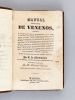
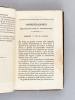
Rare exemplaire de la traduction espagnole publiée en 1833 (l'édition française date de 1824) bien complète des planches rehaussées en couleurs représentant des animaux (chien enragé et vipère), des plantes (pavot, jusquiame, ciguë, belladone, digitale...) ou des champignons (oronges et agarics). Etat moyen (rel. frottée avec accroc et mq. en coiffe sup. et coin, sans la pièce de titre, forte mouill. affectant la marge des premiers feuillets) pour cet exemplaire modeste mais bien complet des belles planches hors texte en couleurs. Prix en l'état.
Chimie Physique
Dunod 1965 in8. 1965. Cartonné.
Bon état couverture un peu ternie frottements intérieur propre
CHIMIE PHYSIQUE
DUNOD. 1957. In-8. Relié toilé. Bon état, Couv. convenable, Dos satisfaisant, Intérieur frais. XVIII + 791 pages - nombreux graphiques et illustrations en noir et blanc dans et hors texte.. . . . Classification Dewey : 540-Chimie et sciences connexes
"TRADUIT PAR H. ABERDAM - Sommaire: description des systemes physico-chimiques - le premier principe de la thermodynamique (dit de ""la conservation de l'energie"") - le second principe de la thermodynamique (dit ""principe de Carnot"") - la thermodynamique et l'equilibre chimique.... Classification Dewey : 540-Chimie et sciences connexes"
Electrochimie des sels fondus. Tome 1 : Propriétés de transport par G. Morand. Préface du professeur G. Champetier.
P., Masson, 1969, grand in 8° broché, VI-199 pages ; couverture rempliée.
Illustré de figures dans le texte. PHOTOS sur DEMANDE. ...................... Photos sur demande ...................

Phone number : 04 77 32 63 69
RECHERCHES RONTGENOGRAPHIQUES SUR LA DEFORMATION DU BISMUTH (THESE)
Non précisé. Non daté. In-8. Broché. Bon état, Couv. convenable, Dos satisfaisant, Intérieur frais. 65 pages. Illustré de nombreux graphiques et photos en noir et blanc dans le texte. Etiquette de code sur le 1er plat. Tampons et annotations de bibliothèque sur le 1er plat et en page de titre.. . . . Classification Dewey : 540-Chimie et sciences connexes
Thèse prés. à la Faculté des Sciences de l'Univ. de Fribourg. Classification Dewey : 540-Chimie et sciences connexes

