 Write to the booksellers
-
Type
Book (5348)
Magazine (35)
Music sheets (3)
Photographs (8)
-
Latest
Last 24h (1)
Last month (73)
Last week (2)
-
Language
Czech (1)
English (3)
French (5377)
German (11)
Latin (1)
Spanish (1)
-
Century
17th (16)
18th (200)
19th (1144)
20th (2263)
21st (78)
-
Countries
Belgium (352)
Côte d'Ivoire (19)
Denmark (687)
France (3979)
Switzerland (357)
-
Syndicate
CLAM (2)
ILAB (3006)
NVVA (183)
SLACES (183)
SLAM (2112)
SNCAO (48)
Que sais-je? N° 46 Les matières plastiques
Presses Universitaires de France Edition original Première édition 31 Décembre 1941. 1941. In-12. Broché. Bon état, Couv. convenable, Dos satisfaisant, Intérieur frais. 128 pages illustrées de quelques dessins en noir et blanc. . . . Classification Dewey : 540-Chimie et sciences connexes
La première encyclopédie de poche fondée en 1941 par Paul Angoulvent, traduite en 43 langues, diffusée, pour les éditions françaises, à plus de 160 millions d'exemplaires, la collection Que sais-je? est l'une des plus importantes bases de données internationnales, construite pour le grand public par des spécialistes. 3800 titres ont été publiés depuis l'origine par 2500 auteurs. Classification Dewey : 540-Chimie et sciences connexes
Que sais-je? N° 46 Les matières platiques
Presses Universitaires de France. 1944. In-12. Broché. Bon état, Couv. convenable, Dos satisfaisant, Intérieur frais. 128 pages illustrées de quelques dessins en noir et blanc. . . . Classification Dewey : 540-Chimie et sciences connexes
La première encyclopédie de poche fondée en 1941 par Paul Angoulvent, traduite en 43 langues, diffusée, pour les éditions françaises, à plus de 160 millions d'exemplaires, la collection Que sais-je? est l'une des plus importantes bases de données internationnales, construite pour le grand public par des spécialistes. 3800 titres ont été publiés depuis l'origine par 2500 auteurs. Classification Dewey : 540-Chimie et sciences connexes
LAVOISIER
P., Gallimard, 1941, un volume in 8, broché, couverture imprimée, 259pp.
---- EDITION ORIGINALE ---- Les arcanes de la rue Jacob - La nymphose d'un grand bourgeois - Ce nouveau Paracelse - L'Europe savante - Serviteur du Roi - Promotion Lavoisier - ETC**3162/M7DE
INTRODUCTION A L'ETUDE DE L'EFFET RAMAN SES APPLICATIONS CHIMIQUES
REVUE D'OPTIQUE THEORIQUE ET INSTRUMENTALE. VERS 1934. In-8. Relié toilé. Bon état, Couv. convenable, Dos satisfaisant, Intérieur frais. 90 pages. Nombreux schémas, tableaux et illustrations en noir et blanc,dans le texte.. . . . Classification Dewey : 540-Chimie et sciences connexes
Préface de M. Jean Cabannes. Classification Dewey : 540-Chimie et sciences connexes
Introduction à l'étude de l'effet raman. Ses applications chimiques. Préface de M. Jean Cabannes
P., Revue d'optique, 1933, un volume in 8 relié en cartonnage éditeur (cachets de bibliothèque), 8pp., 90pp.
---- EDITION ORIGINALE**1558/M5DEP
INTRODUCTION A L'ETUDE DE L'EFFET RAMAN SES APPLICATIONS CHIMIQUES
PARIS EDITIONS DE LA REVUE D'OPTIQUE THEORIQUE ET INSTRUMENTALE 1933 Un volume in-8 de 12 pages non paginées de publicités + 90 pages , dans son cartonnage éditeur pleine percaline marron , titrage en noir , ouvrage enrichi de 38 figures in-texte , soulignages au crayon à papier aux 6 premières pages , autrement très bon exemplaire . Très bon Couverture rigide
Cosmologie et Chimie. L'origine Des Eléments Chimiques et L'évolution De L'univers
Paris P.U. F 1955 Petit In-8 Écu VIII+215 pp, figures in-texte, X planches en noir hors-texte, exemplaire non coupé, intérieur très frais.
Neuf Broché à raba
La technique des rayons X
Paris presses universitaires de France 1924 in8, pleine toile de l'éditeur, 189 pp illustrées
recueil des conférences rapports de documentation sur la physique, édité par la société "journal de physique"
Cosmologie et Chimie. L'origine des éléments chimiques et l'évolution de l'Univers.
P., PUF (Nouvelle Collection Scientifique), 1955, in 8° broché, VIII-217 pages ; 43 figures.
PHOTOS sur DEMANDE. ...................... Photos sur demande ...................


Phone number : 04 77 32 63 69
Cosmologie et chimie. L'origine des éléments chimiques et l'évolution de l'Univers.
P., PUF, 1955, petiti in 8° broché, VIII-217 pages ; illustrations hors-texte ; traces de ruban adhésif sur la couverture et les gardes.
PHOTOS SUR DEMANDE. ...................... Photos sur demande ...................
Phone number : 04 77 32 63 69
The Scattering of Electrons by a Single Crystal of Nickel. - [ELECTRON DIFFRACTION - NOBEL PRIZE IN PHYSICS 1937.]
London, Macmillian and Co, 1927. Royal8vo. Bound in contemporary half cloth with whilte title paper-label to spine. In ""Nature"", vol. 119, 1927, entire volume offered. Stamp to front free end-paper and title-pages of each issue.Light wear to extremieies, otherwise fine. Pp. 558-560. [Entire volume: LIX, (1), 948, 100].
![The Scattering of Electrons by a Single Crystal of Nickel. - [ELECTRON DIFFRACTION - NOBEL PRIZE IN PHYSICS 1937.]. "DAVISSON, C. [CLINTON] & L. H. ...](https://static.livre-rare-book.com/pictures/LLX/59913_1_thumb.jpg)
![The Scattering of Electrons by a Single Crystal of Nickel. - [ELECTRON DIFFRACTION - NOBEL PRIZE IN PHYSICS 1937.]. "DAVISSON, C. [CLINTON] & L. H. ...](https://static.livre-rare-book.com/pictures/LLX/59913_2_thumb.jpg)
First edition of this seminal and highly influential paper on electron diffraction. Today the paper is regarded as one of the most important in the entire journal of Nature, and it led directly to Davisson receiving the Nobel Prize in physics in 1937. It advanced understanding of physics at the quantum level and led to inventions such as the electron microscope. Davisson and Germer's confirmation of the de Broglie hypothesis if today known as the Davisson-Germer experiment.""Davisson's investigations on the scattering of electrons entered a new phase when, in April 1925, his taget was heavily oxidized by an accidental explosion of a liquid-air bottle. He cleaned the target by prolonged heating and then found the distribution-inangle of the secondary electrons completely changed, new showing a strong dependence on crystal direction. Prior to the accident the target had consisted of many tiny crystals, but heating converted it to several large crystals. Davisson and L. H. Germer, who had replaced Kunsman before the accident, at once began bombarding targets of single crystals. [...] When Davisson returned from England, he and Germer began a systematic research for some sort of interference phenomenon, and in January 1927 they observed electron beams resulting from diffraction by a single crystal of nickle. The results were in good agreement with de Broglie's prediction. For his confirmation of electron waves Davisson shared the Nobel Prize in physics in 1937 with G. P. Thomson."" (DSB, III, 597b-598a).
On some Combinations of Phosphorus and Sulphur, and on some other Subjects of Chemical Inquiry. Read June 18, 1812.
(London, W. Bulmer and Co., 1812). 4to. No wrappers as extracted from ""Philosophical Transactions"" 1812 - Part II. Pp. 405-415. Faint offsetting to first page, otherwise fine and wide-margined.
First printing of the paper in which Davy demonstrates that Sulphur dioxide contain equal weights of oxygen and sulphur and hydrogen sulphide ""one proportion of sulphur and two of hydrogen""
The Bakerian Lecture. On the relations of electrical and chemical changes. Read June 8, 1826.
(London, W. Nicol, 1826). 4to. No wrappers as extracted from ""Philosophical Transactions"" 1826 - Part III. Pp. 383-422. Clean and fine.
First printing of Davy's last Bakerian Lecture.""Davy repeats his theory of 1806 (the classic work on electrochemistry) and describes experiments with a galvanometer on currents from metals, etc. in alkali sulphide solutions, and various types of combinations. If two pieces of copper are introduced one after another into a sulphide solution a current is produced"" he explains this as due to the couple: clean copper/copper sulphide on copper, in the same solution. A similar observation, with two pieces of tin in a hydrocloric acid, mentioned by Davy, had been made by....G.O. Ritter...After some time Davy noticed, the polarity is reversed, owing to the reducing action of hydrogen on the oxide or sulphide first formed.""(Partington vol. IV:p. 72.).""Humphry Davy was one of the most brilliant chemists of the early nineteenth century. His early study of nitrous oxide brought him his first reputation, but his later and most importent investigations were devoted to electrochemistry. Following Galvani's experiments and the discovery of the voltaic pile, interest in galvanic electricity had become widespread. The first electrolysis by means of the pile was carried out in 1800 by Nicholson and Carisle, who obtained oxygen and hydrogen from water. Davy began to examine the chemical effects of electricity in 1800, and his numerous discoveries were presented in his Bakerian lectures.""
"DAVY, HUMPHREY. - THE DETONATING EXPERIMENT THAT DAMAGED DAVY'S EYE.
Reference : 45710
(1813)
On a new detonating Compound, in a Letter from ....., to the Right Honourable Sir Joseph Banks. Read November 5, 1812.
(London, W. Bulmer and Co., 1813). 4to. No wrappers as extracted from ""Philosophical Transactions"" 1813 - Part I. Pp. 1-7.
First appearance of this importent historical paper in which Davy describes how he produced Nitrogen Chloride.""In September 1812 Davy heard from Paris of a compound of 'gaz zote et de chlore...."", The discoverer and method of preparation were not stated, and Davy found no notice of it in the French literature. n a paper read on 5 November ....(the paper offered) he described its preparation by the action of chlorine on cooled solutions of ammonia, nitrate of ammonia, and oxalate of ammonia, and some of its explosive properties. He was seriously injured in the eye by an explosion.""(Partington IV, p. 57-58).This explosion induced Davy to hire Faraday as a co-worker.Together with J.F.W.HERSCHEL ""On a remarkable Application of Cote's Theorem. Communcated by by W. Herschel. Read November 12, 1812."" Pp. 8-26 and 1 engraved plate.
Some experiments on a solid compound of iodine and oxygene, and on its chemical agencies. Read April 20, 1815. (+) On the action of acids on the salts usually called hyperoxymuriates. Read May 4, 1815. (2 papers).
(London, W. Bulmer and Co., 1815). 4to. No wrappers as extracted from ""Philosophical Transactions"" 1815 - Part II. Pp. 203-213 a. pp. 214-219.
First appearance of two importent papers by davy. In the second paper offered, he relates his discovery of chlorine dioxyd.""By explosion over mercury he found that 2 vols. give from 2.7 to 2.9 of gas, and this would probably be 3 vols. if no chlorine had been absorbed by the mercury. This gas contains 2 vols. of oxygen and the remainder chlorine, hence the compound consists of 'two in volume of oxygen and one of chlorine, condensed into the space of two volumes' (ClO2). He found it to explode at about 100 deg. with more viollence than euchlorine.""(Partington III, p. 57).Together with ROBERT PORRETT ""Further analytical experiments relative to the constitution of the prussic" of the ferruretted chyazic, and of the sulphuretted chyazic acids and of their salts" together with the application of the atomic theory to the analysis of these bodies."", pp. 220-230 a. 2 tables, one folding.
An Account of some new Experiments on the fluoric Compounds" with some Observations on other Objects of Chemical Inquiry. Read February 13, 1814. (+) Some Experiments and Observations on a new Substance which becomes a violet coloured Gas by heat. Rea...
(London, W. Bulmer and Co., 1814). 4to. 4to. No wrappers as extracted from ""Philosophical Transactions"" 1814 - Part I. Pp. 62-73 a. pp. 74-93.
First appearance of two importent papers i chemical analysis.. The first contains accounts of the 'combining proportion' of fluorine and the efforts to isolate the radical he called fluorine after a suggestion by Ampere. ""It also contains experiments and remarks on the elementary nature of chlorine, and Davy used Gay-Lussac's law of volumes in correcting the experimentaælresults.""(Partington IV, pp. 58 ff).""Humphry Davy was one of the most brilliant chemists of the early nineteenth century. His early study of nitrous oxide brought him his first reputation, but his later and most importent investigations were devoted to electrochemistry. Following Galvani's experiments and the discovery of the voltaic pile, interest in galvanic electricity had become widespread. The first electrolysis by means of the pile was carried out in 1800 by Nicholson and Carisle, who obtained oxygen and hydrogen from water. Davy began to examine the chemical effects of electricity in 1800, and his numerous discoveries were presented in his Bakerian lectures."" Another notable paper comes together with avy's papers: THOMAS BRANDE ""The Bakerian Lecture: on some new Electro-chemical Phenomena. Read November 25, 1813."" Pp. 51-61 a. 1 engraved plate showing the experimental apparatus used.
Consolations in Travel or the last Days of a Philosopher.
Ldn., 1830. Recent full cloth. X,282 pp.
First edition.
Elements of AGRICULTURAL CHEMISTRY in a course of lectures for the board of agriculture
London, Longman, Hurst, Rees, Orme & Brown, 1813, un volume grand in 4 (28cm x 22 cm), relié en demi-basane marron, dos orné de fers et filets dorés (reliure de l'époque), (quelques épidermures au dos), 8pp., 323pp., 63pp., 2 feuillets non chiffrés, 10 PLANCHES DONT UNE EN FRONTISPICE ET UNE AUTRE DEPLIANTE
---- EDITION ORIGINALE ---- BON EXEMPLAIRE GRAND DE MARGE BIEN COMPLET DE SON FRONTISPICE ET DE SES 9 PLANCHES DONT UNE DEPLIANTE ---- "THIS WAS THE FIRST SERIOUS ATTEMPT TO APPLY CHEMISTRY TO AGRICULTURE AND IT REMAINED A STANDARD WORK UNTIL DISPLACED BY LIEBIG'S PUBLICATIONS A GENERATION LATER. In 1802, Humphry DAVY lectured before the Board of Agriculture on agricultural chemistry. This course was repeated each year until 1812 and was published in 1813. The book is of interest because of its pioneering nature. Its value lie in the impulse it gave toward the application of scientific methods in agriculture... " (DSB III p. 601) ---- Norman N° 610 - Partington IV**7927.A5AR
Elements of Chemical Philosophy. Part I. Vol. I (all published). Philadelphia, Bradford and Inskepp, 1812.
Cont. full calf. Back worn and upper 3 cm. of back gone. Hinges slightly loosening. XII,288 pp. and 12 engraved plates (some double-numbered). Some browning ti leaves throughout.
First American edition of a major work by Davy, summarizing his previous investigations, and beeing one of the earliest treatises on physical chemistry. Published the same year as the London-edition.
Further Experiments and Observations on Iodine. Read June 16, 1814.
(London, W. Bulmer and Co., 1814). 4to. No wrappers as extracted from ""Philosophical Transactions"" 1814 - Part II. Pp. 487-507.
First appearance of a classic paper on Iodine. Iodine was discovered in 1811 by the French chemist Curtois and the proof of its elementary nature was given independently by Davy and Gay-Lussac.In the offered paper Davy ""describes Iodine monochloride (chlorionic acid), composed of 'one portion of iodine, and one of chlorine', and bright yellow trichloride...Davy also rediscovered phosphonium iodide as a sublimate of white cubic crystals by the action of iodine on phosphorus in presence of a little water, but thought they were a compound of hydroidic acid and phosphorus...(Partington IV, p. 89).
On a Combination of Oxymuriatic Gas and Oxygene Gas. Read February 21, 1811.
(London, W. Bulmer and Co., 1811). 4to. No wrappers as extracted from ""Philosophical Transactions"" 1811 - Part I. Pp. 155-162. Fine and clean
First printing of an importent paper in chemistry. Davy's famous papers on the chlorine theory - he proved that chlorine is an element - from 1810 a. 1811 gave rise to a controversy. In the offered paper Davy gives further experimental evidences for his thoey of chlorine and its mixtures.
On some Combinations pf Phosphorus and Sulphur, and on some other Subjects of Chemical Inquiry.
(London, W. Bulmer and Co., 1812). 4to. No wrappers as extracted from ""Philosophical Transactions"" 1812 - Part II. Pp. 405-415.
First printing of the paper in which Davy demonstrates that Sulphur dioxide contain equal weights of oxygen and sulphur and hydrogen sulphide ""one proportion of sulphur and two of hydrogen""
Some experiments and observations on the colours used in painting by the Ancients. Read February 23, 1815.
(London, W. Bulmer and Co., 1815). 4to. No wrappers as extracted from ""Philosophical Transactions"" 1815 - Part I. Pp. 97-124. Clean and fine.
First printing of this investigation of the chemical compounds used in Classical times to obtain colours by pigments.He also analysed the colours of the so-called ""Aldobrandini marriage,"" all the reds and yellows of which he discovered to be ochres" the blues and greens, to be oxides of copper the blacks all carbonaceous the browns, mixtures of ochres and black, and some containing oxide of manganese" the whites were all carbonates of lime. ""Humphry Davy was one of the most brilliant chemists of the early nineteenth century. His early study of nitrous oxide brought him his first reputation, but his later and most importent investigations were devoted to electrochemistry. Following Galvani's experiments and the discovery of the voltaic pile, interest in galvanic electricity had become widespread. The first electrolysis by means of the pile was carried out in 1800 by Nicholson and Carisle, who obtained oxygen and hydrogen from water. Davy began to examine the chemical effects of electricity in 1800, and his numerous discoveries were presented in his Bakerian lectures.""
The Bakerian Lecture, on some chemical Agencies of Electricity. Read November 20, 1806. - [FOUNDATION OF ELECTRO-CHEMISTRY - OFF-PRINT, PRESENTATION-COPY]
London, Philosophical Transactions, 1807. 4to. Bound to style in recent plain blue wrappers. Offprint, with the separate printed title-page, from ""Philosophical Transactions"" 1807 - Part I. With author's presentation to title-page: ""From the Author"". Occassional brownspotting throughout and a small tear, not affecting text, to lower margin of B4. (2), 56 pp. + 1 plate.
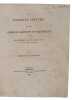
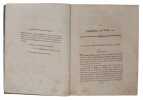
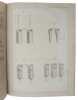
The exceedingly rare offprint, inscribed presentation copy, of Davy’s milestone paper in which he shows that electricity is capable of decomposing the most stable elements. The paper was central to any chemical affinity theory in the first half of the nineteenth century and Berzelius, one of the founders of modern chemistry, considered it ""one of the best memoirs which has ever enriched the theory of chemistry”. Davy early concluded that the production of electricity in simple electrolytic cells resulted from chemical action and that chemical combination occurred between substances of opposite charge. He therefore reasoned that electrolysis, the interactions of electric currents with chemical compounds, offered the most likely means of decomposing all substances to their elements. “These views were explained in 1806 in his lecture “On Some Chemical Agencies of Electricity,” for which, despite the fact that England and France were at war, he received the Napoleon Prize from the Institut de France (1807). This work led directly to the isolation of sodium and potassium from their compounds (1807) and of the alkaline-earth metals magnesium, calcium, strontium, and barium from their compounds (1808).” (Britannica). ""Humphry Davy was one of the most brilliant chemists of the early nineteenth century. His early study of nitrous oxide brought him his first reputation, but his later and most importent investigations were devoted to electrochemistry. Following Galvani's experiments and the discovery of the voltaic pile, interest in galvanic electricity had become widespread. The first electrolysis by means of the pile was carried out in 1800 by Nicholson and Carisle, who obtained oxygen and hydrogen from water. Davy began to examine the chemical effects of electricity in 1800, and his numerous discoveries were presented in his Bakerian lecture to the Royal Society on November 20, 1806 (the paper offered here). His experiments, along the lines stated in this paper, lead to his discoveries of potassum and sodium in 1807 and the year after to barium, calcium and boron.” (A Source Book in Chemistry p. 243). Sparrow: Milestones of Science No 52. Wheeler Gift: 2511. (PMM 255)
The Bakerian Lecture, On some chemical Agencies of Electricity. Read November 20, 1806.
(London, W. Bulmer and Co., 1807). 4to. No wrappers as extracted from ""Philosophical Transactions"" 1807 - Part I. Pp. 1-56 and 1 engraved plate. A bit of browning to the plate. Clean and fine, wide-margined..
First printing of a milestone paper in electrochemistry in which Davy shows that electricity is capable of decomposing the most stable elements.""Humphry Davy was one of the most brilliant chemists of the early nineteenth century. His early study of nitrous oxide brought him his first reputation, but his later and most importent investigations were devoted to electrochemistry. Following Galvani's experiments and the discovery of the voltaic pile, interest in galvanic electricity had become widespread. The first electrolysis by means of the pile was carried out in 1800 by Nicholson and Carisle, who obtained oxygen and hydrogen from water. Davy began to examine the chemical effects of electricity in 1800, and his numerous discoveries were presented in his Bakerian lecture to the Royal Society on November 20, 1806 (the paper offered here). His experiments, along the lines stated in this paper, lead to his discoveries of potassum and sodium in 1807 and the year after to barium, calcium and boron.(A Source Book in Chemistry p. 243). - Sparrow: Milestones of Science No 52. - Wheeler Gift: 2511.

