 Write to the booksellers
-
Type
Book (440)
Magazine (17)
-
Language
English (2)
French (454)
Russian (1)
-
Century
19th (1)
20th (305)
21st (21)
-
Countries
Belgium (12)
Brazil (1)
Canada (3)
Côte d'Ivoire (2)
Denmark (117)
France (287)
Germany (1)
Switzerland (33)
United States of America (1)
-
Syndicate
ALAC (3)
ILAB (216)
NVVA (14)
SLACES (14)
SLAM (80)
SNCAO (1)
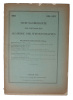
Einheitliche Feldtheorie und Hamiltonsches Prinzip.
Berlin, Gruyter & Co., 1929. 4to. Orig. printed orange wrappers. Offprint/Sonderausgabe aus Sitzungsberichten...pp. (1)-6. Fine fresh copy.
First edition in the rare Offprint, now called ""Sonderausgabe"" instead of ""Sonderabdruck"", having separate printed title and separate pagination. See Weil: 166, where this is not mentioned.The early Offprints from ""Sitzungsberichten..."" are called ""Sonderabdruck"" up to Weil No.165 (including this). From Weil 166 they are called ""Sonderausgabe..."". - Before 161 (up to 160) the Offprints do not have separate title and pagination (the pagination follows the numbering in the periodical). From 166 the Offprint has both separate printed title and pagination. - ( So Weil Nos 161-165 is still ""Abdruck"", but with separate title and pagination). These facts are not mentioned in the bibliographies.Weil No. 166.
Einheitliche Feldtheorie von Gravitation und Elektrizität (+) Neue Möglichkeit für eine einheitliche Feldtheorie von Gravitation und Elektrizität (+) Zur einheitlichen Feldtheorie (+) Einheitliche Feldtheorie und Hamiltonsches Prinzip (+) Über den ge... - [PMM 416 - A NEW THEORY OF GRAVITATION]
Berlin, Königlich Akademie der Wissenschaften, 1925-1929. 1. Einheitliche Feldtheorie von Gravitation und Elektrizität. Offprint: S. B. preuss. Akad. Wiss., 1925, pp.414-419. Original wrappers. Mint. (Weil 147 / Boni 155).2. Neue Möglichkeit für eine einheitliche Feldtheorie von Gravitation und Elektrizität. Offprint: S. B. preuss. Akad. Wiss., 1928, pp.235-245. Original wrappers. Mint. (Weil 162/ Boni 175).3. Zur einheitlichen Feldtheorie. Offprint: S. B. preuss. Akad. Wiss., 1929, pp.2-7. Original wrappers. Mint. (Weil 165/ Boni 183).4. Einheitliche Feldtheorie und Hamiltonsches Prinzip. Offprint: S. B. preuss. Akad. Wiss., 1929, pp.156-159. Original wrappers. Mint. (Weil 166/ Boni 184).5. Über den gegenwärtigen Stand der Feldtheorie. In: Festschrift Dr. A. Stodola, Zürich, Füssli, 1929, pp.126-132. Publishers full cloth. Spine slightly faded. Otherwise mint. (Weil 168 / Boni 178).All in all a very fine set.
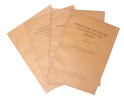
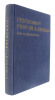
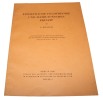
Offprint of all four papers and first edition of the final essay, constituting Einstein's attempt toward creating a unified field theory: ""a new theory of space with a view to unification of all forms of activity that fall within the sphere of physics, giving them a common explanation"" (PMM416). The task of unifying nuclear, electromagnetic, and gravitational force is nowadays by many considered the holy grail of theoretical physics.Maxwell was the first to develop such a theory when he described the forces of electricity and magnetism as the single force electromagnetism. After Einstein had completed his general theory of relativity (a field theory for gravitation), he turned his attention towards generalizing his theory even further to include Maxwell's theory. Even though Einstein never succeeded in completing this task, in the way that he finished his earlier theories, he pioneered and explored many areas of this subject. ""It had been repeatedly observed that Einstein's general theory of relativity necessitated a pluralistic explanation of the universe. In 1925 he announced that he had resolved this difficulty but the announcement was premature. In 1928 he attacked the problem once more, only to find that Riemann's conception of space, on which the general theory was based, would not permit of a common explanation of electromagnetic and gravitational phenomena. In a series of papers [the present] devoted to the development of 'A Uniform Theory of Gravitation and Electricity' he outlined a new theory of space with a view to unification of all forms of activity that fall within the sphere of physics, giving them a common explanation. All that would then remain to complete a scientific unison is the correlation of the organic and inorganic"".PMM 416Barchas 586
Einheitliche Feldtheorie von Gravitation und Elektrizität (+) Neue Möglichkeit für eine einheitliche Feldtheorie von Gravitation und Elektrizität (+) Zur einheitlichen Feldtheorie (+) Einheitliche Feldtheorie und Hamiltonsches Prinzip - [PMM 416 - A NEW THEORY OF GRAVITATION]
Berlin, Königlich Akademie der Wissenschaften, 1925-1929. 1. Einheitliche Feldtheorie von Gravitation und Elektrizität., 1925, pp. 414-419. Uncut, unopened n the original printed wrappers. missing small parts of spine and upper part of front wrapper detached, otherwise fine. (Weil 147 / Boni 155).2. Neue Möglichkeit für eine einheitliche Feldtheorie von Gravitation und Elektrizität. Offprint: S. B. preuss. Akad. Wiss., 1928, pp.235-245. In the original yellow wrappers. Very fine and clean. (Weil 162/ Boni 175).3. Zur einheitlichen Feldtheorie. Offprint: S. B. preuss. Akad. Wiss., 1929, pp.2-7. In the original yellow wrappers. Very fine and clean. (Weil 165/ Boni 183).4. Einheitliche Feldtheorie und Hamiltonsches Prinzip. Offprint: S. B. preuss. Akad. Wiss., 1929, pp.156-159. In the original yellow wrappers. Very fine and clean. (Weil 166/ Boni 184).
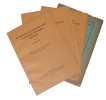
Fine collection, three in offprint and one in the original printed wrappers, of the four papers that together constitute Einstein's attempt towards creating a unified field theory: ""a new theory of space with a view to unification of all forms of activity that fall within the sphere of physics, giving them a common explanation"" (PMM416). The task of unifying nuclear, electromagnetic, and gravitational force is nowadays by many considered the holy grail of theoretical physics.Maxwell was the first to develop such a theory when he described the forces of electricity and magnetism as the single force electromagnetism. After Einstein had completed his general theory of relativity (a field theory for gravitation), he turned his attention towards generalizing his theory even further to include Maxwell's theory. Even though Einstein never succeeded in completing this task, in the way that he finished his earlier theories, he pioneered and explored many areas of this subject.""It had been repeatedly observed that Einstein's general theory of relativity necessitated a pluralistic explanation of the universe. In 1925 he announced that he had resolved this difficulty but the announcement was premature. In 1928 he attacked the problem once more, only to find that Riemann's conception of space, on which the general theory was based, would not permit of a common explanation of electromagnetic and gravitational phenomena. In a series of papers [the present] devoted to the development of 'A Uniform Theory of Gravitation and Electricity' he outlined a new theory of space with a view to unification of all forms of activity that fall within the sphere of physics, giving them a common explanation. All that would then remain to complete a scientific unison is the correlation of the organic and inorganic"".PMM 416Barchas 586Weil 147, 162, 165 & 166.
Elementare Betrachtungen über die thermische Molekularbewegung in festen Körpern.
Leipzig, Barth, 1911. Plain wrappers. In: ""Annalen der Physik"" Vierte Folge, Bd. 35, No 9. With titlepage to vol. 35. Pp. 617-816 a. 3 plates. (Entire issue offered). Einstein'spaper: pp. 679-694. Clean and fine.
First edition. In the paper ""Elementary observations concerning the thermal molecular motion in solid bodie"" he continues his earlier investigations of the specific heat of solids in which the heat agitation of solids was reduced to a monochromatic oscillation of the atom and the specific heat calculated on the basis of the quantum treatment of an oscillator put in the radiation field. Here he deals with with the discrepancies between his formula of the measurements at low temperature..."" (Cornelius Lanzos).Weil: 42. - Boni: 38.

(SLACES, NVVA)
Phone number : 41 (0)26 3223808
Geometrie und Erfahrung
Berlin, Julius Springer, 1921, in-8, 20 pp, Broché, couverture crème imprimée de l'éditeur, Première édition de cette conférence prononcée par Einstein (1879-1955) à l'occasion de la séance commémorative de l'Académie prussienne en l'honneur de Frédéric le Grand. Le physicien y résume ses théories sur la géométrisation de la physique et de la relativité, ainsi que sur la relation des mathématiques au monde : "Comment est-il possible que la mathématique, qui est un produit de la pensée humaine et indépendante de toute expérience, puisse s'adapter d'une si admirable manière aux objets de la réalité ? La raison humaine serait-elle donc capable, sans avoir recours à l'expérience, de découvrir par la pensée seule les propriétés des objets réels ?" L'opuscule a été publié l'année où il reçut le prix Nobel. Cachet ex-libris du révolutionnaire Russe et bibliophile Marcel Bekus (1888-1939). Bon exemplaire. Rares rousseurs marginales, agrafes oxydées. Couverture rigide
Bon 20 pp.

Geometrie und Erfahrung. Erweiterte Fassung des Festvortrages gehalten an der Preussischen Akademie der Wissenschaften zu Berlin am 27. Januar 1921. Mit 2 Textabbildungen.
Berlin, Julius Springer, 1921. Uncut in orig. printed wrappers. 20 pp.
First edition. - Weil: 115. - Boni: 122.
Geometrie und Erfahrung. Erweiterte Fassung des Festvortrages gehalten an der Preussischen Akademie der Wissenschaften zu Berlin am 27. Januar 1921. Mit 2 Textabbildungen.
Berlin, Julius Springer, 1921. Uncut in orig. printed wrappers. 20 pp. Some marks on the 3 last leaves and on backwrapper probably after a rubberband.
First edition. - Weil: 115. - Boni: 122.
H. A. Lorentz als Schöpfer und als Persönlichkeit.
[Leiden, 1953]. 8vo. In the original green printed wrappers. A fine and clean copy. 8 pp. + frontispiece-portrait of Lorentz.
First printing of Einstein's essay on Hendrik Lorentz, a Dutch physicist who shared the 1902 Nobel Prize in Physics with Pieter Zeeman for the discovery and theoretical explanation of the Zeeman effect. Einstein was particulaly interested and indebted to Lorenz Lorenz derived the transformation equations subsequently used by Albert Einstein to describe space and time.
Ideas and options
Crown Publishing Group (6/1995)
LIVRE A L’ETAT DE NEUF. EXPEDIE SOUS 3 JOURS OUVRES. NUMERO DE SUIVI COMMUNIQUE AVANT ENVOI, EMBALLAGE RENFORCE. EAN:9780517884409
Journal de voyage : Extrême-Orient, Palestine, Espagne : 1922-1923
Rivages (5/2019)
LIVRE A L’ETAT DE NEUF. EXPEDIE SOUS 3 JOURS OUVRES. NUMERO DE SUIVI COMMUNIQUE AVANT ENVOI, EMBALLAGE RENFORCE. EAN:9782743647551
Kinetische Theorie des Wärmegleichgewichtes und den zweiten Hauptsatzes der Thermodynamik"
Leipzig, Ambrosius Barth, 1902. Contemp. hcloth. First hinge broken. (=) ""Annalen der Physik. Vierte Folge. Band 9."", VIII,1344 pp. and 5 plates. The Einstein Paper: pp. 417-435. Internally clean and fine. The whole volume offered.
First edition of Einstein's third paper. - Weil, No 3. - The volume contains 2 papers by Max Planck, originally published in ""Jubelband für H.A. Lorentz"" und Jubelband für J. Bosscha: ""Ueber die von einem elliptisch schwingenden Ion emitterte und absorbierte Energie" und Ueber die Verteilung der Energie zwischen Aether und Materie", pp. 619-628 und pp. 629-641.
Kinetische Theorie des Wärmegleichgewichtes und den zweiten Hauptsatzes der Thermodynamik. - [EINSTEIN'S THIRD PAPER]
Leipzig, J. A. Barth, 1902. 8vo. Bound in contemporary half calf with five raised bands and gilt lettering to spine. In """"Annalen der Physik. Vierte Folge. Band 9."". Entire volume offered.
First edition of Einstein's third paper in which he deals with the definitions of temperature and entropy for thermal equilibrium conditions and with the equipartition theorem.The volume contains 2 papers by Max Planck, originally published in ""Jubelband für H.A. Lorentz"" und Jubelband für J. Bosscha: ""Ueber die von einem elliptisch schwingenden Ion emitterte und absorbierte Energie" und Ueber die Verteilung der Energie zwischen Aether und Materie", pp. 619-628 und pp. 629-641.Weil, No 3.
La géométrie et l'exéprience.
Paris, Gauthier-Villars, 1921 ; plaquette in-8, brochée. 19pp. Couverture jaunie avec de petites déchirures marginales.
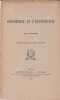
EDITION ORIGINALE. Texte du discours prononcé à l'Académie des Sciences de Berlin le 27 janvier 1921, et complété ensuite. Traduction de Maurice Solovine."... Ma tâche ici était de montrer seulement que la faculté intuitive humaine ne doit nullement capituler devant la géométrie non-euclidienne".On joint l'avis de parution d'un autre discours qu'on trouve parfois relié avec : "L'éther et la théorie de la relativité."
LA RELATIVITE
PETITE BIBLIOTHEQUE PAYOT. 1964. In-12. Broché. Etat d'usage, Plats abîmés, Dos abîmé, Intérieur acceptable. 184 pages - coiffes et coins frottés - mors fendus - plats pliés.. . . . Classification Dewey : 530-Physique
PETITE BIBLIOTHEQUE PAYOT N°62 Classification Dewey : 530-Physique
LA RELATIVITE
Paris, PAYOT, Petite Bibliothèque, 1964, in-12 broché, 184 pp. TRES BON ETAT
Nombreux titres disponibles en Philosophie.
LA RELATIVITE - COLLECTION PETITE BIBLIOTHEQUE PAYOT N°62
PAYOT. 1965. In-12. Broché. Bon état, Couv. convenable, Dos satisfaisant, Intérieur frais. 184 Pages. . . . Classification Dewey : 530-Physique
Classification Dewey : 530-Physique
LA RELATIVITE -COLLECTION PETITE BIBLIOTHEQUE PAYOT N°62
PAYOT. 1964. In-12. Broché. Bon état, Couv. convenable, Dos satisfaisant, Intérieur frais. 184 Pages. . . . Classification Dewey : 530-Physique
Classification Dewey : 530-Physique
LA RELATIVITE - - LA THEORIE DE LA RELATIVITE RESTREINTE ET GENERAL - LA RELATIVITE ET LE PROBLEME DE L'ESPACE - COLLECTION PETITE BIBLIOTHEQUE N°62
PAYOT. 1986. In-12. Broché. Bon état, Couv. convenable, Dos satisfaisant, Intérieur frais. 184 Pages - Quelques formules de calculs dans le texte. . . . Classification Dewey : 500-SCIENCES DE LA NATURE ET MATHEMATIQUES
Classification Dewey : 500-SCIENCES DE LA NATURE ET MATHEMATIQUES
LA RELATIVITE - LA THEORIE DE LA RELATIVITE RESTREINTE ET GENERAL - LA RELATIVITE ET LE PROBLEME DE L'ESPACE - COLLECTION PETITE BIBLIOTHEQUE N°62
PAYOT. 1981. In-12. Broché. Etat passable, Couv. légèrement pliée, Dos satisfaisant, Mouillures. 184 Pages - traces de mouillures sans conséquences pour la lecture. . . . Classification Dewey : 500-SCIENCES DE LA NATURE ET MATHEMATIQUES
Classification Dewey : 500-SCIENCES DE LA NATURE ET MATHEMATIQUES
LA RELATIVITE. LA THEORIE DE LA RELATIVITE RESTREINTE ET GENERALE. LA RELATIVITE ET LE PROBLEME DE L'ESPACE.
PETITE BIBLIOTHEQUE PAYOT N°62. 17 OCT 1986. In-12. Broché. Bon état, Couv. convenable, Dos satisfaisant, Intérieur acceptable. 179 pages. Quelques calculs en noir et blanc dans le texte.. . . . Classification Dewey : 800-LITTERATURE (BELLES-LETTRES)
Classification Dewey : 800-LITTERATURE (BELLES-LETTRES)
La relativite. [Mass Market Paperback] Albert Einstein
PHOTOS SUR DEMANDE
Merci de nous contacter à l'avance si vous souhaitez consulter une référence dans notre boutique à Authon-du-Perche.
La relativite [Unknown Binding]
POCHE BON ETAT PLIS SUR COUV
Merci de nous contacter à l'avance si vous souhaitez consulter une référence dans notre boutique à Authon-du-Perche.
La relativité
Payot. Non daté. In-12. Broché. Bon état, Couv. convenable, Dos satisfaisant, Intérieur frais. 184 pages.. . . . Classification Dewey : 500-SCIENCES DE LA NATURE ET MATHEMATIQUES
Classification Dewey : 500-SCIENCES DE LA NATURE ET MATHEMATIQUES

