 Write to the booksellers
-
Type
Art print (2)
Book (6497)
Magazine (21)
Manuscript (1)
Photographs (3)
-
Latest
Last 24h (1)
Last month (21)
Last week (1)
-
Language
English (10)
French (6510)
German (1)
Greek (1)
Latin (2)
-
Century
16th (3)
17th (11)
18th (256)
19th (927)
20th (3489)
21st (189)
-
Countries
Belgium (242)
Brazil (2)
Canada (3)
Côte d'Ivoire (11)
Denmark (1387)
France (4529)
Italy (38)
Switzerland (312)
-
Syndicate
ALAC (3)
CLAM (2)
ILAB (4298)
NVVA (149)
SLACES (149)
SLAM (2710)
SNCAO (15)
Green's functions for monatomic simple cubic lattices
Bruxelles, Palais des Académies 1960 176pp.with figure and tables, 29cm, in the series "Académie royale de Belgique. Classe des sciences, mémoires, collection in-4o, deuxième série" tome XIV fascicule 7, orig.softcover, pages uncut, VG
Jahrbuch der Radioaktivität und Elektronik"" Dreizehnter band, 13, band, 1916.
Leipzig, Hirzel, 1916. 8vo. In contemporary red half cloth. Stamp to front free end-paper. Wrappers bound in the back. Fine and clean. IV, 463 pp.

Jahrbuch der Radioaktivität und Elektronik"" Vierzehnter band, 14, band, 1917.
Leipzig, Hirzel, 1917. 8vo. In contemporary red half cloth. Stamp to front free end-paper. Wrappers bound in the back. Fine and clean. IV, 499 pp.
Jahrbuch der Radioaktivität und Elektronik"" Zwölfter band, 12, band, 1915
Leipzig, Hirzel, 1915. 8vo. In contemporary red half cloth. Stamp to front free end-paper. Wrappers bound in the back. Fine and clean. IV, 460 pp.
Metaphysica Neutoni, seu Collatio sentnetiarum Neutoni ac Leibnitii/La Metaphysique de Neuton, ou Parallele des sentimens de Neuton et de Leibnitz (+) Anti-Machiavellus, seu Specimen criticum in Principem Machiavelli/Anti-Machiavel (+) Philosophiae n...
Leipzig, Grosse & Gleditsch, 1742. 4to. Contemp. full vellum. Faint handwritten title on spine. Two small stamps on titlepage. In: ""Nova Acta Eruditorum Anno MDCCXLII"". Occassional brownspotting. The entire volume offered. (4), 720, (33) pp + 6 engraved plates].
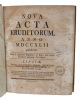

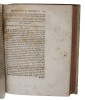
First edition of the 1742-edition of Nova Acta Eruditorum which are including two reviews of Voltaire and one of Newton's Principia.
No. 10A Remote Switching System: System Overview (+) Control-Complex Architecture and Circuit Design (+) Peripheral Systems Architecture and Circuit Design (+) Host Software (+) Physical Design (+) Remote Terminal Firmware (+) System Maintenance (+) T... - [FIRST DESCRIPTION OF THE NO. 10A RSS (REMOTE SWITCHING SYSTEM).]
New York, American Telephone and Telegraph Company, 1982 8vo. Original full green cloth. Volume 61, 1982 of ""The Bell System Technical Journal"". Library stamp to pasted down front free end-paper. Minor bumping to extremities. Beside a very few pencil marks a nice and clean copy. Pp. 391- 657. [Entire issue: Pp. XXXX, (1), 659].
First edition of Bell System's description of the highly influential and innovative first remote switching system. (No. 10A RSS).With the rapid rise in households with a telephone in the 50ies and 60ies, a new and more effective switching system was needed. The Bell System developed the No. 1 ESS (Electronic Switching System) to meet with these demands. The ESS made servicing easier but a more automatic and centralized structure was needed in order to meet the demands of smaller businesses. ""With the evolution in electronic technology currently in progress, it was evident that intelligent remotely controlled devices could be brought into central office switching environment. A system which could effectively and economically remote large portions of its network over large distances could rapidly be deployed over major segments of the Bell System network. The era of electronic switching began with the introduction of the No. 1 ESS into commercial service in 1965. [...] In spite of this activity, there remains a large segment of Bell System central offices that until the introduction of the 10A RSS could not justify the introduction of electronic switching technology."" (From the introducing article).Even though the No. 10A RSS essentially was built upon the No. 1 ESS it was still a milestone in the history of telephony.
SD Submarine Cable System. [11 papers, see below]. - [THE FIRST TRANS-PACIFIC TELEPHONE CABLE]
(New York), American Telephone and Telegraph Company, 1964. 8vo. Volume XLIII, September, No. 4, Part 1 and 2, 1964 of ""The Bell System Technical Journal"". In the original printed blue wrappers. Previous owner's stamp to front wrapper, and very light brownspotting to spine, otherwise a near mint copy. Pp. 1155-1479 + two folded plates, one loosely inserted.
First publication of AT&T's first submarine telephone cable across the pacific. It went from Japan to Hawaii, where it connected to two cables linking Hawaii with the mainland. This brought the same improvements to trans-Pacific service that the TAT-1 had brought to trans-Atlantic service in 1956. (See link below). Since the trans-Atlantic service opened in 1927, calls had traveled across the ocean via radio waves. But cables provide much higher signal quality, avoid atmospheric interference and offer greater capacity and security.Due to uncertainties in global politics, the economic involvement by the US government in the project was minimal. Papers contained in the present issue:1. Ehrbar, R.D." Fraser, J.M. Kelley, R.A. Morris, L.H. Mottram, E.T. Rounds, P.W. The SD Submarine Cable System. Pp. 1155-1184.2. Bowker, M.W. Nutt, W.G. Riley, R.M. Design of Armorless Ocean Cable. Pp. 1185-1208.3. Lerch, B.W. Phelps, J.W.Armorless Cable Manufacture. Pp. 1209-1242.4. Brewer, S.T. Dickinson, F.R. Von Roesgen, C.A. Repeaters and Equalizers for the SD Submarine Cable System. Pp. 1243-1273.5. Johansson, S.G.Manufacture of Rigid Repeaters and Ocean-Block Equalizers. Pp. 1275-1310.6. Holdaway, V.L. Van Haste, W. Walsh, E.J. Electron Tubes for the SD Submarine Cable System. Pp. 1311-1338.7. Bishop, J.D. Mottel, S.Cable Power Facility. Pp. 1339-1366.8. Ehrbar, R.D. A Cable Laying Facility. Pp. 1367-1372.9. Grismore, O.D.Cable and Repeater Handling System. Pp. 1373-1394.10. Gretter, R.W.Cable Payout System. Pp. 1395-1434.11. Butler, J.H. Altenburg, C.J. McSweeney, R.J." Sutton, L.E. Design and Powering of Cable Ship ""Long Lines"". Pp. 1435-1459.
[The Picturephone System, containing 21 articles. See below.]. - [BELL'S PICTUREPHONE SYSTEM.]
New York, American Telephone and Telegraph Company, 1971. 8vo. Original full green cloth, bound with the original blue wrappers. Volume 50, 1971 of ""The Bell System Technical Journal"". Library stamp to free front end-paper and title page. Minor bumping to extremities. A nice and clean copy. [Mentioned articles:] Pp: 219-700. [Entire issue:XXXVII, (3), 1098].
First edition of the technical description of Bell System's picturephone System.When the system was launched it was regarded as a state of the art information tool. It was being used in various science fiction-movies, among these, Stanley Cubric's A Space Odyssey.""The AT&T picturephone offered full motion, a monochrome picture, and about half the resolution of a conventional TV image. It worked over three phone lines, and though fairly costly, was somewhat affordable. The AT&T picturephone utilized sophisticated image technology and was a well designed product offering desk-top, impulse use."" (Noll, Michael. Highway of dreams: a critical view along the information superhighway, 1997, p. 27).It never became a huge success and after a few years only, it was taken off the market. In the history of the telephone and communication in general, however, it occupies an important role, as this was the first time that a visual personal communication tool was being offered to a broad audience. In this respect, it can be regarded as the forerunner of web-cam and video mobiles. Other papers of interest is contained in the present volume:1. Baird, Jack A. The Picturephone System: Foreword. Pp. 219-220. 2. Dorros, Irwin. The Picturephone System: The Network. Pp. 221-233. 3. Crater, T.V. The Picturephone System: Service Standards. Pp. 235-269.4. Cagle, W.B." Strokes, R.R. Wright, B.A. The Picturephone System: The Station: 2C Video Telephone Station Set. Pp. 271-312.5. Gordon, A.M. Singleton, J.B. The Picturephone System: Station Set Components. Pp. 313-349.6. Brown, H.E. The Picturephone System: Transmission Plan. Pp. 351-394. 7. Brown, J.M. The Picturephone System: Baseband Video Transmission on Loops and Short-Haul Trunks. Pp. 395-425.8. Bunin, B.J. Hirsch, R.B. Olsen, R.E. The Picturephone System: Crosstalk Considerations in the Transmission of Analog Signals on Paired Cable. Pp. 427-457. 9. Millard, J.B. Maunsell, H.I. The Picturephone System: Digital Encoding of the Video Signal. Pp. 459-479.10. Broderick, C.W. The Picturephone System: A Digital Transmission System for TD-2 Radio. Pp. 481-499. 11. Gunn, J.F. Ronne, J.S. Weller, D.C. The Picturephone System: Mastergroup Digital Transmission on Modern Coaxial Systems. Pp. 501-520. 12. Urich, J.F. The Picturephone System: Switching Plan. Pp. 521-531. 13. Burgess, P.N. Stickel, J.E. The Picturephone System: Central Office Switching. Pp. 533-552.14. Breen, Charles. The Picturephone System: Customer Switching Systems. Pp. 553-565.15. Daskalakis, A. The Picturephone System: Key Telephone Systems. Pp. 567-584.16. Anderson, H.P. The Picturephone System: The 850A PBX. Pp. 585-604.17. Brown, D.W. Horvath, J.R. Paxton, T.S. The Picturephone System: No. 101 ESS. Pp. 605-620.18. Dougherty, H.J. Peterson, E.B. Schachtman, M.G. The Picturephone System: Maintenance Plan. Pp. 621-644. 19. Favin, D.L. Gilmore, J.F. The Picturephone System: Line and Trunk Maintenance Arrangements. Pp. 645-665.20. Bender, E.C. Howson, R.D. The Picturephone System: Wideband Data Service. Pp. 667-681.21. Warwick, P.S. Phipps, G.W. The Picturephone System: Computer Access. Pp. 683-700.And many other.
Transatlantic Communications. [11 papers, see below]. - [FIRST DESCRIPTION OF THE FIRST SUBMARINE TRANSATLANTIC TELEPHONE CABLE SYSTEM, TAT-1]
New York, American Telephone and Telegraph Company, 1957. 8vo. Volume 36, 1957 of ""The Bell System Technical Journal"". In the original printed blue wrappers. Sunning to spine, and very minor spotting to wrappers. Internally near mint. 348 pp.
First edition of the first technical description of the TAT-1, the first submarine transatlantic telephone cable system. The 2,240-mile cable was laid by the cableship Monarch and ran from Gallanach Bay, near Oban in Argyll, to Clarenville, Canada.""The papers that follow describe the design, manufacture and installation of the first transatlantic telephone cable system with all its component parts, including the connection microwave radio-relay system in Nova Scotia."" (From the introduction to the present volume).""Years of development led up to 1956 when the first transatlantic telephone cable system started carrying calls"" this is an interesting story in itself. Two coaxial cables about 20 miles apart carried 36 two-way circuits. Nearly 50 sophisticated repeaters were spaced from 10 to 40 miles along the way. Each vacuum tube repeater contained 5,000 parts and cost almost $100,000."" (Petruzzellis, Thomas. Telephone Projects for the Evil Genius, 2008, p. 4). The electronic repeaters, the devices that held together the many separate cables, were designed by the Bell Telephone Laboratories. In terms of reliable operation, the most critical component of the system was the repeater. These devices, spaced at intervals of 37.5 nautical miles along the cable, compensated for loss. The repeaters were of a unique flexible design, which allowed them to be handled in the same manner as cable.TAT-1 carried the Moscow-Washington hotline between the American and Soviet heads of state.Other papers of interest contained in the present volume:1. Kelly, Dr. Mervin J." Radley, Sir Gordon. Transatlantic Communications - An Historical Resume. Pp. 1-5.2. Mottram, E.T. Halsey, R.J. Emling, J.W. Griffith, R.G. Transatlantic Telephone Cable System - Planning and Over-All Performance. Pp. 7-27.3. Lewis, H.A. Tucker, R.S. Lovell, G.H. Fraser, J. M. System Design for the North Atlantic Link. Pp. 29-68.4. Gleichmann, T.F. Lince, A.H. Wooley, M.C. Braga, F.J. Repeater Design for the North Atlantic Link. Pp. 69-101. 5. Lamb, H.A. Heffner, W.W. Repeater Production for the North Atlantic Link. Pp. 103-138. 6. Meszaros, G.W. Spencer, H.H. Power Feed Equipment for the North Atlantic Link. Pp. 139-162.7. McNally, J.O. Metson, G.H. Veazie, E.A. Holmes, M.F. Electron Tubes for the Transatlantic Cable System. Pp. 163-188.8. Lebert, A.W. Fischer, H.B. Biskeborn, M.C. Cable Design and Manufacture for the Transatlantic Submarine Cable System. Pp. 189-216.9. Halsey, R.J. Bampton, J.F. System Design for the Newfoundland-Nova Scotia Link. Pp. 217-244.10. Brockbank, R.A. Walker, D.C. Welsby, V.G. Repeater Design for the Newfoundland-Nova Scotia Link. Pp. 245-276.11. Thomas, J.F.P. Kelly, R. Power-Feed System for the Newfoundland-Nova Scotia Link. Pp. 277-292.12. Jack, J.S. Leech, Capt. W.H. Lewis, H.A. Route Selection and Cable Laying for the Transatlantic Cable System. Pp. 293-326.
Transatlantic Communications. TAT-1. - [FIRST DESCRIPTION OF THE FIRST SUBMARINE TRANSATLANTIC TELEPHONE CABLE SYSTEM, TAT-1]
New York, American Telephone and Telegraph Company, 1957. 8vo. Original full green cloth, bound with the original blue wrappers. Volume 36, 1957 of ""The Bell System Technical Journal"". Library stamp to pasted down front free end-paper. Minor bumping to extremities. A nice and clean copy. [Entire issue:] 20, 1513 pp.
First edition of the first technical description of the TAT-1, the first submarine transatlantic telephone cable system. The 2,240-mile cable was laid by the cableship Monarch and ran from Gallanach Bay, near Oban in Argyll, to Clarenville, Canada. The initial capacity was 36 calls at a time at a price per call of $12 for the first three minutes. Since trans-Atlantic service opened in 1927, calls had traveled across the ocean via radio waves. But cables provide much higher signal quality, avoid atmospheric interference and offer greater capacity and security.""The papers that follow describe the design, manufacture and installation of the first transatlantic telephone cable system with all its component parts, including the connection microwave radio-relay system in Nova Scotia."" (From the introduction to the present papers).""Years of development led up to 1956 when the first transatlantic telephone cable system started carrying calls"" this is an interesting story in itself. Two coaxial cables about 20 miles apart carried 36 two-way circuits. Nearly 50 sophisticated repeaters were spaced from 10 to 40 miles along the way. Each vacuum tube repeater contained 5,000 parts and cost almost $100,000."" (Petruzzellis, Thomas. Telephone Projects for the Evil Genius, 2008, p. 4). The electronic repeaters, the devices that held together the many separate cables, were designed by the Bell Telephone Laboratories. In terms of reliable operation, the most critical component of the system was the repeater. These devices, spaced at intervals of 37.5 nautical miles along the cable, compensated for loss. The repeaters were of a unique flexible design, which allowed them to be handled in the same manner as cable.TAT-1 carried the Moscow-Washington hotline between the American and Soviet heads of state.Other papers of interest contained in the present volume:1. Kelly, Dr. Mervin J." Radley, Sir Gordon. Transatlantic Communications - An Historical Resume. Pp. 1-5.2. Mottram, E.T. Halsey, R.J. Emling, J.W. Griffith, R.G. Transatlantic Telephone Cable System - Planning and Over-All Performance. Pp. 7-27.3. Lewis, H.A. Tucker, R.S. Lovell, G.H. Fraser, J. M. System Design for the North Atlantic Link. Pp. 29-68.4. Gleichmann, T.F. Lince, A.H. Wooley, M.C. Braga, F.J. Repeater Design for the North Atlantic Link. Pp. 69-101. 5. Lamb, H.A. Heffner, W.W. Repeater Production for the North Atlantic Link. Pp. 103-138. 6. Meszaros, G.W. Spencer, H.H. Power Feed Equipment for the North Atlantic Link. Pp. 139-162.7. McNally, J.O. Metson, G.H. Veazie, E.A. Holmes, M.F. Electron Tubes for the Transatlantic Cable System. Pp. 163-188.8. Lebert, A.W. Fischer, H.B. Biskeborn, M.C. Cable Design and Manufacture for the Transatlantic Submarine Cable System. Pp. 189-216.9. Halsey, R.J. Bampton, J.F. System Design for the Newfoundland-Nova Scotia Link. Pp. 217-244.10. Brockbank, R.A. Walker, D.C. Welsby, V.G. Repeater Design for the Newfoundland-Nova Scotia Link. Pp. 245-276.11. Thomas, J.F.P. Kelly, R. Power-Feed System for the Newfoundland-Nova Scotia Link. Pp. 277-292.12. Jack, J.S. Leech, Capt. W.H. Lewis, H.A. Route Selection and Cable Laying for the Transatlantic Cable System. Pp. 293-326.And many other.
[Traffic Service Position System No. 1. 11 articles, see below]. - [FIRST DESCRIPTION OF BELL'S TRAFFIC SERVICE POSITION SYSTEM (TSPS)]
New York, American Telephone and Telegraph Company, 1979. 8vo. Original full green cloth. The entire volume 43, nr. 2 of ""The Bell System Technical Journal"". Library stamp to pasted down front free end-paper. Minor bumping to extremities. A nice and clean copy. [Entire volume: pp. 809-1367].
First edition of the first description of Bell System's Traffic Service Position System (TSPS). It was designed by Bell Labs in Columbus, Ohio to replace traditional cord switchboards. Research at Bell Systems was aimed at finding ways to reduce operator labor which at that time was was the largest expenditure when operating a telephone network. ""A new cordless operator position was designed to illustrate how this operator service might be implemented. Trials at New York Telephone Co. demonstrated the feasibility of both the customer dialing of the prefix and the efficiency of the new operator's position. After the trial, a development was started to add such positions, by then known as the ""Traffic Service Position"" [...]. It was an example of the electronic art forcing out the old electromechanical art with many vested interest. The collection of trunks, a ferreed switching network, an SPC, and the positions formed a system called the ""Traffic Service Position System"". Being the first, it was called the ""No. 1 TSPS"". (Chapuis,, 100 Years of Telephone Switching (1878-1978), 1982, p. 170).Articles contained in the Traffic Service Position System No. 1-issue:1. Staehler, R.E." Hayward, W.S. Jr. Traffic Service Position System No. 1: Recent Developments, An Overview. Pp. 1109-1118.2. Bauman, S.M. DiPietro, R.S. Jaeger, R.J. Jr. Remote Trunk Arrangement: Overall Description and Operational Characteristics. Pp. 1119-1135.3. Brune, W.L. Piereth, R.J. Weygand, A.G. Remote Trunk Arrangement and Position Subsystem No. 2: Transmission and Signaling Considerations. Pp. 1137-1165.4. Bulfer, A.F. Gibbons, W.E. Hackett, J.A.Remote Trunk Arrangement: Hardware and Software Implementation. Pp. 1167-1205.5. Berger, M. Dalby, J.C. Jr. Ransom, V.L. Prell, E.M. Automated Coin Toll Service: Overall Description and Operational Characteristics. Pp. 1207-1223.6. Clark, G.T. Streisand, K. Larson, D.H. Station Signaling and Announcement Subsystem: Hardware for Automated Coin Toll Service. Pp. 1225-1249.7. Ahmari, R. Hsu, J.C. Potter, R.L. Reed, S.C.Automated Coin Toll Service: Software. Pp. 1251-1290.8. Youngs, E.A. Bushnell, W.J. Barone-Wing, A. Automated Coin Toll Service: Human Factors Studies. Pp. 1291-1305.9. Stanaway, J.J. Jr. Victor, J.J. Welsch, R.J. Pp. Software Development Tools. Pp. 1307-1333.10. Delatore, J.P. VanHaften, D. Weber, L.A. System Verification and Evaluation Procedures. Pp. 1335-1346.11. Riddell, G. Swanson, C.R. Steinbrenner, R.T. Operator Training Facilities. Pp. 1347-1357.
La Pratique des Machines Frigorifiques. Analyse et Fonctionnement.Deuxième édition revue et augmentée. Avec 77 figures, 2 tableaux et 2 planches hors texte.
Paris - Liège, Librairie Polytechnique Ch. Béranger 1947, 240x155mm, 273pages, reliure d'éditeur.

Nom de possesseur. Pour un paiement via PayPal, veuillez nous en faire la demande et nous vous enverrons une facture PayPal
Actualités scientifiques et industrielles. La conquête de l'énergie atomique : I. Des rayons uraniques à la scission de l'Uranium (1896-1940) / II. De la scission de l'Uranium à la Bombe atomique (1940-1945)
Hermann et Cie Actualités scientifiques et industrielles Broché 1946 In-8 (16.5x25.5 cm), broché, 114 pages, non-rogné ; plis au dos, coiffes et coins frottés, bords des plats et dos insolé, par ailleurs intérieur plutôt frais, assez bon état. Livraison a domicile (La Poste) ou en Mondial Relay sur simple demande.
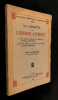

Le choix solaire - Une énergie qui entre dans la vie quotidienne
C.N.R.S. et Tchou Malicorne sur Sarthe, 72, Pays de la Loire, France 1979 Book condition, Etat : Bon broché, sous couverture illustrée d'un soleil grand In-8 1 vol. - 248 pages
28 planches hors-texte en noir et blanc 1ere édition Contents, Chapitres : Avant-propos - 1. Les énergies renouvelables : Energie solaire, hydraulique, marémotrice, géothermie, énergie thermique des océans, énerguie de la houle et des vagues, énergie éolienne, aube des énergies nouvelles - 2. Ressources et rendements de la photosynthèse, produits végétaux, nouvelles cultures alimentaires, fuels végétaux, production d'hydrogène et d'électricité par les plantes, agriculture énergétique, transformation des produits d'origine végétale, fermentation, perspectives de la photosynthèse - 3. Centrales solaires, les précurseurs, Themis, générateurs Thek et Pericles - 4. Conversion photovoltaïque, photopiles sous concentration, générateurs photovoltaïques, futur des cellules photovoltaïques, centrales solaires de l'espace - 5. Habitat solaire, approche bioclimatique, solutions actives, maisons solaires françaises - 6. Urbanisme solaire, énergie solaire et espace rural, la ville et les énergies renouvelables, la cité solaire, la société solaire - Différentes annexes legeres pliures sur les plats de couverture, sinon tres bon etat
Les ondes aujourd'hui
Ellipses , L'Esprit des Sciences Malicorne sur Sarthe, 72, Pays de la Loire, France 2004 Book condition, Etat : Très Bon broché, sous couverture imprimée éditeur jaune et verte, illustrée d'une photographie en couleurs In-8 1 vol. - 128 pages
quelques figures dans le texte en noir et blanc 1ère édition Contents, Chapitres : Introduction - Un univers d'ondes - Un concept débattu - Le son aujourd'hui - La lumière aujourd'hui - Les ondes au quotidien - Les ondes guerrières - Les ondes en délire - Les ondes de l'infiniment petit - Les ondes de gravitation - Les ondes-fantômes du vide - Bibliographie - Annexes : Les mathématiques des ondes - Quelques equations d'ondes bel exemplaire, très frais
DE LA LOI GENERALE DE L'EQUILIBRE DANS LE MONDE
Troyes J.-L. Paton 1930 In-8 Broché Satisfaisant
Plaquette extraite des mémoires de la société académique de l'Aube - 1929 (lecture du 14 décembre 1928) ; couverture de papier bleu pale légèrement défraichie, insolée ; 21pp ; l'auteur était ingénieur des arts et manufactures ; envoi signé "à Mr le chanoine Bresson, vicaire général...
Contribution à l'étude du phénomène de magnétostriction - thèse présentée à la Faculté des Sciences de Paris , pour le grade de docteur ès physique, soutenue le 1er juin 1953
Masson Malicorne sur Sarthe, 72, Pays de la Loire, France 1954 Book condition, Etat : Bon broché In-8 1 vol. - 52 pages
30 figures 1ere édition Contents, Chapitres : contribution théorique - appareillage de mesure - étude des monocristaux de fer et de nickel - étude des ferrites de cobalt - étude d'un ferrite mixte de manganèse et de zinc - courte bibliographie exemplaire augmenté d'un envoi autographe de l'auteur - petite déchirure sans manques dans le haut du dos, sinon très bon état
Microstructure de la lumière.
Editions en langues étrangères. non daté. In-12. Relié. Bon état, Couv. convenable, Dos satisfaisant, Intérieur frais. 214 pages - nombreuses figures en noir et blanc dans le texte.. . . . Classification Dewey : 530-Physique

Traduit du russe par Georges Jakobi. Classification Dewey : 530-Physique
Microstructure de la lumière.
Moscou, Editions en Langues Etrangères, s.d. (ca 1960). 13 x 21, 215 pp., 62 figures, reliure d'édition pleine toile, bon état.
"traduit du russe par Georges Jakobi; en frontispice portrait de S. I. Vavilov."
[Université de Bordeaux I] - VEDEL, Pierre ; SERVANT, R. (Président)
Reference : 51941
(1978)
Etude du rapport signal sur bruit dans un interféromètre à deux antennes en corrélation fonctionnant à 35 Ghz. Contribution à l'étude de corrélateurs. ( Thèse présentée à l'Université de Bordeaux I pour l'obtention du titre de Docteur en Physique, Mention Spectronomie Hertzienne, soutenue le 7 mai 1969 ) [ Exemplaire dédicacé par l'auteur ]
Envoi de l'auteur, 1 vol. in-4 br. polycopié, Université de Bordeaux I, 1969, 102 pp. + 7 ff. d'annexes
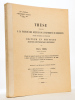
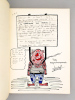
Etat très satisfaisant (titre ms. rajouté sur dos, coins inf. écornés en fin d'ouvrage, bon état par ailleurs) pour cette thèse de docteur en physique. Exemplaire rehaussé par un envoi illustré humoristique par le doctorant.
Die Konstitution der Mischkristalle und die Raumfüllung der Atome. - [VEGARD'S LAW]
Berlin, Julius Springer, 1921. 8vo. Bound in contemporary half cloth with gilt lettering to spine. In ""Zeitschrift für Physik, 5. Band. 1921"". Small library label to lower and library stamp to front free end paper. P. 17-26. [Entire issue: IV, 449 pp.].
First printing of Vegard's paper in which Vegard's Law was first introduced.Vegard's law is an approximate empirical rule which holds that a linear relation exists, at constant temperature, between the crystal lattice parameter of an alloy and the concentrations of the constituent elements.
A Hot Story , Vignettes in Physics (Thermodynamics)
Sangam Books , Vignettes in Physics Malicorne sur Sarthe, 72, Pays de la Loire, France 1993 Book condition, Etat : Bon paperback, editor's red printed wrappers, illustrated by figure with flames In-8 1 vol. - 142 pages
many text-figures 1st paperback edition, 1993 Contents, Chapitres : Contents, Preface, viii, Text, 134 pages - How it all began - Thermodynamics - Behind thermodynamics - Some fine print - The march towards zero - Negative absolute temperatures - Wherefrom the second law ? - A few parting thoughts - Bibliography wrappers very lightly yellowing, with minor folding tracks on the corners, inside is clean, no markings, low quality paper but clean, it remains a very good copy
"Les poudres et explosifs et les mesures de sécurité dans les mines de houille. Encyclopédie de science chimique appliquée; tome sixième."
Paris/Liège, Librairie Polytechnique Ch. Béranger, 1914. 16 x 25, xviii-573-12 pages., 96 + 18 figures, reliure d'édition pleine percaline bordeaux, bon état (toutes petites taches sur la couverture).
"Livre Premier : Poudres et explosifs, généralités, préparation, emplois par L. Vennin; Livre Deuxième : Mesures de sécurité dans les mines de houille par G. Chesneau."
VERCHERE J. F., DEMEILLERS B., CONTESSI G.
Reference : RO60047878
(1980)
ISBN : 2711733629
PROBLEMES DE SCIENCES PHYSIQUES, TERMINALES C, D, E
Vuibert. 1980. In-8. Broché. Bon état, Couv. convenable, Dos satisfaisant, Intérieur acceptable. 271 pages. Illustré de figures en noir et blanc dans le texte. Tranche légèrement salie.. . . . Classification Dewey : 530-Physique
Nouveaux programmes. Classification Dewey : 530-Physique
EXERCICES DE PHYSIQUE ET DE CHIMIE 3e
VUIBERT. 1985. In-12. Broché. Bon état, Couv. convenable, Dos satisfaisant, Intérieur frais. 182 pages. Quelques figures en noir et blanc, dans le texte.. . . . Classification Dewey : 530-Physique



Classification Dewey : 530-Physique

