 Write to the booksellers
-
Type
Art print (2)
Book (5887)
Magazine (20)
Manuscript (1)
Old papers (1)
Photographs (3)
-
Latest
Last 24h (1)
Last month (4)
Last week (4)
-
Language
English (10)
French (5899)
German (1)
Greek (1)
Italian (1)
Latin (2)
-
Century
16th (2)
17th (9)
18th (246)
19th (887)
20th (2966)
21st (133)
-
Countries
Belgium (266)
Canada (3)
Côte d'Ivoire (13)
Denmark (1365)
France (3966)
Switzerland (301)
-
Syndicate
ALAC (3)
CLAM (3)
ILAB (4128)
NVVA (139)
SLACES (139)
SLAM (2601)
SNCAO (15)
Elémens de la philosophie de Neuton, Mis à la portée de tout le monde.
Amsterdam, , 1738. In-8, plein veau époque, dos à nerfs orné de fleurons. Faux-titre, 399 pp, 1 p non chiffrée (errata). Edition originale illustrée du portrait de l'auteur, d'un frontispice dessiné par J. Dubourg et gravé par J. Folkéma, de 6 planches hors-texte, d'un tableau dépliant, de 25 vignettes et 25 culs-de-lampe par Dubourg, Folkéma, Konder, Lacave, B. Picart et Schley, d'un fleuron sur le titre par Debrie et de 61 figures géométriques in-texte (cf Cohen 609), Bengesco 1570 Une coiffe arasée, coins émoussés, taches sur les plats, Mouillure angulaire sur les pages.

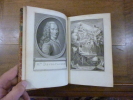
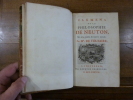
Voltaire travaillait, dès 1736, à cet ouvrage. L'édition ici présente fut imprimée par Ledet, à qui Voltaire avait confié le manuscrit incomplet des Elémens. Ledet fit achever l'ouvrage par un mathématicien hollandais et le mit en vente vers la fin de mars ou le commencement dd'avril 1738. Voltaire, après avoir envoyé à divers journaux des "Eclaircissements nécessaires sur les Eléments de la philosophie de Newton", se décida à donner lui-même à Paris, une édition plus correcte de son livre. Elle fut publiée par Prault. Voltaire a ajouté à cette édition un XXVIe chapitre intitulé: "Du flux et du reflux".
Elémens de la Philosophie de Neuton, Mis à la parté de tout le monde.
Amsterdam, Etienne Ledet & Compagnie, 1738. 8vo. In contemporary full sprinkled calf with five raised bands and richly gilt spine. Wear to extremities, corners bumped and with loss of leather, spine-ends with loss of leather. With a small printed note pasted on to lower margin of title-page. Ex-libris pasted on to verso of front board. Pencil annotations to front free end-paper and previous owner's names in ink. A few pages slightly browned, but internally generally nice and clean. (6), XII, 399, (1), 401-410, (6) pp. + 1 frontispiece and 7 engraved plates. Numerous engraved headpieces, vignettes and diagrams throughout. Wanting the portrait.
First edition - with the imprint of Amsterdam publisher Ledet, to whom Voltaire had sent the manuscript - of this important work in which Voltaire introduced Newton in France and thereby ending the Cartesian era.""Voltaires importence for the history of science lies particularly in his having composed a famous popularization of Newton, Élemens de la Philosophie de Newton (1738), which also collaborating with his companion and mistress Émilie, marquise de Chatelet, on her translation of the Principia into French, and more generally in his having referred, with the lightness of touch that made him a serious critic of human condition, his moral philosophy to what he took to be Newtonian, and hence the correct, account of physical reality."" (DSB XIV:p.83). - G.J.Gray No. 155.

Elémens de la Philosophie de Neuton, Mis à la portée de tout le monde.
A Amsterdam, chez Etienne Ledet & Compagnie, 1738. In-8 de 1 frontispice gravé, 2 portraits, (6)-XII-(2)-399-(1)-(400 à) 410-(6) pp., veau brun, dos orné à nerfs, pièce de titre en maroquin rouge (reliure de l'époque).
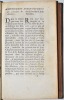
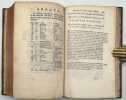
Très rare état de l'édition originale, avec les additions faites à Paris par Voltaire lui-même, ajoutées aux exemplaires non encore débités, imprimées en caractères différents sur papier à la marque de Jacques Duval de la Généralité de Rouen, comprenant : un Avertissement des libraires de Londres et un Avertissement des libraires d'Amsterdam (en regard sur deux colonnes), des Éclaircissements nécessaires, les Tables des chapitres et des matières, et les Additions par le chapitre vingt-six Du Flux et du reflux.« L'importance de Voltaire pour l'histoire des sciences réside particulièrement dans la fameuse vulgarisation de Newton qu'il composa, les Éléments de la philosophie de Newton (1738), tout en collaborant avec sa compagne et maîtresse Émilie, marquise Du Châtelet, sur sa traduction des Principia en français » (DSB). Voltaire publia cet ouvrage comme une « machine de guerre » dirigée contre les cartésiens qui, à ses yeux, retenaient la France à l'écart de la lumière scientifique moderne.Voltaire commença la composition de son principal ouvrage scientifique pendant l'été de 1736, inspiré par les études de la marquise Du Châtelet, qui entreprendra plus tard la traduction des Principia, parue en 1759, et par l'exemple de Francesco Algarotti, dont Le Newtonianisme pour les dames parut la même année. L'ouvrage parut avant que Voltaire eût envoyé la fin du 23e chapitre et le 24e : malgré sa réticence, l'éditeur hollandais fit achever l'édition par un mathématicien anonyme et ajouta au titre : mis à la portée de tout le monde. Voltaire publia ensuite une édition parisienne chez Prault avec quelques cartons.Illustration : frontispice gravé représentant la marquise Du Châtelet tenant un miroir qui éclaire le visage de Newton ; portrait de Newton ; portrait de Voltaire par Folkema ; 25 culs-de-lampe par Dubourg, Folkema, Konder, Decave, B. Picart et Schley ; 7 figures dont une planche repliée.À la fin : 12 feuillets manuscrits : Mémoire sur un endroit des Elemens de la Philosophie de Newton.Petit défaut d'impression aux trois derniers feuillets de table avec perte de quelques lettres.Bengesco, II, 1570, p. 29 ; L'Oeuvre imprimé de Voltaire (BnF), 3753 ; Cohen-De Ricci, 1037.

Elemens de la philosophie de NEUTON mis à la portée de tout le monde -- EDITION ORIGINALE -- BON EXEMPLAIRE
Amsterdam, Ledet, 1738, un volume in 8 relié en plein veau glacé, dos orné de fers dorés, tranches rouges (reliure de l'époque), (habiles restaurations aux mors), 1 portrait de NEWTON, 1 portrait de VOLTAIRE, (1), 399pp., (1pp.), 6 planches hors texte, 1 tableau dépliant, nombreuses figures dans le texte
---- EDITION ORIGINALE ---- BON EXEMPLAIRE ---- "Voltaire' importance for the history of science lies particularly in his having composed a famous popularization of Newton, Eléments de la philosophie de Newton (1738), while collaborating with his companion and mistress, Emilie, Marquise Du Châtelet, on her translation of the Principia into french...". (DSB XIV pp. 83 et suivantes) ---- BABSON N° 120 : "From 1725 to 1728, Voltaire lived in exile in England and became a fervent admirer of the Newtonian philosophy which he introduced into France . He may have met Newton... In 1736, while a refugee in Holland, he sent the first chapters of his "Elémens" to the Amsterdam publisher, Ledet, but departed without supplying the rest of the manuscript. Finally 25 chapters were printed, with the additional phrase on the title "Mis à la portée de tout le monde". The text is preceded by a poem and dedication to Voltaire's mistress, the brilliant Marquise du Châtelet, who collaborated with him in the study of Newton" ---- Gray N° 39**7236/ARB5
Sur la Théorie des Variations des Latitudes.
Berlin, Stockholm, Paris, Beijer, 1899. 4to. Without wrappers as extracted from ""Acta Mathematica. Hrdg. von G. Mittag-Leffler."", Bd. 22, pp. 201-357.
First edition. As the north and south poles, instead of being fixed points on the earth's surface, wander round within a circle of ab. 5o ft. in diameter, the result is a variability of terrestial latitudes generally. Volterra gives an elaborate mathematical analysis of these yearly fluxtuations.
La théorie de la relativité Tome II La relativité générale et la théorie de la gravitattion d'Einstein
Gauthier-Villars. 1926. In-8. Relié. Bon état, Coins frottés, Dos satisfaisant, Intérieur frais. 318 pages.. . . . Classification Dewey : 530-Physique
Etiquette sur coiffe en pied. Tampon bibliothèque. 2 photos disponibles. Classification Dewey : 530-Physique
Lehrbuch der Experimentalphysik
J. Ambrosius Barth, 1908 14,5 x 22,5, 631 pp., 438 figures, 1 spectre couleur, cartonné, Etat moyen - reliure usagée, 16ème édition revue et augmentée par König (Dr.W.)
Bewegung/ feste Körper - Fessigkeiten/ Gase - Wärme/ Magnetismus - Elektrizität/ elektrische Ströme - Wellen und Schall/ Licht
Beweis des Ergodensatzes und des H-Theorems in der neuen Mechanik.
Berlin, Springer, 1929. 8vo. In contemporary half cloth with gilt lettering to spine. In ""Zeitschrift für Physik"", bd. 57, 1929. Entire issue offered. Library stamp to front free end-paper, otherwise fine and clean. Pp. 30-70. [Entire volume:VII, (1), 872 pp.].
First printing of Neumann's important formulation and proof of an ergodic theorem for quantum systems.""The basic principle of this work is to define quantum analogues of cells in phase space by considering sets of quantum states for which all macroscopic quantities have given values within a certain inaccuracy. One further considers the unitary transformation u relating these quantum states to the eigenstates of the hamiltonian. The ergodicity is then established for ""almost every"" value of the transformation u. Although the latter restriction is a rather unsatisfactory one from the physical standpoint, one must consider von Neumann's ergodic theorem as one of the very few important contributions to a most difficult subject which even now is far from complete clarification."" (Hove, Von Neumann's Contributions to Quantum Theory, p. 98).
Beweis des Ergodensatzes und des H-Theorems in der neuen Mechanik.
Berlin, Springer, 1929. 8vo. In contemporary half cloth with gilt lettering to spine. In ""Zeitschrift für Physik"", bd. 57, 1929. Entire issue offered. Library stamp to front free end-paper and light wear to spine, otherwise fine and clean. Pp. 30-70. [Entire volume:VII, (1), 872 pp.].
First printing of Neumann's important formulation and proof of an ergodic theorem for quantum systems.""The basic principle of this work is to define quantum analogues of cells in phase space by considering sets of quantum states for which all macroscopic quantities have given values within a certain inaccuracy. One further considers the unitary transformation u relating these quantum states to the eigenstates of the hamiltonian. The ergodicity is then established for ""almost every"" value of the transformation u. Although the latter restriction is a rather unsatisfactory one from the physical standpoint, one must consider von Neumann's ergodic theorem as one of the very few important contributions to a most difficult subject which even now is far from complete clarification."" (Hove, Von Neumann's Contributions to Quantum Theory, p. 98).
Equations fondamentales d'un mélange de n fluides, déduites de la théorie cinétique en tenant compte du diamètre des molécules
Bruxelles, Hayez 1925 32pp., 29cm., extrait de "Académie royale de Belgique. Classe des sciences, mémoires, collection in-4o, deuxième série" tome VI, br.orig., bel état
Introduction de la théorie d’Einstein. Exposé philosophique élémentaire.
Paris, Albin Michel 1922, 185x120mm, 234pages, broché. Bon état.
Pour un paiement via PayPal, veuillez nous en faire la demande et nous vous enverrons une facture PayPal
Introduction à la Théorie d'Einstein
ALBIN MICHEL. 1922. In-12. Broché. Très bon état, Couv. convenable, Dos satisfaisant, Intérieur acceptable. 234 pages.. . . . Classification Dewey : 530-Physique
Exposé Philosophique Elémentaire. Bibliothèque des Sciences Modernes et Sociales. Classification Dewey : 530-Physique
Qu'est ce, au fond que la Science ? réflexions sur les théories de la physique
Albin Michel ,1924, in-8 de 397 pages ,ill. in-t., , br. ,Bon état , .Les frais de port pour la France sont offerts à partir de 25 euros d'achat (Mondial relay ). (colissimo suivi +6,90 ).
ANNALES DU BACCALAUREAT AVEC MODELES ET SOLUTIONS, SCIENCES PHYSIQUES, 1re ET 2e PARTIES, FASC. I Bis, 1951
Vuibert. 1951. In-12. Broché. Bon état, Couv. légèrement passée, Dos fané, Intérieur acceptable. 191 pages.. . . . Classification Dewey : 530-Physique
Fascicule I bis. Séries Mathématiques et Mathématiques et Technique. Classification Dewey : 530-Physique
Die Zustandsgleichung. Rede gehalten am 12. Dez. 1910 in Stockholm bei Empfang des Nobelpreises für Physik.
Leipzig, Akademische Verlagsgesellschaft, 1911. Uncut in orig. printed wrappers. 24 pp.
First edition. Waals was awarded the Nobel Prize for Physics in 1910 for his equation, linking pressure, absolute temperature and volume, ""The van der Waals-equation"".
Die Wissenschaft und die Gefährdete Welt. Eine wissenschaftssoziologie der Atomphysik. Zweite, durchgesehene und ergänzte Auflage.
München, Beck'sche Verlagsbuchh., 1969. Orig. full cloth. VIII,582 pp.
Le carnaval de la physique l'explication des phénomènes physiques en 610 questions et sans formules
Dunod. 1980. In-8. Broché. Bon état, Coins frottés, Dos satisfaisant, Intérieur frais. 257 pages augmentées de nombreux schémas en noir et blanc dans texte.. . . . Classification Dewey : 530-Physique
Classification Dewey : 530-Physique
Zur Frage der Einwirkung der Wärmebewegung auf die Interferenz von Röntgenstrahlen. - [THE DEBYE-WALLER FACTOR]
Berlin, Springer, 1923. 8vo. Bound in contemporary half cloth with gilt lettering, In ""Zeitschrift für Physik"", Band 17, 1923. Library stamp to title page, otherwise fine and clean. Pp. 398-408. [Entire volume offered: IV, 424 pp.].
First printing of the complete and accurate Debye-Waller factor. Peter Debye introduced the concept in 1913 but it was not untill Waller in 1923 with the present publication gave the complete fully usefull Debye-Waller factor.The Debye-Waller factor is the ratio of the coherent scattering or absorption cross section of a photon or electron by particles bound in a complex system to the value for the same process on an analgous free particle. It is often interpreted also as the probability of the coherent process, normalized to unity, with the difference between unity and the Debye Waller factor interpreted as the probability of incoherent processes.
Linienstrukturen an Bruchflächen. - [MODERN FORENSIC SCIENCE - WALLNER LINES]
Berlin, Springer, 1939. 8vo. In contemporary halv cloth with gilt lettering to spine. In ""Zeitschrift für Physik"", Bd. 114, 1939. Entire volume offered. Stamp to front free end-paper and titlepage, otherwise fine and clean. Pp. 368-78. [Entire volume: VIII, 749 pp.].
First printing of Wallner's important paper on microscopic lines - Wallner Lines - in various materials. Wallner lines are microscopic fractures that propagate on a rigid surface. Using the Wallner lines, it is possible to determine the speed at which a surface is cracked. The method works for example on glass, epoxy, tungsten and carbon-filled rubber. The measurement of Wallner lines are a standard method of modern forensic science.
Linienstrukturen an Bruchflächen. - [MODERN FORENSIC SCIENCE - WALLNER LINES]
Berlin, Springer, 1939. 8vo. In contemporary halv cloth with gilt lettering to spine. In ""Zeitschrift für Physik"", Bd. 114, 1939. Entire volume offered. Stamp to front free end-paper. Fine and clean. Pp. 368-78. [Entire volume: VIII, 749 pp.].
First printing of Wallner's important paper on microscopic lines - Wallner Lines - in various materials. Wallner lines are microscopic fractures that propagate on a rigid surface. Using the Wallner lines, it is possible to determine the speed at which a surface is cracked. The method works for example on glass, epoxy, tungsten and carbon-filled rubber. The measurement of Wallner lines are a standard method of modern forensic science.
Institutiones Philosophicae, quas in usum Auditorum suorum elucubratus est P. Henricus Walser. Liber V. Physica Generalis.
Augustae Vindelicorum (Augsburg), Rieger, 1795. Contemp. blue boards, a little rubbed. VIII,485,(3) pp. and 5 folded engraved plates. Some brownspots and last leaves a bit dampstained. One plate frayed in outer margin. Plates with dampstaining.
Last, independent, volume of Walser's general handbook in 5 volumes, this part deals with Physics.
La protection sélective des réseaux H.T. par relais de distance.
Paris, Dunod, 1936. 17 x 25, 231 pp., 167 figures, broché, très bon état.
traduit de l'allemand par R. Nierenberger.
Physik. Bearbeitet von F. Auerback (etc.) Mit 106 Abb. im Text.
Leipzig und Berlin, Teubner, 1915. Lex8vo. Orig. full cloth, gilt. Light wear to extremities. VIII,762 pp.
With 2 first printings by Albert Einstein (Weil Nos 70 and 71), 2 by Max Planck and 1 by H.A. Lorentz and 1 by P. Zeeman. (Die Kultur der Gegenwart dritter Theil, 3. Abth.).
Conference organized in Collab.with the Intern.Union of Physics a. The Polish Intellectual Co.Operation Committee. Warsaw, May 30th-June 3rd 1938.
Paris,(1939). Orig.full cloth. XX,247 pp. - First edition with contributions by N.Bohr, L.de Broglie, O.Klein, H.A.Kramers, L.Brillouin, A.S.Eddington, E.A.Milne a.others

