 Write to the booksellers
-
Type
Art print (2)
Book (5887)
Magazine (20)
Manuscript (1)
Old papers (1)
Photographs (3)
-
Latest
Last 24h (1)
Last month (4)
Last week (4)
-
Language
English (10)
French (5899)
German (1)
Greek (1)
Italian (1)
Latin (2)
-
Century
16th (2)
17th (9)
18th (246)
19th (887)
20th (2966)
21st (133)
-
Countries
Belgium (266)
Canada (3)
Côte d'Ivoire (13)
Denmark (1365)
France (3966)
Switzerland (301)
-
Syndicate
ALAC (3)
CLAM (3)
ILAB (4128)
NVVA (139)
SLACES (139)
SLAM (2601)
SNCAO (15)
La physique expliquée à mes enfants - Cours complet et raisonné à l'usage des établissements d'enseignement primaire et des aspirants au brevet supérieur
Retaux-Bray. Non daté. In-12. Relié demi-cuir. Etat d'usage, Coins frottés, Dos satisfaisant, Intérieur acceptable. 581 pages. Nombreuses illustrations monochromes dans le texte. Titre et filets dorés au dos. Tampon sur les gardes et en page de titre. Une illustration en couleurs hors texte. Deux photos disponibles.. . . . Classification Dewey : 530-Physique
Classification Dewey : 530-Physique
Le Rôle de l'Osmose en Biologie.
FLAMMARION Ernest. 1920. In-12. Broché. Bon état, Couv. convenable, Dos satisfaisant, Intérieur frais. 190 pages. Quelques dessins en noir et blanc dans le texte.. . . . Classification Dewey : 530-Physique
Bibliothèque de Culture Générale. Essai de Physique Végétale. Classification Dewey : 530-Physique
Le spectre infrarouge.
1928 Paris, Journal de Physique, 1928, grand et fort in 8°, cartonnage éditeur, 468 pages, cachets.
...................... Photos sur demande ...................


Phone number : 04 77 32 63 69
Elémens de Géologie et d'Hydrographie, ou Résumé des Notions acquises sur les grandes lois de la Nature ; faisant suite et servant de complément aux élémens de géographie physique et de météorologie (2 Tomes - Complet) [ Edition originale ]
Avec huit planches gravées, 2 vol. in-8 reliure de l'époque demi-veau marron, Chez J.-B. Baillière, Paris, Londres, 1838, frontispice, XV-516 pp. ; 2 ff., 575 pp., avec 7 planches dépliantes hors texte. Rappel du titre complet : Elémens de Géologie et d'Hydrographie, ou Résumé des Notions acquises sur les grandes lois de la Nature ; faisant suite et servant de complément aux élémens de géographie physique et de météorologie (2 Tomes - Complet) [ Edition originale ]
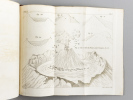
Bel exemplaire de l'édition originale, bien complet des 8 planches gravées (dont 7 dépliantes). Le frontispice est particulièrement remarquable.
Electro-Acoustique. Oscillations et ondes harmoniques. Transformateurs électro-mécaniques. Transformateurs mécanico-acoustiques. Génération d’oscillation acoustiques. Acoustique physiologique. Mesures.
Paris, Etienne Chiron 1934, 250x165mm, 87pages, broché. Haut du dos déchiré, petites déchirures sur le bas du dos.

Pour un paiement via PayPal, veuillez nous en faire la demande et nous vous enverrons une facture PayPal
Dynamique appliquée . 2ème édition
,Paris, Octave Doin 1921, XI-394+379 pp., 2 vol. in 12 reliés pleine percaline, légérement défraichis, figures in texte.
PHYSIQUE - TOME I - P.C.B - notions mathematiques, metrologie, mecanique, proprietes des fluides à temperature constante, thermodynamique.
HERMANT CLAUDE. NON DATE. In-8. Broché. Bon état, Couv. convenable, Dos satisfaisant, Intérieur frais. 197 + V pages - texte dactylographie.. . . . Classification Dewey : 530-Physique
Sommaire: notions mathematiques, metrologie, mecanique, proprietes des fluides à temperature constante, thermodynamique. Classification Dewey : 530-Physique
Nouvelle analyse physique des vibrations lumineuses basée sur la mécanique de l'élasticité et conduisant logiquement à l'explication e tous les phénomènes de l'optique
Librairie centrale des sciences. 1892. In-8. Broché. Etat d'usage, Couv. défraîchie, Dos abîmé, Intérieur acceptable. 156 pages. Nombreuses figures monochromes dans le texte.. . . . Classification Dewey : 530-Physique
Classification Dewey : 530-Physique
Etude critique sur la lumière et l’électricité.
Saint-Just, impr. de l’Université 1896, 230x150mm, 44pages, broché.
Pour un paiement via PayPal, veuillez nous en faire la demande et nous vous enverrons une facture PayPal
MANUEL DE PHYSIQUE, BREVET SUPERIEUR
De Gigord. Non daté. In-12. Relié. Etat d'usage, Tâchée, Dos abîmé, Intérieur bon état. 508 pages. Illustré de nombreuses gravures en noir et blanc dans le texte. Vers 1900. Annotations au dos des plats et en page de garde.. . . . Classification Dewey : 530-Physique
Notions de mécanique. Chaleur. Optique. Electricité statique... Classification Dewey : 530-Physique
SCIENCES PHYSIQUES VULGARISEES, PHYSIQUE ET CHIMIE, PREPARATION AUX BREVETS
De Gigord. Non daté. In-12. Relié. Etat d'usage, Plats abîmés, Dos abîmé, Quelques rousseurs. 474 pages. Illustré de nombreuses gravures en noir et blanc dans le texte. Tampon Hommage de l'éditeur sur le 1er plat. Dos et plats très abîmés et détachés. Cahiers se détachant. Quelques pages passées et tachées.. . . . Classification Dewey : 530-Physique
Notions de mécanique. Chaleur. Optique. Electricité statique... Classification Dewey : 530-Physique
LA PHYSIQUE DES RAYONS X - OUVRAGE INCOMPLET
GAUTHIER-VILLARS ET CIE. 1921. In-8. Broché. Etat passable, Plats abîmés, Dos abîmé, Intérieur frais. 320 pages augmentées de nombreuses illustrations en noir et blanc dans et hors texte - OUVRAGE INCOMPLET - MANQUE DERNIERES PAGES ET 2EME PLAT - dos partiellement manquant - 1er plat bruni - VENDU EN L'ETAT. . . . Classification Dewey : 530-Physique
Classification Dewey : 530-Physique
ELEMENTS USUELS DES SCIENCES PHYSIQUES ET NATURELLES, COURS SUPERIEUR
Hachette. Non daté. In-12. Relié. Etat d'usage, Coins frottés, Dos frotté, Quelques rousseurs. 442 pages. Illustré de nombreuses gravures en noir et blanc. Dos, 1er plat et quelques pages se détachant. Pages de garde et de titre abîmées et annotées. Quelques taches et annotations dans le texte. Pages légèrement passées.. . . . Classification Dewey : 530-Physique
Avec dse applications à l'hygiène, à l'agriculture, et à l'industrie. Classification Dewey : 530-Physique
COURS ELEMENTAIRE DE CHIMIE, CLASSE DE RHETORIQUE ET BACCALAUREAT ES LETTRES
Belin. 1885. In-12. Relié. Etat d'usage, Couv. légèrement passée, Mors fendus, Intérieur acceptable. 263 pages. Illustré de nombreuses gravures en noir et blanc dans le texte.. . . . Classification Dewey : 530-Physique
Programme de 1885. Classification Dewey : 530-Physique
Recherches sur les gaz, volumes moléculaire et états correspondants - Nouvelles recherches sur les gaz, Applications (2 volumes)
Gauthier-Villars. 1899. In-8. Broché. Etat passable, Couv. défraîchie, Dos abîmé, Intérieur acceptable. 113 + 54 pages. Second plat du premier volume désolidarisé. Nombreuses annotations au crayon dans le premier volume. Trois photos disponibles.. . . . Classification Dewey : 530-Physique
Classification Dewey : 530-Physique
Question of Parity Conservation in Weak Interactions. - [FOUNDATIONAL THEORY OF THE UNIVERSAL FORCES OF NATURE]
Lancaster, American Institute of Physics, 1956. Lex8vo. Volume 104, October 1, No. 1, 1956 of ""The Physical Review"", Second Series. Entire volume offered. In the original printed blue wrappers. Minor bumping and sunning to extremities, otherwise a fine and clean copy. Pp. 254-58. [Entire issue: Pp. (2), 272 pp.].
![Question of Parity Conservation in Weak Interactions. - [FOUNDATIONAL THEORY OF THE UNIVERSAL FORCES OF NATURE]. "LEE, T.D. (+) C. N. YANG.](https://static.livre-rare-book.com/pictures/LLX/43610_1_thumb.jpg)
![Question of Parity Conservation in Weak Interactions. - [FOUNDATIONAL THEORY OF THE UNIVERSAL FORCES OF NATURE]. "LEE, T.D. (+) C. N. YANG.](https://static.livre-rare-book.com/pictures/LLX/43610_2_thumb.jpg)
First printing of Yang and Lee's seminal and topic-creating paper which proved that parity is not conserved in weak interactions. ""The discovery of parity nonconservation contributed to a general change in the intellectual climate of fundamental physics, leading to a tendency to question the absolute validity of other conservation laws as well."" (Kragh, Quantum Generations, pp. 318-9). Before 1956, the general belief was that parity conservation is never violated in nature, a firm paradigm that was not challenged until the publication of the present paper. Chen Ning Yang and Tsung-Dao Lee were awarded the 1957 Nobel Prize in Physics ""for their penetrating investigation of the so-called parity laws which has led to important discoveries regarding the elementary particles"". Lee is the youngest Nobel laureate after WWII. It had earlier been suggested that parity might not be conserved but noone had been able to put forth compelling evidence. A careful review by Lee and Yang went further, showing that while parity conservation had been verified in decays by the strong or electromagnetic interactions, it was untested in the weak interaction. They proposed several possible direct experimental tests.When Lee and Yang's paper appeared in 1956, physicists were not immediately swept away by their ground breaking conclusions. The physicist Freeman Dyson wrote of his reaction to the paper: ""A copy of it was sent to me and I read it. I read it twice. I said, This is very interesting,' or words to that effect. But I had not the imagination to say, By golly, if this is true it opens up a whole new branch of physics.' And I think other physicists, with very few exceptions, at that time were as unimaginative as I."" Wolfgang Pauli wrote to Weisskopf after reading the paper: ""Now after the first shock is over, I begin to collect myself. Yes, it was very dramatic. I am shocked not so much by the fact that the Lord prefers the left hand as by the fact that He still appears to be left-right symmetric when he expresses Himself strongly."" (Kragh, Quantum Generations, pp. 319).The presented theory paved the way for a reconsideration of physical theories and led to new, far-reaching discoveries regarding the nature of matter and the universe. The removal of the restrictions imposed by parity law brought order to the theoretical chaos that existed with regard to subatomic particles elementary particles seen in cosmic rays and particle accelerator experiments were understood to be manifestations of the strong and weak nuclear interactions. Eventually the better understanding of their characteristics has led to a more unified theory of the fundamental universal forces of nature.
Question of Parity Conservation in Weak Interactions. - [FOUNDATIONAL THEORY OF THE UNIVERSAL FORCES OF NATURE]
Lancaster, American Institute of Physics, 1956. Lex8vo. Volume 104, October 1, No. 1, 1956 of ""The Physical Review"", Second Series. Entire volume offered. In the original printed blue wrappers. Minor bumpings to extremities and two small tears to bottom and right side of front wrapper. Otherwise a fine and clean copy. Pp. 254-58. [Entire issue: (2), 272 pp.].
![Question of Parity Conservation in Weak Interactions. - [FOUNDATIONAL THEORY OF THE UNIVERSAL FORCES OF NATURE]. "LEE, T.D. (+) C. N. YANG.](https://static.livre-rare-book.com/pictures/LLX/44074_1_thumb.jpg)
First printing of Yang and Lee's seminal and topic-creating paper which proved that parity is not conserved in weak interactions. ""The discovery of parity nonconservation contributed to a general change in the intellectual climate of fundamental physics, leading to a tendency to question the absolute validity of other conservation laws as well."" (Kragh, Quantum Generations, pp. 318-9). Before 1956, the general belief was that parity conservation is never violated in nature, a firm paradigm that was not challenged until the publication of the present paper. Chen Ning Yang and Tsung-Dao Lee were awarded the 1957 Nobel Prize in Physics ""for their penetrating investigation of the so-called parity laws which has led to important discoveries regarding the elementary particles"". Lee is the youngest Nobel laureate after WWII. It had earlier been suggested that parity might not be conserved but noone had been able to put forth compelling evidence. A careful review by Lee and Yang went further, showing that while parity conservation had been verified in decays by the strong or electromagnetic interactions, it was untested in the weak interaction. They proposed several possible direct experimental tests.When Lee and Yang's paper appeared in 1956, physicists were not immediately swept away by their ground breaking conclusions. The physicist Freeman Dyson wrote of his reaction to the paper: ""A copy of it was sent to me and I read it. I read it twice. I said, This is very interesting,' or words to that effect. But I had not the imagination to say, By golly, if this is true it opens up a whole new branch of physics.' And I think other physicists, with very few exceptions, at that time were as unimaginative as I."" Wolfgang Pauli wrote to Weisskopf after reading the paper: ""Now after the first shock is over, I begin to collect myself. Yes, it was very dramatic. I am shocked not so much by the fact that the Lord prefers the left hand as by the fact that He still appears to be left-right symmetric when he expresses Himself strongly."" (Kragh, Quantum Generations, pp. 319).The presented theory paved the way for a reconsideration of physical theories and led to new, far-reaching discoveries regarding the nature of matter and the universe. The removal of the restrictions imposed by parity law brought order to the theoretical chaos that existed with regard to subatomic particles elementary particles seen in cosmic rays and particle accelerator experiments were understood to be manifestations of the strong and weak nuclear interactions. Eventually the better understanding of their characteristics has led to a more unified theory of the fundamental universal forces of nature.
Notions Elémentaires de Physique et de Chimie. Pour la classe de Sixième.
GERMER BAILLIERE & Cie. 2ème édition. Non daté. In-12. Cartonné. Bon état, Couv. défraîchie, Dos satisfaisant, Intérieur acceptable. 403 pages. Coupes des plats frottés.. . . . Classification Dewey : 530-Physique
Classification Dewey : 530-Physique
Dictionnaire d'Electricité.
BAILLIERE et FILS. 2ème édition. 1895. In-8. Relié demi-cuir. Bon état, Couv. défraîchie, Dos satisfaisant, Quelques rousseurs. 1160 pages. Nombreuses illustrations et figures en noir et blanc, dans le texte et en hors-texte. Titre et filets dorés sur le dos.. . . . Classification Dewey : 530-Physique
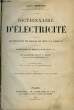
Comprenant les applications aux Sciences, aux Arts et à l'Industrie à l'usage des Electriciens, des Ingénieurs, des Industriels ... Introduction par M.E. Bouty. Classification Dewey : 530-Physique
La spectroscopie.
P., Gauthier-Villars, Masson, (1901), in 12 broché, 188 pages ; illustrations et figures dans le texte.
Encyclopédie scientifique des aides-mémoires. PHOTOS sur DEMANDE. ...................... Photos sur demande ...................
Phone number : 04 77 32 63 69
Optique. 1ère partie : Optique Théorique.
ECOLE D'APPLICATION DU MATERIEL. 1949. In-4. Broché. Etat d'usage, Couv. défraîchie, Dos satisfaisant, Intérieur frais. 174 pages. Nombreuses figures. Texte dactylographié. Tampons.. . . . Classification Dewey : 530-Physique
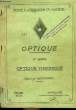
Classification Dewey : 530-Physique
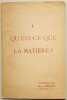
Qu'est-ce que la matière ? Conférence de Marc Lefrancq, Valenciennes 1957
Valenciennes sn 1957 in-8 plaquette agrafée Valenciennes, sn, 1957 (imp. de Hollande fils). 24 x 16 cm, in-8, 23 pp. - 2 planches hors texte en noir, figures dans le texte, plaquette agrafée sous couverture imprimée.
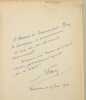
Long ENVOI autographe signé de l'auteur. Bon exemplaire. Bon
Stability of Nonlinear Control Systems. Mathematics in Science and Engineering, Vol. 13.
New York, London, Academic Press 1965, 235x155mm, XI - 150pages, editor's binding. Book in good condition.
Pour un paiement via PayPal, veuillez nous en faire la demande et nous vous enverrons une facture PayPal
LES SCIENCES 3è ANNEE DES COLLEGES D'ENSEIGNEMENT TECHNIQUE
Delagrave. 1963. In-8. Cartonnage d'éditeurs. Bon état, Couv. convenable, Dos satisfaisant, Intérieur frais. 319 pages. Figures noir et blanc.. . . . Classification Dewey : 530-Physique
Jeunes filles - Toutes professions. Classification Dewey : 530-Physique
PHYSIQUE - CLASSE DE TROISIEME -
HACHETTE. 1957. In-12. Cartonné. Etat d'usage, Coins frottés, Coiffe en tête abîmée, Intérieur frais. 329 pages augmentées de nombreuses illustrations en couleur et noir et blanc dans et hors texte -. . . . Classification Dewey : 530-Physique
Classification Dewey : 530-Physique

