 Write to the booksellers
-
Type
Art print (2)
Book (5904)
Magazine (20)
Manuscript (1)
Old papers (1)
Photographs (3)
-
Latest
Last 24h (3)
Last 3 days (1)
Last month (8)
-
Language
English (10)
French (5916)
German (1)
Greek (1)
Italian (1)
Latin (2)
-
Century
16th (2)
17th (9)
18th (243)
19th (886)
20th (2965)
21st (134)
-
Countries
Belgium (266)
Canada (3)
Côte d'Ivoire (13)
Denmark (1368)
France (3980)
Switzerland (301)
-
Syndicate
ALAC (3)
CLAM (3)
ILAB (4131)
NVVA (139)
SLACES (139)
SLAM (2601)
SNCAO (15)
La physique de la télévision - Collection petite bibliothèque payot n°54.
Payot. 1963. In-12. Broché. Etat d'usage, Coins frottés, Dos satisfaisant, Papier jauni. 176 pages - nombreuses figures en noir et blanc dans et hors texte.. . . . Classification Dewey : 530-Physique
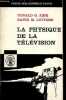
Collection petite bibliothèque payot n°54. Classification Dewey : 530-Physique

Past-Future Asymmetry of the Gravitational Field of a Point Particle. - [INTRODUCING THE EVENT-HORIZON AND INITIATED BLACK HOLE RESEARCH]
Lancaster PA, American Physical Society, 1958. Royal8vo. In the original blue printed wrappers. In ""The Physical Review"", Volume 110, Second Series, Number 4, May 15. Previous owner's stamp to front wrapper, otherwise a very fine and clean copy. Pp. 965-967. [Entire issue: Pp. 793-997].
First printing of Finkelstein's landmark paper in which he identified the Schwarzschild surface as an event horizon, ""a perfect unidirectional membrane: causal influences can cross it in only one direction"". This did not strictly contradict Oppenheimer's results, but extended them to include the point of view of infalling observers. Finkelstein's solution extended the Schwarzschild solution for the future of observers falling into a black hole. This paper influenced Penrose and Landau and essentially triggered the black-hole research.""Many prominent doubting physicists were reluctant to accept the concept of a black hole, in large measurement because of the anomaly that the implosion of a star cannot be observed. Yet a particle inexorably falls into the center at r = 0 just as time marches on - because in general relativity time and space exchange roles inside a black hole (which has the making of another paradox). One solution, or at least reconciliation, of the observational black hole paradox was achieved only in the last decades. David Finkelstein (in the present paper) ascertained a new reference frame of framework for Schwarzschild space-time. Finkelstein's reference frame simultaneously covered all regions of space-time from the imploding star to distant reaches of space. This all-embracing reference frame is now called the Eddington-Finkelstein frame"" (Kreitler, Trends in Black Hole research, P. 6).
L’électronique des praticiens. Avec de nombreux exemples de calculs et d’essais de machines et transformateurs. Traduit de l’allemand par F. Gaibrois.
Paris, Dunod 1926, 240x160mm, 623pages, illustré, reliure toile de l’éditeur.
Pour un paiement via PayPal, veuillez nous en faire la demande et nous vous enverrons une facture PayPal
Das Melde'sche Capillarbarometer. ‘Beil. z. Osterprogr. d. Königl. Gymn. zu Marburg’.
Marburg, Univ.-Buchdruckerei, 1889, in-4to, 22 S. + 1 Tafel, Broschüre ohne Umschlag.

(SLACES, NVVA)
Phone number : 41 (0)26 3223808
Der Bau massiver Brückenpfeiler mit Pressluftgründung.
Berlin, Wilhelm Ernst, 1917, in-4to, 2 Bl. + 79 S., mit 71 Abbildungen, unbeschnitten, hs. Besitzeintrag ‘Scherrer Ingénieur en chef’, Buchblock teils gelöst in Original-Broschüre, Rücken und Kanten teils etwas beschädigt.
(SLACES, NVVA)
Phone number : 41 (0)26 3223808
Mecanique appliquee Hydraulique.
Paris, Baudry et Cie, 1891. Royal8vo. Contemp. hcalf. Spine richly gilt. Edges a bit worn. XXX,687 pp., textillustrations.
Mécanique générale -- EDITION ORIGINALE
P., Tignol, 1888, un volume in 8 relié en demi-basane marron, dos orné de filets dorés (reliure de l'époque), (2), 32pp., 544pp., figures dans le texte
---- EDITION ORIGINALE ---- A. Flamant, ingénieur des Ponts et Chaussées, fut professeur à l'Ecole centrale des Arts et Manufactures et à l'Ecole des Ponts et Chaussées ---- Centres de gravité et moments d'inertie, cinématique, lois physiques du mouvement, théorèmes généraux de la mécanique, des forces vives et du travail, de l'équilibre et des machines simples - ETC**2089/M7DE
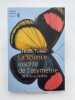
La science insolite de l'asymétrie. De la ola au neutrino
Paris Seuil Paris, Éditions du Seuil, 2016. Collection : Science ouverte. Petit in-8 broché de 265 pages. Bon état
Toutes les expéditions sont faites en suivi au-dessus de 25 euros. Expédition quotidienne pour les envois simples, suivis, recommandés ou Colissimo.
On the Conversion of Electric Oscillations into Continous Currents by means of a Vacuum Valve. (+) An Instrument for the Measurement of the Lenght of Long Electric Waves, and also Small Inductances and Capacities. - [THE ""FLEMING-VALVE""]
London, Harrison and Sons, 1905. 8vo. In the original printed wrappers. In ""Proceedings of the Royal Society of London"", vol. 74, No. 505. With new paper back-strip (presumably after having been extracted from a binding). Ex-libris (""Alan. A. C. Swinton"") pasted on to verso of title-page. Internally fine and clean. Pp. 476-487"" pp. 488-498. [Entire volume: Pp. (2), 447-518].
First printing of these two seminal articles, in which the basic principle of the modern wireless valve, also called the ""Fleming Valve"", is introduced for the first time, making radio-telephony and broadcasting possible. ""The immense superiority of the Fleming thermionic valve to all previous detectors of wireless waves caused it to be widely used as an efficient and reliable detector."" (PMM). When Lee DeForest perfected the ""grid"" in 1907, Fleming's wireless signals could be amplified to the degree necessary to make radio-telephony and broadcasting possible. The Edison effect was first described in a paper by William Henry Preece, who was shown an experiment by Edison ""On a peculier of Glow-Lamps when raised to high Incasdence"", 1885. This effect was known as the ""Edison effect"", and in 1890 Fleming, an electrical engineer who had worked with Edison Company in London and was now professor at University College, began a careful study of this phenomenon in carbon filament lamps. In 1904 he was able to demonstrate that this occurred not only with electric waves but also with wireless waves. He thus introduced the basic principle of the modern wireless valve, which permits only unilateral conductivity. (see PMM No. 396). From the library of Alan Archibald Campbell-Swinton (1863-1930), Electrical engineer, member of the Royal Society.Shiers, Early Television. A Bibliographical Guide to 1940, no. 323 (for the first article here present)"" the article has been reprinted in George Shiers, ed. !The Telephone: An Historical Anthology"", 1977. PMM no. 396 (for the first article here present).
""On the Conversion of Electric Oscillations into Continous Currents by means of a Vacuum Valve."" (And by the same author:) ""An Instrument for the Measurement of the Lenght of Long Electric Waves, and also Small Inductances and Capacities."" - [INTRODUCING THE BASIC PRINCIPLES OF MODERN WIRELESS VALVE (PMM 396)]
London, Harrison and Sons, 1905. Bound in recent marbled boards. Both papers extracted from ""Proceedings of the Royal Society of London"", vol. 74, With title-page to volume 74. Pp. 476-487 and pp. 488-498.
First printing of these two seminal articles, in which the basic principle of the modern wireless valve, also called the ""Fleming Valve"", is introduced for the first time, making radio-telephony and broadcasting possible. ""The immense superiority of the Fleming thermionic valve to all previous detectors of wireless waves caused it to be widely used as an efficient and reliable detector."" (PMM). When Lee DeForest perfected the ""grid"" in 1907, Fleming's wireless signals could be amplified to the degree necessary to make radio-telephony and broadcasting possible. The Edison effect was first described in a paper by William Henry Preece, who was shown an experiment by Edison ""On a peculier of Glow-Lamps when raised to high Incasdence"", 1885. This effect was known as the ""Edison effect"", and in 1890 Fleming, an electrical engineer who had worked with Edison Company in London and was now professor at University College, began a careful study of this phenomenon in carbon filament lamps. In 1904 he was able to demonstrate that this occurred not only with electric waves but also with wireless waves. He thus introduced the basic principle of the modern wireless valve, which permits only unilateral conductivity. (see PMM No. 396).Shiers, Early Television. A Bibliographical Guide to 1940, no. 323 (for the first article here present)"" the article has been reprinted in George Shiers, ed. !The Telephone: An Historical Anthology"", 1977. PMM no. 396 (for the first article here present).
Loudness, its Definition, Measurement and Calculation. - [FIRST PUBLICATION OF FLETCHER-MUNSON CURVES.]
New York, American Telephone and Telegraph Company, 1933. Royal8vo. Original full blue cloth. Volume XI!, 1933 of ""The Bell System Technical Journal"". Library stamp to front free end-paper. Minor bumping to extremities. A nice and clean copy. Pp. 377-430. [Entire volume: 7, (1), 537 pp.].
First edition of Fletcher and Munson's important paper in which they proved that loudness not only varies in intensity but also in frequency. Fletcher is today widely regarded as the father of stereophonic sound.
Articulation Testing Methods. - [ARTICULATION TESTING]
New York, American Telephone and Telegraph Company, 1929. 8vo. Volume VII, October, No. 4, 1929 of ""The Bell System Technical Journal"". In the original printed bluish grey wrappers. A bit of sunning to extremities and a pencil-marking to top of front wrapper. Internally clean. Pp. 806-54.[Entire issue: Pp. 613-861.]
First printing of this very early study on the technique behind articulation testing. Harvey Fletcher pioneered in research within hearing and psychoacoustics and dominated all research in acoustics within Bell Systems in the period 1925 to 1950. Fletcher is often referred to as the ""father of stereophonic sound"".The issue contains the following papers:1. Dodge, H.F." Romig, H.G. A Method of Sampling Inspection. Pp. 613-631.2. Molina, E.C. Wilkinson, R.I. The Frequency Distribution of the Unknown Mean of a Sampled Universe. Pp. 632-645.3. Sivian, L.J. Speech Power and Its Measurement. Pp. 646-661.4. Wise, W. Howard. Asymptotic Dipole Radiation Formulas. Pp. 662-671.5. Darrow, Karl K. Statistical Theories of Matter, Radiation and Electricity. Pp. 672-748.6. Townsend, J.R. Straw, W.A. Physical Properties and Methods of Test For Some Sheet Non-Ferrous Metals. Pp. 749-805.7. Fletcher, H. Steinberg, J.C. Articulation Testing Methods. Pp. 806-854.
Elements de physique, à l'usage des écoles moyennes, industrielles,
Manceaux, Collection nationale de classiques, 1886 13 x 20,5, 288 pp., 180 figures, broché, Etat moyen - petit manque haut dos, 2 collants dos, taches de rouille éparses, 2ème édition revue
chaleur, acoustique - optique, magnétisme - électricité statique - électricité dynamique - météorologie
Généralités sur les mesures - Préparation, Exécution, Interprétation, Calculs, Unités, Législation -- EDITION ORIGINALE
P., Hermann, 1935, un volume in 8 broché, couverture imprimée, 73pp., (1)
---- EDITION ORIGINALE**7190/o7ar
Etalons photométriques Tome 2 Collection Encyclopédie photométrique Troisième section Photométrie visuelle
Revue d'optique théorique et instrumentale. 1932. In-8. Relié. Bon état, Couv. convenable, Dos satisfaisant, Intérieur frais. 122 pages.. . . . Classification Dewey : 530-Physique
Collection Encyclopédie photométrique Troisième section Photométrie visuelle. Etiquette sur coiffe en pied. Préface de Fabry Charles. Classification Dewey : 530-Physique
Electrostatique courants continus magnétisme - Physique générale et expérimentale.
Eyrolles. 1957. In-8. Relié. Bon état, Couv. convenable, Dos satisfaisant, Intérieur frais. 552 pages + 4 planches en noir et blanc - nombreuses figures en noir et blanc dans le texte.. . . . Classification Dewey : 530-Physique
Classification Dewey : 530-Physique
Images optique - physique generale et experimentale d'apres le traite de j. lemoine et a. blanc- 3e edition- faisceaux de lumiere, reflexion, refraction, vibrations et ondes lumineuses, miroirs plans et spheriques, dioptres plans, prismes, lentilles ...
"EYROLLES. 1962. In-4. Relié. Bon état, Tâchée, Dos satisfaisant, Quelques rousseurs. 530 pages. Nombreuses figures et illustrations en noir et blanc, dans et hors texte. Quelques tampons ""lycee de jeunes filles, laboratoire de physique, fort de france"". Rousseurs sur la couverture.. . . . Classification Dewey : 530-Physique"
SOMMAIRE : faisceaux de lumiere, reflexion, refraction, vibrations et ondes lumineuses, miroirs plans et spheriques, dioptres plans, prismes, lentilles spheriques minces, aberrations chromatiques, achromatisme, birefringence, interferences, diffraction, interferences en lumiere polarisee, l'oeil et la vision, photographie et projection, instruments d'observation: loupe, occulaire, microscope, telescopes... notions sur la fabrication de spieces et instruments d'optique... Classification Dewey : 530-Physique
Images optiques - Physique générale et expérimentale.
Eyrolles. 1956. In-8. Relié. Bon état, Couv. convenable, Dos satisfaisant, Intérieur frais. 530 pages - nombreuses figures en noir et blanc dans le texte - rodhoïde conservé.. . . . Classification Dewey : 530-Physique
Classification Dewey : 530-Physique
CHALEUR THERMODYNAMIQUE - ETATS DE LA MATIERE.
EYROLLES. 1954. In-8. Relié toilé. Etat d'usage, Couv. convenable, Dos satisfaisant, Intérieur frais. 523 pages augmentées de nombreuses figures en noir in texte - Marques d'ahésif sur les pages de garde.. . . . Classification Dewey : 530-Physique
D'APRES LE TRAITE DE J. LEMOINE ET A. BLANC. Classification Dewey : 530-Physique
"Courants alternatifs - Ondes hertziennes (Collection ""Physique générale et expérimentale"")"
Eyrolles. 1958. In-8. Relié. Bon état, Couv. partiel. décollorée, Dos fané, Intérieur frais. 383 pages. Nombreux schémas en noir et blanc dans le texte.. . . . Classification Dewey : 530-Physique
D'après le traité de J. Lemoine A. Blanc. Classification Dewey : 530-Physique
ELECTROSTATIQUE - COURANTS CONTINUS - MAGNETISME.
EYROLLES. 1957. In-8. Relié toilé. Etat d'usage, Couv. convenable, Dos satisfaisant, Intérieur frais. 552 pages augmentées de nombreuses figures en noir in texte + 4 PLANCHES.. . . . Classification Dewey : 530-Physique
D'APRES LE TRAITE DE J. LEMOINE ET A. BLANC. Classification Dewey : 530-Physique
Electrostatique, courants continus, magnétisme -- EDITION ORIGINALE -- BEL EXEMPLAIRE
P., Eyrolles, 1957, un volume in 8, relié en pleine toile éditeur, 552pp.
---- EDITION ORIGINALE ---- BEL EXEMPLAIRE ---- Electrostatique - Electrocinétique - Champ magnétique, induction - Aimantation - Courants dans les divers milieux**2099/M5AR
"Electrostatique - courants continus - magnétisme (Collection ""Physique générale et expérimentale"")"
Eyrolles. 1960. In-8. Relié. Bon état, Couv. convenable, Dos satisfaisant, Intérieur frais. pages. Nombreuses figures en noir et blanc dans le texte.. . . . Classification Dewey : 530-Physique
"Collection ""Physique générale et expérimentale"" d'après le traité de J. Lemoine et A. Blanc. Nouvelle édition Classification Dewey : 530-Physique"
IMAGES OPTIQUES.
EYROLLES. 1956. In-8. Relié toilé. Etat d'usage, Couv. convenable, Dos satisfaisant, Intérieur frais. 530 pages augmentées de nombreuses figures en noir in texte - quelques marques d'adhésifs sur les pages de garde.. . . . Classification Dewey : 530-Physique
D'APRES LE TRAITE DE J. LEMOINE ET A. BLANC. Classification Dewey : 530-Physique
"Images optiques (Collection ""Physique générale et expérimentale"")"
Eyrolles. 1956. In-8. Relié. Bon état, Couv. convenable, Dos satisfaisant, Intérieur frais. 530 pages. Nombreuses figures en noir et blanc dans le texte.. . . . Classification Dewey : 530-Physique
"Collection ""Physique générale et expérimentale"" d'après le traité de J. Lemoine et A. Blanc. Classification Dewey : 530-Physique"

