 Write to the booksellers
-
Type
Art print (2)
Book (5881)
Magazine (20)
Manuscript (1)
Old papers (1)
Photographs (3)
-
Latest
Last 3 days (5)
Last month (27)
Last week (6)
-
Language
English (10)
French (5893)
German (1)
Greek (1)
Italian (1)
Latin (2)
-
Century
16th (2)
17th (9)
18th (246)
19th (886)
20th (2961)
21st (132)
-
Countries
Belgium (277)
Canada (3)
Côte d'Ivoire (13)
Denmark (1367)
France (3947)
Switzerland (301)
-
Syndicate
ALAC (3)
CLAM (3)
ILAB (4111)
NVVA (139)
SLACES (139)
SLAM (2582)
SNCAO (15)
"Les poudres et explosifs et les mesures de sécurité dans les mines de houille. Encyclopédie de science chimique appliquée; tome sixième."
Paris/Liège, Librairie Polytechnique Ch. Béranger, 1914. 16 x 25, xviii-573-12 pages., 96 + 18 figures, reliure d'édition pleine percaline bordeaux, bon état (toutes petites taches sur la couverture).
"Livre Premier : Poudres et explosifs, généralités, préparation, emplois par L. Vennin; Livre Deuxième : Mesures de sécurité dans les mines de houille par G. Chesneau."
VERCHERE J. F., DEMEILLERS B., CONTESSI G.
Reference : RO60047878
(1980)
ISBN : 2711733629
PROBLEMES DE SCIENCES PHYSIQUES, TERMINALES C, D, E
Vuibert. 1980. In-8. Broché. Bon état, Couv. convenable, Dos satisfaisant, Intérieur acceptable. 271 pages. Illustré de figures en noir et blanc dans le texte. Tranche légèrement salie.. . . . Classification Dewey : 530-Physique

Nouveaux programmes. Classification Dewey : 530-Physique
EXERCICES DE PHYSIQUE ET DE CHIMIE 3e
VUIBERT. 1985. In-12. Broché. Bon état, Couv. convenable, Dos satisfaisant, Intérieur frais. 182 pages. Quelques figures en noir et blanc, dans le texte.. . . . Classification Dewey : 530-Physique
Classification Dewey : 530-Physique
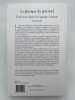
La physique du potentiel. Étude d'une lignée de Lagrange à Duhem.
Paris CNRS Paris, Éditions du CNRS, 2018. In-8 broché de 374 pages. Bon état
Toutes les expéditions sont faites en suivi au-dessus de 25 euros. Expédition quotidienne pour les envois simples, suivis, recommandés ou Colissimo.
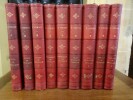
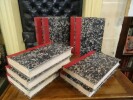
OEUVRES précédées d'une notice par M. A. De La Rive - TOME I : Notes et mémoires (Recherches sur les phénomènes d'induction, note sur les interférences de la lumière polarisée, sur l'intensité des images lumineuses formées au foyer des lentilles et des miroirs, Sur l'explication du phénomène des couronnes, Recherches sur les propriétés optiques développées par l'action du magnétisme, Constitution de la lumière non polarisée et de la lumière partiellement polarisée, Introduction aux oeuvres d'Auguste Fresnel) - TOMES II & III : Cours de physique professé à l'Ecole Polytechnique - Tome IV 1ère & 2ème parties : Conférences de physique faites à l'Ecole Normale - TOMES V & VI : Leçons d'optique physique - TOMES VII & VIII : Théorie mécanique de la chaleur --- EDITION ORIGINALE --- BEL EXEMPLAIRE --- 8 TOMES reliés en 9 volumes (COMPLETE SET)
P., Imprimerie Nationale, 1868/1872, 8 tomes reliés en 9 volumes in 8, demi-chagrin vert (reliures de l'époque), T.1 : 1 portrait, 28pp., 390pp., T.2 : (2), 2pp., 459pp., T.3 : (2), 512pp., T.4 1ère partie et deuxième partie : (2), 10pp., 1050pp., T.5 : (2), 6pp., 584pp., T.6 : (2), 648pp., T.7 : (2), 148pp., 335pp., T.8 : (2), 424pp., nombreuses figures dans le texte
---- EDITION ORIGINALE ---- BEL EXEMPLAIRE ---- "Verdet was one of the outstanding physics teachers of mi-nineteenth-century France, holding professorships at the Ecole normale supérieure, the Ecole Polytechnique and the Faculté des sciences in Paris. He introduced into the French scientific world the thermodynamics of Joule, Clausius, Helmholtz and William Thompson and conducted important experiments on the effects of a magnetic field on plane-polarized light. Verdet educated his colleagues as well as his students. French physicists of his time were ignorant of much of the research going on outside their country, so Verdet undertook to publish abstracts of the most important articles appearing in foreing journals. From 1852 to 1864 every volume of the Annales de chimie contained ten or more of this synopses... In 1864/1865 he taught the new thermodynamics and the notes from his course were compiled by two students and published as La théorie mécanique de la chaleur, a textbook which has become a classic... His early research included a series of experiments on electromagnetic induction and a theoretical treatise on the image-forming power of lenses. In his major effort Verdet investigated the phenomenon now known as the "Faraday effect"... He studied the dependence of the Faraday effect on the strength of the magnet causing the rotation, the medium in which the light is traveling, and the color of the light. he found that the magnetic power of rotation was directly proportional to the square of the wavelengh of the light and related the index of refraction of the material. In recognition of the importance of this work a measure of the power of magnetic rotation was named "Verdet's constant". His entire scientific output is collected in Oeuvres de Verdet, 8 vols (Paris 1868/1872) which includes all his scientific papers and the lecture notes from his courses".(DSB XIII pp. 614/615)**5176/L3/L7AR
Conférences de Physique faites à l'Ecole Normale. Première et Deuxième parties - 2 volumes
1872 A Paris, Librairie de G. Masson - Imprimé par autorisation de Mr Le Garde des Sceaux à l'Imprimerie Nationale - 1872 - Œuvres d'Emile Verdet publiées par les soins de ses élèves (volumes IV) - 2 volumes in-8 - Demi chagrin vert sapin à coins ( dos décoloré), 5 nerfs, titre, auteur et fleurons en doré - 1050 pages ( pagination continue sur les deux volumes ) - Figures dans le texte - Fers de l'Université de France / Collège Stanislas sur les premiers plats - Etiquette du "Prix de Lagarde " du Collège Stanislas au revers du premier plat - Tranches supérieures dorées -
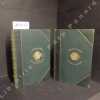
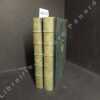
Bon état général - Reliure bien compacte - Quelques rousseurs éparses - Dos de la reliure uniformément décoloré - Coins un peu émoussés - Tranches un peu piquées -
Oeuvres, précédées d'une notice par M. A. de La Rive. Tome I: Notes et mémoires. Tome II et III: Cours de physique professé à l'école polytechnique. Tome IV 1ère et 2ème parties en 2 volumes: Conférences de physique faites à l'école normale. Tome V et VI: Leçons d'optique physique. Tome VII et VIII: Théorie mécanique de la chaleur.
Paris, Imprimerie nationale, 1872 (pour les tome I, IV et IX); Paris, Imprimerie impériale, 1868-1870 (pour le reste). 8 tomes en 9 volumes in-8, demi chagrin époque, dos lisses ornés de fleurons dorés et de filets estampés à froid, titre doré, toutes tranches jaspées. Tome I: faux-titre, titre, XXVIII, 390 pp; Tome II: faux-titre, titre, II, 459 pp; faux-titre, titre, 512 pp; Tome IV: faux-titre, titre, X, 1050 pp; Tome V, faux-titre, titre, III, 584 pp; Tome VI: faux-titre, titre, 648 pp; Tome VII: faux-titre, titre, CXLVIII, 335 pp; Tome VIII: faux-titre, titre, 424 pp. Ouvrage illustré d'un portrait de l'auteur en frontispice du tome I et de nombreuses figures in-texte. Petits morceaux d'étiquette sur les dos, coins légèrement frottés, dos assombris par endroits, tampons de la manufacture d'armes de Chatellerault sur chaque volume, intérieur frais malgré quelques rousseurs.
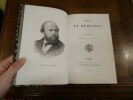
Théorie méchanique de la chaleur. Publiée par MM. Prudhon et Violle. ‘Oeuvres’, 7.
Paris, Imprimerie Impériale, (Victor Masson), 1868, gr. in-8vo, (III) à CXLVIII (two lessons, followed by Notes) + 342 p., half cloth, spine faded and with some small stains, slight rubbing. Very good copy.
First edition of this classic textbook. The work is preceded by two lessons taught by professor Verdet in 1862 at the "Société chimique" de Paris. The last part of the volume is made up of an important "Bibliographie de la théorie mécanique de la chaleur et des ses applications". By M.J. Violle. (p. 268-338). The DSB on this work by Verdet: “In 1864-1865 he taught the new thermodynamics at the Sorbonne, and the notes from this course were compiled by two students and published as «La théorie mécanique de la chaleur», a textbook which has become a classic”. DSB XIV/614-615.

(SLACES, NVVA)
Phone number : 41 (0)26 3223808
COMMENT FAIRE LES PREPARATIONS MICROSCOPIQUES
LAHURE A.. 1960. In-16. Broché. Bon état, Couv. convenable, Dos satisfaisant, Intérieur frais. 94 pages. . . . Classification Dewey : 530-Physique
DIFFUSION MICROSCOPIQUE Classification Dewey : 530-Physique
Ondes liquides de gravité
P., Gauthier-Villars, 1928, un volume in 8, broché, 58pp.
---- EDITION ORIGINALE**5179/o7ar-CAV/E2
L'équilibre thermodynamique des fluides homogènes
P., Gauthier-Villars, 1939, un volume in 8, broché, 76pp.
---- EDITION ORIGINALE**5180/o7ar-CAV.E2
L'émission photoélectrique et ses applications. Préface de A. Lallemand.
P., Dunod (Collection "Monographies Dunod" N°44), 1963, in 12 reliure pleine toile de l'éditeur, XI-155 pages.
PHOTOS sur DEMANDE. ...................... Photos sur demande ...................

Phone number : 04 77 32 63 69
[Librairie de l'Enseignement Technique, Léon Eyrolles] - VERNOT, Marcel
Reference : 48908
(1940)
Cours élémentaire de résistance des matériaux et de stabilité des constructions (Compléments)
1 vol. i-8 br., coll. Encyclopédie Industrielle et Commerciale, Librairie de l'Enseignement Technique, Léon Eyrolles éditeur, Paris, 1940, 57 pp.
Etat très satisfaisant (couv. lég. frottée, bon état par ailleurs)
LIVRE DU MAITRE (MANUSCRIT) : PARS SECONDA PHILOSOPHIAE - PHYSICA GÉNÉRALIS (COURS DE PHILOSOPHIE - SECONDE PARTIE : PHYSIQUE GÉNÉRALE) - 1749 -
petit séminaire SAINT MAURICE de VIENNE 1749 -in-4- plein velin ancien parcheminé un cours manuscrit en latin illustré et orné de calligraphies , reliure plein velin ancien parcheminé (ancien parchemin de chant grégorien avec lettrine en rouge, portée rouge et notes carrées...réutilisé) petit in quarto (binding full vellum small in-quarto) (23 x 17,6 cm), dos muet, petit éclat avec manque en haut du dos sur un centimètre carré (spine little damaged), toutes tranches lisses (all smooth edges) jaspées (all marbled edges) rouges (all red edges), EX LIBRIS MANUSCRIT à l'encre brune en latin sur la page de garde : C. M. BRÉRARD, étudiant en philosophie au petit séminaire SAINT MAURICE de VIENNE (isère), le vingtième jour de mars 1772, Livre Manuscrit à l'encre brune à la plume (d'oiseau) sur papier vergé ligné et filigrané, orné de 68 Figures dessinées de façon manuscrite in et hors-texte à l'encre brune et ou rouge + de trés nombreux fronts de chapitres, lettrines et cul-de-lampes ainsi que certains encadrements de Figures Calligraphiées à la plume (d'oiseau) (reprenant tout les thèmes : fleurs, feuilles, visage humain, pot de fleurs, oiseaux, arbres etc...), sans pagination (533 Pages), Cours de "Philosophiae pars seconda : physica generalis" donné au Petit Séminaire de VIENNE (Isère) (minori vinensi seminario) en 1772, mais le manuscrit lui-même est daté par deux fois de 1749 (une fois sur la figure page 188 et une autre fois sur la Calligraphie cul-de-lampe en bas de la page 294), ce qui attesterai qu'il s'agit bien de la date de 1749, date réelle du Manuscrit écrit par le professeur lui-même, sorte de "Livre du Maitre" (on peut remarquer en bas de la dernière page que la date de 1772 a été rajoutée sur un papier collé sur la première feuille) ,
La signification ancienne de la PHYSIQUE rassemble l'actuelle physique, la chimie et les sciences naturelles actuelles......jusqu'à cette époque la "PHYSICA" était toujours donné en latin et faisait partie du cours de Philosophie ........ Cours de Physique manuscrit complet, qui traite surtout de la mécanique: des corps, des forces et de la gravité. L'auteur anonyme présente les définitions, les lois et axiomes à ce sujet et discute les hypothèses des grands philosophes, physiciens et mathématiciens tel que Newton (page 328), Pierre Gassendi (page 3), Aristote (page 310), Archimède ( page 312), Galilée (page 315), Christiaan Huygens , Malebranche, Descartes(page 323) et Leibniz et Pierre Varignon . Le texte, rédigé dans une belle écriture et bien structuré par des chapitres et sous-titres...est superbement illustré de spendides calligraphies ..... le texte fait souvent "réference" aux dessins des planches in texte et hors-texte, Chaque planche contient un ou plusieurs dessins très fins représentant des expérimentations ou des figures géométriques et des instruments mécaniques tel que des poulies, leviers, pendules etc.), chacun numéroté ou ayant le texte en regard .............. en bon état (good condition). en bon état
LES BRICOLOUS, ILLUSIONS D'OPTIQUE
Fleurus. Non daté. In-8. Cartonnage d'éditeurs. Bon état, Couv. convenable, Dos satisfaisant, Intérieur frais. Coffret contenant un livret et des éléments à assembler.. . . . Classification Dewey : 530-Physique
36 illusions fascinantes. Classification Dewey : 530-Physique
Les rayons cathodiques. 2ème éd.
1908 P., Gauthier-Villars,SCIENTIA,1908,in-8vo,107p. cartonnage original.
dos cassé, Remise de 20% pour toutes commandes supérieures à 200 €
LES RAYONS CATHODIQUES / COLLECTION SCIENTIA 1900 - PHYSIQUE MATHEMATIQUE N°10.
NAUD C.. 1990. In-8. Cartonné. Etat d'usage, Couv. convenable, Dos abîmé, Intérieur frais. 118 + 28 pages - nombreuses figures en noir et blanc dans le texte - dos absent - page de garde et de faux-titre desolidarisées - page 27-28 en fin d'ouvrage desolidarisées.. . . . Classification Dewey : 530-Physique
Classification Dewey : 530-Physique
Leçons sur l'hydrodynamique -- EDITION ORIGINALE -- BEL EXEMPLAIRE
P., Gauthier-Villars, 1929, un volume in 8, broché, couverture imprimée, (2), 3pp., (1), 296pp.
---- EDITION ORIGINALE ---- BEL EXEMPLAIRE ---- "Mathématicien français (1879/1972), membre de l' Académie des sciences (1932), H. Villat s'est consacré à la mécanique des fluides et à l'aérodynamique et fut amené à perfectionner la théorie de la représentation conforme et à étudier les équations différentielles à coefficients doublement périodiques"**5208/M3
Leçons sur la théorie des tourbillons
Gauthier Villars. 1930. In-8. Broché. Bon état, Couv. convenable, Dos satisfaisant, Non coupé. 300 pages.. . . . Classification Dewey : 530-Physique
Etiquette sur coiffe en pied. Tampon bibliothèque.. Classification Dewey : 530-Physique
Leçons sur les fluides visqueux
Gauthier-Villars. 1943. In-8. Broché. Bon état, Couv. convenable, Dos satisfaisant, Non coupé. 540 pages.. . . . Classification Dewey : 530-Physique
Etiquette sur coiffe en pied. Tampon bibliothèque. 2 photos disponibles. Classification Dewey : 530-Physique
Les divers aspects de la théorie de la relativité
Gauthier-Villars. 1923. In-8. Broché. Etat d'usage, 1er plat abîmé, Dos abîmé, Intérieur frais. 95 pages. 1er plat désolidarisé de la coiffe.. . . . Classification Dewey : 530-Physique
Etiquette sur coiffe en pied. Tampon bibliothèque. Préface de Brillouin M. Classification Dewey : 530-Physique
Physique élémentaire et théories modernes. Première partie : Molécules et atomes. Etats d'équilibre et mouvements de la matière (mécanique, statique des fluides, chaleur, élasticité et acoustique) -- EDITION ORIGINALE
P., Gauthier-Villars, 1921, un volume in 8 relié en pleine toile bleue (reliure de l'époque), 10pp., 197pp.
---- EDITION ORIGINALE ---- .Eléments de mécanique - Equilibre des solides - La conservation de l'énergie - Equilibre et propriétés des liquides - Equilibre et propriétés des gaz - Dilatations thermiques - Elasticité et acoustique - Molécules et atomes - ETC**5210/N5DE
Traité élémentaire et pratique de la résistance des matériaux et de la stabilité des constructions civiles mis à la portée des entrepreneurs, maîtres ouvriers et commis de chantier. Avec une préface de M. Th. Ricour.
P., Dunod, 1903, in 8° relié pleine percaline verte de l'éditeur, 332 pages ; figures ; signature sur le titre.
PHOTOS SUR DEMANDE. ...................... Photos sur demande ...................
Phone number : 04 77 32 63 69
Les causeries de l'oncle Jean sur les sciences physiques et naturelles.
Paris, Hachette,1913 ; 8°,cartonnage orné d'un décor doré sur le premier plat et le dos. Tranches dorées. 300 charmantes gravures, principalement in-texte.
Très minime usure au dos, sinon excellent état. Contient : Voyage à travers le firmament, A propos d'un baromètre, Chevaux d'acier et voiture sans chevaux...entre autres.
HISTOIRE DE LA LITTÉRATURE FRANÇAISE AU DIX-HUITIEME SIECLE
Lausanne Chez les éditeurs 1883 in 8 (22x14,5) 2 volumes reliures plein chagrin noir de l'époque, dos à nerfs, tranches dorées, lettres '' E B '' dorées au centre des plats suprérieurs, IX et 404 pages, 378 pages [1], quelques rares rousseurs claires éparses. Bel exemplaire, bien relié ( Photographies sur demande / We can send pictures of this book on simple request )
Très bon Couverture rigide

