 Write to the booksellers
-
Type
Art print (2)
Book (5902)
Magazine (20)
Manuscript (1)
Old papers (1)
Photographs (3)
-
Latest
Last month (14)
Last week (14)
-
Language
English (10)
French (5914)
German (1)
Greek (1)
Italian (1)
Latin (2)
-
Century
16th (2)
17th (9)
18th (247)
19th (890)
20th (2977)
21st (134)
-
Countries
Belgium (277)
Canada (3)
Côte d'Ivoire (13)
Denmark (1368)
France (3967)
Switzerland (301)
-
Syndicate
ALAC (3)
CLAM (3)
ILAB (4142)
NVVA (139)
SLACES (139)
SLAM (2612)
SNCAO (15)
Ueber die Natur des weissen Lichtes.
Leipzig, Johann Ambrosius Barth, 1902. 8vo. In contemporary half calf with gilt lettering and red title label to spine. In ""Annalen der Physik, Vierte Volge"", Band. 7. Entire volume offered. Spine lacking the upper 1 cm of spine. Pp. 390-400. [Entire volume: VIII, 948, (1) pp. + 3 plates].
First printing of Planck's paper on the nature of white light.
Ueber die Natur des weissen Lichtes.
Leipzig, Johann Ambrosius Barth, 1902. 8vo. In later black cloth with gilt lettering to spine. In ""Annalen der Physik, Vierte Volge"", Band. 7. Library plates pasted on to front free end paper and small library stamp to title page. Pp. 390-400. [Entire volume: VIII, 948, (1) pp. + 3 plates].
First printing of Planck's paper on the nature of white light.
Ueber die Natur des weissen Lichtes.
Leipzig, Johann Ambrosius Barth, 1902. 8vo. In contemporary half calf with gilt lettering and red title label to spine. In ""Annalen der Physik, Vierte Volge"", Band. 7. Entire volume offered. Stamp to title page. Pp. 390-400. [Entire volume: VIII, 948, (1) pp. + 3 plates].
First printing of Planck's paper on the nature of white light.
Ueber die von einem elliptisch schwingenden Ion emmittirte und absorbirte Energie. (Aus dem Jubelband für H.A. Lorentz, Arch. Néerl. p. 164. 1900, mitgetheilt vom Verfasser). (+) Ueber die Verteilung der Energie zwischen Aether und Materie. (Aus dem J...
(Leipzig, Barth), 1902. No wrappers. Punched in inner margins after cords. In: ""Annalen der Physik und Chemie. Hrsg. von G. Wiedemann"", Vierte Folge, Bd. 9., No. 11. Pp. 497-728. a. (Entire issue offered). Planck's papers: pp. 619-628 a. 629-641. Clean and fine.
First appearance in ""Annalen"" to which Planck submitted them in order to reach a wider audience. Here importent contributions to the clarification of the relation between entropy and probability, revising Boltzmann's distribution law of a given amount of energy.Akademie No 54 a. 56.
Zur Theorie der Wärmestrahlung.
Leipzig, Barth, 1910. 8vo. Contemp. hcalf. Gilt spine, titlelabel with gilt lettering. Spine a bit rubbed and lower part of hinge weakening. In: ""Annalen der Physik und Chemie. Hrsg. von G. Wiedemann"", Vierte Folge, Bd. 31.. VIII,1064 pp. and 6 plates. (Entire volume offered). Planck's paper: pp. 758-768. Internally clean and fine.
First printing of an importent paper in which Planck tries to ecplains some of the difficulties with the quantum theory by pointing to the central exchange of energy between matter and radient energy and criticising Jean's theory.""Planck explained his point of view in some detail in an article which he submitted (the paper offered) in January 1910... There he reviewed the main progress in radiation theory that had taken place since 1900, and also indicated his own attitude towards it. Two extreme points of view, he said, could be assumed. The most conservative way was raken by Jans, who had derived from the equations of classical mechanics and electrodynamics the classical radiation equation. Since the equation obviously disagreed with experiments, the necessity arose to find a way of modifying the equations of dynamics so as to include the existence of the quantum of action 'h'."" (Mehra & Rechenberg Vol. I:1, pp. 123 ff.).
Über die Grundlage der Lösungstheorie.
Leipzig, Barth, 1903. No wrappers. Punched in inner margins after cords. In: ""Annalen der Physik und Chemie. Hrsg. von G. Wiedemann"", Vierte Folge, Bd. 10., No. 2. Pp. 225-456 a. 1 folded plate. (Entire issue offered). Planck's paper: pp. 436-445.
First printing. Planck answers the critique of his thermodynamical theory set forewardby Mathias Cantor.Akademie No. 57.Also with Ferdinand Braun ""Einige versuche über Magnetisierung durch schnelle Schwingungen"", pp., 326-333, an importent paper in the development of radio communication.
Über die Natur der Wärmestrahlung.
Leipzig, Barth, 1924. 8vo. In full black cloth with gilt lettering to spine. In ""Annalen der Physik"", Vol. 73, 1924. Entire volume offered. Library labels pasted on to front free end papers, small stamp to first page of contents. Otherwise fine and clean. Pp. 272-288. [Entire volume: VIII, 650 pp. + 4 plates.].
First appearance of Planck's paper on the Nature of thermal radiation.
Initiations à la physique
Flammarion, coll. « Bibliothèque de philosophie scientifique » 1941 In-12 broché 19,4 cm sur 13. 278 pages. Couverure légeremet décirée interieur frais sinon état correct d’occasion.
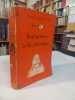
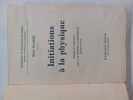
Etat correct d’occasion
LECONS DE THERMODYNAMIQUE - AVEC UNE CONFERENCE SUR LE THEOREME DE NERNST ET L'HYPOTHESE DES QUANTA.
HERMANN. 1913. In-8. Broché. Etat d'usage, Couv. défraîchie, Coiffe en pied abîmée, Quelques rousseurs. 310 pages - Mouillure sur le 1er plat.. . . . Classification Dewey : 530-Physique
Classification Dewey : 530-Physique

Die Theorie des Sättigungsgesetzes.
Leipzig, Barth, 1881. 8vo. No wrappers. In: ""Annalen der Physik und Chemie. Hrsg. von G. Wiedemann"", Neue Folge, Bd. XIII. No. 7. With titlepage to Bd. XIII. Pp. (385-) 544 a. 1 plate. (Entire issue offered). Planck's paper: pp. 535-543. Stamp to titlepage and verso of. Clean and fine.
First apperance of Planck's first scientific paper, not to mention his dissertation and his habilitationsschrift (1880).Akademie No. 3.
Verdampfen, Schmeltzen und Sublimiren.
Leipzig, Barth, 1882. 8vo. Contemp. hcalf. Raised bands gilt spine with gilt lettering. Spine a bit rubbed. In: ""Annalen der Physik und Chemie. Hrsg. von G. Wiedemann"", Neue Folge, Bd. XV. VIII,680 pp. and 8 plates. (Entire volume offered). Planck's paper: pp. 446-475. Internally clean and fine. Stamp to titlepage and verso of.
First apperance of Planck's second scientific paper, not to mention his dissertation and his habilitationsschrift (1880).Akademie No. 4.The volume contains further importent papers by E. Goldstein (4 papers on Cathode-Rays), by Ångström, Kohlrausch etc.
Ueber das thermodynamische Gleichgewicht von Gasmengen.
Leipzig, Barth, 1883. 8vo. Contemp. hcalf. Raised bands gilt spine with gilt lettering. Spine a bit rubbed. In: ""Annalen der Physik und Chemie. Hrsg. von G. Wiedemann"", Neue Folge, Bd. XIX. VIII,956 pp. and 10 plates. (Entire volume offered). Planck's paper: pp. 358-378. Internally clean and fine. Stamp to titlepage and verso of.
First apperance of Planck's third scientific paper, not to mention his dissertation and his habilitationsschrift (1880). The paper deals with thermo-dynamic equilibrium of gas-mixtures.Akademie No. 5.The volume contains further importent papers by Heinrich Hertz, W.C. Röntgen, Kohlrausch, Elster & Geitel etc.
Vorlesungen über die Theorie der Wärmestrahlung. Fünfte (5.), abermals umgearbeitete Auflage.
Leipzig, Johann Ambrosius Barth, 1923, gr. in-8°, IX + 221 S., mit 6 Abbildungen, Original-Leinenband.
Poggendorff III/1046-7 and IV/1172-3; Dictionary of Scientific Biography XI/7-17.

(SLACES, NVVA)
Phone number : 41 (0)26 3223808
Ueber irreversible Strahlungsvorgänge. (+) Nachtrag. (Beide:) (Für die Annalen bearbeitet vom Verfasser). (+) Bemerkungen zu einer Abhandlung über Thermodynamik des Hrn. K. Wesendonck.
Berlin, Johann Ambrosius Barth, 1900. Contemp. hcloth. over marbled boards, gilt title to spine. Housed in a fine black morocco slicase, gilt borders on sides, spine with raised bands and gilt lettering. In: ""Annalen der Physik"", Vierte Folge, Band 1. VIII, 792 pp. + 3 folded engraved plates.(Entire volume offered). Planck's papers: pp. 69-122" 621-624"719-737. A very fine and clean copy. With the bookplate of Andras Gedeon on inside frontcover.
First edition of these fundamental and highly influential Planck-papers in which he defines his concept of entropy and heat radiation and hereby ANTICIPATES HIS FAMOUS SEMINAL PAPER OF 1900 which redefined physics and took it to the 20th century. - The first two papers ""Ueber irreversible Strahlungsvorgänge"" were rewritten for the ""Annalen"" and was first introduced in ""Sitzungsberichte d.k. Akad. Wissensch. zu Berlin"".""By invoking the hypothesis of natural radiation Planck not only succeeded in obtaining a relation between the energy of the resonator and the intensity of radiation for a given wavelength or frequency, but also in defining the entropy of radiation by a proper expression such that the change of the total entropy was always a positive quantity"". (Mehra, Jagdish. The historical development of quantum theory, 2001, p. 36). These results found in the period 1894-00 culminated in the present paper ""Ueber irreversible Strahlungsvorgänge"" and for the first time incorporates the concept of natural radiation and made a purely electromagnetic definition of entropy and of temperature.
Ueber irreversible Strahlungsvorgänge. (+) Nachtrag. (Beide:) (Für die Annalen bearbeitet vom Verfasser). (+) Bemerkungen zu einer Abhandlung über Thermodynamik des Hrn. K. Wesendonck.
Berlin, Johann Ambrosius Barth, 1900. Later full buckram. Stamp on verso of titlepage. Narrow inner margins (binding style with cords in margin). In: ""Annalen der Physik"", Vierte Folge, Band 1. VIII, 792 pp. + 3 folded engraved plates.(Entire volume offered). Planck's papers: pp. 69-122" 621-624"719-737. Internally fine and clean.
First edition of these fundamental and highly influential Planck-papers in which he defines his concept of entropy and heat radiation and hereby ANTICIPATES HIS FAMOUS SEMINAL PAPER OF 1900 which redefined physics and took it to the 20th century. - The first two papers ""Ueber irreversible Strahlungsvorgänge"" were rewritten for the ""Annalen"" and was first introduced in ""Sitzungsberichte d.k. Akad. Wissensch. zu Berlin"".""By invoking the hypothesis of natural radiation Planck not only succeeded in obtaining a relation between the energy of the resonator and the intensity of radiation for a given wavelength or frequency, but also in defining the entropy of radiation by a proper expression such that the change of the total entropy was always a positive quantity"". (Mehra, Jagdish. The historical development of quantum theory, 2001, p. 36). These results found in the period 1894-00 culminated in the present paper ""Ueber irreversible Strahlungsvorgänge"" and for the first time incorporates the concept of natural radiation and made a purely electromagnetic definition of entropy and of temperature.
Über irreversible Strahlungsvorgänge. Erste Mittheilung. (Vorgetragen am 4 Februar: - gedruckt im Bericht vom gleichen Tage [St. VI]" - ausgegeben am 11 Februar.). [In: Mathematische und naturwissenschaftliche Mittheilungen aus den Sitzungsberichten d...
Berlin, 1897. 4to. Uncut and unopened in original printed wrappers. Fresh copy, fine and clean. Near mint. The entire ""Heft"" II: Pp. 35-81. Planck's paper pp.35-46.
Max Planck is considered to be the founder of the quantum theory and was awarded the Nobel Prize in Physics in 1918. ""Über irreversible Strahlungsvorgänge"" is a mathematical description of the electromagnetic radiation emitted from a black-body.""Über irreversible Strahlungsvorgänge was published in five parts in the period 1897-1901, the present volume being number 1.""With the Kirchhoff-Wien-Boltzmann work as a background, Max Planck began his attack on the black-body problem in 1897. He labored under the erroneous impression for some time that Wien's formula was the only one which harmonized with the second law of thermodynamics. The experiments on black-bodies due to Lummer and Pringsheim, Rubens and Kurlbaum forced him from that position."" (Planck, Max. Catalogue 258, Interlibrum Vaduz) ""I had already been struggling with the problem of the equilibrium of matter and radiation for some years without success"" I knew the problem is of fundamental significance for Physics."" The significance was unparallelled, when he in December 1900 delivered a paper entitled ""On the Theory of the Energy Distribution Law in the Normal Spectrum"" before the German Physical Society, which today is considered the birth of quantum physics. The present volume constitutes a precursor to this work. - Akademie No 33
Mesures hypsométriques dans les Alpes effectuées à l'aide du baromètre. Extrait des ‘Mémoires de la société de physique et d'histoire naturelle de Genève’, tome XV, 2ème partie.
Genève, Schuchardt, 1860, in-4to, 39 p., sans brochure.
(SLACES, NVVA)
Phone number : 41 (0)26 3223808
Mémoire sur les phénomènes qui présente une masse liquide libre et soustraite à l'action de la pesanteur. Première partie
Bruxelles, Académie royale (impr.par Hayez) 1843 34pp.+ 1 planche hors-texte (avec rousseurs), publié dans et extrait de "Nouveaux mémoires de l'Académie Royale des sciences et belles-lettres de Bruxelles" Tome XVI (16), in-4, non coupé
Mémoire sur l'irradiation
Bruxelles, 1838 112pp.+ 1 planche dépliante, (Mémoire lu à la séance du 3 nov.1838), publié dans et extrait de "Nouveaux mémoires de l'Académie Royale des sciences et belles-lettres de Bruxelles" Tome XI (11, 1838), in-4
Recherches expérimentales et théoriques sur les figures d'équilibre d'une masse liquide sans pesanteur, Septième série
Bruxelles, Académie royale (impr.par Hayez) 1867 66pp., [contient: Nouvelle étude de liquide glycérique; procédés de préparation beaucoup plus certains et plus efficaces ques les premiers. Théorie de la génération des lames liquides.], publié dans et extrait de "Mémoires couronnés et mémoires des savants étrangers publiés par l'Académie Royale des sciences, des lettres et des beaux-arts de Belgique" Tome XXXVI (36), in-4, non coupé, W57699
Recherches expérimentales et théoriques sur les figures d'équilibre d'une masse liquide sans pesanteur. Troisième série
Bruxelles, 1857 56pp., Mémoire présenté à la séance de l'Académie le 4 aout 1855, publié dans et extrait de "Mémoires de l'Académie Royale des sciences, des lettres et des beaux-arts de Belgique"" Tome XXX (30, 1857), in-4, br. muette, W60973
Recherches expérimentales et théoriques sur les figures d'équilibre d'une masse liquide sans pesanteur (deuxième série)
Bruxelles, 1849 151pp.+ 4 planches hors-text (avec 30 figures), (Mémoire présenté à la séance de l'Acaédemie le 19 mai 1847), publié dans et extrait de "Mémoires de l'Académie Royale des sciences, des lettres et des beaux-arts de Belgique"" Tome XXIII (23, 1849), in-4, W60982
Statique expérimentale et théorie des liquides soumis aux seules forces moléculaires -- EDITION ORIGINALE -- 2 VOLUMES (complete set)
Paris, Londres, Gand & Leipzig, Gauthier-Villars, Trubner, Clem, 1873, 2 volumes in 8 reliés en demi-basane rouge, dos orné de filets dorés (reliures de l'époque), (petites restaurations dans les marges de titre et de faux-titre au tome, cachets de bibliothèque partiellement grattés dans la marge supérieure des faux-titres), T.1 : (2), 450pp., T.2 : (2), 495pp., figures dans le texte
---- EDITION ORIGINALE ---- RARE ---- "Plateau was one of the best-known belgian scientists of the nineteenth century. He was a successful teacher and was also active in organizing the physics laboratory at the university... Plateau's work on molecular forces was published in a series of memoirs between 1843 and 1868 and again, with some revision, as a book in 1873. In this work he rationalized the arrangement, made corrections, and carried his historical account up to the year 1869. He has introduced new material on the superficial viscosity of liquids, and on the constitution of liquid veins, and made several smaller additions. At the end of volume 2 is a listing of articles which appeared after 1869. Plateau was concerned with the equilibrium of masses of liquid and with the properties of layers of liquids, and of columns of unstable liquids. his exhaustive analysis is illustrated with the results of experiments and with historical accounts of the development of related concepts... During his blindness, Plateau was aided in his work by his son-in-law G. Van der Mensbrugghe". (DSB & Bibliotheca Mechanica p. 256)**7077/M3
Physique
Bruxelles, Jamar 1852 326pp.illustré de figures dans le texte + quelques planches hors-texte (portraits), 18cm., reliure cart., dos en cuir vert avec titre et faux-nerfs dorés, feuilles de garde marbrées, dans la série "Encyclopédie populaire", bon état, W88005
Cinématique des milieux continus -- EDITION ORIGINALE
P., Hermann, 1936, un volume in 8, broché, 34pp.
---- EDITION ORIGINALE**4200/o7ar

