 Write to the booksellers
-
Type
Art print (2)
Book (5886)
Magazine (20)
Manuscript (1)
Old papers (1)
Photographs (3)
-
Latest
Last 3 days (11)
Last month (10)
Last week (14)
-
Language
English (10)
French (5898)
German (1)
Greek (1)
Italian (1)
Latin (2)
-
Century
16th (2)
17th (9)
18th (247)
19th (886)
20th (2964)
21st (133)
-
Countries
Belgium (266)
Canada (3)
Côte d'Ivoire (13)
Denmark (1368)
France (3962)
Switzerland (301)
-
Syndicate
ALAC (3)
CLAM (3)
ILAB (4128)
NVVA (139)
SLACES (139)
SLAM (2598)
SNCAO (15)
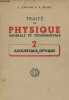
Traité de physique générale et expérimentale d'après le cours du conservatoire national des arts et métiers - Tome 2 : Acoustique - optique - 4e édition.
Eyrolles. 1946. In-8. Broché. Etat d'usage, Couv. légèrement passée, Dos satisfaisant, Intérieur acceptable. 898 pages - nombreuses figures en noir et blanc dans le texte - plats jaunis - petite déchirure en tête sur le 1er plat.. . . . Classification Dewey : 530-Physique
Classification Dewey : 530-Physique
Cours élémentaire de physique rédigé conformément au programme officiel de 1912 - Second cycle - Classe de philosophie.
Paris, Librairie classique Eugène Belin, 1929 1 volume In-8° (11 x 17,5cm) Cartonnage éditeur gris bleu. 862p., 1 feuillet; 619 vignettes en noir, 2 planches couleurs hors texte.
14è édition de ce manuel publié par Jules LEMOINE (1864-1939) et Georges VINCENT (1872-1955); 207 problèmes in fine, souvent suivis de leur solution; 619 figures in texte (graphiques, croquis et engins divers), 2 planches couleurs hors texte. Bon état (2nd plat un peu sali).
COURS ELEMENTAIRE DE PHYSIQUE, CLASSE DE 2de, PESANTEUR, EQUILIBRE DES LIQUIDES ET DES GAZ, CHALEUR
Belin. 1930. In-12. Relié. Etat d'usage, Couv. légèrement passée, Mors fendus, Intérieur acceptable. 336 pages. Illustré de nombreuses gravures en noir et blanc dans le texte. Annotation en page de garde (ex-libris). Dernière page de garde déchirée.. . . . Classification Dewey : 530-Physique
20e édition refondue. Classification Dewey : 530-Physique
COURS ELEMENTAIRE DE PHYSIQUE, OPTIQUE, ELECTRICITE, 2d CYCLE, CLASSE DE 1re
Belin. 1928. In-12. Relié. Etat d'usage, Couv. défraîchie, Dos abîmé, Quelques rousseurs. 386 pages. Illustré de nombreuses gravures en noir et blanc dans le texte. Quelques pages se détachant.. . . . Classification Dewey : 530-Physique
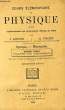
19e édition. Conforme au programme de 1925. Classification Dewey : 530-Physique
COURS ELEMENTAIRE DE PHYSIQUE, SECOND CYCLE, CLASSE DE SECONDE
Librairie Classique Eugène Belin. 1917. In-12. Relié. Bon état, Couv. légèrement passée, Dos satisfaisant, Intérieur bon état. 377 pages. Illustré de nombreuses gravures en noir et blanc dans le texte.. . . . Classification Dewey : 530-Physique
11e édition. Pesanteur. Equilibre des liquides et des gaz. Chaleur. Classification Dewey : 530-Physique
COURS ELEMENTAIRE DE PHYSIQUE - SECOND CYCLE - CLASSE DE PHILOSOPHIE / 6e EDITION.
EUGENE BELIN. 1914. In-12. Relié toilé. Etat d'usage, Couv. convenable, Dos satisfaisant, Intérieur frais. 862 pages augmentées de nombreuse figures en noir in texte et 1 planche en couleurs.. . . . Classification Dewey : 530-Physique
Classification Dewey : 530-Physique
Loix du Magnétisme, Comparées aux Observations & aux Expériences, dans les différentes parties du globe Terrestre, pour perfectionner la théorie générale de l'aimant, & indiquer par-là les Courbes magnétiques qu'on cherche à la mer, sur les Cartes réduites.
A Paris, De l'Imprimerie Royale, 1776. In-8 de XXXI-168-XXIIIpp., veau havane, dos lisse orné, pièce de titre de maroquin rouge (reliure de l'époque).
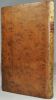
Édition originale. 2 planches dépliantes hors-texte. Pierre-Charles Lemonnier (1715-1799), confident et continuateur de Halley et de Bradley, fut l'astronome privilégié de Louis XV qui lui fournit les moyens d'avoir son observatoire. Une seconde partie fut publiée en 1778 avec le titre : Loix du magnétisme. Seconde partie, qui contient les nouvelles recherches sur la situation géographique de l'Équateur et des pôles de l'aimant, avec l'art de construire les boussoles. Bel exemplaire.
EXERCICES DE PHYSIQUE / B.G., PC. ET LICENCE / DEUXIEME EDITION.
VUIBERT. 1969. In-4. Broché. Etat d'usage, Couv. convenable, Dos satisfaisant, Intérieur frais. 279 pages illustrées de nombreuses figures dans le texte.. . . . Classification Dewey : 530-Physique
Classification Dewey : 530-Physique
EXERCICES DE PHYSIQUE / LICENCE / TOME 3 : PHYSIQUE MODERNE.
VUIBERT. 1971. In-4. Broché. Etat d'usage, Couv. convenable, Dos satisfaisant, Intérieur acceptable. 251 pages illustrées de nombreuses figures dans le texte.. . . . Classification Dewey : 530-Physique
Classification Dewey : 530-Physique
Exercices de Physique. TOME I : Mécanique et Thermodynamique.
VUIBERT. 3ème édition.. 1978. In-8. Broché. Parfait état, Couv. fraîche, Dos satisfaisant, Intérieur frais. 258 pages.. . . . Classification Dewey : 530-Physique
Avec solutions. Licence. Classification Dewey : 530-Physique
Vorbemerkung Lenards zu Soldners: Über die Ablenkung eines Lichtstrahls von seiner geradlinigen Bewegung durch die Attraktion eines Weltkörpers, an welchem er nahe vorbeigeht.
Leipzig, Ambrosius Barth, 1921. 8vo. In contemporary full cloth with gilt lettering to spine. In ""Annalen der Physik"", Vierte Folge, Band 65. Entire volume offered. Library labels pasted on the pasted down front free end paper. Stamp to title page, othrewise a fine copy. Pp. 593-604 [Entire volume: (1), 736, VII pp.].
First appearance of Lenards infamous paper in which he - on the grounds of anti-Semitism - gave priority for ""E=mc²"" to Hasenöhrl. After Einstein had published his theory in 1905 Hasenöhrl published his results on cavity radiation. The similarity between those formulas led some critics of Einstein, up until the 1930s, to claim that he plagiarized the formula from Hasenöhrl. However, Max von Laue quickly rebutted those claims by saying that the inertia of electromagnetic energy was long known before Hasenöhrl, especially by the works of Henri Poincaré (1900) and Max Abraham (1902), while Hasenöhrl only used their results for his calculation on cavity radiation. Laue continued by saying that credit for establishing the inertia of all forms of energy (the real mass-energy equivalence) goes to Einstein, who was also the first to understand the deep implications of that equivalence in relation to relativity.""Lenard’s anti-Semitism and nationalism increased. He attributed the turmoil in the newspapers about the general theory of relativity to an agreement between Einstein and the Jewish press. When the so-called Arbeitsgemeinschaft deutscher Naturforscher zur Erhaltung reiner Wissenschaft, founded by nationalistic and anti-Semitic demagogues, began a slander campaign against Einstein in Berlin in the summer of 1920, Lenard volunteered to head the movement.The growing conflict broke into the open on 9 September 1920 at the eighty-sixth conference of the Deutsche Naturforscher und Ärzte in Bad Nauheim. The debate over the general theory of relativity turned into a dramatic duel between Einstein and Lenard. As Max Born recounted it, Lenard directed ""sharp, malicious attacks against Einstein, with an unconcealed anti-Semitic bias."" Fortunately, Max Planck, who was presiding over the debate, was able to prevent an uproar."" (DSB).
Über die Absorption von Kathodenstrahlen verschiedener Geschwindigkeit. - [THE FIRST SCATTERING EXPERIMENT]
Leipzig, Ambrosius Barth, 1903. 8vo. In full black cloth with gilt lettering to spine. In ""Annalen der Physik"", Vierte Folge, Band 12. Entire volume offered. Library labels to front end papers and stamp to title page, otherwise fine and clean. Pp. 714-44. [Entire volume: VIII, 1184 pp. + 3 plates.].
First appearance of Lenard's important paper in which he for the first time documented that cathode rays can traverse atoms themselves thus creating the very first scattering experiment.""In 1903 Lenard studied in detail the absorption of cathode rays, i.e., electrons, by different materials. He found that they can traverse quite thick layers of solid matter and concluded that the cathode rays must be able to traverse the atoms themselves. He therefore assumed that the atoms are composed of 'finer constituents' which he called dynamides, ' with many free spaces between them' such that the cathode rays could pass through these free spaces. Lenard was the first to probe the structure of the atom by shooting particles at it. Such scattering experiments with atoms or its constituents as targets are done to this day."" (The Harvest of a Century).""Lenard was in fact able to infer from the absorption of the cathode rays by matter the correct conclusion that the effective center of the atom is concentrated in a tiny fraction of the atomic volume previously accepted in the kinetic theory of gases. Lenard’s ""dynamide"" was an important predecessor of the atomic model of Rutherford, who in 1910-1911, on the basis of the deflections of a particles, drew the same conclusion as Lenard had earlier from the scattering of electrons."" (DSB).
Ueber Kathodestrahlen in Gase von atmosphärischen Druck und im äussersten Vacuum. (On cathode rays in gases under atmospheric pressure and in extreme vacua).
Leipzig, Johann Ambrosius Barth, 1894. Without wrappers. In ""Annalen der Physik und Chemie. Hrsg. von G. Wiedemann."", Neue Folge Bd. 51, No. 2. (Entire issue offered). Pp. 225-416 a. 2 plates. Lenard's paper: pp. 225-267 a. 1 arge folded lithographed plate, showing the apparatus. Clean and fine.
First appearance of Lenard's importent paper on cathode rays for the work on which he was awarded the Nobel Prize in 1905.""After many experiments with aluminium foil of various thickness he was able to publish, in 1894 the paper offered), his great discovery that the plate of quartz that had, until then, been used to close the discharge tube, could be replace by a thin plate of aluminium foil just thick enough to maintain the vacuum inside the tube, but yet thin enough to allow the cathode rays to pass out. It thus became possible to study the cathode rays, and also the fluorescence they caused, outside the discharge tube and Lenard concluded from the experiments that he then did that the cathode rays were propagated through the air for distances of the order of a decimetre and that they travel in a vacuum for several metres without being weakened. Although Lenard at first followed Hertz in believing that the cathode rays were propagated in the ether, he later abandoned this view as the result of the work of Jean Perrin in 1895, Sir J.J. Thomson in 1897 and W. Wien in 1897, which proved the corpuscular nature of the cathode rays.""(Nobel Prize.org).Shiers ""Early Television"" no 239.
Ueber die lichtelektrische Wirkung.
(Berlin, J.A. Barth, 1902). No wrappers. In ""Annalen der Physik"", Vierte Folge. Band 8, No 5. Pp. 1-232 a. 1 folded plate. (Entire issue offered, No. 5). Lenard's paper: pp. 149-198. The block is punched in inner margins after cords. Punching does not affects the text. Fine and clean.
First printing of Lenard's famous paper in which he made the crucial discovery that the electron energy showed not the slightest dependence on the light intensity', a fact to be explained in 1905 by the existence of light-quanta by Einstein.""In 1902 Lenard succeeded in discovering importent properties of the photoelectric effect. He found that as the intensity of the light increases the number of electrons set free rises, but their velocity remains unaffected: the velocity depends solely on the wavelenght. The interpretation of this relationship was provided in 1905 by Albert Einstein's hypothesis of light quanta. In 1905 Lenard received the Nobel Prize in physics for his cathode ray experiments"" and in 1907 he succeede Quincke as professor and director of the physics and radiology laboratory at the University of Heidelberg...(The Laboratory was renamed the Philipp Lenard Laboratory in 1935).""(DSB VIII, p. 181). - Parkinson ""Breakthroughs"" 1902 P.
Etude sur les Combustibles en général et sur leur emploi au Chauffage par le Gaz.
Paris Lacroix 1878 Grd In-8 - 16,5x24,5cm. Reliure de l'époque en demi-basane havane, dos lisse orné de triples filets dorés, tranches mouchetées. 344pp.
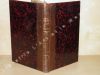
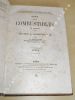
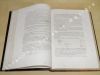
Dos très légèrement frotté, des rousseurs sans conséquence, cependant, bel exemplaire. Ouvrage orné de 55 figures. - Clients Livre Rare Book : Les frais postaux indiqués sont ceux pour la France métropolitaine et la Corse, pour les autres destinations, merci de contacter la librairie pour connaître le montant des frais d'expédition, merci de votre compréhension. Livre Rare Book Customers : The shipping fees indicated are only for France, if you want international shipping please contact us before placing your order, thank you for your understanding. - Frais de port : -Colissimo France 9,5 € -Colissimo International (Union Européenne + Suisse : 20 €) (Reste du Monde : 40 €) -Mondial Relay France 6 €


Phone number : +33 6 18 71 03 67
Introduction à la physique du laser. Traduit par F. Petit
P., Eyrolles, 1968, un volume in 8 relié en pleine toile éditeur, 358pp., figures dans le texte
---- BON EXEMPLAIRE**3257/M5DEP
INTRODUCTION A LA PHYSIQUE DU LASER .
EYROLLES. 1968. In-8. Relié. Etat d'usage, Coins frottés, Dos satisfaisant, Intérieur frais. 358 pages illustrées de quelques figures dans le texte - Jaquette légèrement frottée.. Avec Jaquette. . . Classification Dewey : 530-Physique
Classification Dewey : 530-Physique
PHYSIQUE - CHALEUR ET THERMODYNAMIQUE - ELECTRICITE - LES PHENOMENES ONDULATOIRES.
HERMANT CLAUDE. NON DATE. In-8. Broché. Bon état, Couv. convenable, Dos satisfaisant, Intérieur frais. 526 + II pages - nombreux schemas en noir et blanc dans le texte - texte dactylographié.. . . . Classification Dewey : 530-Physique
Classification Dewey : 530-Physique
Une visite chez les infiniment petits.
IMP. Léon GY - Albert LAINE. 1916. In-12. Broché. Etat d'usage, Couv. défraîchie, Dos fané, Quelques rousseurs. 102 pages. Nombreuses planches d'illustrations en noir et blanc hors-texte. Tampon de bibliothèque. Quelques pages non coupées.. . . . Classification Dewey : 530-Physique
Micrographiesde Paul Perrot. Classification Dewey : 530-Physique
LENZ, E. (HEINRICH FRIEDRICH EMIL.) - ESTABLISHING ELECTROMAGNETIC LAWS.
Reference : 47413
(1837)
On the Laws according to which the Magnet acts upon a Spiral when it is suddenly approached to or removed from it" and on the most advantageous mode of constructing Spirals for Magneto-electrical purposes.
(London, Richard and John E. Taylor, 1837) No wrappers. Extracted fron ""Scientific Memoirs, selected from The Transactions of Foreign Academies of Science and Learned Societies. Edited by Richard Taylor."", Vol. I. Pp. 608-630.
First English edition of Lenz' first importent paper on electromagnetic induction.""Lenz worked out the theoretical and practical aspects of the ballistic method of measuring electrical and magnetic quantities (1832) on the basis of his conception of the instantaneous, impactlike effect of induction current. Employing this method, he was able to make the first quantitative investigation of the induction phenomena themselves. (He established that the induced electromotive force in a coil is the sum of the electromotive force in each turn and does not depend upon the diameter of the turns, the thickness of the wire, or the metal of which it is made.) He also made a quantitative comparison of the resistivity of wire of different metals, established the laws of temperature dependence of resistivity in quadratic form for eight metals, derived the squarelaw variation of the attractive force of electromagnets with the magnetization current (under the conditions of the experiment, the magnetic field was proportional to the magnetic induction), and plotted curves showing the intensity distribution of magnetization along an iron core of a coil of finite length.""(DSB).Lenz was born on February 12, 1804 in Dorpat, and died in Rome on februray 10, 1865. He became professor of physics at the University of St. Petersburg. He investigated the conductivity of many materials for electricity and the effect of temperature on conductivity. he also studied the heat produced by the current and discovered the law which is known by the name of Joule.(Magie ""A Source Book of Physics"" pp.511-13).
Histoire physique, politique et monumentale de la ville d'Anvers
, Anvers, Poittevin de la Croix, 1847, Reliure nouvelle, toile vert, dos a 5 nerfs, titre dore en dos, frontispice : une carte depliante ( Anvers en 1572 ), 170 x 265mm., 544pp., illustrations en b/n, dont 6 depliantes.
une carte depliante ( Anvers en 1572), 11 illustrations en b/n, dont 6 depliantes. + lithograp, *Bonne condition.
HISTOIRE PHYSIQUE, POLITIQUE ET MONUMENTALE DE LA VILLE D'ANVERS,
, Anvers, Poittevin de la Croix, 1847, Relie, demi - veau, dos a 5 nerfs et a imprint dore, plattes interieures decorees, frontispice : une carte depliante ( Anvers en 1572 ), 170 x 265mm., 544pp.,11 illustrations en b/n, dont 6 depliantes +lithograph
Edition magnifique, bonne condition.
Science et bonheur des hommes
Champs / Flammarion n°11, 1977. Format poche. Un pli de coin en 4eme de couverture.Bon etat.
Rayons cosmiques. Aspect des phénomènes et méthodes expérimentales. Préface de Maurice De Broglie -- EDITION ORIGINALE
P., Hermann, 1934, un volume in 8, broché, couverture imprimée, 43pp.
---- EDITION ORIGINALE**3275/o7ar
DES ATOMES ET DES HOMMES.
FAYARD.. 1966.. In-8. Broché. Bon état, Couv. légèrement passée, Dos satisfaisant, Intérieur acceptable. 200 pages.. . . . Classification Dewey : 530-Physique
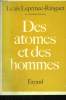
Nouvelle édition revue et complétée. Classification Dewey : 530-Physique

