 Write to the booksellers
-
Type
Art print (2)
Book (5881)
Magazine (20)
Manuscript (1)
Old papers (1)
Photographs (3)
-
Latest
Last 3 days (1)
Last month (34)
Last week (4)
-
Language
English (10)
French (5893)
German (1)
Greek (1)
Italian (1)
Latin (2)
-
Century
16th (2)
17th (9)
18th (251)
19th (892)
20th (2966)
21st (132)
-
Countries
Belgium (264)
Canada (3)
Côte d'Ivoire (13)
Denmark (1369)
France (3944)
Switzerland (315)
-
Syndicate
ALAC (3)
CLAM (3)
ILAB (4134)
NVVA (139)
SLACES (139)
SLAM (2589)
SNCAO (15)
Nouveau manuel complet de physique, ou élémens abrégés cette science, mis à la portée des gens du monde et des étudians, contenant l'exposé complet et méthodique des propriétés générales des corps solides, liquides et aériformes, ainsi que les phénomènes du son; suivi de la nouvelle théorie de la lumière dans le système des ondulations, et de celle de l'électricité et du magnétisme réunis.
Paris, Roret, 1841. In-16, demi cuir de Russie époque, dos lisse orné de fleurons et de roulettes dorés, titre doré. 411 pp. Nouvelle édition revue et augmentée, contenant 8 planches dépliantes en fin de volume. Dos insolé, épidermures et frottements au dos, manques à la coiffe supérieure, rousseurs.
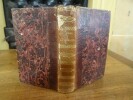


Nouveau manuel de physique ou élémens abrégés de cette science mis à la portée des gens du monde et des étudians
Librairie Encyclopédique de Roret Manuels-Roret Relié 1839 In-12° relié, demi veau, pièce de titre, filets dorés ornant le dos, 356 pp., V planches dépliantes en fin de volume ; reliure frottée, coiffe supérieure manquante, pales rousseurs sur certaines pages, par ailleurs bon état général Livraison a domicile (La Poste) ou en Mondial Relay sur simple demande.


PHYSIQUE, 2de CT
Hachette. 1975. In-8. Broché. Etat passable, Couv. légèrement passée, Dos abîmé, Quelques rousseurs. 320 pages. Illustré de nombreux schémas et photos en noir et blanc. Plats légèrement passés, et maintenus à la page de titre et à la dernière page par du scotch jauni. Quelques pages légèrement passées. Quelques annotations au crayon dans le texte.. . . . Classification Dewey : 530-Physique
Programme de juin 1966. Classification Dewey : 530-Physique
LE MICROSCOPE A LA PORTEE DE TOUT LE MONDE, OU DESCRIPTION, CALCUL & EXPLICATION DE LA NATURE, DE L’USAGE & DE LA FORCE DES MEILLEURS MICROSCOPES, AVEC LES METHODES NECESSAIRES POUR PREPARER, APPLIQUER, CONSIDERER & CONSERVER TOUTES SORTES D’OBJETS, & LES PRECAUTIONS A PRENDRE POUR LES EXAMINER AVEC SOIN. LE DETAIL DES DECOUVERTES LES PLUS SURPRENANTES, FAITES PAR LE MOYEN DU MICROSCOPE, & UN GRAND NOMBRE D’EXPERIENCES & D’OBSERVATIONS NOUVELLES SUR PLUSIEURS SUJETS INTERESSANS. TRADUIT DE L’ANGLOIS DE HENRY BAKER, DE LA SOCIETE ROYALE DE LONDRES, SUR L’EDITION DE 1743, OU L’ON A AJOUTE LA FIGURE DU MICROSCOPE SOLAIRE, & PLUSIEURS OBSERVATIONS NOUVELLES SUR LE POLYPE.
A PARIS. CHEZ CH. A. JOMBERT, IMPRIMEUR DU ROI POUR LE GENIE & L’ARTILLERIE. 1754. IN-8 (13 X 20 X 3 CENTIMETRES ENVIRON) DE XVII + (3) ET 356 PAGES, RELIURE D'EPOQUE PLEIN VEAU MARBRE, DOS A CINQ NERFS ORNE D'UN DECOR DE CAISSONS A FLEURONS DORES, TITRE DORE SUE ETIQUETTE MAROQUIN ROUGE, FILET DORE SUR COUPES, TRANCHES ROUGES. ILLUSTRE DE 15 PLANCHES REPLIEES HORS TEXTE, NUMEROTEES DE I A XIV, DONT UNE III BIS. PREMIERE ET UNIQUE EDITION FRANCAISE. LA TRADUCTION EST DUE AU PERE ESPRIT PEZENAS, JESUITE (1692-1776) QUI DIRIGEA L’OBSERVATOIRE DE MARSEILLE. QUELQUES TRACES D'USURE EXTERIEURE, DONT MORS SUPERIEUR, SINON BEL EXEMPLAIRE.
Les lois essentielles de la physique pour tous
Librio Mémo. 2013. In-8. Broché. Bon état, Couv. convenable, Dos satisfaisant, Intérieur frais. 156 pages. Quelques illustrations en noir et blanc dans le texte.. . . . Classification Dewey : 530-Physique
"Collection ""Libriomémo"" n°1065. Classification Dewey : 530-Physique"
On the Influence of the Non Linearity of the Characteristics on the Frequency of Dynatron and Triode Oscillators.
(Eindhoven), 1936. 8°. P. 649-665. Orig. wrappers. = "Laboratoria N.V. Philips' Gloeilampenfabrieken, Eindhoven (Holland)", Separaat 1121.
Published in: Physica III, number 7.
CARTILLAS CIENTIFICAS : NOCIONES DE FISICA
GARNIER HERMANOS. 1923. In-12. Cartonné. Etat d'usage, Couv. légèrement passée, Dos satisfaisant, Intérieur frais. 111 pages. Nombreuses illustrations en noir et blanc dans le texte. Texte en espagnol.. . . . Classification Dewey : 530-Physique
Classification Dewey : 530-Physique
LA POMME ET L'ATOME, DOUZE HISTOIRES DE PHYSIQUE CONTEMPORAINE
ODILE JACOB Sciences. 2005. In-8. Broché. Bon état, Couv. convenable, Dos satisfaisant, Intérieur frais. 250 pages.. . . . Classification Dewey : 530-Physique
Classification Dewey : 530-Physique
Beiträge zur Geschichte der Erkenntnis des Erdmagnetismus -- EDITION ORIGINALE -- BEL EXEMPLAIRE
Aarau, Sauerländer, 1956, un fort volume in 8 relié en pleine toile éditeur, 892pp., figures dans le texte, 3 PLANCHES
---- EDITION ORIGINALE ---- BEL EXEMPLAIRE ---- - Ex-libris Edward MAY ---- Fortlaufende darstellung - Einzelne belege - Besondere zusammenstellungen - Quellen und Hinweise - Biographisches register - Personenverzeichnis und kleines sachverzeichnis - Eigene ¥bersetzungen**6411(00)-L5DE
Notiz über die Spectrallinien des Wasserstoffs. - [THE DISCOVERY OF BALMER LINES.]
Leipzig, Johann Ambrosius Barth, 1885. 8vo. Contemporary half calf. 5 raised bands, gilt spine and gilt lettering to spine. A few scratches to spine. Small stamp on half title, title page and verso of title page. In: ""Annalen der Physik und Chemie"", Band. XXV. VIII, 680 pp. + 4 large folded plates all with a small stamp.Balmer's paper: pp. 80-87. Internally fine and clean.
First edition of Balmer's seminal paper on spectral lines of the hydrogen atom which today is known as Balmer series, the first discovery of a mathematical relationsship between the frequencies of atomic spectral lines. Balmer's discovery was the decisive factor in Bohr's famous and groundbreaking discovery and description of his model of atomic structure published in 1913. ""As soon as I saw Balmer's formula, the whole thing was immediately clear to me"" Bohr told Leon Rosenfeld in an interview. (Heilbron, Historical studies in the theory of atomic structure, p. 265).The discovery that sets of lines in the spectra of alkalis and alkaline earth are related in series was discovered by G. D. Liveing in 1879 but Balmer discovered a simple formula (presented in the present paper) how to relate the wavelength of a series of line in the visible spectrum of hydrogen. The Balmer series was far from similar to the more simple ratio proposed by George Stoney. Although Balmers fomular linked together the four then known hydrogen spectra and turned out to by applicable for the ultraviolet and infrared spectra of hydrogen a complete understandig of the relations came first with Bohr in 1913.""What Balmer did is slightly incredible. Having at his disposal four frequencies measured by Åndgtröm, he fitted them with a mathematical expression that predicts an infinity of lines - and his formula is in fact correct! Balmer's formula has stood the test of time as more hydrogen lines kept being discovered. Soon his results became widely known"" they were quoted in the 1912 edition of the Encyclopedia Britannica. For nearly thirty years no one knew, however, what the formula was trying to say - then Bohr came along."" (Pais. Niels Bohr's Times, pp. 142-3).Due to the relatively large occurrences of hydrogen in the universe the Balmer lines are useful in astronomy since the spectral classification of stars, which is primarily a determination of surface temperature, is based on the relative strength of spectral lines.(Appeared simultaneously in Verhandlungen der Naturforschenden Gesellschaft in Basel, Vol. 7, 1885, pp. 548-556, 750-752).Other papers of interest contained in the present volume:Lorenz, L. Bestimmung der electrischen Widerstände von Quecksilbersäulen in absolutem electromagnetischen Maasse. Pp. 1-31.Kirchhoff, G. Ueber einige Anwendungen der Theorie der Formänderung, welche ein Körper erfährt, wenn er magnetisch oder diëlectrisch polarisirt wird. Pp. 601-617.And many other.
Examen et réfutation des élémens de la philosophie de NEWTON de M. DE VOLTAIRE avec une dissertation sur la réflexion et la réfraction de la lumière -- EDITION ORIGINALE -- BON EXEMPLAIRE
P., Lambert & Durand, 1739, un volume in 8 relié en plein veau moucheté, dos orné de fers dorés, tranches rouges (reliure de l'époque), (petit accroc à la coiffe), (2), 98pp., 5 feuillets non chiffrés de table, 308pp., (2), 5 PLANCHES DEPLIANTES, 17 VIGNETTES en tête de chapitres par CROISAT gravées par SCOTIN
---- EDITION ORIGINALE ---- BON EXEMPLAIRE ---- BABSON N° 39 : "As an introduction, the preface comprises a dissertation on the reflection and refraction of light. BANIERES defines light, explains its properties, measures distances, and feels that NEWTON's system is a very gratuitous supposition. He shows that the seven primary colors correspond with the seven tones of music" ---- GRAY N° 44**7227/ARM1D-8777/ARB6
De la Statosphère à l'Ionosphère.
P., PUF (Collection "La Science Vivante"), 1942, in 12 broché, VIII-155 pages ; 38 figures et 8 planches hors-texte ; couvetrure défraichie, dos très abimé avec manques, le plat inférieur manque. Exemplaire de travail.
PHOTOS SUR DEMANDE. ...................... Photos sur demande ...................


Phone number : 04 77 32 63 69
Diffusion in Binary Alloys. - [FROM THE FATHER OF THE TRANSISTOR]
Lancaster, American Institute of Physics, 1949. Lex8vo. Volume 76, November 1, No. 9, 1949 of ""The Physical Review"", Second Series. In the original printed blue wrappers. Minor browning to extremities very slight wear to spine. Previous owner's stamp to front wrapper (C. Møller). A fine and clean copy. Pp. 1403-1405. [Entire issue: Pp. 1275-1422].
First publication of Bardeen's paper on diffusion in binary alloys.Bardeen is known as the inventor of the transistor, for which he, together with Shockley, was awarded the Nobel Prize in Physics in 1956. Bardeen is the only person to have been awarded the Nobel Prize in Physics twice, first in 1956 and again in 1972 for his part in the development of the theory of superconductivity (BCS-theory) and thus also became the only person, until this day, to receive the Nobel Prize more than once in the same field.
Theory of Relation between Hole Concentration and Characteristics of Germanium Point Contacts. - [FROM THE FATHER OF THE TRANSISTOR]
New York, American Telephone and Telegraph Company, 1950. 8vo. Original printed blue wrappers. In ""The Bell System Technical Journal."", Volume XXIX, October, 1950, No. 4. pp. 469-495. [Entire volume: pp. 469-675]. A bit of sunning to spine and a crease to front wrapper. Internally fine and clean.
First edition of Bardeen's paper on hole concentration and germanium point contacts. Bardeen is known as the inventor of the transistor, for which he, together with Shockley, was awarded the Nobel Prize in Physics in 1956. Bardeen is the only person to have been awrded the Nobel Prize in Physics twice, first in 1956 and again in 1972 for his part in the development of the theory of superconductivity (BCS-theory) and thus became the only person, until this day, to receive the Nobel Prize more than once in the same field. Hook & Norman: Origins of Cyberspace, No. 450 (the journal issue). Other papers contained in the volume:1. Morton, J.A." Ryder, R.M. Design Factors of the Bell Telephone Laboratories 1553 Triode. Pp. 496-530.2. Bowen, A.E. Mumford, W.W. A New Microwave Triode: Its Performance as a Modulator and as an Amplifier. Pp. 531-552.3. Hines, M.E. A Wide Range Microwave Sweeping Oscillator. Pp. 553-559.4. Van Roosbroeck, W. Theory of the Flow of Electrons and Holes in Germanium and Other Semiconductors. Pp. 560-607. 5. Pierce, J.R. Traveling-Wave Tubes (Fourth Installment). Pp. 608-671.
Theory of Relation between Hole Concentration and Characteristics of Germanium Point Contacts. - [FROM THE FATHER OF THE TRANSISTOR]
(New York), American Telephone and Telegraph Company, 1950. 8vo. Original printed blue wrappers. In ""The Bell System Technical Journal."", Volume XXIX, October, 1950, No. 4. pp. 469-495. [Entire volume: pp. 469-675]. A bit of sunning to spine and a small tear to lower part of spine. Previous owner's name to front front wrapper. Internally fine and clean.
First edition of Bardeen' paper on hole concentration and germanium point contacts. Bardeen is known as the inventor of the transistor, for which he, together with Shockley, was awarded the Nobel Prize in Physics in 1956. Bardeen is the only person to have been awrded the Nobel Prize in Physics twice, first in 1956 and again in 1972 for his part in the development of the theory of superconductivity (BCS-theory) and thus became the only person, until this day, to receive the Nobel Prize more than once in the same field. Hook & Norman: Origins of Cyberspace, No. 450 (the journal issue). Other papers contained in the volume:1. Morton, J.A." Ryder, R.M. Design Factors of the Bell Telephone Laboratories 1553 Triode. Pp. 496-530.2. Bowen, A.E. Mumford, W.W. A New Microwave Triode: Its Performance as a Modulator and as an Amplifier. Pp. 531-552.3. Hines, M.E. A Wide Range Microwave Sweeping Oscillator. Pp. 553-559.4. Van Roosbroeck, W. Theory of the Flow of Electrons and Holes in Germanium and Other Semiconductors. Pp. 560-607. 5. Pierce, J.R. Traveling-Wave Tubes (Fourth Installment). Pp. 608-671.
Electrical Properties of Pure Silicon and Silicon Alloys Containing Boron and Phosphorous.
Lancaster, American Institute of Physics, 1949. Lex8vo. Volume 75, March 1, No. 5, 1949 of ""The Physical Review"", Second Series. Entire volume offered in the original printed blue wrappers. Previous owner's stamp to front wrapper. A fine and clean copy. Pp. 865-883. [Entire issue: Pp. 705-911].
First publication of Bardeen and Pearson's research on silicon as semiconductor.
Tunnelling from a Many-Particle Point of View. - [FROM THE FATHER OF THE TRANSISTOR]
(New York), American physical Society, 1961. Lex8vo. Volume 6, No. 2, January 15, 1961 of ""Physical Review Letters"", entire volume offered. In the original printed blue wrappers. Back wrapper has some scratches and minor sunning. Otherwise a very nice and clean copy externally as well as internally. Pp. 57-9. [Entire issue: Pp. 47-84].
First printing of Bardeen's paper in which he discusses Tunneling from a many-particle point of view after Giaever (see link below), Nicol, Shapiro and Smith observed the tunneling current flowing between two metals separated by a thin oxide layer. In 1956 Bardeen and Brattain shared the Nobel Prize in Physics with William Shockley ""for their researches on semiconductors and their discovery of the transistor effect"". In 1972 Bardeen again received the Nobel Prize in Physics for his part in the development of the theory of superconductivity (BCS-theory), and thus became the only person, until this day, to receive the Nobel Prize more than once in the same field.
Theory of Superconductivity. (Contained in The Physical Review, Second Series, Volume 108, Number 5, p.1175-1204.).
Lancaster, PA, 1957. The complete issue in original blue printed wrappers. A fine copy, with no tears, stamps or fading.
First edition of this historic paper. The phenomenon of low-temperature superconductivity was discovered by the Dutch physicist Kamerling Onnes already in 1911. For nearly half a century this peculiar phenomenon remained a mystery. The B(ardeen)C(ooper)S(schrieffer)-theory was first announced in this issue of the Physical Review. The theory turned out to be very successful in explaining in considerable detail the properties of superconductors. The theory also predicted new effects and stimulated an intensive activity in theoretical and experimental research. In 1972 the authors shared the Nobel Prize in Physics ""for their jointly developed theory of superconductivity, usually called the BCS-theory"". This was Bardeen's second Nobel Prize in Physics (1956 for the co-invention of the transistor) - until today only two scientists have received the prize twice in the same field. The importance of this paper is still today of the greatest magnitude, as it has been one of the most cited articles in the last decade.
Physical Principles Involved in Transistor Action. [In: The Bell System Technical Journal, vol. 28, pp.239-277]. - [INVENTION OF THE TRANSISTOR]
New York: Bell Telephone Laboratories, 1949. 8vo. The entire April issue in original printed wrappers offered. Spine strips with some wear. Small rubberstamp on front wrapper. Otherwise fine.
First edition. The first comprehensive report to describe the transistor - one of the most important inventions of the 20th Century. The invention of the transistor was first announced in three short letters by Bardeen, Brattain, Shockley, and Pearson, in The Physical Review (Number 2 Volume 74, 1948). The following year Bardeen and Brattain published the more comprehensive report ""Physical Principles Involved in Transistor Action"" [as offered here]. This paper was simultaneously published, the same month, in The Physical Review (Number 8 volume 75). In 1956 Bardeen and Brattain shared the Nobel Prize in Physics with William Shockley ""for their researches on semiconductors and their discovery of the transistor effect"". In 1972 Bardeen again received the Nobel Prize in Physics for his part in the development of the theory of superconductivity (BCS-theory), and thus became the only person, until this day, to receive the Nobel Prize more than once in the same field. Hook & Norman: Origins of Cyberspace, No. 450.
Effects of Electrical Forming on the Rectifying Barriers of n- and p-Germanium Transistors
Lancaster, American Institute of Physics, 1950. Lex8vo. Entire volume offered in the original blue wrappers with previous owner´s stamps [C. Møller, Danish physician] to front wrapper. In ""The Physical Review"" Volume 77, February 1, No. 3, 1950. A fine and clean copy. Pp. 401-2. [Entire volume: Pp. 305-424].
First printing of Bardeen and Pfann's note on the effects of electrical forming. Bardeen recived the Nobel Prize in Physics for his work on the transistor.C. Møller was a Danish physician. He was the author of ""The Theory of Relativity"", 1952.
"BARDEEN, J. (+) W. H. BRATTAIN (+) W. SHOCKLEY (+) W. L. PEARSON (+) TOMONAGA (+) G. GAMOW (+) R. P. FEYNMAN (+) J. SCHWINGER.
Reference : 47051
(1948)
The transistor, a semi-conductor triode (+) Nature of the forward current in Germanium Point Contacts [BARDEEN, J. & BRATTAIN, W. H.] (+) Modulation of conductance of thin films of semi-conductors by surface charges [SHOCKLEY, W. & PEARSON, W. L.] (+)... - [DISCOVERY OF THE TRANSISTOR - THE SINGLE MOST IMPORTANT VOLUME OF THE PHYSICAL REVIEW]
Lancaster, PA & New York, American Physical Society, 1948. Royal8vo. Bound in contemporary black full cloth with gilt lettering to spine. In ""Nature"", Vol. 74, 1948. Spine with a bit a wear and front hinge a bit loose, otherwise a fine and clean copy.
First printing of the single most important volume of The Physical Review containing an exceptional number of important papers - amongst other the first paper to describe the transistor: One of the most important inventions of the 20th Century which awarded them the Nobel Prize in physics in 1956.,The three first titles are the short letters in Physical Review which first announced the invention of the transistor. The following year Bardeen and Brattain published the more comprehensive report ""Physical Principles Involved in Transistor Action"". This paper was simultaneously published, the same month, in The Bell System Technical Journal (Number 2 volume 28). In 1956 Bardeen and Brattain shared the Nobel Prize in Physics with William Shockley ""for their researches on semiconductors and their discovery of the transistor effect"". In 1972 Bardeen again received the Nobel Prize in Physics for his part in the development of the theory of superconductivity (BCS-theory), and thus became the only person, until this day, to receive the Nobel Prize more than once in the same field. ""The invention of the transistor would in time change the world by making possible the microchip and all the devices that followed from it, but the discovery ruined the spirit of the Bell Laboratories semiconductor group. Shockley, who had been uninvolved in the invention of the original transistor, stunned Bardeen and Brattain when he tried to patent the invention in his name, hoping to base it on his suggestion of the field-effect amplifier. Shockley's plan failed because the patent attorneys discovered that Julius E. Lilienfeld, a Polish-American inventor, had already patented the field-effect notion in 1930. Shockley further antagonized Brattain and Bardeen by preventing them from working on the consequences of their historic invention, a second transistor, known as the junction device, which could better be used commercially."" (DSB)The issue also contain two of the papers leading to Richard Feynman's 1965 Nobel Prize in Physics, (A Relativistic Cut-Off for Classical Electrodynamics & Relativistic Cut-Off for Quantum Electrodynamics) and the paper that led to Polykarp Kusch's 1955 Nobel Prize in Physics (The Magnetic Moment of the Electron)Also containing Maria Goeppert-Mayer paper that led to her 1963 Nobel Prize in Physics (On Closed Shells in Nuclei), the seminal P. A. M. Dirac paper on magnetic monopoles (A theory of Magnetic Poles) and three important papers on The Big Bang Theory by George Gamow, Ralph Alpher and George Herman (The Origin of the Elements and the Separation of Galaxies & Thermonuclear Reactions in the Expanding Universe & On the Relative Abundance of the Elements & A Neutron-Capture Theory of the Formation and Relative Abundance of the Elements).See Hook & Norman: Origins of Cyberspace, No. 450.
Fibers optics in astronomy Volume 3 Sommaire: Fiber optic properties; Multi-fiber instruments; Fibers in high precision applications...
Astronomical society of the Pacific. 1988. In-8. Relié. Bon état, Couv. convenable, Dos satisfaisant, Intérieur frais. 295 pages.. . . . Classification Dewey : 530-Physique
Etiquette sur coiffe en pied. Tampon bibliothèque. Texte écrit en anglais. Sommaire: Fiber optic properties; Multi-fiber instruments; Fibers in high precision applications... Classification Dewey : 530-Physique
Zur Theorie des Wasserstoffatoms: Bemerkungen zur gleichnamigen Arbeit von V. Fock.
Berlin, Springer, 1936. 8vo. In contemporary halv cloth with gilt lettering to spine. In ""Zeitschrift für Physik"", Bd. 99, 1936. Entire volume offered. Stamp to front free end-paper and titlepage, Extremities with soiling and some leaves with light dampstain, not affecting the Bargmann paper. Pp. 576-582.. [Entire volume: VIII, 803 pp.].
First appearance of Bargmann's paper in which he showed that the Kepler problem is mathematically equivalent to a particle moving freely on the surface of a four-dimensional (hyper-)sphere, so that the whole problem is symmetric under certain rotations of the four-dimensional space.Bargmann functioned as Albert Einstein assistant for several years.
Zur Theorie des Wasserstoffatoms: Bemerkungen zur gleichnamigen Arbeit von V. Fock.
Berlin, Springer, 1936. 8vo. In contemporary halv cloth with gilt lettering to spine. In ""Zeitschrift für Physik"", Bd. 99, 1936. Entire volume offered. Stamp to front free end-paper, otherwise fine. Pp. 576-582.. [Entire volume: VIII, 803 pp.].
First appearance of Bargmann's paper in which he showed that the Kepler problem is mathematically equivalent to a particle moving freely on the surface of a four-dimensional (hyper-)sphere, so that the whole problem is symmetric under certain rotations of the four-dimensional space.Bargmann functioned as Albert Einstein assistant for several years.

