 Write to the booksellers
-
Type
Autograph (20)
Book (18558)
Magazine (13)
Manuscript (6)
Photographs (4)
-
Latest
Last 24h (1)
Last 3 days (1)
Last month (24)
Last week (1)
-
Language
English (41)
French (18550)
German (2)
Japanese (1)
Latin (2)
Polish (1)
Portuguese (1)
Russian (1)
Spanish (1)
Swedish (1)
-
Century
16th (5)
17th (35)
18th (294)
19th (3723)
20th (11096)
21st (1435)
-
Countries
Belgium (394)
Côte d'Ivoire (19)
Denmark (1337)
France (16699)
Switzerland (152)
-
Syndicate
CLAM (8)
ILAB (16681)
NVVA (27)
SLACES (27)
SLAM (15309)
SNCAO (12)
Beweis, dass jede Menge wohlgeordnet werden kann. (Aus einem an Herrn Hilbert gerichteten Briefe). - [INTRODUCING BOTH ""THE AXIOM OF CHOICE"" AND ""THE WELL-ORDERING THEOREM""]
Leipzig, B.G. Teubner, 1904. With orig. printed wrappers (no backstrip) to 4. Heft, 59. Bd. of ""Mathematische Annalen"". The issue: pp. 449-572. Zermelo's paper: pp. 514-516.
First appearence of this fundamental paper in metamathematics and mathematical logic. By this paper Zermelo contributed decisively to the development of set-theory. Zermelo took up the problem, left over by Cantor, of what to do about the comparison of sets that are not well-ordered. ""In 1904 (the paper offered) he proved....that every set can be well-ordered. To make the proof he had to use what is now known as the axiom of choice (Zermelo's axiom), which states that given any collection of nonempty, disjoined sets, it is possible to choose one member from each set and so make up a new set. The axiom of choce, the well-ordering theorem, and the fact that any two sets may be compared as to size, are equivalent principles.""(Morris Kline). A controversy arose around ""The axiom of Choice"", from Bertrand Russell, Tarski, Frege, Hilbert, Brouwer and others, mainly, and of course importent, over how to interpret the words ""choose"" and ""exists"".
Beweis, dass jede Menge wohlgeordnet werden kann. (Aus einem an Herrn Hilbert gerichteten Briefe). - [INTRODUCING BOTH ""THE AXIOM OF CHOICE"" AND ""THE WELL-ORDERING THEOREM""]
Leipzig, B.G. Teubner, 1904. 8vo. Bound in half cloth with five raised bands and gilt lettering to spine. In ""Mathematische Annalen. Begründet 1868 durch von A. Clebsch und C. Neumann. 59. Band."" Small bar-code pasted on to top left corner of front wrapper. Two library labels pasted on to pasted down front free end-paper and a small stamp to verso of title page. Pp. 514-16.
First appearence of this fundamental paper in metamathematics and mathematical logic in which he introduced both ""The Axiom of Choice"" and ""his sensational proof of the well-ordering theorem"" (DSB). By this paper Zermelo contributed decisively to the development of set-theory. Zermelo took up the problem, left over by Cantor, of what to do about the comparison of sets that are not well-ordered. ""In 1904 (the paper offered) he proved....that every set can be well-ordered. To make the proof he had to use what is now known as the axiom of choice (Zermelo's axiom), which states that given any collection of nonempty, disjoined sets, it is possible to choose one member from each set and so make up a new set. The axiom of choce, the well-ordering theorem, and the fact that any two sets may be compared as to size, are equivalent principles.""(Morris Kline). A controversy arose around ""The axiom of Choice"", from Bertrand Russell, Tarski, Frege, Hilbert, Brouwer and others, mainly, and of course importent, over how to interpret the words ""choose"" and ""exists"".The issue also contain the following papers of interest:David Hilbert. Über das dirichletsche prinzip. Pp. 161-186.Lie, Sophus. Drei Kapitel aus dem unvollendeten zweiten Bande der Geometrie der Berührungstransformationen. Pp. 193-313.Schoenflies, A. Beitrage zur Theorie der Punktmengen II, Pp. 129-160.
Stabilité des systèmes dynamiques - Collection Etudes.
Presses Universitaires de Perpignan. 2014. In-8. Broché. Bon état, Couv. convenable, Dos satisfaisant, Intérieur frais. 289 pages - couverture contrepliée.. . . . Classification Dewey : 510-Mathématiques
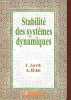
Collection Etudes. Classification Dewey : 510-Mathématiques
Forelæsninger over Mathematikens Historie. 2 Bd. (1. Oldtid og Middelalder. 2. 16de og 17de Aarhundrede).
København, 1893-1903. Indbundet i 2 ensartede samt. hldrbd. Rygge lidt falmet. (10),292VIII,612 pp. Enkelte blyantsindtregninger.
Thèses de mathématiques.
qui seront démontrées dans la salle de l'académie des arts sous les auspices de MM. les magistrats de la ville de Lille, par le Sr. Guy-Joseph Zevort, natif de Lille, élève de l'école de mathématiques, le samedi 17 octobre 1789, depuis 10 heures du matin jusqu'à douze. M. Saladin, médecin, correspondant de la Société Royale de Médecine, & professeur de la classe de mathématiques, présidera aux thèses.Lille, de l'imprimerie de MM. du magistrat, 1789. 11 pages.Broché. Cahier cousu. Mouillure sur le bas des pages. Format in-4° (25x20).

Approximation Theory and Applications
Academic Press Cartonné 1981 In-8 (15,8 x 23,4 cm), cartonné, 358 pages, texte en anglais ; dos de biais, ex-libris, par ailleurs très bon état. Livraison a domicile (La Poste) ou en Mondial Relay sur simple demande.

JE FAIS... DES MATHEMATIQUES - 2E LIVRET - 5-6 ANS - MATERNELLES CLASSES ENFANTINES - 2E LIVRET
NATHAN. 1988. In-8. Broché. Bon état, Couv. convenable, Dos satisfaisant, Intérieur frais. 47 Pages. Nombreuses illustrations en couleur et en noir et blanc dans et hors texte.. . . . Classification Dewey : 372.7-Livre scolaire : mathématiques
Illustrations de Marie-Dominique Faccon Classification Dewey : 372.7-Livre scolaire : mathématiques
Rechentafel nebst Sammlung haufig gebrauchter Zahlenwerthe
Berlin, Wilh. Ernst & Sohn 1899 xxxiv + 204pp., 25cm., editor's hardcover in grey cloth with gilt lettering, good condition, W89950
One-dimensional Stable Distributions. Translations of Mathematical Monographs, volume 65.
Providence, American Mathematical Society 1986, 235x160mm, IX - 284pages, editor's binding. Book in good condition.
Pour un paiement via PayPal, veuillez nous en faire la demande et nous vous enverrons une facture PayPal
Über biegungsinvarianten eine anwendung der Lie'schen gruppentheorie.
Berlin, Stockholm, Paris, F. & G. Beijer, 1892-93. 4to. Without wrappers as extracted from ""Acta Mathematica. Hrdg. von G. Mittag-Leffler."", Bd. 16. Including the title page. Fine and clean. (6), 64 Pp.
First printing of Zorawski's important paper which is one of the very first responses to Sophus Lie's group theory. ""One of the first mathematicians who reacted to Lie's newly introduced concept was Kasimir Zorawaski, a polish scientist who worked in Warsaw. As examples of differential invariants, Zorawski mentioned Gauss curvature, Beltrami operators, and Minding's geodesic curvature. Similar to Lie, he asked for the number of invariants of different orders. From then on, two concepts played a major role within the theory of differential calculus, initiated by Ricci, and the group concept that was introduced by Lie and improved by Zorawski."" (Earman, The Attraction of gravitation: new studies in the history of general relativity, P. 229)
Über biegungsinvarianten eine anwendung der Lie'schen gruppentheorie.
[Berlin, Stockholm, Paris, F. & G. Beijer, 1892-93.] 4to. Without wrappers as extracted from ""Acta Mathematica. Hrdg. von G. Mittag-Leffler."", Bd. 16, With half title and title page of volume 16, including the frontiespiece. Pp. 153-215.
First printing of Zorawski's important paper which is one of the very first responses to Sophus Lie's group theory. ""One of the first mathematicians who reacted to Lie's newly introduced concept was Kasimir Zorawaski, a polish scientist who worked in Warsaw. As examples of differential invariants, Zorawski mentioned Gauss curvature, Beltrami operators, and Minding's geodesic curvature. Similar to Lie, he asked for the number of invariants of different orders. From then on, two concepts played a major role within the theory of differential calculus, initiated by Ricci, and the group concept that was introduced by Lie and improved by Zorawski."" (Earman, The Attraction of gravitation: new studies in the history of general relativity, P. 229)
Exercices Numériques De Mathématiques
Paris Gauthier-Villars Et Cie 1914 Petit In-8 XV+124 pp, dos passé, frotté et partiellement débroché ; léger manque sur coiffe en queue, corps d'ouvrage fendu
Moyen Pour Le Brochage Broché à raba
LECONS D'ALGEBRE - CLASSES DE MATHEMATIQUES A ET B.
PAULIN HENRY ET CIE. NON DATE. In-12. Relié. Etat d'usage, Couv. convenable, Dos satisfaisant, Intérieur acceptable. II + 464 pages augmentés de quelque figures en noir in texte.. . . . Classification Dewey : 372.7-Livre scolaire : mathématiques
Classification Dewey : 372.7-Livre scolaire : mathématiques
LECONS DE MATHEMATIQUES GENERALES
Gauthier-Villars & Cie. 1925. In-8. Broché. Etat d'usage, Plats abîmés, Dos fané, Intérieur acceptable. 788 pages. Etiquette de code sur le dos. Tampons et annotations de bibliothèque sur le 1er plat et en page de titre. Petit manque sur le coin supérieur du 1er plat. Pages légèrement jaunies. Nombreuses pages non coupées.. . . . Classification Dewey : 510-Mathématiques
2e édition revue. Avec une Préface de P. Appell. Géométrie et géométrie analytique. Algèbre, Théorie des fonctions, dérivées et applications... Classification Dewey : 510-Mathématiques
Leçons de mathématiques générales.
Paris, Gauthier-Villars, s.d. (ca 1915). 14 x 22, 788 pp., 235 figures, reliure pleine toile, bon état.
Préface de P. Appell.
Lecons sur le Prolongement Analytique.
Paris, Gauthier-Villars, 1911. Royal8vo. Uncut in orig. printed wrappers. Backstrip a little torn at top and bottom. VI,114,(4) pp.
First edition.
Leçons sur le prolongement analytique.
Couverture souple. Broché. 117 pages. 16, 5 x 25 cm.
Livre. Editions Gauthier-Villars, 1911.
Leçons sur le prolongement analytique, professées au Collège de France.
P., Gauthier-Villars, 1911, grand in 8° broché, VI-115 pages.
Fermeture du 1er au 23 Août


Phone number : 04 77 32 63 69
Théorie de la commande.
Editions Mir Moscou. 1978. In-8. Relié. Etat d'usage, Couv. convenable, Dos satisfaisant, Intérieur frais. 468 pages - tampon et une étiquette collée sur le 1er contre plat - petite déchirures sur la jaquette.. Avec Jaquette. . . Classification Dewey : 510-Mathématiques
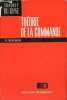
Traduit du russe par Irina Pétrova. Classification Dewey : 510-Mathématiques
MATHEMATIQUES - EN 2 VOLUMES : LIVRE + CORRIGES / DECF (EPREUVE N°5) - ENSEIGEMENT SUPERIEUR - FORMATION CONTINUE.
DUNOD. 1992. In-4. Broché. Etat d'usage, Couv. convenable, Dos satisfaisant, Intérieur frais. 408 + 137 pages.. . . . Classification Dewey : 510-Mathématiques
Classification Dewey : 510-Mathématiques
CONSTRUCTION DES MATHEMATIQUES - L'EDUCATEUR - COLLECTION DIRIGEE PAR G. MIALERET
PUF. 1966. In-8. Broché. Bon état, Tâchée, Dos frotté, Intérieur acceptable. 180 pages. Quelques illustrations en noir et blanc dans le texte.. . . . Classification Dewey : 372.7-Livre scolaire : mathématiques
Traduit de l'anglais par G. Walusinski. Préface par H. Read. Classification Dewey : 372.7-Livre scolaire : mathématiques
Les premiers pas en mathématique : Exploration de l'espace et pratique de la mesure
O.C.D.L 1966 in8. 1966. Broché.

Bon état
Novum Instrumentum Geometricum: Das ist, Kurtzer und grundtlicher Bericht alle Weite, Breite, Höhe und Tieffe, mit sonderbarem Vortheil, kunstlichen und gewiss, auch von der Arithmetic unerfahrnen abzumessen: Mit XXII. schönen, kunstreichen und verstä... - [INSTRUMENT FOR SURVEYING AND GUNNERY]
Basel, Ludwig Königs, 1607. 4to. Sewn as issued in later blank wrappers. Engraved ornamental title showing 2 geometers with instruments, on verso large engraved coat of arms (Henry Prince of Wales). (8),65,(2) pp. With 20 large engravings in the text. Printed on good paper, fine and clean.
First edition, though a Latin translation appeared at the same time. Zubler was a prolific mathematician and instrument-maker in Zürich, and in this work he describes a triangulation instrument (depicted on a full-page engraving), invented by himself, and shows its use in different situations of practical surveying and military use in artistic settings. The triangulation instrument was able to provide measures for length, width, height and angles all at once, to be read on the scales on the baseline etc. The instrument has two arms and a baseline. By fixing the angle between the baseline and the pivoted arm, setting the sliding sight on the baseline arm to the scaled length of the baseline itself, and finally, from the second station, sighting across the two arms while moving the second sliding sight into alignment with the first sight and the target, the side of the triangle on the ground will be given with the position of the second sight, adjusted to the scale. The provision of a degree scale on a semicircular plate at the pivot permits other techniques involving angle measurements or setting the arms at right angles.Cockle: 947 (Latin ed.) - Poggendorff II:1420.
Linear Algebra.
Colombus, Ohio, Charles E. Merrill Publishing Co. 1972, 230x160mm, XVI - 416pages, editor's binding. Book in very good condition.
Pour un paiement via PayPal, veuillez nous en faire la demande et nous vous enverrons une facture PayPal
Cours de cryptographie
Cassini. 2000. In-8. Broché. Bon état, Couv. convenable, Dos satisfaisant, Intérieur frais. XI + 227 pages.. . . . Classification Dewey : 510-Mathématiques
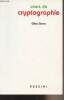
Classification Dewey : 510-Mathématiques

