 Write to the booksellers
-
Type
Autograph (20)
Book (18481)
Magazine (13)
Manuscript (6)
Photographs (4)
-
Latest
Last 24h (3)
Last month (11)
Last week (5)
-
Language
English (41)
French (18473)
German (2)
Japanese (1)
Latin (2)
Polish (1)
Portuguese (1)
Russian (1)
Spanish (1)
Swedish (1)
-
Century
16th (5)
17th (35)
18th (292)
19th (3722)
20th (11058)
21st (1400)
-
Countries
Belgium (393)
Côte d'Ivoire (19)
Denmark (1337)
France (16623)
Switzerland (152)
-
Syndicate
CLAM (8)
ILAB (16607)
NVVA (27)
SLACES (27)
SLAM (15235)
SNCAO (12)
Les probabilités associées à un système d'événements compatibles et dépendants en 2 volumes 1ère partie Evénements en nombre fini fixe 2ème partie Cas particuliers et applications Collection actualités scientifiques et industrielles N° 859 et 942
Hermann & Cie. 1940-1943. In-8. Broché. Bon état, Couv. convenable, Dos satisfaisant, Intérieur frais. 80 + 115 pages.. . . . Classification Dewey : 510-Mathématiques
Etiquette sur coiffe en pied. Tampon bibliothèque. Collection actualités scientifiques et industrielles N° 859 et 942 . Classification Dewey : 510-Mathématiques

Leçons de statistique mathématique Quatrième cahier Les ensembles statistiques renouvelés et le remplacement industriel Collection les cours de Sorbonne
Centre de documentation universitaire. non daté. In-4. Broché. Etat d'usage, Couv. défraîchie, Coiffe en pied abîmée, Intérieur frais. 168 pages.. . . . Classification Dewey : 510-Mathématiques
Collection les cours de Sorbonne. Etiquette sur coiffe en pied. Tampon bibliothèque. Classification Dewey : 510-Mathématiques
Frédéric Boure, Claudine Merdy, Christophe Plas...
Reference : RO20267824
(2019)
ISBN : 2013954719
Declic Maths - 2de - programme 2019 - special reforme lycee 2019 - specimen
HACHETTE EDUCATION. 2019. In-4. Broché. Bon état, Couv. convenable, Dos satisfaisant, Intérieur frais. 416 Pages illustrées en couleur - couverture avec rabats illustrés de mementos, photos ect. . . . Classification Dewey : 372.7-Livre scolaire : mathématiques
Frédéric Boure, Claudine Merdy, Christophe Plas, Raphaël Tosetti, Frédéric Léon, Jean-Paul Beltramone, laboudigue geoffroy Classification Dewey : 372.7-Livre scolaire : mathématiques
Frédérique Bourgeat, Véronique Carlod, Damien ...
Reference : RO20268006
(2014)
ISBN : 2091717789
Transmath 5e - edition 2014 - specimen
NATHAN. 2014. In-4. Broché. Bon état, Couv. convenable, Dos satisfaisant, Intérieur frais. 303 + IV pages illustrées en couleur - annotation en page de titre. . . . Classification Dewey : 372.7-Livre scolaire : mathématiques
Frédérique Bourgeat, Véronique Carlod, Damien Jacquemoud, Anne Keller, Monique Maze, Annie Plantiveau, Frédéric Puigredo, Franck Verdier, Joël Malaval Classification Dewey : 372.7-Livre scolaire : mathématiques
Theory of Dielectrics Dielectric Constant and Dielectric Loss. Reprint.
Oxford, Clarendon, 1986. Paperback. VI, 192 pp.
Oxford Science Publications.
Eléments d'Arithmétique. Cours Supérieur.
VITTE Emmanuel. 10ème édition. 1893. In-12. Cartonné. Etat d'usage, Couv. défraîchie, Dos fané, Intérieur frais. 448 pages. Dos toilé bleu. Charnières fendues. Tranches des plats frottées. Quelques pages volantes. Ouvrage légèrement déboité.. . . . Classification Dewey : 372.7-Livre scolaire : mathématiques
Classification Dewey : 372.7-Livre scolaire : mathématiques
Eléments d'arithmétique à l'usage des écoles primaires - cours élémentaire - 3e édition
Librairie Générale Catholique et Classique / Emmanuel Vitte. 1900. In-12. Relié. Etat d'usage, Tâchée, Dos frotté, Quelques rousseurs. 255 pages - papier jauni - petit manque sur le dos. . . . Classification Dewey : 372.7-Livre scolaire : mathématiques
Classification Dewey : 372.7-Livre scolaire : mathématiques
Calculs pour établir et vérifier : factures majorations bénéfices escomptes rabais remises feuilles de paie inventaires métrages surfaces volumes prix de revient intérêts - 5e édition
M. Krayn 1930 in4. 1930. Relié.
Bon état de conservation couverture défraîchie frottée intérieur jauni propre tampon sur la page titre
Proceedings of the Colloquium on Abelian Groups. Tihany (Hungary), September 1963.
Budapest, Akadémia Kiado, 1964. Orig. full cloth with dustjacket. 162,(1) pp.
Lobrede auf Leonhard Euler, in der Versammlung der kaiserlichen Akademie der Wissenschaften zu St. Petersburg den 23. Octob. 1783 vorgelesen.
Basel, Johann Schweighauser, 1797, in-8°, 99 S., schwach stockfleckig, teils unaufgeschnitten, Bibl.-Stempel auf dem Titel, Interims-Pappband, leicht berieben und bestossen.
Erstausgabe der Lobrede des verdienten Basler Mathematikers auf dem berühmten schweizer Mathematiker L. Euler.Nikolaus Fuss kam 1773 auf Empfehlung Daniel Bernoullis zu Leonhard Euler nach Petersburg als dessen Gehilfe und Schüler. Er war Professor der Mathematik am adeligen Landkadettenkorps und am russischen Marinekorps, Mitglied der Petersburger Akademie der Wissenschaften und nach Eulers Tode dessen Nachfolger im Sekretariat der Akademie; russ. kaiserl. Staatsrat. Der Ehe mit L. Eulers Grosstochter Albertine Euler entsprossen weitere verdiente Wissenschaftler. HBLS III/365, Nr. 1; Poggendorff I/821-823; DSB V/209-210.

(SLACES, NVVA)
Phone number : 41 (0)26 3223808
"FUSS, NICOLAUS (NIKOLAI IVANOVICH FUS). - A PRIZE WINNING MEMOIR ON COMETS.
Reference : 44926
(1785)
Recherches sur le Dérangement d'une Comète qui passe prés d'une Planete.
(Paris, Moutard, 1785). 4to. Extracted from ""Mémoires fe Mathematique et de Physique, Présentés à l'Academie des Sciences par divers Savans"", Tome X. Pp. 1-64 (having its own titlepage). 1 folded engraved plate. Wide-margined, clean and fine.
First printing of the prize winning memoir on the perturbations of a comet.""Fuss was an honorary member of the Berlin, Swedish, and Danish academies. In 1778 the Paris Academy of Sciences awarded him a prize for his astronomical paper ""Recherche sur le dérangement d’une cométe qui passe prés d’une planète"" ....Fuss was born into a Swiss family of modest means. His mathematical abilities, which manifested themselves quite early, attracted the attention of a number of prominent scholars, including Daniel Bernoulli, who in 1772 recommended him to Euler, then living in Russia, as a secretary. Fuss arrived in St. Petersburg at the age of seventeen and spent the rest of his life in Russia.""(DSB).
Mathématiques financières, tome 1.
Delagrave.. 1957. In-8. Cartonnage d'éditeurs. Bon état, Couv. convenable, Dos satisfaisant, Intérieur frais. 227 pages. . . . Classification Dewey : 372.7-Livre scolaire : mathématiques
Classification Dewey : 372.7-Livre scolaire : mathématiques
Mathématiques financières. tomes 1 et 2.
Couverture souple. 2 volumes brochés. 230 + 250 pages. Annotations sur plusieurs pages. Couvertures légèrement défraîchies. Papier bruni.
Livre. Editions Delagrave, 1950.
MATHEMATIQUES FINANCIERE. TOME 1
"DELAGRAVE. 1949. In-8. Broché. Etat d'usage, Tâchée, Dos abîmé, Intérieur acceptable. 227 pages. Nombreux tableaux et schémas en noir et blanc dans le texte. Quelques écritures au stylo en marge de quelques pages. Un tampon ""hommage de l'éditeur"" sur la page de titre. Une déchirure sur le 1er plat.. . . . Classification Dewey : 510-Mathématiques"
Classification Dewey : 510-Mathématiques
MATHEMATIQUES FINANCIRES
DELAGRAVE. 1953. In-12. Broché. Etat passable, Plats abîmés, Dos abîmé, Papier jauni. 230 pages. Les deux plats et le dos sont manquants. Première page de garde un peu déchirée.. . . . Classification Dewey : 372.7-Livre scolaire : mathématiques
Tome 1. Classification Dewey : 372.7-Livre scolaire : mathématiques
MATHEMATIQUES FINANCIERES - TOME 2 + TABLES FINANCIERES A USAGE SCOLAIRE
DELAGRAVE. 1953. In-8. Broché. Etat du neuf, Couv. défraîchie, Dos abîmé, Intérieur acceptable. 247 et 24 pages. Couverture illustrée en couleur.. . . . Classification Dewey : 372.7-Livre scolaire : mathématiques
Classification Dewey : 372.7-Livre scolaire : mathématiques
Arithmétique commerciale et algèbre financière.
Delagrave.. 1926. In-12. Cartonnage d'éditeurs. Bon état, Couv. convenable, Dos satisfaisant, Intérieur frais. 400 pages.. . . . Classification Dewey : 372.7-Livre scolaire : mathématiques
Bibliothèque des écoles pratiques de commerce et d'industrie. 8è édition, revue et corrigée. Classification Dewey : 372.7-Livre scolaire : mathématiques
Eléments d'arithmétique de géométrie et d'algèbre - 6e édition revue.
Hachette et cie. 1903. In-12. Cartonné. Etat d'usage, Tâchée, Dos satisfaisant, Papier jauni. 574 pages - papier jauni - quelques figures en noir et blanc dans le texte.. . . . Classification Dewey : 372.7-Livre scolaire : mathématiques
Classification Dewey : 372.7-Livre scolaire : mathématiques
"Les mathématiques - ""Les encyclopédies du savoir moderne"""
Retz-CEPL. 1975. In-8. Relié. Etat d'usage, Couv. convenable, Dos satisfaisant, Intérieur acceptable. 544 pages - nombreux schémas en noir et blanc dans le texte. Jaquette convenable. Pages indexées.. Avec Jaquette. . . Classification Dewey : 510-Mathématiques
Classification Dewey : 510-Mathématiques
Solutions raisonnées des problèmes énoncés dans le cours et dans le traité élémentaire de géométrie
Librairie Classique de F.-E. André-Guedon in8. Sans date. Relié.
charnières fragilisées détendues présence de rousseurs
Félix Hément (1827-1891), licencié en mathématiques, inspecteur général de l'instruction publique, vulgarisateur scientifique.
Reference : 010049
Lettre autographe signée à Arthur Mangin
Félix Hément (1827-1891), licencié en mathématiques, inspecteur général de l'instruction publique, vulgarisateur scientifique. L.A.S., sd, 1p in-8. A Arthur Mangin. Il déplore ne pas avoir vu une ligne sur ses conférences dans La Patrie. « J'espérais que M. Delamarre se souviendrait que j'avais fait chez lui une conférence dont il a été satisfait ». Peu commun. [301]
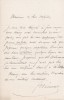
Félix Hément (1827-1891), licencié en mathématiques, inspecteur général de l'instruction publique, vulgarisateur scientifique.
Reference : 010050
Lettre autographe signée à Arthur Mangin
Félix Hément (1827-1891), licencié en mathématiques, inspecteur général de l'instruction publique, vulgarisateur scientifique. L.A.S., 6 novembre 1864, 1p in-4. A Arthur Mangin. Il lui propose un échange de service : quelques livres dans La Patrie sur les Conférences du quai Malaquais contre les services d'Hément dans un des journaux dont il s'occupe pour des publications de Mangin. La page est à entête de 4 journaux. Peu commun. [301]
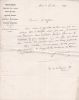
Dans le jardin de Monsieur Fève - Collection L'enfant mathématicien.
Albert Blanchard. 1962. In-8. Broché. Bon état, Couv. convenable, Dos satisfaisant, Papier jauni. 62 pages agrafées, rodhoïde conservé, nombreuses illustrations en noir et blanc dans le texte.. . . . Classification Dewey : 372.7-Livre scolaire : mathématiques
Collection L'enfant mathématicien. Classification Dewey : 372.7-Livre scolaire : mathématiques
Diagrammes n°118: Mathématique moderne.
du CAP. 1966. In-8. Broché. Etat d'usage, Coins frottés, Coiffe en pied abîmée, Papier jauni. 95 pages, nombreuses figures dans le texte, une illustration en noir et blanc en frontispice - annotation à l'encre sur le 1er plat.. . . . Classification Dewey : 510-Mathématiques
Classification Dewey : 510-Mathématiques
Géométrie - Classes de 4e et 3e - Cours de mathématiques pour l'enseignement des premier et second degrés.
Dunod. 1964. In-8. Broché. Etat d'usage, Coins frottés, Coiffe en pied abîmée, Papier jauni. 150 pages, nombreuses figures en noir et blanc et en couleur dans le texte - sur un exemplaire: petite déchirure en tête des deux dernières pages ne génant pas la lecture.. . . . Classification Dewey : 372.7-Livre scolaire : mathématiques
Classification Dewey : 372.7-Livre scolaire : mathématiques

