 Write to the booksellers
-
Type
Autograph (20)
Book (18911)
Magazine (13)
Manuscript (6)
Photographs (4)
-
Latest
Last 24h (1)
Last month (33)
Last week (2)
-
Language
English (41)
French (18903)
German (2)
Japanese (1)
Latin (2)
Polish (1)
Portuguese (1)
Russian (1)
Spanish (1)
Swedish (1)
-
Century
16th (5)
17th (35)
18th (293)
19th (3728)
20th (11415)
21st (1467)
-
Countries
Belgium (395)
Côte d'Ivoire (19)
Denmark (1337)
France (17051)
Switzerland (152)
-
Syndicate
CLAM (8)
ILAB (16681)
NVVA (27)
SLACES (27)
SLAM (15309)
SNCAO (12)
Der Raum. Ein Beitrag zur Wissenschaftslehre. - [SPACE - CARNAP'S FIRST PUBLICATION]
Berlin, Reuther & Reichard, 1922. 8vo. Uncut in the original grey printed wrappers w. very neat professional repairs to inner hinges and to capitals. Printing on spine nearly fully intact. A very faint waterstaining to upper corner throughout, otherwise a very good, nice and clean copy of a publication, which in itself is quite fragile. 87 pp.
First edition of Carnap's first publication, his doctoral dissertation. Printed in Kant-Studien, Ergänzungshefte, Nr. 56. Issued by H. Vaihinger, M. Frischeisen-Kähler and A Liebert. Rudolf Carnap (born 1891 in Ronsdorf, Germany, died 1970 in Santa Monica, California) was an immensely influential analytic philosopher, who has contributed decisively to the fields of logic, epistemology, semantics, philosophy of science, and philosophy of language. He was one of the leading figures of the Vienna Circle, and a prominent logical positivist. He studied philosophy, physics and mathematics at the universities of Berlin and Freiburg, and worked at the universities of Jena, Vienna and Prague until 1935, when he, due to the war, emigrated to the U.S., where he became an American citizen in 1941. In America he became professor of the University of Chicago. In Jena he was appointed Professor of Mathematics, though his main interest at that time was in physics. By 1913 he planned to write his dissertation on thermionic emission, but this was interrupted by World War I, where he served at the front until 1917. Afterwards he studied the theory of relativity under Einstein in Berlin, and he developed the theory for a new dissertation, namely on an axiomatic system for the physical theory of space and time. He thus ended up writing the important dissertation under the direction of Bouch on the theory of space (Raum) from a philosophical point of view. The dissertation was submitted in 1921, and, due to the clear influence from Kantian philosophy, it was published the following year in this supplement to the ""Kant-Studien"". After the publication of his first work, Carnap's involvement with the Vienna Circle began to develop. He met Reichenbach in 1923 and was introduced to Moritz Schlick in Vienna, where he then moved to become assistant professor at the university. He soon became one of the leading members of the Vienna Circle, and in 1929 he, Neurath, and Hahn wrote the manifest of the Circle.As the title indicates, ""Der Raum"" deals with the philosophy of space. Partly influenced by Husserl, under whom he studied at Freiburg, Carnap poses the question whether our knowledge of space is analytic, synthetic a priori or empirical. His answer is that it depends on what is meant by ""space"", and thus differentiates between three kinds of theories of space: Formal (which is analytic [a priori]), intuitive (which is synthetic a priori), and physical (which is empirical [or synthetic aposteriori]). He compares this division of space with that of geometry into: projective, metric and topological. This, of course, anticipates much of his later philosophy, and some of his theories developed in this paper became the official position of logical empiricism on the philosophy of space. In this work he also develops a formal system for space-time topology, which became quite influential.

Der Raum. Ein Beitrag zur Wissenschaftslehre. - [SPACE - CARNAP'S FIRST PUBLICATION]
Berlin, Reuther & Reichard, 1922. 8vo. Original grey printed wrappers w. very minor loss to capitals. Printing on spine nearly fully intact. Internally near mint. A very good, nice and clean copy of a publication, which in itself is quite fragile. 87 pp.
First edition of Carnap's first publication, his doctoral dissertation. Printed in Kant-Studien, Ergänzungshefte, Nr. 56. Issued by H. Vaihinger, M. Frischeisen-Kähler and A Liebert. Rudolf Carnap (born 1891 in Ronsdorf, Germany, died 1970 in Santa Monica, California) was an immensely influential analytic philosopher, who has contributed decisively to the fields of logic, epistemology, semantics, philosophy of science, and philosophy of language. He was one of the leading figures of the Vienna Circle, and a prominent logical positivist. He studied philosophy, physics and mathematics at the universities of Berlin and Freiburg, and worked at the universities of Jena, Vienna and Prague until 1935, when he, due to the war, emigrated to the U.S., where he became an American citizen in 1941. In America he became professor of the University of Chicago. In Jena he was appointed Professor of Mathematics, though his main interest at that time was in physics. By 1913 he planned to write his dissertation on thermionic emission, but this was interrupted by World War I, where he served at the front until 1917. Afterwards he studied the theory of relativity under Einstein in Berlin, and he developed the theory for a new dissertation, namely on an axiomatic system for the physical theory of space and time. He thus ended up writing the important dissertation under the direction of Bouch on the theory of space (Raum) from a philosophical point of view. The dissertation was submitted in 1921, and, due to the clear influence from Kantian philosophy, it was published the following year in this supplement to the ""Kant-Studien"". After the publication of his first work, Carnap's involvement with the Vienna Circle began to develop. He met Reichenbach in 1923 and was introduced to Moritz Schlick in Vienna, where he then moved to become assistant professor at the university. He soon became one of the leading members of the Vienna Circle, and in 1929 he, Neurath, and Hahn wrote the manifest of the Circle.As the title indicates, ""Der Raum"" deals with the philosophy of space. Partly influenced by Husserl, under whom he studied at Freiburg, Carnap poses the question weather our knowledge of space is analytic, synthetic a priori or empirical. His answer is that it depends on what is meant by ""space"", and thus differentiates between three kinds of theories of space: Formal (which is analytic [a priori]), intuitive (which is synthetic a priori), and physical (which is empirical [or synthetic aposteriori]). He compares this division of space with that of geometry into: projective, metric and topological. This, of course, anticipates much of his later philosophy, and some of his theories developed in this paper became the official position of logical empiricism on the philosophy of space. In this work he also develops a formal system for space-time topology, which became quite influential.
Einführung in die symbolische Logik mit besonderer Berücksichtigung ihrer Anwendungen. Zweite neubearbeitete und erweiterte Auflage. Mit 5 Textabbildungen. - [MAX BLACK'S COPY]
Wien, Springer=Verlag, 1954. 8vo. Orig. grey cloth w. blue lettering, capitals a bit bumped" orig. white and black dust-jacket w. some soiling, and a bit of loss to upper capital. X, 209, (1), (2, -advertisements) pp.
Second issue of Carnap's important Introduction to Symbolic Logic with Applications, which constitutes a highly important introduction to this foundational science of the 20th century, Max Black's copy with his signature to front free end-paper.""Die symbolische Logik ist eine Grundlagenswissenschaft ersten Ranges geworden, deren Bedeutung heute vor allem in angelsächsischen Ländern eingeschätzt wird. Nach den Worten des Verfassers, der, aus dem ""Wiener Kreis"" kommend, selbst massgeblich an der Gestaltung dieser Wissenschaft mitgewirkt hat, ist die Symbolik eine unter genauen Regeln stehende Sprach, durch deren Verwendung die Formen des eigenen Denkens verschärft werden können..."" (Front flap).The British-American Max Black (1909-1988) was one of the leading analytic philosophers of the first half of the 20th century. He has contributed with important works within the fields of philosophy of language, mathematics and science as well as studies on and translations of Frege. He studied mathematics at Queens' College, Cambridge, where he met Russell, Wittgenstein, G. E. Moore, and Ramsey and developed a profound interest in the philosophy of mathematics.Rudolf Carnap (born 1891 in Ronsdorf, Germany, died 1970 in Santa Monica, California) was an immensely influential analytic philosopher, who has contributed decisively to the fields of logic, epistemology, semantics, philosophy of science, and philosophy of language. He was one of the leading figures of the Vienna Circle, and a prominent logical positivist. He studied philosophy, physics and mathematics at the universities of Berlin and Freiburg, and worked at the universities of Jena, Vienna and Prague until 1935, when he, due to the war, emigrated to the U.S., where he became an American citizen in 1941. In America he became professor of the University of Chicago. In Jena he was appointed Professor of Mathematics, though his main interest at that time was in physics.After the publication of his first work, Carnap's involvement with the Vienna Circle began to develop. He met Reichenbach in 1923 and was introduced to Moritz Schlick in Vienna, where he then moved to become assistant professor at the university. He soon became one of the leading members of the Vienna Circle, and in 1929 he, Neurath, and Hahn wrote the manifest of the Circle.This copy of Carnap's important introduction to this field so important for the analytic philosophers, unites two of the giants of the period. In his autobiography, Carnap writes ""I also had interesting discussions with some of the younger philosophers, among them Alfred Ayer, who had been in Vienna for some time when I was already in Prague, R.B. Braithwaite, and Max Black"" they were interested in recent ideas of the Vienna Circle, such as physicalism and logical syntax."" (In Schilpp, ""The Philosophy of Rudolf Carnap"", 1963, p.34).
Foundations of Logic and Mathematics.
(Chicago, 1965). 8vo. Orig. yellow wrappers. A bit of soiling. IV, 71 pp.
11. impression of this important work in the development of mathematical logic. Originanlly published in 1939. From the International Encycloppedia of Unified Science.
Foundations of Logic and Mathematics.
Chicago, The University of Chicago Press, (1939). 8vo. In the original blue printed wrappers. A very nice and clean copy - near mint. VIII, 71 pp.
First printing of Carnap's seminal publication of his semantical period. Here Carnap presents a clear and detailed account of the application of logic and mathematics in empirical science and the central importance of the analytic/synthetic distinction herein.Carnap thought that the logic of science could be fruitfully applied to the problems of quantum theory as well. In particular, the final sections of Foundations of Logic and Mathematics (1939, 24, 25) suggest that the vexed question of the ""interpretation"" of the wave-function can be resolved by appreciating that theories of modern mathematical physics operate with ""abstract"" terms which are implicitly defined, in the manner of Hilbert, in an axiomatic system (and thus require no ""intuitive"" or ""visualizable"" meaning) but which still relate to empirical phenomena (experimental measurements) indirectly. (Cambridge Companion to Carnap).These thoughts anticipate Carnap's later conception of the ""partial interpretation"" of theoretical terms.Rudolf Carnap (born 1891 in Ronsdorf, Germany, died 1970 in Santa Monica, California) was an immensely influential analytic philosopher, who has contributed decisively to the fields of logic, epistemology, semantics, philosophy of science, and philosophy of language. He was one of the leading figures of the Vienna Circle, and a prominent logical positivist. He studied philosophy, physics and mathematics at the universities of Berlin and Freiburg, and worked at the universities of Jena, Vienna and Prague until 1935, when he, due to the war, emigrated to the U.S., where he became an American citizen in 1941. In America he became professor of the University of Chicago.
Foundations of Logic and Mathematics.
Chicago, The University of Chicago Press, (1953). 8vo. In the original blue printed wrappers. Light miscolouring and wear to extremities. Paper label pasted on to verso of back wrapper. Otherwise a fine and clean copy. VIII, 71 pp.
Seventh impression of Carnap's seminal publication of his semantical period. Here Carnap presents a clear and detailed account of the application of logic and mathematics in empirical science and the central importance of the analytic/synthetic distinction herein.Carnap thought that the logic of science could be fruitfully applied to the problems of quantum theory as well. In particular, the final sections of Foundations of Logic and Mathematics (1939, 24, 25) suggest that the vexed question of the ""interpretation"" of the wave-function can be resolved by appreciating that theories of modern mathematical physics operate with ""abstract"" terms which are implicitly defined, in the manner of Hilbert, in an axiomatic system (and thus require no ""intuitive"" or ""visualizable"" meaning) but which still relate to empirical phenomena (experimental measurements) indirectly. (Cambridge Companion to Carnap).These thoughts anticipate Carnap's later conception of the ""partial interpretation"" of theoretical terms.Rudolf Carnap (born 1891 in Ronsdorf, Germany, died 1970 in Santa Monica, California) was an immensely influential analytic philosopher, who has contributed decisively to the fields of logic, epistemology, semantics, philosophy of science, and philosophy of language. He was one of the leading figures of the Vienna Circle, and a prominent logical positivist. He studied philosophy, physics and mathematics at the universities of Berlin and Freiburg, and worked at the universities of Jena, Vienna and Prague until 1935, when he, due to the war, emigrated to the U.S., where he became an American citizen in 1941. In America he became professor of the University of Chicago.
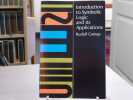
Introduction to Symbolic Logic and Its Applications.
Dover Publications, Incorporated New-York S.D. In-8 ( 205 X 135 mm ) de 241 pages, broché sous couverture imprimée. Très bel exemplaire.
Meaning and Necessity. A Study in Semantics and Modal Logic. - [THE DEFINITIONS OF L-TRUE AND L-FALSE]
Chicago, (1947). 8vo. Orig. green full cloth w. gilt lettering to spine. Minor bumping to extremities, otherwise a very nice, clean and fresh copy. VIII, 210 pp.
The not common first edition of Carnap's important main work on semantics, in which he, as the first logician ever, uses semantics to explain modalities. This led to a interest in the structure of scientific theories, and his main concerns here were to describe the distinction between analytic and synthetic statements and to suitably formulate the verifiability principle" -he thus wishes to find a criterion of significance that can be applied to scientific language.It is in his ""Meaning and Necessity"" that Carnap first defines the notions of L-true and L-false (Chapter II). A statement is said to be L-true if its truth depends on semantic rules, and L-false if its negation is L-true. Any statement that is either L-true or L-false is L-determined"" analytic statements are L-determined, while synthetic statements are not L-determined. As opposed to the definitions he gives in his ""The Logical Syntax of Language"", these definitions now apply to semantic in stead of syntactic concepts. It is also in this work that he gives his interesting explanation of his ""belief-sentences""Rudolf Carnap (born 1891 in Ronsdorf, Germany, died 1970 in Santa Monica, California) was an immensely influential analytic philosopher, who has contributed decisively to the fields of logic, epistemology, semantics, philosophy of science, and philosophy of language. He was one of the leading figures of the Vienna Circle, and a prominent logical positivist. He studied philosophy, physics and mathematics at the universities of Berlin and Freiburg, and worked at the universities of Jena, Vienna and Prague until 1935, when he, due to the war, emigrated to the U.S., where he became an American citizen in 1941. In America he became professor of the University of Chicago. In Jena he was appointed Professor of Mathematics, though his main interest at that time was in physics. By 1913 he planned to write his dissertation on thermionic emission, but this was interrupted by World War I, where he served at the front until 1917. Afterwards he studied the theory of relativity under Einstein in Berlin, and he developed the theory for a new dissertation, namely on an axiomatic system for the physical theory of space and time. He thus ended up writing the important dissertation under the direction of Bouch on the theory of space (Raum) from a philosophical point of view. After the publication of his first work, Carnap's involvement with the Vienna Circle began to develop. He met Reichenbach in 1923 and was introduced to Moritz Schlick in Vienna, where he then moved to become assistant professor at the university. He soon became one of the leading members of the Vienna Circle, and in 1929 he, Neurath, and Hahn wrote the manifest of the Circle.According to Hintikka, Carnap came extremely close to possible-worlds semantics in his ""Meaning and Necessity"", but did not succeed, because he was not able to go beyond classical model theory (see ""Carnap's heritage in logical semantics"" in ""Rudolf Carnap, Logical Empiricist"").
Meaning and Necessity. A Study in Semantics and Modal Logic. - [THE DEFINITIONS OF L-TRUE AND L-FALSE]
Chicago, (1947). 8vo. Orig. green full cloth w. gilt lettering to spine, minor bumping to extremities, with the scarce original green dust-jacket, not price-clipped. D-j. w. several tears to extremities, some resulting in loss, the worst being to top of spine (ab. 2x1 cm) and top of back (ab. 1,5 1 cm.). Old owner's name erased from bottom of title-page, one page with underlinings. Otherwise a very nice and clean copy. VIII, 210 pp.
The not common first edition, with the scarce dust-jacket, of Carnap's important main work on semantics, in which he, as the first logician ever, uses semantics to explain modalities. This led to an interest in the structure of scientific theories, and his main concerns here were to describe the distinction between analytic and synthetic statements and to suitably formulate the verifiability principle" -he thus wishes to find a criterion of significance that can be applied to scientific language.It is in his ""Meaning and Necessity"" that Carnap first defines the notions of L-true and L-false (Chapter II). A statement is said to be L-true if its truth depends on semantic rules, and L-false if its negation is L-true. Any statement that is either L-true or L-false is L-determined"" analytic statements are L-determined, while synthetic statements are not L-determined. As opposed to the definitions he gives in his ""The Logical Syntax of Language"", these definitions now apply to semantic instead of syntactic concepts. It is also in this work that he gives his interesting explanation of his ""belief-sentences""Rudolf Carnap (born 1891 in Ronsdorf, Germany, died 1970 in Santa Monica, California) was an immensely influential analytic philosopher, who has contributed decisively to the fields of logic, epistemology, semantics, philosophy of science, and philosophy of language. He was one of the leading figures of the Vienna Circle, and a prominent logical positivist. He studied philosophy, physics and mathematics at the universities of Berlin and Freiburg, and worked at the universities of Jena, Vienna and Prague until 1935, when he, due to the war, emigrated to the U.S., where he became an American citizen in 1941. In America he became professor of the University of Chicago. In Jena he was appointed Professor of Mathematics, though his main interest at that time was in physics. By 1913 he planned to write his dissertation on thermionic emission, but this was interrupted by World War I, where he served at the front until 1917. Afterwards he studied the theory of relativity under Einstein in Berlin, and he developed the theory for a new dissertation, namely on an axiomatic system for the physical theory of space and time. He thus ended up writing the important dissertation under the direction of Bouch on the theory of space (Raum) from a philosophical point of view. After the publication of his first work, Carnap's involvement with the Vienna Circle began to develop. He met Reichenbach in 1923 and was introduced to Moritz Schlick in Vienna, where he then moved to become assistant professor at the university. He soon became one of the leading members of the Vienna Circle, and in 1929 he, Neurath, and Hahn wrote the manifest of the Circle.According to Hintikka, Carnap came extremely close to possible-worlds semantics in his ""Meaning and Necessity"", but did not succeed, because he was not able to go beyond classical model theory (see ""Carnap's heritage in logical semantics"" in ""Rudolf Carnap, Logical Empiricist"").
CARNEC / HAYE / DE NARP / RANDE / SEROUX / SERRA
Reference : R320015250
(1989)
ISBN : 2040182578
"MATHEMATIQUES - TERMINALE D / COLLECTIN ""FRACTALE""."
BORDAS. 1989. In-4. Broché. Etat d'usage, Couv. convenable, Dos satisfaisant, Intérieur acceptable. 415 pages illustrées de nombreuses figures - Couverture illustrée en couleurs.. . . . Classification Dewey : 372.7-Livre scolaire : mathématiques
Classification Dewey : 372.7-Livre scolaire : mathématiques

"MATHEMATIQUES : TERMINALE D - COLLECTION ""FRACTALE""."
BORDAS. 1989. In-8. Broché. Etat d'usage, Coins frottés, Dos frotté, Mouillures. 415 pages. Une annotation sur la page de titre. Trace de mouillures sans réelle conséquence sur la lecture.. . . . Classification Dewey : 372.7-Livre scolaire : mathématiques
Classification Dewey : 372.7-Livre scolaire : mathématiques
MATHS ENSEIGNEMENT DE SPECIALITE - TERMINALE S
ELLIPSES. 2003. In-8. Broché. Bon état, Couv. convenable, Dos satisfaisant, Intérieur frais. 156 pages.. . . . Classification Dewey : 372.7-Livre scolaire : mathématiques
collection controle continu dirigée par Pascal Clavier. Classification Dewey : 372.7-Livre scolaire : mathématiques
"MATHS - ENSEIGNEMENT DE SPECIALITE / TERMINALE S / RESUMES DE COURS - EXERCICES ET CONTROLES CORRIGES / COLLECTION ""CONTROLE CONTINU."
ELLIPSES. 2003. In-4. Broché. Bon état, Couv. convenable, Dos satisfaisant, Intérieur frais. 156 pages illustrées de quelques figures dans le texte - Quelques annotations sur la page de titre au crayon a papier.. . . . Classification Dewey : 372.7-Livre scolaire : mathématiques
Collection dirigée par Pascal CLAVIER. Classification Dewey : 372.7-Livre scolaire : mathématiques
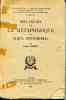
Réflexions sur la métaphysique du calcul infinitésimal
Paris, Mallet-Bachelier 1860 160pp. + grande planche dépliante, 4e éd., 23cm., brochure originale (dos restauré) bien protégée par une couverture supplémentaire transparente de papier cristal, qqs. rousseurs, bon état, W82114
Réflexions sur la métaphysique du calcul infinitésimal
,Paris, Gauthier-Villars coll. 'Les maitres de la pensée scientifique' 1921, VIII-117+104 pp., 2 vol. in 12 br. quelques manques de papier aux couvertures, dos fragilisés avec des traces anciennes d'adhésif
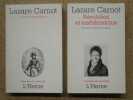
Révolution et mathématiques (2 volumes).
L'Herne Classiques de la Stratégie L'Herne, Classiques de la Stratégie, 2 volumes, 1984-1985, 437-505 p., brochés, environ 21x14 cm. Une signature et une date manuscrites sur la page de garde de chaque volume, dos insolé avec un pli de lecture sur le T.2, bon état pour le reste.
Merci de nous contacter à l'avance si vous souhaitez consulter une référence au sein de notre librairie.
Réflexions sur la métaphysique du calcul infinitésimal - Nouveau tirage augmenté d'une préface de M. Marcel Mayot
Librairie Philosophique J. Vrin Malicorne sur Sarthe, 72, Pays de la Loire, France 1970 Book condition, Etat : Bon broché, sous couverture imprimée éditeur crème In-8 1 vol. - 154 pages
9 figures dans le texte nouvelle édition de 1970, complète en 1 volume, avec une préface de Marcel Mayot Contents, Chapitres : Préface, xiv, Texte, 153 pages - 1. Principes généraux de l'analyse infinitésimale - Définitions - Principe fondamental - 2. De l'algorithme adapté à l'analyse infinitésimale : Du calcul différentiel - Du calcul intégral - Du calcul des variations - 3. Des méthodes par lesquelles on peut suppléer à l'analyse infinitésimale : Méthode d'exhaustion - Méthode des indivisibles - Méthode des indéterminés - De la méthode des premières ou dernières raisons, ou des limites - De la méthode des fluxions - Du calcul des quantités évanouissantes - De la théorie des fonctions analytiques ou fonctions dérivées - Conclusion générale - Note relative au n° 162 de l'ouvrage précédent - Lazare Carnot est un mathématicien, physicien, général et homme politique français, né à Nolay le 13 mai 1753 et mort en exil à Magdebourg en Prusse le 2 août 1823. - Lazare Carnot est mondialement connu pour ses travaux scientifiques. Dans son Essai sur les machines en général (1783) (édition de 1786), il précisa les lois du choc et énonça la loi de conservation du travail. Il publie Métaphysique du calcul infinitésimal en 1797 (3e édition, 1839). Avec sa Géométrie de position (1803), suivie en 1806 de son Essai sur la théorie des transversales, il apparaît en même temps que Monge comme l'un des créateurs de la géométrie moderne. Il participa par ailleurs avec celui-ci à la fondation de l'École polytechnique. (source : Wikipedia) infimes traces de pliures aux coins des plats de la couverture, étiquette de prix au bas du plat inférieur, la couverture reste en bon état, intérieur frais et propre, papier à peine jauni
Je comprends tout Maths 3ème - N°17- 14/15 ans - Je comprends tout - regles du programme, exercices et bilans notes, corriges detachables, ...
NATHAN. 2016. In-4. Broché. Etat d'usage, Couv. convenable, Dos satisfaisant, Intérieur frais. 79 pages illustrées en couleur - quelques exercices remplis au crayon à papier. . . . Classification Dewey : 372.7-Livre scolaire : mathématiques

Classification Dewey : 372.7-Livre scolaire : mathématiques
200 JEUX-TESTS POUR ETRE FORT EN CALCUL - 8/10 ANS
RETZ. 1995. In-8. Broché. Bon état, Couv. convenable, Dos satisfaisant, Intérieur frais. 126 pages. Quelques illustrations en noir et blanc,dans le texte.. . . . Classification Dewey : 372.7-Livre scolaire : mathématiques
Classification Dewey : 372.7-Livre scolaire : mathématiques
FORMULAIRE DE MECANIQUE - MATHEMATIQUES SPECIALES- CINEMATIQUE, DYNAMIQUE, STATIQUE
"LIBRAIRIE VUIBERT. Non daté. In-12. Broché. Bon état, Couv. convenable, Dos satisfaisant, Intérieur frais. 72 pages de formules mathématiques et schémas en noir et blanc- 1 tampon sur le premier plat- avec en supplément une feuille volante ""Table de logarithmes"" - 2 annotations au stylo en tête de la page de titre. . . . Classification Dewey : 510-Mathématiques"
2ème édition Classification Dewey : 510-Mathématiques
EXERCICE DE GEOMETRIE - 8° LIVRE
LIBRAIRIE VUIBERT - 2° EDITION. 1938. In-12. Broché. Etat d'usage, Couv. défraîchie, Dos satisfaisant, Non coupé. 255 pages.. . . . Classification Dewey : 372.7-Livre scolaire : mathématiques
Classification Dewey : 372.7-Livre scolaire : mathématiques
EXERCICES DE GEOMETRIE, 6e LIVRE
Vuibert. 1931. In-12. Broché. Bon état, Couv. convenable, Dos satisfaisant, Intérieur acceptable. 204 pages. Illustré de nombreuses figures en noir et blanc dans le texte. Dos muet et insolé.. . . . Classification Dewey : 372.7-Livre scolaire : mathématiques
Projection d'une aire plane. Prismes. Symétries... Classification Dewey : 372.7-Livre scolaire : mathématiques
EXERCICES DE GEOMETRIE, 7e LIVRE
Vuibert. 1932. In-12. Broché. Bon état, Couv. convenable, Dos satisfaisant, Quelques rousseurs. 199 pages. Illustré de nombreuses figures en noir et blanc dans le texte. Dos muet et insolé.. . . . Classification Dewey : 372.7-Livre scolaire : mathématiques
Surface cylindrique. Aire latérale. Surface conique. La sphère... Classification Dewey : 372.7-Livre scolaire : mathématiques
EXERCICES DE GEOMETRIE - CINQUIEME LIVRE. LE PLAN - HUITIEME EDITION
VUIBERT. 1960. In-12. Broché. Etat d'usage, 1er plat abîmé, Dos satisfaisant, Intérieur frais. 159 pages - 1er plat absent - 1 tampon sur la page de titre.. . . . Classification Dewey : 510-Mathématiques
Classification Dewey : 510-Mathématiques
EXERCICES DE GEOMETRIE - GEOMETRIE DE L'ESPACE.
LIBRAIRIE VUIBERT. 1936. In-12. Broché. Etat d'usage, Tâchée, Dos abîmé, Intérieur frais. 159 + 199 pages - nombreuses figures en noir et blanc dans le texte -. . . . Classification Dewey : 372.7-Livre scolaire : mathématiques
Classification Dewey : 372.7-Livre scolaire : mathématiques

