 Write to the booksellers
-
Type
Autograph (20)
Book (18829)
Magazine (13)
Manuscript (6)
Maps (1)
Photographs (4)
-
Latest
Last 3 days (6)
Last month (44)
Last week (2)
-
Language
English (41)
French (18822)
German (2)
Japanese (1)
Latin (1)
Polish (1)
Portuguese (1)
Russian (1)
Spanish (1)
Swedish (2)
-
Century
16th (4)
17th (36)
18th (294)
19th (3723)
20th (10996)
21st (1381)
-
Countries
Belgium (388)
Côte d'Ivoire (19)
Denmark (1333)
France (16981)
Switzerland (152)
-
Syndicate
CLAM (6)
ILAB (16519)
NVVA (27)
SLACES (27)
SLAM (15153)
SNCAO (12)
CALCULS INSTANTANES, NOUVELLE METHODE DE CAMILLE SICRE, 1917, DONNE REPONSE A TOUT
Librairie Parmentier, Paris. 1917. In-8. Broché. Etat d'usage, Couv. convenable, Coiffe en tête abîmée, Intérieur frais. 63 pages.. . . . Classification Dewey : 510-Mathématiques
(Rare) Abréviation de toutes les opérations servant à calculer les intérêts, les pourcentages, les bénéfices, etc. Classification Dewey : 510-Mathématiques


Ueber die graphische Darstellung imaginärer Functionen.
Berlin, G. Reimer, 1858. 4to. As extracted from ""Journal für die reine und angewandte Mathematik, 55. Band, 1858""., without backstrip. Fine and clean. [Siebeck:] Pp. 221-253" [Steiner)] Pp. 356-378.
Newton et Goethe Deux approches de la nature à l'exemple des phénomènes de la couleur
Bel exemplaire in-12 reliure éditeur de 273 pages dont 7 de bibliographie
NONPARAMETRIC STATISTICS FOR THE BEHAVIORAL SCIENCES
MC GRAW-HILL. non daté. In-8. Broché. Bon état, Couv. défraîchie, Dos satisfaisant, Intérieur frais. 689 pages. Ouvrage en anglais.. . . . Classification Dewey : 510-Mathématiques
International student edition. The Use of statistical tests in research, choosing an appropriate statistical test, the one-sample case, the case of two related samples... Classification Dewey : 510-Mathématiques
A Selection of Problems in the Theory of Numbers. Translated from the polish by A. Sharma. A Pergamon Press Book.
New York, The Macmillan Company 1964, 220x145mm, 126pages, editor's binding. Book in good condition.
Pour un paiement via PayPal, veuillez nous en faire la demande et nous vous enverrons une facture PayPal
General Topology. Second edition.
Toronto, University Press, (1961). 8vo. Publishers full cloth with dust jacket. Very good condition. XII,290 pp.
Reprint of the second edition published 1956, translated and revised by C.C. Krieger.
MATHEMATIQUES, MA CHERE TERREUR / COLLECTION LE PASSE RECOMPOSE.
CALMANN-LEVY. 2001. In-8. Broché. Bon état, Couv. convenable, Dos satisfaisant, Intérieur frais. 232 pages - Nombreuses annotations sur la page de garde - 1er Plat illustré d'une photo en noir et blanc.. . . . Classification Dewey : 510-Mathématiques
Classification Dewey : 510-Mathématiques
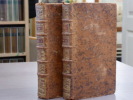
Leçons de Physique expérimentale
Des Ventes De La Doué Paris 1767 2 volumes in-12 ( 170 X 100 mm ) de XVI-424-2 pp. + 12 planches et 502-4 pp. + 6 planches, plein veau marbré, dos à nerfs ornés de caissons et fleurons dorés, tranches marbrées ( reliures de l'époque ). 18 planches gravées rempliées. EDITION ORIGINALE. Quelques usures et épidermures, très rares et minimes rousseurs. Bon exemplaire.
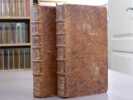
Traité d' arithmétique.
P, Durand et Pedonne Lauriel, 1876, in8 1/2 chagrin vert, dos lisse légèrement frotté Langue: Français
LES TESTS DE LOGIQUE ET DE MATHEMATIQUES AUX CONCOURS DES ECOLES DE COMMERCE / COLLECTION PRINCIPES
STUDYRAMA. 2008. In-8. Broché. Bon état, Couv. convenable, Dos satisfaisant, Intérieur frais. 350 pages - quelques grahiques et calculs noir et blanc dans le texte - trace d'étiquette sur le 2e plat. . . . Classification Dewey : 510-Mathématiques
Classification Dewey : 510-Mathématiques
Silvestre-François Lacroix; L -F Duruisseau, graveur).; J -B -M Duprat, libraire).
Reference : 22133
(1797)
Traité du calcul différentiel et de calcul intégral ,2 volumes - Tome premier [-second].
1797 A Paris : chez J.B.M. Duprat, an V=1797 - an VI=1798. 2 volumes à grandes marges,de I. II, (4), III à XXXII, 519, (1) pages et 4 planches depliantes ; de II. (2), VIII, 732 pages et 2 planches depliantes; 2 volumes demi-basane fauve de l'époque, dos lisse portant des piéces de titre rouges,tranches rouges. Rare première édition de ce traité sur les différentielles et les intégrales paru en deux volumes . 6 feuilles de planche gravées depliantes sur cuivre par Lefrançois et Duruisseau.Description : 2 vol. (XXXII, 519, [9] p.et 4 planches depliantes- tome 1 ;mouillures en marge a quelques feuillets,brunissures aux derniers feuillets de texte; VIII, 732 p.) ; 2 f. de pl.depliantes : ill. ;tome 2 frais - reliures in-4.en bon état,rare.Rare première édition de ce traité sur les différentielles et les intégrales paru en deux volumes et complété en 1800 par un "Traité des différences et des séries, faisant suite au Traité du calcul différentiel et du calcul intégral"
![Traité du calcul différentiel et de calcul intégral ,2 volumes - Tome premier [-second].. Silvestre-François Lacroix; L -F Duruisseau, graveur).; J -B ...](https://static.livre-rare-book.com/pictures/BRK/22133_1_thumb.jpg)
![Traité du calcul différentiel et de calcul intégral ,2 volumes - Tome premier [-second].. Silvestre-François Lacroix; L -F Duruisseau, graveur).; J -B ...](https://static.livre-rare-book.com/pictures/BRK/22133_2_thumb.jpg)
![Traité du calcul différentiel et de calcul intégral ,2 volumes - Tome premier [-second].. Silvestre-François Lacroix; L -F Duruisseau, graveur).; J -B ...](https://static.livre-rare-book.com/pictures/BRK/22133_3_thumb.jpg)
D'après Poggendorf, "the treatise is a very successful synthetis of the works of Euler, Lagrange, Laplace, Monge, Legendre, Poisson, Gauss and Cauchy". En effet, il donne une idée très complète de l'analyse au début du XIXe siècle, grâce à des renvois bibliographiques précis, avant l'édification rigoureuse du calcul infinitésimal. Lacroix, après avoir enseigné à l'école des gardes de marine de Rochefort, puis à l'Ecole Militaire, professa à l'école des Quatre-Nations, à Polytechnique, puis, en 1815, au Collège de France. Remise de 20% pour toutes commandes supérieures à 200 €
Commentaire sur deux mémoires de RIEMANN relatifs à la théorie générale des fonctions et au principe de Dirichlet. Thèse présentée à la Faculté des sciences de Paris le 23 Mai 1882 -- EDITION ORIGINALE -- BEL EXEMPLAIRE
P., Gauthier-Villars, 1882, un volume in 4 relié en cartonnage bradel (reliure postérieure), couvertures conservées, (2), 123pp.
---- EDITION ORIGINALE ---- BEL EXEMPLAIRE ---- Cajori p. 316**6546/N5AR
MEMO BREVET, REVISIONS. MATHS
BORDAS. 2004. In-12. Broché. Bon état, Couv. convenable, Dos satisfaisant, Intérieur frais. 159 pages.. . . . Classification Dewey : 372.7-Livre scolaire : mathématiques
Classification Dewey : 372.7-Livre scolaire : mathématiques
JOKERS, EXERCICES AVEC CORRIGES. MATHEMATIQUES 3e.
BORDAS. 1991. In-12. Broché. Etat d'usage, Couv. légèrement passée, Dos satisfaisant, Intérieur frais. 319 pages. Nombreux schémas en noir et blanc.. . . . Classification Dewey : 372.7-Livre scolaire : mathématiques
Classification Dewey : 372.7-Livre scolaire : mathématiques
SIMONE SUCH, ALETH GALLICE, HENRY BONNET
Reference : R260135861
(1989)
ISBN : 2040182446
MATHEMATIQUES 3e. COLLECTION SUCH-DURRANDE.
BORDAS. 1989. In-8. Cartonné. Etat d'usage, Coins frottés, Dos satisfaisant, Intérieur frais. 287 pages. Premier plat illustré en couleurs. Schémas en couleurs dans le texte.. . . . Classification Dewey : 372.7-Livre scolaire : mathématiques
Classification Dewey : 372.7-Livre scolaire : mathématiques
MATHEMATIQUES 5e. NOUVELLE COLLECTION DURRANDE.
BORDAS. 1989. In-8. Cartonné. Etat d'usage, Coins frottés, Dos satisfaisant, Intérieur frais. 255 pages. Premier plat illustré en couleurs. Schémas en couleurs dans le texte.. . . . Classification Dewey : 372.7-Livre scolaire : mathématiques
Classification Dewey : 372.7-Livre scolaire : mathématiques
Programmation linéaire
Dunod 1962 in8. 1962. Cartonné.
Bon état couverture ternie intérieur propre tranche ternie ex libris
SCIENCES PHYSIQUES - PREMIERE C, D ET E : PROBLEMES AVEC SOLUTIONS
LIBRAIRIE VUIBERT. VERS 1978. In-8. Broché. Bon état, Couv. convenable, Dos satisfaisant, Intérieur frais. 421 pages. Nombreuses figures géométriques en noir et blanc,dans le texte.. . . . Classification Dewey : 372.7-Livre scolaire : mathématiques
SOMMAIRE : électrostatique - électrolyse lois de faraday - énergie électrique loi de Joule, loi d'ohm pour les résistances mortes, les voltamètres et les moteurs - courants dérivés - générateurs loi de puillet - appareils de mesure shunts - application des lois du courant à un réseau - propriétés du courant alternatif - champ magnétique des courants - appareils de mesure à cadre mobile - chimie organique compléments - chimie organique - loupe oculaires - microscope - lunette astronomique lunette terrestre viseur - chimie minérale propriétés des métaux - etc. Classification Dewey : 372.7-Livre scolaire : mathématiques
SCIENCES PHYSIQUES - SECONDE A, C ET T -PROBLEMES AVEC SOLUTIONS
LIBRAIRIE VUIBERT. 1977. In-8. Broché. Bon état, Couv. convenable, Dos satisfaisant, Intérieur frais. 240 pages. Nombreuses figures géométriques en noir et blanc,dans le texte.. . . . Classification Dewey : 372.7-Livre scolaire : mathématiques
Classification Dewey : 372.7-Livre scolaire : mathématiques
Best Approximation in Normal Linear Spaces by Elements of Linear Subspaces.
Bucharest, Berlin, Publ. House of the Academy, Springer, 1970. Royal8vo. Orig. full cloth. 409 pp. Clean and fine.
Le problème de mathématique - Classes de 1re (toutes sections) - Collection Durrande.
Technique & Vulgarisation. 1975. In-8. Broché. Etat d'usage, Coins frottés, Dos plié, Papier jauni. 366 pages.. . . . Classification Dewey : 372.7-Livre scolaire : mathématiques
Collection Durrande. Classification Dewey : 372.7-Livre scolaire : mathématiques
Bericht über die Nachgelassenen Schriften L. Sylows.
Kristiania, Jacob Dybwad, 1922. Royal8vo. Uncut, unopened in the original printed wrappers. Fine and clean. 7 pp.
First appearance of Skolem's paper on the posthumous published works by L. Sylow.
Untersuchungen über die moglichen Verteilungen ganzzahliger Losungen gewisser Gleichungen.
Kristiania, 1921. Royal8vo. Unopened, uncut in the original printed wrappers. Very fine and clean. 57 pp.
First edition.
Verallgemeinerungen der Betti-Guidiceschen Formel.
Oslo, jacob Dybwad, 1940. Royal8vo. Uncut, unopened in the original printed wrappers. Very fine and clean. 18 pp.
First appearance of Skolem's paper on the generalizations of the Betti-Guidiceschen equations.
A CLASS OF LINEAR DIFFERENTIAL DIFFERENCE EQUATIONS
PACIFIC JOURNAL OF MATHEMATICS - VOL 10 N°4. 1960. In-8. Cartonnage d'éditeurs. Bon état, Livré sans Couverture, Dos satisfaisant, Intérieur frais. Paginé de 1419 à 1427. Ouvrage en anglais et photocopié.. . . . Classification Dewey : 510-Mathématiques
Classification Dewey : 510-Mathématiques

