Previous 1 ... 478 479 480 481 ... 559 637 715 793 ... 796 Next Exact page number ? OK

‎EUCLID (EUKLID) OF ALEXANDRIA.‎

Reference : 37801

(1619)

‎Euclidis Elementorum libri XV. Una cum scholiis antiqvis a Federico Commandino Urbinate in latinum conuersi. Ac nuper a multis mendis quibus antea scatebat vendicati....‎

‎Pisavri (Pesaro), Typis Flaminij Concordiæ, 1619. Folio. Contemp. hcalf. Fronthinge nearly broken, but still holding. Titlepage in red a. black. (8) of 10 leaves, lacking first leaf of the foreword and last leaf of Index. Text complete. 255 leaves with many figures in the text. First 16 leaves with some browning and foxing in lower right corners. 5 leaves mended, no loss of text and 8 with smaller repairs, no loss. A few annotations in margins in old hand.‎


‎Scarce second (expanded) edition of Federico Commandino's importent translation of the Elements. Commandino's first translation was published in 1572, and this translation was made use of by subsequent editors for centuries. The first Italian translation was also done from the Latin text of Commandino. - Riccardi 1619,2. - Max Steck: IV 19.‎

Logo ILAB

Phone number : +45 33 155 335

DKK8,500.00 (€1,137.52 )

‎EUCLID (EUKLID) OF ALEXANDRIA.‎

Reference : 45401

(1691)

‎Euclidis elementorum sex libri priores. Magnam partem novis demonstrationibus adornati. Opera & Studio Henrici Coetsii.‎

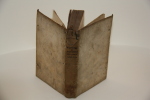
‎Lugdunum Batavorum (Leiden), Danielem à Gaesbeek, 1691. Small8vo. Contemp. full vellum. Spine gone and frontcover detached. Some soiling to covers. Wood-cut printers device on titlepage. (24),468 pp. and many diagrams in the text. A few scattered brownspots and a few quires with light browning.‎


‎First edition of Heinrich Coetsius' translation of the six first books of Euclid.Riccardi 1691, 7 - Max Steck p. 109, 1691.‎

Logo ILAB

Phone number : +45 33 155 335

DKK3,500.00 (€468.39 )

‎"EUCLID (EUKLID) OF ALEXANDRIA.‎

Reference : 32859

(1558)

‎Euclidis Megarensis mathematici clarissimi Elementorum geometricorum libri XV. Cum expositione Theonis in priores XIII à Bartholomæo Zamberto Veneto (= Zamberti) latinitate donata, Campani in omnes, & Hypsiclis Alexandrini in duos postremos. His addie...‎

‎Basel, Johannem Hervagium & Bernhardum Brand, 1558. Folio. (30,5x21,5). Bound in 19th century brown hmorocco with 5 raised bands. Light wear to back and corners a bit bumped. (2),587 pp.Numerous wood-cut diagrams and initials throughout. First ab. 20 leaves with different degrees of yellowing and occasional with marginal faint dampstaining. 3 leaves with upper right corners repaired without loss of text. The ""privilege"" at verso of title partly unreadable as a piece of paper is pasted on, some of these letters are faint, just as some letters in ""Basiliae"" on title are weak. Last leaf with colophon and printers large woodcut-device on verso is mounted, but not hiding the wood-cut. The word ""Basiliae"" on last leaf recto, is weak or nearly gone. Overall a large good copy as usually without the foreword by Melanchton. A small rubber-stamp on title: ""Duplum Bibliothecæ V.E."" and in old hand: ""Bibliothecæ Conventij Romani S. Andrea de Fratrij (?)""‎


‎Scarce third printing of the so-called Zambert-Campanus Edition of the Elements, all printed by Johann Herwagen in Basel - this edition printed together with his son-in-law Bernhard Brand. The first of the Herwagen prints was the famous Editio Princeps in Greek from 1533, and in 1537 he published a Latin version, which became the first Euclid-editon to contain also Euclids smaller tracts as ""Phenomena""(Spherical geometry), ""Katroptik"" (Mirror-reflexion), ""Optik"" und ""Data""(Geometrical excersises). The 1537- edition was reprinted 1546 and in 1558 (the present).""The most famous source of Greek geometry is the monumental work of Euclid of Alexandria, called the ""Elements"" (around 300 B.C.). No other book of science had a comparable influence on the intellectual development of mankind. It was a treatise of geometry in thirteen books which included all the fundamental results of scientific geometry up to his time. Euclid did not claim for himself any particular discovery, he was merely a compiler. Yet, in view of the systematic arrangement of the subject matter and the exact logical procedure followed, we cannot doubt that he himself provided a large body of specific formulations and specific auxiliary theorems in his deductions. It is no longer possible to pass judgement on the authorship of much of this material"" his book was meant as a textbook of geometry which paid attention to the material, while questions of priority did not enter the discussion."" (Cornelius Lanzos in ""Space through the Ages"").Max Steck III:57 - Thomas-Stanford: 15 - Riccardi 1558/3 - Adams E:976.‎

Logo ILAB

Phone number : +45 33 155 335

DKK28,500.00 (€3,814.04 )

‎"EUCLID (EUKLID) OF ALEXANDRIA. - FIRST DANISH EDITION OF ""EUCLID"".‎

Reference : 41890

(1744)

‎Euclidis Elementa Geometriæ, Det er, Første Grund Til Geometrien, I det Danske Sprog oversat af Ernst Gotlieb Ziegenbalg.‎

‎Kjøbenhavn, Ernst Henrik Berling, 1744. 4to. Samt. hldrbd. over træ. Ryg lidt slidt Overtrækspapiret på permer med mangler.(12),20,311 pp. samt 5 foldede kobberstukne plancher, i teksten talrige geometriske figurer. De første blade og de 5 plancher med en svag vandskjold. Svag skjold på de sidste ca 20 blade. En del blade med brunplet i øvre margin.4to. Contemporary half calf over wooden boards. Spine a bit worn and lacing some of the paper over boards. Faint damp stain to first leaves, to plates, and to the last ab. 20 leaves. Some leaves with a brown spot to upper margin. (12), 20, 311 pp + 5 folded engraved plates. Numerous geometrical figures in the text. ‎


‎Første udgave på dansk af Euclids ""Elementer"", omfattende Bog 1-6 og 11-12. J.F. Ramus have allerede nogle år tidligere udgivet Euclid, men disse var mindre lærebøger i uddrag og på latin. Oversættelsen indeholder en lang introduktion af Ramus ""Betænkning om Euclidis Elementer og om deres Oversættelse i det Danske Sprog.""Ziegenbalg var teologisk kandidat, men havde studeret matematik i flere år, både i Jena og i England. Han blev udnævnt til professor i matematik ved Københavns Universitet efter Ramus, og havde i nogle år forinden fungeret som dennes assistent. Hans oversættelse er dedikeret Christian den VI, og i forordet introducerer han den således ""offereres (oversættelsen) Deres Kongelige Majestæt...disse udi det Danske Sprog oversatte Elementa Geometriæ, som ere Hoved=Kilden til alle Mathematiske Videnskaber og have nu i 2000 Aar været i saa stor Estime, at alle de største og erfarne Mathematici have grundet deres Skrifter paa dem og at de til almindelig Nytte og Brug ere bekientgiorte næsten udi alle Europæiske, men ey tilforn i dette Sprog.""First edition of the first Euclid-translation into Danish, comprising Book 1-6 and 11-12. Bound in cont. hcalf. Rebacked in old style. A good copy. - Riccardi, Bibl. Euclideana, Parte 4, p. 47. - Bibl. Danica IV:96.‎

Logo ILAB

Phone number : +45 33 155 335

DKK6,500.00 (€869.87 )

‎"EUCLID (EUKLID) OF ALEXANDRIA. - TARTAGLIA'S TRANSLATION.‎

Reference : 34674

(1565)

‎Euclide Megarense Philosopho, solo Introduttore delle Scientie Mathematice. Diligentementee Rassettato, et alla integrità ridotto, per il degno professore di tal Scientie Nicolo Tartalea Brisciano (Nicolo Tartaglia). Secondo le due Tradottioni. Con un...‎

‎Venetia, Curtio Trojano, 1565. 4to. Bound in a very nice recent hcalf in old style. Raised bands and richly gilt back. 315,(1) leaves (=632 pp). Profusely illustrated with gemetrical diagramss in the text. Printers woodcut-device at end. Small part of lower right corner of title gone, no loss of text. Light browning to first and last leaf. 6 last leaves with a faint dampstain. Very light browning to outher margins. Otherwise a fine clean copy.‎


‎Scarce second edition of Tartaglia's very influential translation of all Euclid's 15 Books, as this Italian translation of Euclid was the first translation at all into the vernacular. The translation by Tartaglia was first published 1543 and was founded on the latin edition of Campanus and Zambetti.Niccolo Fontana of Brescia has a great name in the history of mathematics. A cut in the face from a French soldier caused him to stammer and as a consequence of this he was called 'Tartaglia'. He is famous for his solution of third-degree equations which occasioned a long polemic with Cardano about priority. He is also known for ""Tartaglia's Triangle"", later known as ""Pascal's Triangle"", and he is well-known for his Archimedes-edition of 1543 and 1551 with his commentaries.""The most famous source of Greek geometry is the monumental work of Euclid of Alexandria, called the ""Elements"" (around 300 B.C.). No other book of science had a comparable influence on the intellectual development of mankind. It was a treatise of geometry in thirteen books which included all the fundamental results of scientific geometry up to his time. Euclid did not claim for himself any particular discovery, he was merely a compiler. Yet, in view of the systematic arrangement of the subject matter and the exact logical procedure followed, we cannot doubt that he himself provided a large body of specific formulations and specific auxiliary theorems in his deductions. It is no longer possible to pass judgement on the authorship of much of this material"" his book was meant as a textbook of geometry which paid attention to the material, while questions of priority did not enter the discussion."" (Cornelius Lanzos in ""Space through the Ages"").Max Steck III:72 - Thomas-Stanford: 39 - Riccardi Euclideana V:1 - Adams E:993. - Brunet II:1090.‎

Logo ILAB

Phone number : +45 33 155 335

DKK18,500.00 (€2,475.78 )

‎EUCLID (+) GEORG FOURNIER (+) BAZIN.‎

Reference : 60194

(1654)

‎Sex Primi Elementorum Geometricorum (+) Elementa Astronomica.‎

‎London, Edwardi Story, 1654. 12mo. In contemporary full vellum. Binding slightly twisted. Front board with large stain. Annotations in contemporary hand to pasted down front end-paper and free front end-paper. Small marks with annotations pasted in margin. Internally fine and clean. (10), 302, 72 pp. with many diagrams and illustrations in text.‎


‎Rare first edition of George Fournier's work on Euclid's Element. “Some of the benefits of the smaller format adopted by Clavius’s edition were negated by the length of the text, and the next phase of Euclidean publication during the seventeenth century saw the rapid adoption of smaller formats, culminating in a number of tiny duodecimo issues such as the 1644 Paris edition of Georges Fournier, later reprinted in Cambridge. (In note:) Issued as a duodecimo in Paris in 1644 and 1654, and in London in 1654 and 1665.” (Anja-Silvia Goeing, Early Modern Universities: Networks of Higher Learning). Georges Fournier, a French Jesuit priest, geographer and mathematician, served as a naval military chaplain on a ship of the line, and acquired a strong knowledge of technical and naval matters. In 1642, he published the treaty Hydrographie, where he attempted to provide a scientific foundation to the design of ships. He also authored a Treaty of fortifications or military architecture, drawn from the most estimated places of our times, for fortifications, whose original edition was published in Paris in 1649 by Jean Hénault at the Salle Dauphine of l'ange gardien. Another edition was published in 1668 in Mayence by Louis Bourgeat. His works on Euclidean geometry (Paris, 1644 and 1654) were translated into English, and gave rise to three successive editions.Georges Fournier taught René Descartes.Steck IV, p. 100. ‎

Logo ILAB

Phone number : +45 33 155 335

DKK8,000.00 (€1,070.61 )

‎EUCLID OF ALEXANDRIA.‎

Reference : 34704

(1543)

‎Evclide Megarense Philosopho: solo introdvtttore delle Scientie Mathematice" diligentemente Reassettato, et alla integrita ridotto per il degno Professore di tal Scientie Nicolo Tartalea, Brisciano, Secondo le due Tradottioni: e per commune commodo & ... - [FIRST EUCLID IN THE VERNACULAR, BY TARTAGLIA.]‎

‎(Colophon: Venice, Venturino Rossenelli, 1543). Folio. (30,5x22 cm.). Contemporary full Italian limp vellum. Remains of ties. Old handwritten title on spine. Upper part of front cover slightly creased. A few small nicks to hinges at cords. Vellum with brownspots. 242 leaves (2-241 numb. II-CCXXXIX). Misnumbering of leaves in sign. A (10 lvs.), due to the insertion of corrections on f A5. (Collation corresponds to that given by Thomas-Stanford No. 34). Large margins profusely illustrated with diagrams. Upper right corner of title gone with loss of of 3 letters ""NSE"" in MEGARENSE, f A2-A6 with upper right corners and a wormtract-hole in lower margin repaired. A wormtract in lower margin on the next 11 lvs. A1-A6 mounted skillfully on thin opaque parchment-paper. A rather faint dampstain in upper right corner throughout. Last 5 leaves with a small nick in right margin, no loss. Otherwise remarkably clean and printed on good, strong paper. On the title a large woodcut device with arms with G.T. (Gabriele Tadino, to whom the work is dedicated). Colophon with large woodcut device with the letters .P.Z.F. and this repeated on verso of last leaf.‎


‎Scarce first edition of the first translation of Euclid into any modern language, by the famous Niccolo Tartaglia. The translation and Tartaglia's commentaries strongly accelerated the development of physics and mechanics in the 16th century, as it showed how mathematics could be applied to dynamics and mechanics as well as to architecture, construction, and perspective. More than 20 years should elapse before the next language would receive the privilege of displaying Euclid among their goods, this was the French translation published by Pierre Forcadel, Paris 1564. ""When Tartaglia submits that his redaction was made ""secondo le due tradittioni"", there is no question that Campanus - who appears to be heavely favored - and Zamberti are meant. When Campanus has added propositions or premises, Tartaglia has approriately translated them and noted their absence ""nelle seconda tradittione"", while things omitted by Campanus but included by Zamberti receive the reverse treatment"" (John Murdoch in DSB). Niccolo Fontana Tartaglia of Brescia has a great name in the history of mathematics. A cut in the face from a French soldier caused him to stammer and as a consequence of this he was called 'Tartaglia' (the stammerer). He is famous for his solution of third-degree equations which occasioned a long polemic with Cardano about priority. He is also known for ""Tartaglia's Triangle"", later known as ""Pascal's Triangle"", and he is well-known for his Archimedes-edition of 1543 and 1551 with his commentaries. ""The most famous source of Greek geometry is the monumental work of Euclid of Alexandria, called the ""Elements"" (around 300 B.C.). No other book of science had a comparable influence on the intellectual development of mankind. It was a treatise of geometry in thirteen books which included all the fundamental results of scientific geometry up to his time. Euclid did not claim for himself any particular discovery, he was merely a compiler. Yet, in view of the systematic arrangement of the subject matter and the exact logical procedure followed, we cannot doubt that he himself provided a large body of specific formulations and specific auxiliary theorems in his deductions. It is no longer possible to pass judgement on the authorship of much of this material"" his book was meant as a textbook of geometry which paid attention to the material, while questions of priority did not enter the discussion."" (Cornelius Lanzos in ""Space through the Ages""). Max Steck III:40 - Thomas-Stanford: 34 - Riccardi Euclideana 1543, 1 - Adams E:992. - Brunet II:1090. (Premiere edition de ce travail estimé). - Graesse II:513.‎

Logo ILAB

Phone number : +45 33 155 335

DKK50,000.00 (€6,691.29 )

‎"EUCLID OF ALEXANDRIA - GESTRINIUS, MARTIN ERIK.‎

Reference : 34701

(1637)

‎In geormetriam Euclidis Demonstrationum Libri Sex. In quibus Geometria planorum traditur, & brevis Notis perspicue explicatur. Impensis & sumptibus Authoris. - [FIRST SWEDISH EUCLID-EDITION.]‎

‎Uppsala, Eschillus Matthiæ, 1637. Small 4to. Cont. full vellum over wood. Spine ends worn, tears to hinges, but not broken, lower edges of boards with old repairs. Some old ink annotations on boards. Inside frontcover and on title many old owner names, small wholes cut in titel without loss of letters. First ab. 20 leaves with a faint dampstain in upper margin, inkspots on last page. Internally clean. (24),350,(2) pp., numerous geometrical diagrams in the text.‎


‎Scarce first edition of the first Swedish edition of Euclid's Elements (Book I-VI) with Gestrinius' commentaries to the axioms and porpositions and with his attempt of a proof of the ""Parallel-axiom"" (The Fifth Postulate). In the preface he discusses the use of plane-geometry in the theories of Aristoteles, Eudoxus, Ptolemy and Kepler. - Gastrinius (1594-1648) became professor of mathematics in Uppsala in 1621 after studies in Greifswald.Collijn (1600-Talet) I:310. - Riccardi p. 436 (1637,2) - Poggendorff I:889. - Not in Max Steck.‎

Logo ILAB

Phone number : +45 33 155 335

DKK22,500.00 (€3,011.08 )

‎EUKLID (EUCLID).‎

Reference : 46855

(1825)

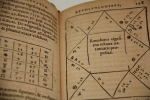
‎Euklid's Elemente acht Bücher: die sechs, nebst dem eilften und zwölften, aus dem Griechischen übersetzt von Johann Friedrich Lorenz. (Auch mit dem Titel Euklid's Geometrie...).‎

‎Halle, Waisenhauses, 1825. Contemp. hcalf.Gilt spine, titlelabel with gilt lettering. Light wear to top of spine. With 2 titlepages. VI,204, many textfigs. Interleaved and with a large number of manuscripts diagrams, text and addenda in a contemporary hand.‎


‎Max Steck VI.14. - Riccardi p. 489.‎

Logo ILAB

Phone number : +45 33 155 335

DKK1,250.00 (€167.28 )

‎EULER (L.)‎

Reference : 8014

‎Elémens d'algèbre traduits de l'allemande (par Daniel BERNOULLI) avec des notes et des additions (de J.L. LAGRANGE) -- BEL EXEMPLAIRE -- 2 VOLUMES (COMPLETE SET)‎

‎Lyon, Bruyset, An III (1795), 2 volumes in 8 reliés en plein Veau marbré, dos richement ornés de fers dorés, tranches rouges (reliure de l'époque, (pages de faux-titre et de titre du tome 1 uniformément jaunis ainsi que quelques feuillets de texte, mouillures angulaires à quelques feuillets au tome 2), T.1 : 16pp., 704pp., T.2 : (2), 668pp.‎


‎---- En dépit des défauts signalés BEL EXEMPLAIRE ---- Seconde traduction française et la première par D. BERNOULLI avec des notes et additions de J.L. LAGRANGE ---- Second edition in french of Euler's Vollständige Anleitung zur Algebra (1770). THE TRANSLATION was made by J. BERNOUILLI and CONTAINS NUMEROUS and VALUABLE ADDITIONS by LAGRANGE ---- "Euler's Vollständige Anleitung zur Algebra first appeared in Russian translation in 1768/1769 ; it went through numerous german, french, english, italian, dutch and russian editions" ---- "This book greatly influenced nineteenth and twentieth-century texts on the subject". (DSB IV p. 475) ---- "The first volume treats of determinate algebra. This contains one of the earliest attempts to place the fundamental processes on a scientific basis ; the same subject had attracted D'Alembert's attention. This work also includes the proof of the binomial theorem for an unrestricted real index... The second volume of the algebra treats of indeterminate or Diophantine algebra. This contains the solutions of some of the problems proposed by Fermat and which had hitherto remained unsolved". (Ball"A short history of the Hist. of math.", p. 397)**8014/ARB4‎

Phone number : 01 43 25 51 73

EUR800.00 (€800.00 )

‎EULER (L.)‎

Reference : 8204

‎Introduction à l'analyse infinitésimale traduite du latin en français avec des notes et des éclaircissemens par J.B. Labey -- PREMIERE EDITION FRANCAISE -- BEL EXEMPLAIRE GRAND DE MARGES -- 2 TOMES RELIES EN UN VOLUME (COMPLETE SET)‎

‎P., Barrois, 1796/1797, 2 TOMES reliés en un volume in 4 (20cm x 26cm), pleine basane marbrée, dos orné de fers dorés, étiquette rouge (reliure de l'époque), T.1 : 14pp., (1-errata du tome premier), 364pp., 1 tableau dépliant (p. 252), T.2 : 6 feuillets non chiffrés (faux-titre, titre, dédicace, errata du tome 1, table des chapitres, errata du tome 2), 424pp., 16 planches dépliantes‎


‎---- PREMIERE EDITION de cette traduction française par J.B. LABEY, professeur de mathématiques à l'Ecole centrale, puis à l'Ecole polytechnique ---- BEL EXEMPLAIRE GRAND DE MARGES ---- "On paraissait désirer, il y a longtemps, une traduction complète de l'Introduction à l'analyse infinitésimale d'Euler, tant à cause de la difficulté de se procurer cet ouvrage devenu rare depuis plusieurs années que parce que beaucoup de jeunes gens qui se livrent à l'étude des mathématiques, n'entendent pas la langue dans laquelle il a été écrit...". (Préface) ---- "In the Introductio, Euler presented the first clear statement of the idea that mathematical analysis is a science of function ; and he also presented a more thorough investigation of the very concept of function...". (DSB IV p. 467) ---- "This work caused a revolution in analytical mathematics, a subject which had hitherto never been presented in so general and systematic manner". (Cajori p. 233)**8204/ARM3‎

Phone number : 01 43 25 51 73

EUR1,450.00 (€1,450.00 )

‎"EULER, LEONARD. - ON THE ISOCHRONE PROBLEM.‎

Reference : 50850

(1735)

‎De innumerabilibus Curuis tautochronis in in Vacuo. (On the innumerable tautochrone curves in a vacuum). (+) Curva Tautochrona in Fluido resistentiam faciente secundum Quadrata cerilitatum. (Tautochrone curves in a fluid making a second resistance pr...‎

‎(Petropoli, St. Petersburg, Typis Academiae, 1735). 4to. No wrappers. In: ""Classes Prima continens Mathematica. Commentarii Academiae Scientiarum Imperialis Petropolitanae"", Tomus IV ad Annum 1729. The whole section of ""Mathematica""offered. Pp 1-118 pp. and 10 engraved plates. Euler's papers: pp. 49-67 a. 2 engraved plates. Pp. 67-89 a. 1 engraved plate. Wide-margined, clean.‎


‎Both first editions and some of the earliest mathematical papers by Euler. The first paper is a masterful work, in which Euler first establishes a surprisingly simple geometric condition for tautochronic curves, and then shows how to generate such curves, both analytic and algebraic, starting from the familiar cycloid "" the next paper extends the analysis to a resistive medium where the resistance is in proportion to the square of the speed. - Enestroem E12 and E13.The section (Mathematica) also contains papers by Jacob Hermann, Christopher Maier, G.W. Krafft and Daniel Bernoulli ""Problema astronomicum inneniendi altitudinem poli,...."", pp. 89-94.‎

Logo ILAB

Phone number : +45 33 155 335

DKK2,500.00 (€334.56 )

‎EULER, LEONHARD.‎

Reference : 51148

(1789)

‎Auszug aus Herrn Leonhard Eulers vollständigen Anleitung zur Algebra mit einigen Weläuterungen und Vermehrungen herausgegeben von Johann Jacob Ebert. Erster- (Zweyter) Theil. 2 Bde.‎

‎Frankfurt am Mayn, Johann Georg Fleischer, 1789. Contemp. hcalf. Gilt spine. Titlelabel with gilt lettering. A paperlabel pasted on top of spine. Spine slightly rubbed. Stamps on first title-page. VIII,246(6),282 pp. Scattered brownspots and occasional light browning.‎


‎Poggendorff I, 641.‎

Logo ILAB

Phone number : +45 33 155 335

DKK2,500.00 (€334.56 )

‎"EULER, LEONHARD.‎

Reference : 50924

(1740)

‎De Minimis oscillationibus Corporum tam rigidorum qvam flexibilium. Methodus nova et facilis. (On the smallest oscillations of rigid and flexible bodies. A new and easy method.)‎

‎(Petropoli, St. Petersburg, Typis Academiae, 1740). 4to. No wrappers. In: ""Classes Prima continens Mathematica. Commentarii Academiae Scientiarum Imperialis Petropolitanae"", Tomus VII ad Annum 1735, &..... Euler's paper: pp. 99-122 a. 2 engraved plates. Wide-margined, clean.‎


‎First printing of Euler's first paper on vibrating bars. Euler here solves the partial differential equation for a forced harmonic oscillator and notices the resonnance phenomenon. - Enestroem E40.‎

Logo ILAB

Phone number : +45 33 155 335

DKK1,800.00 (€240.89 )

‎"EULER, LEONHARD.‎

Reference : 45702

(1758)

‎Exposition de quelques paradoxes dans le calcul integral.‎

‎(Berlin, Haude et Spener, 1758). 4to. No wrappers as issued in ""Memoires de l'Academie Royale des Sciences et Belles Lettres"". tome XI, 1756 pp. 300-321 and 1 folded engraved plate.‎


‎First appearance of this paper in which Euler examines some peculiar differential equations that can be solved through the rather paradoxical method of integration by differentiation. He presents four such problems, which were found to all be members of the same family of differential equations, thus this presentation will focus on reworking several of these problems to make use of this generalization.Together with a paper by Eulers son (Euler le Fils - Johann Albrecht): Des Cerfs - Volans. Traduit du Latin. Pp. 322-364 and 3 folded engraved plates. - Johann here exposes his electrical theory in relation to kites, and indicates that kites were not only children's toys but had been used by the celebrated Romas in his electrical experiments.Enestroem E236.‎

Logo ILAB

Phone number : +45 33 155 335

DKK2,200.00 (€294.42 )

‎"EULER, LEONHARD.‎

Reference : 49129

(1758)

‎Exposition de quelques paradoxes dans le Calcul Intégral. (Explanation of certain paradoxes in integral calculus).‎

‎(Berlin, Haude et Spener, 1758). 4to. No wrappers as issued in ""Mémoires de l'Academie Royale des Sciences et Belles-Lettres"" Tome 12 (1756), pp. 300-321 a. 1 folded engraved plate.‎


‎First edition. Euler looks at singular integrals of differential equations (derivation through differentiation"" proof that these integrals are not included in the general solution.) Enestroem: 236. - Also with Euler le Fils: ""Des Cerfs - Volans"", pp. 322-364 a. 1 plate.‎

Logo ILAB

Phone number : +45 33 155 335

DKK1,250.00 (€167.28 )

‎"EULER, LEONHARD.‎

Reference : 39052

(1755)

‎Principes de la Trigonometrie Spherique tirés de la Méthode des plus Grands et plus Petits (Principles of spherical Trigonometry deduced from the Method of Maxima and Minima). (And same author:) Élémens de la Trigonometrie spheroidique tirés de la Met... - [EULER'S SPHERICAL GEOMETRY]‎

‎(Berlin, Haude et Spener, 1755). 4to. Without wrappers as issued in ""Mémoires de l'Academie Royale des Sciences et Belles-Lettres"", tome IX, pp. 223-257 and 1 folded engraved plate (a tear to plate, no loss), and pp. 258-293 and 1 folded engraved plate.‎


‎Both papers first edition. The modern form of trigonometry as well of all trigonometry are due to Euler. Whereas trigonometry before Euler was concerned with trigonomic Lines, Euler's trigonometry deals with trigonomic Function. - ""In the first paper Euler constructs spherical trigonometry as the intrinsic geometry of the surface of the sphere. He expresses the line element ds of the surface in terms of the longitude and latitude of a point, defines the great circles as curves that minimize the integral of the line element, and, in connection with with the determination of the minimum of a side of a spherical triangle, derives 10 equations of spherical geometry.. After the discovery that the shape of the earth is that of a spheroid, Euler, (in the second paper here offered) extended his methods to spheroids. He develops this subject in its entirety...and here deduced very many of the formulas of spherical geometry"" (Rosenfeld & Abramovich). - Enestrom: E:214 a. E: 215. - Another Paper by Euler is withbound: Examen d'une Controverse sur la Loi de Refraction de Rayon de differentes Couleurs par Rapport a la diversité des Milieux transparens par lesquels ils sont transmis."" pp. 294-320. (Enestrom: E 216.‎

Logo ILAB

Phone number : +45 33 155 335

DKK7,500.00 (€1,003.69 )

‎"EULER, LEONHARD.‎

Reference : 39097

(1759)

‎Recherches sur la Déclination de L'Aiguille aimantée. (And:) Corrections Nécessaires pour la Théorie de la Déclination. (And the same author:) Sur la Force de Colonnes.(Research concerning the declination of the magnetized needle - The necessary corre...‎

‎(Berlin, Haude et Spener, 1759-68). 4to. Without wrappers extracted from ""Mémoires de l'Academie Royale des Science et Belles-Lettres"", tome XIII, pp. 175-251 and 4 folded engraved plates, tome XXII, pp. 213-264 and 2 engraved plates., tome XIII, pp.and 1 folded engraved plate.‎


‎All 3 papers all in first edition. Euler's proposed theory of magnetic fields influenced both Faraday and Maxwell. Euler viewed the magnetic field as waves through the ether, jus like his theory of light was founded on the existence of the ether. - Enestrom E 237 + E 362 and E 238.‎

Logo ILAB

Phone number : +45 33 155 335

DKK2,500.00 (€334.56 )

‎"EULER, [LEONHARD].‎

Reference : 44267

(1755)

‎Recherches sur la veritable courbe que decrivent les corps jettes dans l'air ou dans un autre fluide quelconque.‎

‎(Berlin, Haude et Spener, 1755). 4to. No wrappers as issued in ""Memoires de l'Academie Royale des Sciences et Belles Lettres"". tome IX, pp. 321-352.‎


‎First printing of this Euler-paper in which he examines curves of airborne bodies. Euler describes how the forces acting on a cannonball give different differential equations for the ascending branch than for descending branch. See Eneström E217.‎

Logo ILAB

Phone number : +45 33 155 335

DKK2,000.00 (€267.65 )

‎"EULER, LEONHARD.‎

Reference : 39047

(1766)

‎Recherches sur le Mouvement de Rotation des Corps celestes (Studies on the rotational movement of celestial bodie). (And the same author:) Solution d'une Question curieuse qui ne paroit soumise a aucune Analyse. (Solutions of a curious question which ... - [RECREATIONAL MATHEMATICS]‎

‎(Berlin, aud et Spener, 1766). 4to. Without wrappers as issued in ""Mémoires de l'Academie Royale des Sciences et Belles-Lettres"", tome XV, pp. 265-309 a. 2 engraved plates., pp. 310-337.‎


‎Both papers first edition. In the first paper Euler uses his method of pertubations on, or the ""variation of the elements or parameters"" on the movement of the planets. - The second pper is one of Euler's more famous papers and a good example of his work in an area called ""recreational mathematics"". It was the first mathematical paper on knight's tours (A knight's tour is a path that a knight chesspiece can follow to visit every square on the chessboard without revisiting any square). (Eneroth: E 308 a. E 309).‎

Logo ILAB

Phone number : +45 33 155 335

DKK2,800.00 (€374.71 )

‎"EULER, LEONHARD.‎

Reference : 34682

(1750)

‎Recherches sur les plus Grand et plus Petits qui se trouvent dans les Actions des Forces.‎

‎(Berlin, Haude et Spener, 1750). 4to. No wrappers, as issued in ""Mémoires de l'Academie Royale des Sciences et Belles-Lettres"", tome IV, pp. 149-188 and 2 folded engraved plates..‎


‎First edition. Euler shows that any discrete system obeys the Maupertois principle" from this result, he derives the general equation for the balance of moments in a plane elastica, which includes the general catenary as a special case. He also proves that Daniel Bernoulli's principle for the elastica that is free of distributed loads is also a special case of this general equation. - Enestrom No. 145.‎

Logo ILAB

Phone number : +45 33 155 335

DKK1,500.00 (€200.74 )

‎"EULER, LEONHARD.‎

Reference : 41244

(1752)

‎Recherches sur L'Origine des Forces.‎

‎(Berlin, Haude et Spener, 1752). 4to. Unbound, but stitched. In: ""Memoires de l'Academie Royale des Sciences et Belles-Lettres"" Tome VI, pp. (419-)447 and 1 folded engraved plate.‎


‎First edition, in the periodical form. - Enestroem No. 181.‎

Logo ILAB

Phone number : +45 33 155 335

DKK1,250.00 (€167.28 )

‎"EULER, [LEONHARD].‎

Reference : 44268

(1753)

‎Recherche sur une nouvelle maniere d'elever de l'eau proposee par M. de Mour. - [EULER ON HOW TO RAISE WATER]‎

‎(Berlin, Haude et Spener, 1753). 4to. No wrappers as issued in ""Memoires de l'Academie Royale des Sciences et Belles Lettres"". tome VII, pp. 305-330 + two engraved plates.‎


‎First printing of Euler's paper on how to raise water, which was a study written on the background of his - unsuccessful - garden-project in Frederick the Great's large complex of summer palaces, Sanssouci where Euler was asked to design the pumps to the many fountains. ""I wanted to make a fountain in my Garden"", Frederic the Great wrote to Voltaire on 25 January 1778. But the water-art project ended in a fiasco. The fountain design was supposed to be executed according to the latest knowledge in hydraulics and should even surpass Versailles with its splendor. ""Euler calculated the effort of the wheels for raising the water to a basin, from where it should fall down through canals, in order to form a fountain jet at Sans-Souci. My mill was constructed mathematically, and it could not raise one drop of water to a distance of fifty feet from the basin.""Since then the fiasco at Sanssouci stands out as an example for the gulf between theory and practice. And Leonhard Euler, the mathematical genius from Basel, became a target of mockery and malicious joy"". (Michael Eckert: Euler and the Fountains of Sanssouci).See Enetröm E202.‎

Logo ILAB

Phone number : +45 33 155 335

DKK3,800.00 (€508.54 )

‎"EULER, [LEONHARD].‎

Reference : 44265

(1756)

‎Reflexions sur un probleme de geometrie traite par quelques geometres et qui es neanmoins impossible (+) Recherches physiques sur la diverse refrangibilite des rayons de lumiere. - [EULER ON LIGHT RAYS]‎

‎(Berlin, Haude et Spener, 1756). 4to. No wrappers as issued in ""Memoires de l'Academie Royale des Sciences et Belles Lettres"". tome X, pp. 173-199" pp. 200-226. ‎


‎First printing of two Euler-papers in which he occupies himself with an unsolvable geometric problem and the physics of the different refrangibilities of light rays, a field Euler made important and original contributions to. Euler's wave theory of light, published in 1746, was based on an analogy between sound and light to a more and more mathematical elaboration on that notion. His wave theory degenerated, and it was not until Fresnel introduced transverse waves and an elaborate notion of interference that the wave theory again progressed. He was the second after Christian Huygens to proposed a wave theory of light, and thereby one of the earliest to argue against Newton's particle theory of light. His 1740s papers on optics helped ensure that the wave theory of light proposed by Christian Huygens would become the dominant mode of thought until the development of the quantum theory of light.See Eneström E220, E221.‎

Logo ILAB

Phone number : +45 33 155 335

DKK4,200.00 (€562.07 )

‎"EULER, LEONHARD.‎

Reference : 41875

(1771)

‎Solution d'une Question tres difficile dansl le Calcul des Probabilités.‎

‎(Berlin, Haude et Spener, 1771). 4to. No wrappers as issued in ""Memoires de l'Academie Royale des Sciences et Belles Lettres"". tome XXV, pp. 285-302. Fine and clean.‎


‎First printing of one of Euler's papers in probabilistic analysis, dealing with an analysis of a lottery for which there are several classes and a guarateed payment.The Genoise lottery was the first number lottery. It and its variants were discussed by many mathematicians because such lotteries were perceived to be unfair and because they gave rise to many interesting problems. Usually it took the form of choosing 5 from 100 with various payoffs depending upon the wager made. - Enestroem E 412.‎

Logo ILAB

Phone number : +45 33 155 335

DKK1,500.00 (€200.74 )
Previous 1 ... 478 479 480 481 ... 559 637 715 793 ... 796 Next Exact page number ? OK
Get it on Google Play Get it on AppStore
Mathematics
The item was added to your cart
You have just added :

-

There are/is 0 item(s) in your cart.
Total : €0.00
(without shipping fees)
What can I do with a user account ?

What can I do with a user account ?

  • All your searches are memorised in your history which allows you to find and redo anterior searches.
  • You may manage a list of your favourite, regular searches.
  • Your preferences (language, search parameters, etc.) are memorised.
  • You may send your search results on your e-mail address without having to fill in each time you need it.
  • Get in touch with booksellers, order books and see previous orders.
  • Publish Events related to books.

And much more that you will discover browsing Livre Rare Book !