 Write to the booksellers
-
Type
Autograph (1)
Book (233)
Magazine (2)
Music sheets (2)
-
Century
19th (133)
20th (15)
21st (2)
-
Countries
Belgium (6)
Côte d'Ivoire (1)
Denmark (26)
France (192)
Switzerland (13)
-
Syndicate
ILAB (107)
NVVA (2)
SLACES (2)
SLAM (78)
SNCAO (2)
Littérature et voyages. Allemagne et Scandinavie.-
Paris. Pigoreau. s. d. In-8 (135 x 205mm) percaline rouge ornée à froid, dos lisse, marque du Collège Bourbon d'Aix sur le 1er plat (étiquette de prix du même collège au revers), 4ff., 488 pages. Percaline un peu tachée, des rousseurs comme souvent.
Littérature et voyages. Allemagne et Scandinavie.
Paris, Paulin 1833, 210x140mm, reliure basane. Reliure de l’époque veau blond avec pièce de titre et d’auteur, et filets dorés au dos. Coins frottés. Ex-libris moderne.
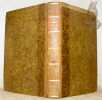
2 ff. - 488 pages, Pour un paiement via PayPal, veuillez nous en faire la demande et nous vous enverrons une facture PayPal
Littérature et voyages. Allemagne et Scandinavie
Paris, chez Paulin, 1833, in-8, de (IV), 488 pp., demi-veau bleu de l'époque, dos lisse, Édition originale de cet ouvrage sur la littérature allemande, slave et scandinave, y compris les essais sur Goethe, Hoffmann, l'Edda et les Sagas. On y trouve aussi les mémoires de l'auteur sur son voyage de Berlin à Copenhague. Plat supérieur légèrement endommagé sinon en bel état Couverture rigide
Bon de (IV), 488 pp..
Littérature. Voyages & Poésies. TOME 1er.
DIDIER. 1850. In-12. Relié demi-cuir. Bon état, Couv. convenable, Dos satisfaisant, Quelques rousseurs. 502 pages. Titre, filets, roulettes et tomaison dorés sur le dos cuir noir.. . . . Classification Dewey : 890-Littératures des autres langues
Esquisses du Nord. - Littératures Danoise, Slave et bohême, Allemande, scandinave - Histoire comparée des Langues - Edda et Sagas - Mythologie scandinave. Des Scaldes. Classification Dewey : 890-Littératures des autres langues
MELANGES D'HISTOIRE LITTERAIRE ET DE LITTERATURE, TOME I
Michel Lévy Frères, Paris. 1867. In-8. Broché. Parfait état, Couv. convenable, Dos frotté, Intérieur frais. 514 pages.. . . . Classification Dewey : 840.01-Origines - 1400
De l'histoire de la poésie. L'ancienne littérature scandinave. de la chevalerie. Joinville. Amyot... Classification Dewey : 840.01-Origines - 1400
Promenade en Amérique. Etats-Unis - Cuba - Mexique. Nouvelle édition entièrement revue. Tome 1 et 2. En 2 vols.
Paris, Michel Lévy Frères, 1856, in-8vo, XI + 421 p. / 425 p., reliures en toile. / Orig. clothbound.
Interesting voyage in the french language to the United States, on p. 113 of the 1st. vol., there is a short description of a slave sale. The final price for a ‘Nègre’ (Nigger) got 69 dollars, a horse sold a bit later on the same sale, fetched 2 dollars more! Mr. Ampere visits prisons, libraries wherever he finds them, talkes aboud tabacco as a American habit, as this plant was not known to the old world, he states that only in the antiquity the Thraces inhaled the smoke of the hemp plant, or its derivate Haschich. Sabin 1, 169. Image disp.

(SLACES, NVVA)
Phone number : 41 (0)26 3223808
Promenade en Amérique. Etats-Unis - Cuba - Mexique.
Paris, Michel Levy Frères, 1876. Deux volumes in-8. tome premier XI pp (introduction de J. J. Ampère A M. Alexis de Tocqueville)-421 pp., Tome second 425 pp. Demi-chagrin bordeaux, plat en percaline, écusson " Lycée Louis Le Grand " sur les plats, dos à 5 nerfs, écussons dorés entre les nerfs, auteur titre tomaison en lettres dorées.
Nouvelle édition entièrement revue de cet ouvrage dédié à Tocqueville par l'historien Jean-Jacques Ampère. Bon exemplaire sans rousseurs.Fils du célèbre physicien André-Marie Ampère, Jean-Jacques Ampère 51800-1864) fait partie du cercle de Mme Récamier. Il est professeur au Collège de France, conservateur de la bibliothèque Mazarine, membre de l'Académie des inscriptions et belles-lettres (1842) et de l'Académie française (1848).Il fait un premier voyage en Orient en 1841 avec Prosper Mérimée et deux autres amis, Jean de Witte et Charles Lenormant : Naples, Malte, Syros, Athènes, Éphèse, Magnésie, Sardes, Smyrne puis Constantinople et Rome sur le chemin du retour.
Promenade en Amérique Etats-Unis - Cuba - Mexique (2 tomes)
Michel Lévy Frères 1867, 2 volumes in-8 cartonnage gaufré noir de l'éditeur avec dos en chagrin noir, XI-421 et 425 p. (très bons exemplaires, premiers plats ornés de fers dorés du Lycée Fontanes) Nouvelle édition entièrement revue d'un classique récit, riche en observations sur la société américaine, que le fils du célèbre savant dédia à son ami Tocqueville.
Promenades En Amérique
Paris Michel Lévy - Librairie Nouvelle 1875 GRAND In-8 coiffe supérieure avec manque, nerfs fottés 311 pp, intérieur frais, dos orné de petits fers dorés , nouvelle édition illustrée par les principaux artistes, précédée d'une étude sur J-J Ampère par C-A. Sainte-Beuve
Correct Demi chagrin Rouge
Essai sur la philosophie des sciences ou exposition analytique d'une classification naturelle de toutes les connaissances humaines
P., Mallet-Bachelier, 1856/1843, 2 volumes in 8 reliés demi-chagrin rouge, fers dorés sur les plats (reliure de l'époque) - Exemplaire de prix offert par le lycée impériale de Nice (qq. rousseurs), T.1 : 62pp., 272pp., T.2 : 10pp., 96pp., 180pp., 1 grande planche comprenant : "Optimo et carissimo filio carmen pnemonicum" et "classification des connaissances humaines ou tableaux synoptiques des sciences et des arts" (ces deux tableaux réunis dans cet exemplaire en une seule planche se trouvent parfois avoir été séparés dans d'autres exemplaires)
---- Seconde édition AUGMENTEE D'UN VOLUME ---- BEL EXEMPLAIRE DE PRIX bien complet des deux tableaux réunis dans cet exemplaire en une grande planche dépliante---- "En 1834, deux ans avant sa mort, AMPERE fait paraître un OUVRAGE GIGANTESQUE intitulé Essai sur la philosophie des sciences, ou exposition analytique d'une classification naturelle de toutes les connaissances humaines". (En Français dans le texte N° 240 1st ed.) ---- "AMPERE's philosophical analysis also provided him with the key for his classification of the sciences, which he considered the capstone of his career. Like Kant, he was concerned with relating precisely what man could know with the sciences that dealt with each part of man's ability to know. The chart appended to his Essai sur la philosophie des sciences (1834) seems, at first glance, to be a fantastic and uncorrelated list of possible objects of investigation... In Ampère's classification this is divided into two second-order sciences - elementary general physics and mathematical physics. Each of these, in turn, has two divisions. Elementary general physics consists of experimental physics and chemistry ; mathematical physics is divided into stereonomy and atomology. Experimental physics deals with phenomena. Chemistry deals with the noumenal causes of the vacts discovered by experimental physics... This classification reveals Ampere's far-ranging mind and permits us to understand his occasional excursions into botany, taxonomy and even animal anatomy and physiology... In his Essai sur la philosophie des sciences, he maintained that the fit was too good to be coincidence ; the classification must reflect truth. Once again he had found certainty where his predecessors had not... ". (DSB I p. 142)**78/K2 + 80/ARB3 + 7980.ARB3 + 7648.CART 8
Le grand Ampère d'après des documents inédits. Ouvrage orné de gravures. Troisième édition.
P., Perrin, 1925, in 8° broché, XV-277 pages ; petite déchirure sans manque à la couverture .
PHOTOS sur DEMANDE. ...................... Photos sur demande ...................

Phone number : 04 77 32 63 69
André-Marie Ampère. La science et la foi. Préface de Louis de Launay.
P., Grasset, in 12 broché, 139 pages ; couverture illustrée.
PHOTOS sur DEMANDE. ...................... Photos sur demande ...................
Phone number : 04 77 32 63 69
La Grèce, Rome et Dante. Etudes littéraires d'après nature
1859 A Paris, à la Librairie Académique Didier et Ce, Libraires-éditeurs - 1859 - In-8, demi chagrin rouge; 5 nerfs avec auteur et tire dorés au dos - 464 pages
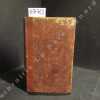
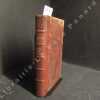
Bon état - Menus frottements sur les plats et les coins - Coin inférieur probablement recollé - Trace de mouillure sur le coin supérieur (sans incidence sur le texte)
Littérature, Voyages & Poésies
Paris Didier 1850 In-12 Forts 2 vol. in-12 forts, 504+336 pp, exemplaires non coupés, quelques faibles rousserus éparses. Dos insolés, frottés avec quelques manques de papier.
Dos Usés Brochés
AMPERE - OERSTED - ARAGO - BIOT - DAVY - FARADAY - G. et A. DE LA RIVE - FRESNEL - BARLOW - SAVARY - WEBER - ETC -- Société Française de Physique
Reference : 4807
Mémoires sur l'ELECTRODYNAMIQUE
P., Gauthier-Villars, 1885/1887, 2 VOLUMES in 8 reliés en demi-chagrin rouge et en demi-chagrin vert (reliures de l'époque), 7pp., 412pp. ; (2), 403pp.
EDITION ORIGINALE ---- Réunion en deux volumes, par la Société Française de physique, des mémoires publiés sur l'électrodynamique par AMPERE, OERSTED, ARAGO, BIOT, DAVY, FARADAY, G. et A. DE LA RIVE, FRESNEL, BARLOW, SAVARY, WEBER, ETC ---- "Ces mémoires sont rangés par ordre de date. Le premier volume commence par le mémoire d'OERSTED, publié le 21 Juillet 1820, et va jusqu'à la fin de 1823. Il renferme également les mémoires d'AMPERE, d'ARAGO, de BIOT, de DAVY, de FARADAY, etc... Ceux d'AMPERE tiennent naturellement la plus grande place. Les mémoires d'AMPERE postérieures à 1823 occupent également une grande partie du volume. On trouvera, à très peu près, dans ces deux volumes tout ce qui a été publié sur l'électrodynamique par l'illustre physicien. On trouvera également quelques morceaux restés inédits ou publiés seulement par extraits ainsi que DEUX NOTES INEDITES DE FRESNEL relatives au magnétisme...". (Avertissement) ---- OERSTED : Expérience relative à l'effet du conflit électrique sur l'aiguille aimantée -- AMPERE : De l'action exercée sur un courant électrique par un autre courant, le globe terrestre ou un aimant ; Mémoire sur l'expression mathématique des attractions et des répulsions électriques ; Analyse des mémoires lus à l'Académie les 11 et 26 Décembre 1820 et les 8 et 15 Janvier 1821 ; Extrait d'une lettre d'Ampère à M. Le Professeur De La Rive sur des expériences électromagnétiques ; Expériences relatives aux nouveaux phénomènes électrodynamique obtenus au mois de Décembre 1821 ; Réponse à la lettre de M. Van Beck, sur une nouvelle expérience électromagnétique ; Exposé sommaire des nouvelles expériences électromagnétiques faites par différents physiciens, depuis le mois de Mars 1821 ; Second mémoire sur la détermination de la formule qui représente l'action mutuelle de deux portions infiniment petites de conducteurs voltaïques ; Mémoire sur la théorie mathématique des phénomènes électro-dynamiques, uniquement déduite de l'expérience, dans lequel se trouvent réunis les mémoires que M. Ampère a communiqués à l'Académie royale des Sciences, dans les séances des 4 et 26 Décembre 1820, 10 Juin 1822, 22 Décembre 1823, 12 Septembre et 28 Novembre 1825... -- ARAGO : Expériences relatives à l'aimantation du fer et de l'acier par l'action du courant voltaïque - Davy : Sur les phénomènes magnétiques produits par l'électricité ; Nouvelles recherches sur les phénomènes magnétiques produits par l'électricité . Sur un nouveau phénomène électromagnétique -- FRESNEL : Note sur des essais ayant pour but de décomposer l'eau avec un aimant ; Comparaison de la supposition des courants autour de l'axe avec celle des courants autour de chaque molécule ; Deuxième note sur l'hypothèse des courants particulaires -- BIOT & SAVARY : Sur l'aimantation imprimée aux métaux par l'électricité en mouvement -- G. DE LA RIVE : Notice sur quelques expériences électromagnétiques -- FARADAY : mémoire sur les mouvements électromagnétiques et la théorie du magnétisme ; notes d'Ampère sur le mémoire de Faraday -- BARLOW : Sur une expérience électromagnétique curieuse - G. DE LA RIVE : Lettre à M. Arago sur de nouvelles expériences relatives aux actions des courants galvaniques - A. De La Rive : Mémoire sur l'action qu'exerce le globe terrestre sur une portion de circuit voltaïque -- SAVARY, WEBER - ETC**4807/M2
André-Marie Ampère. 4e édition publiée à l'occasion du centenaire de sa mort.
Lyon, Vitte, 1936, in 8 broché, 270 pages, non coupé, gravures hors-texte ; couverture illustrée (manque angulaire en pied du plat supérieur).
...................... Photos sur demande ...................
Phone number : 04 77 32 63 69
L'histoire Romaine à Rome - tome premier
Michel Lévy 1868 500 pages in8. 1868. Relié. 500 pages.
Etat Correct couverture défraîchie bords frottés intérieur propre tampons ex libris
André-Marie et Jean-Jacques Ampère. Correspondance et souvenirs. (de 1805 à 1864). Recueillis par Mme H. [Chevreux]
Paris, Hetzel, 1875 2 vol. in-12, 508 pp. et 461 pp., broché. Rousseurs.
Tulard, 20. "Dans l'édition de la correspondance de 1805 à 1864 figure le journal de Bredin, ami d'Ampère, qui donne des détails sur le mariage du savant, son séjour à Lyon, son entrée à l'Institut en 1814". - - VENTE PAR CORRESPONDANCE UNIQUEMENT - LIEN DE PAIEMENT, NOUS CONSULTER.
Journal et correspondance.
J. Hetzel et Cie. 1873. In-12. Broché. A relier, Tâchée, Dos abîmé, Quelques rousseurs. 368 pages - papier jauni, pliures sur les plats, 1er plat rogné en coin en pied, dos partiellement désolidarisé, coiffes abimées, coins frottés, ouvrage partiellement désolidarisé.. . . . Classification Dewey : 846-Lettres, correspondance littéraire
Recueillis par Mme H. Cheuvreaux. Classification Dewey : 846-Lettres, correspondance littéraire
Journal et correspondance de André-Marie Ampère.
J.Hetzel et cie. 1872. In-12. Broché. Etat d'usage, Couv. défraîchie, Dos satisfaisant, Quelques rousseurs. 368 + 16 pages - couverture muette - manque en tête sur la page de titre, la page de faux titre.. . . . Classification Dewey : 840.08-XIX ème siècle
Recueillis par Mme H.C. Classification Dewey : 840.08-XIX ème siècle
JOURNAL ET CORRESPONDANCE DE ANDRÉ-MARIE AMPÈRE Recueillis par Mme H. C. [ Cheuvreaux ]
Paris J. Hetzel et Cie, Editeurs 1872 in 12 (18,5x12) 1 volume reliure demi chagrin vert de l'époque, dos à nerfs souligné de filets dorés, et orné de beaux fleurons dorés, 368 pages, quelques rousseurs éparses au début et à la fin du volume. Bel exemplaire ( Photographies sur demande / We can send pictures of this book on simple request )
Très bon Couverture rigide
Journal et correspondance. Recueillis par madame H. C. [Cheuvreux]
Paris, Hetzel, 1872 in-12, VI-368 pp., reliure d’époque demi cuir, dos à nerfs, pièce de titre dorée. Coiffes frottées, usure sur la bordure du plat, coins émoussés, intérieur frais.
![Journal et correspondance. Recueillis par madame H. C. [Cheuvreux]. AMPÈRE (André-Marie)](https://static.livre-rare-book.com/pictures/SFA/2752_1_thumb.jpg)
![Journal et correspondance. Recueillis par madame H. C. [Cheuvreux]. AMPÈRE (André-Marie)](https://static.livre-rare-book.com/pictures/SFA/2752_2_thumb.jpg)
![Journal et correspondance. Recueillis par madame H. C. [Cheuvreux]. AMPÈRE (André-Marie)](https://static.livre-rare-book.com/pictures/SFA/2752_3_thumb.jpg)
Edition originale des souvenirs du célèbre mathématicien lyonnais (1775-1836) qui donna son nom à l'unité de mesure de l'intensité électrique. Ne cherchez pas dans cet ouvrage un livre scientifique, mais plongez vous dans la vie d'un érudit à la période charnière que fût la fin du XVIIIème et le début du XIXème.
Journal et correspondance. Recueillis par madame H. C. [Cheuvreux]
Paris, Hetzel, 1872 in-12, VI-368 pp., demi-basane verte, dos lisse, filets dorés (rel. de l'époque). Dos passé, coiffes usées.
Fierro, 21 : "Intéresse surtout la vie privée d'Ampère."Tulard, 20. - - VENTE PAR CORRESPONDANCE UNIQUEMENT - LIEN DE PAIEMENT, NOUS CONSULTER.
Journal et correspondance. Recueillis par madame H. C. [Cheuvreux]
Paris, Hetzel, 1872 in-12, VI-368 pp., demi-maroquin noir à coins, dos à nerfs, tête marbrée (Thierry). Rousseurs.
Fierro, 21 : "Intéresse surtout la vie privée d'Ampère."Tulard, 20. - - VENTE PAR CORRESPONDANCE UNIQUEMENT - LIEN DE PAIEMENT, NOUS CONSULTER.

