 Write to the booksellers
-
Type
Book (1187)
Magazine (26)
Maps (3)
Photographs (2)
-
Latest
Last month (24)
Last week (2)
-
Language
English (2)
French (1216)
-
Century
16th (1)
17th (1)
18th (26)
19th (137)
20th (293)
21st (104)
-
Countries
Belgium (130)
Canada (3)
Denmark (107)
France (893)
Switzerland (85)
-
Syndicate
ALAC (2)
ILAB (239)
NVVA (61)
SLACES (61)
SLAM (68)
Itineraire au pays du matin calme
Éditions des Écrivains 1998 422 pages in8. 1998. broché. 422 pages. Récit de voyage de Guy Millet Cornetto décrivant son parcours et ses découvertes en Corée du Sud surnommée 'le pays du matin calme' à travers une perspective personnelle et culturelle
Bon état
GYP. [Comtesse de MARTEL DE JANVILLE, née Sybille-M. G. A de RIQUETTI DE MIRABEAU).
Reference : 18447
BOB AU SALON DE 1889. Dessins de Bob. Deuxième édition.
Paris, Calmann-Lévy, 1889. Grand in-8 ; 136 pp. Pleine toile bleue Bradel, pièce de titre noire, couvertures imprimées conservées.
" Pièce de théâtre " brodée " sur le thème du Salon, où l'on retrouve les noms de tous les artistes de l'époque, commentés et caricaturés par Gyp, qui inventa le personnage du petit Bob, gamin " gavroche ", pseudonyme qu'elle utilisait pour ses caricatures et ses dessins enfantins. Elle-même exposa au Salon". Gyp a peint, voire caricaturé, avec un rare don d'observation, le monde d'oisifs, de riches et de mondains, les parvenus et les aristocrates dégnérés de la haute société parisienne et cela, , non comme l'eût fait un auteur, car ses libertés de langage sont grandes, mais en spectateur narratif, malicieux sans nulle méchanceté, attaché surtout aux ridicules évidents de son entourage. 56 dessins en noir à pleine page, dessins caricaturaux et naïfs pleins d'humour. Bel exemplaire. Photos sur demande.
La psychanalyse revisitee
La Découverte 1988 205 pages collection textes à l'appui / série psychanalyse et société. 13x22x2cm. 1988. Broché. 205 pages. Dans 'La Psychanalyse revisitée' Gérard Mendel propose une relecture critique de la psychanalyse en la confrontant aux dimensions sociales et anthropologiques. L'ouvrage s'inscrit dans le projet plus large de l'auteur de développer une socio-psychanalyse qui interroge les liens entre psychisme individuel et structures sociales


Le roman du Grand Bazar.
Turquie, Istanbul Kitapligi, 1983. 19 x 27, 84 pp., 80 planches en couleurs et en N/B, broché, très bon état.
Légende des photos bilingue : français-turque.
Über ein neues, die Emanation des Thoriums gebendes radioaktives Element.
Leipzig, S. Hirzel, 1905. No wrappers. Issued in ""Jahrbuch der Radioaktivität und Elekronik"", 2. Bd., Heft 3. Hahn's paper: pp. 233-264. Enntire issue: pp. 233-262 (= entire ""Heft 3""). Fine and clean.
First printing of this paper, which is Hahn's Habilitation paper, announcung his discovery of a new element in residues from a Ceylon mineral called Thorianite. He later showed that it is an intermediate disintegration product.""Because the sample (thorianite) was small, Ramsay proposed that Hahn confirm Marie Curie's determination of the atomic weight of radium by preparing it in some organic compounds (thereby greatly increasing the total amount being examined) and calculating the atomic weight from the measured molecular weights. Chance sometimes favors the unprepared mind, and Hahn, who familiarized himself with only the basic of radioactivity, followed the prescribed separationss technique and found himself the discovere of a new radioelement: radiothorium. The explanation was that the material given him came from an ore which contained a large percentage of thorium in addition to the radium. Thus, upon completion of the chemical procedure, not all the activity was confined in the radium-containg fraction"" indeed the nes subsyance in the remainder was several hundred thousand times more active than thorium and ultimately yielded the characteristic one.minute halflife of thorium emanation.""(DSB VI, p. 15). - Weeks, Discovery of the Elements,p. 308 ff.).
HAHN Roger - Conférence donnée au Palais de la Découverte - [Hydro-physique]
Reference : 2133
(1967)
L'hydrodynamique au XVIIIe siècle. Aspects scientifiques et sociologiques D 100
1967 Paris Université de Paris Palais de la découverte 1965 Un volume in°12 broché 25 pages LR30
Très bon état bord de la couv un peu frottée N'hésitez pas à nous mettre dans vos favoris. Vous serez ainsi tenu au courant de nos nouveautés
HAEMASTATIQUE, OU LA STATIQUE DES ANIMAUX : expériences hydrauliques faites sur les animaux vivants. Avec un Recueil de quelques Expériences sur les Pierres que l'on trouve dans les reins et dans la vessie ; et des recherches sur la nature de ces concrétions irrégulières. Ouvrage très utile aux médecins ; traduit de l'anglais et augmenté de plusieurs remarques et de deux Dissertations de médecine, sur la Théorie de l'inflammation, et sur la Cause de la Fièvre ; par Mr. De Sauvages.
Genève, Herit. Cramer et Frères Philibert, 1744 ; in-4 ; plein veau fauve marbré, dos à nerfs décoré et doré, pièce de titre havane, tranches rouges (reliure de l'époque) ; XXII pp., (1) f. bl., 348 pp., 1 planche dépliante ; les 2 dernières pages sont un catalogue de livres du libraire.
Un mors supérieur fendillé et quelques épidermures sans gravité, très bon exemplaire.

Christophe Colomb
Paillart C. Broché 1895 In-8 (23x14.5 cm), dos broché, couverture illustrée, 240 pages, illustrations en noir ; couverture roussie, petit manque au dos, rares rousseurs dans le texte, assez bon état. Livraison a domicile (La Poste) ou en Mondial Relay sur simple demande.
Flic maison
1950 Editions Les Presses de la Cité - Collection "Mystère" - 1950 - In-12 broché, couverture signée Aslan - 221 pages
Bon état - Frottements sur les coins et les coiffes - Plis de lecture au dos Bon
L'Arabie heureuse
Éditions Albin Michel 1961 in8. 1961. Broché. Récit de l'explorateur Hans Helfritz l'un des premiers étrangers à avoir pénétré au cœur du Yémen décrivant ses pérégrinations et les découvertes qu'il a faites dans cette région appelée "Arabie Heureuse"
Très bon état
Essays and photographs. Some birds of the Canary Islands and South Africa.
London, R. H. Porter, 1901, lg. in-8vo, 212 p., + 92 photogr. plates, small legacy-stamp Dr. Guggisberg, orig. cloth, title gilt, corners a bit bumped, spine a bit spotted. very good copy.

(SLACES, NVVA)
Phone number : 41 (0)26 3223808
Petit Lapin perdu
PASTEL Sans date. Pour son anniversaire Petit Lapin qui se considère désormais comme un grand lapin est emmené par ses parents au parc d'attractions. Il réalise rapidement que cet endroit est immense et se retrouve séparé de sa famille confronté à son désir d'indépendance
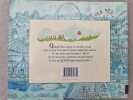
Bon état
HARTNER Dr W. - Conférence donnée au Palais de la Découverte - [Astronomie]
Reference : 2140
(1967)
Le problème de la planète Kaïd D 36
1967 Paris Université de Paris Palais de la découverte 1955 Un volume in°12 broché 23 pages LR30
![Le problème de la planète Kaïd D 36. HARTNER Dr W. - Conférence donnée au Palais de la Découverte - [Astronomie]](https://static.livre-rare-book.com/pictures/RLI/2140_1_thumb.jpg)
Très bon état bord de la couv un peu frottée N'hésitez pas à nous mettre dans vos favoris. Vous serez ainsi tenu au courant de nos nouveautés
Histoire politique et littéraire de LA PRESSE avec une introduction historique sur les ORIGINES DU JOURNAL et la BIBLIOGRPHIE GENERALE DES JOURNAUX depuis leur origine par Eugène HATIN.
Paris, Poulet-Malassis et de Broise, 1859-1861. 7 volumes in-12, demi-percaline grise, dos lisse, auteur titre et tomaison en lettres dorées, (reliure époque). T. 1. XXXII-(préface)-475 pp. T. 2. 479 pp. T. 3. 512 pp. T. 4. 466 pp. T. 5. 482[1]. T. 6. 550 pp. T. 7. 606 pp. Pour chaque tome : 3 ff-(1 f blanc, faux-titre et titre).
Eugène Louis Hatin, né à Auxerre le 8 septembre 1809 et mort à Paris le 16 septembre 1893, est un historien, journaliste et bibliographe français. Son travail considérable de lHistoire politique et littéraire de la presse en France a été considéré comme nayant guère déquivalent à létranger. Sa Bibliographie de la presse est un recueil précieux abondant en renseignements curieux.Sept volumes sur 8. Le tome 7 s'arrête à La Presse sous L'Empire. (Le Publiciste - Journal des Débats - Journal de Paris - Le Spectateur du Nord).Edition originale. Bons exemplaires rares. Photos sur demande.
Le Sénégal
in 8 broché couverture illustrée en couleurs (dos et premier plat) Faux-titre, frontispice, titre, 240 pages, illustrations hors-texte et dans le texte. Paris H. Lecène & H OUDIN éditeurs, 1887. Rousseurs, principalement en début et fin de volume.
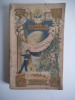
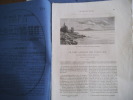
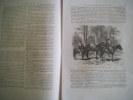
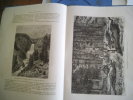
Le parc national des Etats Unis 1870-1871
ouvrage complet en 4 livraisons de 16 pages chacune. 48 illustrations dans le texte et à pleine page, une carte. Hachette & Cie 1874 Le Tour du Monde livraisons 722-723-724-725,avec les couvertures de livraison(2 avec des déchirures)
Lumieres sur la Gaule
Plon, collection "Les recentes decouvertes archeologiques", 1960. Format 14x20 cm, reliure souple sous jaquette illustree, 335 pages. Jaquette sale.Bon etat, petites traces d'usage sur un livre d'occasion.
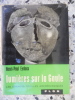
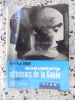
Monuments et trésors de la Gaule
Plon, collection "Les recentes decouvertes archeologiques", 1958. Format 14x20 cm, reliure souple sous jaquette illustree, 265 pages. Jaquette sale.Bon etat, petites traces d'usage sur un livre d'occasion.
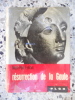
Resurrection de la Gaule
Plon, collection "Les grandes fouilles archeologiques", 1961. Format 14x20 cm, reliure souple sous jaquette illustree, 420 pages. Jaquette sale.Bon etat, petites traces d'usage sur un livre d'occasion.
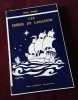
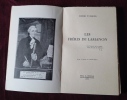
Les frères de Lamanon, Essai biographique Henri Teissier , Edition du Régional 1960 , Voyages de La Pérouse , Régionalisme , Salon de Provence , Histoire , Navigation , Découverte , Biographie
Avec 1 carte et 5 hors texte. Broché, couverture illustrée d'un dessin du peintre A. Cheinet, très bon état, 159 p.
Franco de port pour la France en en Mondial Relay ou Shop2shop, remise en conséquence si vous désirez un autre mode de livraison et pour l'international
La Conquête des Pôles- huit reproductions et six cartes
Gallimard 1940 347 pages in8. 1940. broché. 347 pages. La Conquête des pôles d'Henry Bidou retrace l'histoire dramatique de l'exploration des régions polaires présentée comme une quête humaine fondamentale pour prendre possession des espaces les plus hostiles de la planète. L'ouvrage examine l'évolution de cette conquête à travers les âges depuis les motivations instinctives jusqu'aux expéditions modernes
Bon état
Itinéraires romans en Normandie
Broché, 96 pages, paru en 1979 chez Zodiaque, livre en très bon état général.
Facts in reference to the Spark, &c from along conductor uniting the poles of a Galvanic Battery.
Philadelphia, Fraklin Institute, 1835. 8vo. Later full green cloth. Tome-and titlelabels in leather with gilt lettering on spine. In: ""Journal of the Franklin Institute of the State of Pennsylvania... Edited by Thomas P. Jones"", Vol. XV. New series. Engraved frontisp. (2),446 pp., 2 folded engraved plates and 2 folded engraved maps. (Entire volume offered). Henry's announcement: pp. 169-70. A stamp to verso of frontispiece (Library of Congress duplicate stamp).
First printing of this importent paper, the first to describe in detail how the phenomena of Self-Induction was discovered. Henry discovered the induction phenomena - how an electric current in one coil may set up a current in the other through the development of the magnetic field - independently of Faraday, but Faraday was first to publish on electromagnetic induction. Henry's experiments with induction led him to his importent discovery of SELF-INDUCTION, which is the phenomenon in which a change in electric current in a coil produces an induced emf in the coil itself. This phenomenon was also discovered inependently by Faraday, but this time Henry had published first. The basic unit of inductance was to be called ""the Henry"". Relevant to the controversy between Faraday and Henry is the following statement by A D Bache, Secretary of the American Philosophical Society introducing an abstract of Henry in J Franklyn Inst. 1835 pp. 169-70 (H. Norman 1053 and the paper offerd): ""A memoir on this subject has been since submitted to the Society, containing an extension of the subject, the primary fact in relation to which was observed by Professor Henry as early as 1832, and announced by him in the American Journal of Science. Mr. Faraday having recently entered upon a similar train of observations, the immediate publication of the accompanying is important, that the prior claims of our fellow countryman may not be overlooked.""(Spark Museum).Magee ""Source Book in Physics"", p. 515.
On the Influence of a Spiral Conductor in increasing the Intensity of Electricity from a Galvanic Arrangement of a Single Pair, &c.
(London, Richard and John E. Taylor, 1837). No wrappers. Extracted fron ""Scientific Memoirs, selected from The Transactions of Foreign Academies of Science and Learned Societies. Edited by Richard Taylor."", Vol. I. Pp. 540-547.
Henry's milestone paper announcing his discovery of electrical self-induction. ""Henry independently discovered electro-magnetic induction and in this paper announced his discovery of electric self-induction, one of the prime properies of an electro-magnetic circuit. Henry was an eminent experimenter but was casual in publishing his findings with resulting lack of recognition of his contributions.""(Bern Dibner).Dibner ""Heralds of Sciece"", No.63.It was also printed the same year in ""Transactions of the American Philosophical Society, New Series, Vol. 5"". The paper was later printed in ""Philosophical Magazine"", 1840.""The direction of Henry’s thought became somewhat apparent in his 1835 paper (refers to the papers reading before the American Phil. Soc., febr. 6th, 1835) on the action of a spiral conductor in increasing the intensity of galvanic currents. The paper started out as an affirmation of Henry’s priority in the discovery of self-induction. He then combined induction proper (using Faraday’s findings and his own) with selfinduction to show how these produce a pattern of repulsions yielding an increased effect in spirals. He specifically linked these “magneto-electrical” results to the principles of static induction developed by Cavendish and Poisson. This explanation was then applied to Savary’s report of changes of polarity when magnetic needles were placed at varying distances from a wire in which a current was being transmitted (""Mémoire sur l’aimantation,"" in Annales de chimie et de physique, 34 [1827],. That is, currents appeared periodically in the air surrounding a current-bearing straight wire as a result of the actions of induction and self-induction."" (DSB).Wheeler Gift: 2724-2725a.
"HENRY, JOSEPH - THE DISCOVERY OF SELF-INDUCTION - GERMAN VERSION.
Reference : 44147
(1842)
Ueber elektro-dynamische Induction.
(Leipzig, Johann Ambrosius Barth, 1842). Without wrappers. In ""Annalen der Physik und Chemie. Hrsg. von J.C. Poggendorff"", Ergänzungsband 1, Stück 2. Pp. 193-384 a. 1 folded engraved plate. (The entire issue offered). Henry's paper: pp. 282-312.
First German version of Henry's description of his discovery of self-induction. He missed the credit for the discovery of induction to Faraday, but he had done the key experiment ahead of Faraday, but Faraday was the first to publish. But he is credited for the discovery of self-induction (1832) and Faraday discovered it independently two years later (1834).""In Henry's paper, however, he explained thet the electric current in a coil can induce another current not only in another coil but in itself. The actual current observed in the coil is, then, the combination of the original current and the induced current. This is called self induction.""(Isac Asimov).The issue contains further notable papers Michael Faraday's ""Vierzehnte Reihe von Experimental-Untersuchungen über Elektricität"", 2o-22. (Nos 1667-1748). Pp. 249-281. First German version. In this paper FARADAYamplifies his theory of electrostatic induction by making further use of the analogy with the induction of magnetism. Whittaker describes the paper as having ""THE FUNDAMENTAL EQUATION OF ELECTROSTATICS"", as modified in order to take into account the effect of the specific inductive capacity.""(Whittaker I, pp.187-89).

