 Write to the booksellers
-
Type
Book (1187)
Magazine (26)
Maps (3)
Photographs (2)
-
Latest
Last month (24)
Last week (1)
-
Language
English (2)
French (1216)
-
Century
16th (1)
17th (1)
18th (26)
19th (137)
20th (290)
21st (103)
-
Countries
Belgium (130)
Canada (3)
Denmark (107)
France (893)
Switzerland (85)
-
Syndicate
ALAC (2)
ILAB (238)
NVVA (61)
SLACES (61)
SLAM (67)
Les Hommes Fossiles. Éléments de paléontologie humaine
- reliure - Editions Masson et Cie, Paris - Quatrième édition - 1952 - Fort in-8 (25 x 17) reliure pleine toile - 583 pages - Riche iconographie en noir et blanc (299 figures)


Bon état - Toile très légèrement ternie sur les coins ainsi qu'en haut et bas du dos - Petite inscription au stylo en haut de la première page de garde
La Terre-Sainte. Voyage dans l'Arabie Pétrée, La Judée, La Samarie, La Galilée et La Syrie, par M. L'Abbé J.J. Bourassé.
Nombreuses planches hors-texte sur bois en noir et blanc. Tours, Ad. Mame et Cie, Imprimerurs-Libraires, 1860. Grand in-8 (25x16cm) relié demi chagrin rouge, dos à faux-nerfs et très orné fleurons dorés, tranches dorées, coiffes avec éraflures, et traces de salissures sur les gardes de couleurs. 508pp. Sans rousseurs intérieur.
Bon état intérieur.
Paysages de la sagesse.
Paris, Editions Herscher, 1981. 25 x 27, sans pagination, 90 planches en couleurs, reliure d'édition pleine toile + jaquette, très bon état.
photographies de Charles Luke Powell.
La Chasse Au Lezard
Le seuil / Points 1990 269 pages in8. 1990. Broché jaquette. 269 pages. Premier recueil de seize nouvelles de William Boyd explorant souvent les relations entre hommes et femmes les jeux d'attirance et les découvertes sexuelles d'adolescents et d'étudiants avec une vision désabusée et pessimiste. Les histoires qualifiées de mini-romans mettent en scène des personnages des deux côtés de l'Atlantique et démontrent la diversité du talent d'écriture de l'auteur
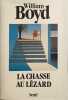
Bon état
Boyer Laure Barillé Albert Barbaud Jean Jauze Jean-Gabriel
Reference : 500102076
(2017)
ISBN : 9782215151586
Il était une fois... les explorateurs (+ DVD): Avec 2 épisodes de la série en DVD : Les premiers explorateurs ; Magellan
FLEURUS 2017 48 pages 21 6x24 2x1cm. 2017. Broché. 48 pages.
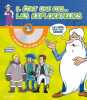
Comme neuf - ouvrage issu de destockage jamais lu mais pouvant présenter d'infimes marques de stockage et/ou de manipulation - expédié soigneusement dans emballage adapté
Boyer Laure Barillé Albert Barbaud Jean Jauze Jean-Gabriel
Reference : 500113121
(2017)
ISBN : 9782215151586
Il était une fois... les explorateurs (+ DVD): Avec 2 épisodes de la série en DVD : Les premiers explorateurs ; Magellan
FLEURUS 2017 48 pages 21 6x24 2x1cm. 2017. Broché. 48 pages.
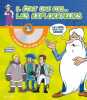
Très bon état
Précis historique et observations sur les effets du ROB ANTISIPHILITIQUE
pour servir de manuel aux malades qui veulent se traiter par ce remède,nouvelle édition revue et corrigée in 8 broché,couverture muette d’attente.Faux-titre, VIII,173 pages,A Paris chez l’auteur rue de Varennes n°10.1821
En Ecosse. Collection : Guides Hachette/Visa.
Paris, Hachette, 1990. 12 x 22, 256 pp., illustrations en couleurs, cartes et plans en couleurs, broché, bon état.
Le tour du monde en famille.
Voyage de la famille BRASSEY dans son yacht Le SUNBEAM raconté par la mère. Traduit de l’anglais par Richard VIOT. In 4 reliure éditeur plaine toile rouge, plaque dorée, avec titre au premier plat, reliure de SOUZE. 220x300mm. Faux-titre, frontispice, titre, 400 pages, illustrations dans le texte, tranches dorées. Tours MAME é fils 1887. Caraïbe, Amérique du Sud, Pacifique, Afrique, Méditerranée, Singapour, Ceylan, Brésil, Argentine, Polynésie, Japon, Chine, Rousseurs éparses, plus concentrées en fin de volume. Petite déchirure angle inférieur droit de la première page de garde. Sinon Bon exemplaire.
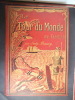
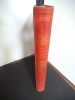
Voyage d’une famille à travers la méditerranée
à bord de son yatch le Sunbeam racontés par la mère. Traduit de l’anglais par J BUTLER. In 8 pleine toile rouge de l’éditeur à décor passe partout, titre dans cartouche. Faux-titre, frontispice sous serpente, titre, 302 pages, tranches dorées, 127 illustrations par A.Y BINGHAM dans le texte, hors-texte, en tête, culs de lampe. Paris librairie d’éducation Nationale sans date (1902.) Dos insolé. BRASSEY Lady Voyage d’une famille à travers la méditerranée, à bord de son yatch le Sunbeam racontés par la mère. Traduit de l’anglais par J BUTLER. In 8 pleine toile rouge de l’éditeur à décor passe partout, titre dans cartouche. Faux-titre, frontispice sous serpente, titre, 302 pages, tranches dorées, 127 illustrations par A.Y BINGHAM dans le texte, hors-texte, en tête, culs de lampe. Paris librairie d’éducation Nationale sans date (1902.) Dos insolé. 45€ premier voyage, Constantinople et les îles Ioniennes- second voyage Chypre, Constantinople.
"BRAUN, FERDINAND. - THE DISCOVERY OF SEMICONDUCTOR RECTIFIER EFFECT.
Reference : 49327
(1874)
Ueber die Stromleitung durch Schwefelmetalle.
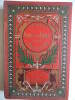
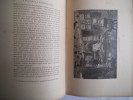
Leipzig, Johann Ambrosius Barth, 1874. 8vo. Contemp. hcalf. 5 raised bands, gilt spine and gilt lettering to spine. A few scratches to spine. Small stamp on verso of first -and general- titlepage. In: ""Annalen der Physik und Chemie. Hrsg. von J.C. Poggendorff"", Sechste Reihe Bd. 3, (= Poggendorff Bd. 153). X,636 pp., 4 plates. (Entire volume offered). Braun's paper: pp. 556-563.
First printing of Brown's importent paper in which he described his discovery of a semiconductor diode, noting that electrical currents flows freely in only one direction at the contact between a metal point and a galena crystal.""In 1874 Braun published the results of his research on mineral metal sulfides. He found that these crystals conducted electric currents in only one direction. This information was important in electrical research and in measuring another property of substances, the electrical conductivity, but Braun’s discovery did not have immediate practical application. In the early twentieth century the principle that Braun had discovered was employed in crystal radio receivers.""(DSB).The Nobel Prize in Physics 1909 was awarded jointly to Guglielmo Marconi and Karl Ferdinand Braun ""in recognition of their contributions to the development of wireless telegraphy"".

Breslin Jimmy Degachi Souad Shelledy Maxime
Reference : 500115308
(2020)
ISBN : 9791033904748
La balance: Grandeur et décadence d'un gangster
HARPERCOLLINS 2020 288 pages 13 9x20 5x2 3cm. 2020. Broché. 288 pages.
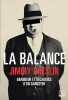
Très bon état
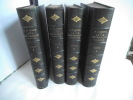
La vie des animaux illustrée.
4 tomes en 4 volumes in 4 demi-chagrin vert à nerfs, titre, initiales en pied dorés, filets à froid. Edition française revue par Z.GERBE Description populaire du règne animal. Tome 1 : mammifères caractères, mœurs, chasses, combats, captivité, domesticité, acclimatation, usages. Faux-titre, titre illustré, 765 pages, texte sur 2 colonnes, nombreuses illustrations en tête à mi page et hors-texte. Tome 2 : Les mammifères faux-titre, titre, 870 pages, 2 pages de catalogue, 382 illustrations dans le texte, 21 hors-texte. Paris J.B Baillière & fils libraires éditeurs sans date . Coupes frottées. Tome 3 : Les oiseaux (pas de page de titre) XXVI, 791 pages, 1 page de catalogue, 213 illustrations dans le texte et 19 hors-texte. Tome 4 : Les oiseaux pas de page de titre, 905 pages. Nombreuses gravures à mi page et hors-texte.. J.B Baillière & fils libraires éditeurs sans date. Coupes frottées. Rousseurs habituelles, fortes à certaines pages
Sur les pistes de l'A.E.F.
1945 Editions Alsatia - 1945 - Grand in-8, broché, sous jaquette illustrée - 285 p. - Reproductions photographiques hors texte en N&B
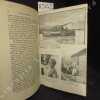
Bon état - Départ de fente au dos de l'ouvrage - Jaquette légèrement défraîchie (déchirures sans manque, frottements) Bon
La resurrection des villes mortes - Tome 1
Plon, collection "D'un monde a l'autre", 1959. Format 14x20 cm, reliure souple, il manque la jaquette, 342 pages.Bon etat, petites traces d'usage sur un livre d'occasion.
Jean La Poudre
1925 Editions Boivin et Cie, collection "Les Romans de la Jeunesse" N° 12 - 1925 - In-8, broché couverture illustrée - 95 pages
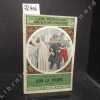
Couverture un peu salie avec d'infimes rousseurs, dos frotté et émoussé sur le bas, sinon bon état.
Paris intime
in 12 demi cuir bleu à nerfs,titre,fers dorés,faux-titre, titre,332 pages,illustrations en noir dans le texte,Ernest Flammarion éditeur sans date,bon exemplaire
La belle histoire de LYAUTEY l’Africain
in 4 broché portrait de Lyautey, en couleurs,contrecollé sur le premier plat de la couverture,introduction d’André MAUROIS,1 feuillet,faux-titre,titre,XV,illustration photo. Sur papier couché.153 pages,2 feuillets de table des chapitre,table des illustrations.Editions Pau Duval sans date(1934)
"BROGLIE (DE BROGLIE), LOUIS DE . - DISCOVERY OF THE WAVE THEORY OF MATTER AND CREATION OF WAVE-MECHANICS
Reference : 49718
(1923)
Ondes et quanta. Note de M. Louis de Broglie, présentée par M. Jean Perrin. (Séance du 10 Septembre 1923). (+) Quanta de lumière, diffraction et interférences. Note de M. Louis de Broglie, transmise par M. Jean Perrin. (Séance du 24 Septembre 1923). (...
Paris, Gauthier-Villars et Cie, 1923. 4to. Bound in one contemp. full buckram. Spines gilt and with gilt lettering. In: ""Comptes Rendus Hebdomadaires des Séances de L'Academie des Sciences"", Tome 177. Bound with orig. printed front-wrapper to No. 1, half-title and title-page to vol. 177. 1513 pp. (Entire volume offered). De Broglie's papers: pp. 507-510, pp. 548-551 a. pp. 630-32. Clean and fine. A punched stamp on foot of title-page.
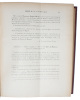
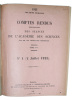
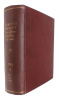
First edition of these papers which ESTABLISHED A NEW ERA IN PHYSICS by introducing the epochal new principle that particle-wave duality should apply not only to radiation but also to matter and thus CREATING QUANTUM MECHANICS. These 3 papers were extended to form his doctoral thesis of 1924 ""Recherches sur la Théorie des Quanta.""De Broglie relates ""After long reflection in solitude and meditation, I suddenly had the idea, during the year 1923, that the discovery made by Einstein in 1905 should be generalized by extending it to all material particles and notably to electrons"" (Preface to his PhD thesis 1924).""He made the leap in his September 10, 1923, paper: E=hv should hold not only for photons but also for electrons, to which he assigns a 'fictitious associated wave'. In his September 24 paper, he indicated the direction in which one 'should seek experimental confirmations of our ideas': a stream of electrons traversing an aperture whose dimensions are small compared with the wavelenght of the electron waves 'should show diffraction phenomena' .""(Pais ""Subtle is the Lord"", pp. 425-436).In the third paper (October 8) he discusses ""The interplay between the propagation of the particle and of the waves could be expressed in more formal terms as an identity between the fundamental variational principles of Pierre de Fermat (rays), and Pierre Louis Maupertuis (particles) as de Broglie discussed it further in his last communication . Therein he also considered some thermodynamic consequences of his generalized wave-particle duality. He showed in particular how one could, using Lord Rayleigh’s 1900 formula for the number of stationary modes for phase waves, obtain Planck’s division of the mechanical phase space into quantum cells.Louis de Broglie achieved a worldwide reputation for his discovery of the wave theory of matter, for which he received the Nobel Prize for physics in 1929. His work was extended into a full-fledged wave mechanics by Erwin Schrödinger and thus contributed to the creation of quantum mechanics. After an early attempt to propose a deterministic interpretation of his theory, de Broglie joined the Copenhagen school’s mainstream noncausal interpretation of the quantum theory.""(DSB).""This idea [i.e. de Broglie's that matter might behave as waves] was tested and confirmed by Davisson and Germer in 1927... Thus the duality of both light and matter had been established, and physicists had to come to terms with fundamental particles which defied simple theories and demanded two sets of 'complementary' descriptions, each applicable under certain circumstances, but incompatible with one another."" (Printing and the Mind of Man, 417).
"BROGLIE (DEBROGLIE), LOUIS de. - DISCOVERY OF THE WAVE THEORY OF MATTER AND CREATION OF WAVE-MECHANICS.
Reference : 46949
(1923)
Ondes et quanta. Note de M. Louis de Broglie, présentée par M. Jean Perrin. (Séance du 10 Septembre 1923). (+) Quanta de lumière, diffraction et interférences. Note de M. Louis de Broglie, transmise par M. Jean Perrin. (Séance du 24 Septembre 1923). (...
Paris, Gauthier-Villars et Cie, 1923. 4to. Bound in 2 contemp. full cloth. Spines gilt and with gilt lettering. In: ""Comptes Rendus Hebdomadaires des Séances de L'Academie des Sciences"", Tome 177. With htitle a. titlepage. 1513 pp. (Entire volume offered). De Broglie's papers: pp. 507-510, pp. 548-551 a. pp. 630-32. Clean and fine. A stamp to verso of titlepage.
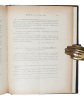
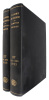
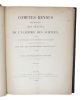
First edition of these papers which ESTABLISHED A NEW ERA IN PHYSICS by introducing the epochal new principle that particle-wave duality should apply not only to radiation but also to matter and thus CREATING QUANTUM MECHANICS. These 3 papers were extended to form his doctoral thesis of 1924 ""Recherches sur la Théorie des Quanta.""De Broglie relates ""After long reflection in solitude and meditation, I suddenly had the idea, during the year 1923, that the discovery made by Einstein in 1905 should be generalized by extending it to all material particles and notably to electrons"" (Preface to his PhD thesis 1924).""He made the leap in his September 10, 1923, paper: E=hv should hold not only for photons but also for electrons, to which he assigns a 'fictitious associated wave'. In his September 24 paper, he indicated the direction in which one 'should seek experimental confirmations of our ideas': a stream of electrons traversing an aperture whose dimensions are small compared with the wavelenght of the electron waves 'should show diffraction phenomena' .""(Pais ""Subtle is the Lord"", pp. 425-436).In the third paper (October 8) he discusses ""The interplay between the propagation of the particle and of the waves could be expressed in more formal terms as an identity between the fundamental variational principles of Pierre de Fermat (rays), and Pierre Louis Maupertuis (particles) as de Broglie discussed it further in his last communication . Therein he also considered some thermodynamic consequences of his generalized wave-particle duality. He showed in particular how one could, using Lord Rayleigh’s 1900 formula for the number of stationary modes for phase waves, obtain Planck’s division of the mechanical phase space into quantum cells.Louis de Broglie achieved a worldwide reputation for his discovery of the wave theory of matter, for which he received the Nobel Prize for physics in 1929. His work was extended into a full-fledged wave mechanics by Erwin Schrödinger and thus contributed to the creation of quantum mechanics. After an early attempt to propose a deterministic interpretation of his theory, de Broglie joined the Copenhagen school’s mainstream noncausal interpretation of the quantum theory.""(DSB).""This idea [i.e. de Broglie's that matter might behave as waves] was tested and confirmed by Davisson and Germer in 1927... Thus the duality of both light and matter had been established, and physicists had to come to terms with fundamental particles which defied simple theories and demanded two sets of 'complementary' descriptions, each applicable under certain circumstances, but incompatible with one another."" (Printing and the Mind of Man, 417).
Tibesti. Journal de route du voyage P. Brossette - G. Cavot dans le 83642, Mars-Avril 1953.
1954 Editions A.I.P.P.E. - 1954 - Edition sur Roto blanc des Papeteries Barjon et encarts sur Couché des Papeteries Navarre limitée à 500 exemplaires, n°381 - In-8, broché, couverture illustrée - 38 p. - Riche iconographie hors texte en N&B - Ouvrage non coupé (jamais lu)
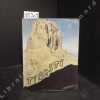
Bon état - Légers plis et frottements sur la 1ère de couverture
Mikroskopische Beobachtungen über die im Pollen der Pflanzen enthaltenen Partikeln, und über das allgemeine Vorkommen activer Molecüle in organischen und unorganischen Körpern"" (Unterdem Titel: ""A brief Account of Microscopical Observations made in th...
Leipzig, Johann Ambrosius Barth, 1828. Without wrappers as issued in ""Annalen der Physik und Chemie. Hrsg.von Poggendorff"", Bd. 14, Zweites Stück. (=Jahrgang 1828, zehntes Stück). Pp. 191-306 a. 3 engraved plates. (the entire issue offered (Heft 2) together with the titlepage to 14. Band). Brown's paper: pp. 294-313. Clean and fine. Small stamp on verso of titlepage.
First appearance in German of this monumental paper in atomic theory and kinematics, as it was the first evidence for atomism that was an observation rather than a deduction from abstract principles.""In 1827 as he was viewing a suspension of pollen in Water under the microscope, he noted that the individual grains were moving about irregularly. This, he thought, was the result of the life hidden within the pollen grains. However, when he studied dye particles (indubitably nin-livin) suspended in water, he found the same erratic motion. This has been called ""Brownian motion"" ever since and Brown could merely report on the observation. He had no explanation for it. Nor had anyone else until the development of the kinetic theory of gases by men such as Maxwell a generation later. It seemed plain. after Maxwell and especially after the work of Einstein and Perrin a half century after Maxwell, that the Brownian Motion was actually a visible effect of the fact that water was composed of particles. It was the first evidence for atomism that was an observation rather than a deduction."" (Asimov).The issue contains other importent papers by C.. Naumann, G. Magnus, Th. Saussure ""Kohlensäuregas in der Atmosphäre"" andothers.PMM: 290 (the English paper from 1828) - Sparrow, Milestones of Science No 31. - Magie ""A Source Book in Physics p. 251-255. - Dibner, Heralds of Science No 156.
JAN ROMBOUTS. THE DISCOVERY OF AN EARLY SIXTEENTH-CENTURY MASTER IN LOUVAIN,
Turnhout, Brepols, 2011 Bound, black cloth, illustrated paper dustjacket, 210 x 305mm., 312 p., 237 b/w ill. 48 colour illustrations. . ISBN 9782503525693.
This monograph introduces the sixteenth-century Louvain artist Jan Rombouts (c. 1480 - 1535), whose oeuvre was previously assigned to Jan van Rillaer. Debates concerning Rombouts's identity are explored in detail by means of reinterpretation of published archival documents and the discovery of numerous new documents. The publication of the sources, most with full transcriptions, provides a sound basis for the author's arguments supporting the new identification.The remaining oeuvre of the artist, as it is known today, comprises engravings and paintings. This monograph argues for the expansion of Rombouts's oeuvre with some dozen stained-glass windows, roundels and a drawn design for a church window, while suggestions are put forth for other possible attributions. Attention is given to the historical context for Rombouts's activity as a glass painter, and the attributions of these works, none of which are monogrammed, are made by comparing their style with that of works securely attributed to the artist. This section is backed up by numerous illustrations of the windows, many of which are quite inaccessible. Finally, a discussion of archival sources concerning the Louvain confraternity of St Luke and commissions for works of art to local artists in the period covered by the book, form the rich historical background against which Jan Rombouts executed his oeuvre of engravings, paintings, roundels and stained-glass windows. The size, individuality, diversity and craftsmanship of this oeuvre enable us to finally identify and place him securely within the history of south Netherlandish art of his time. New book.
National Géographic - 100 ans d'aventures et de découvertes
PARIS, Nathan Image - 1988 - In-4 - Reliure toile éditeur sous jaquette illustrée en couleurs - Gardes illustrées - Très nombreuses illustrations NB et en couleurs, dans le texte et HT, certaines PP et double page - Bibliographie, index - 483 pages - Très bel exemplaire, comme neuf
Cnformément à nos conditions générales de vente :Les frais de port sont affichés à titre indicatif. Il se peut que nous devions vous contacter pour vous informer du coût de laffranchissement supplémentaire en fonction du poids et du nombre de livres, surtout pour les envois internationaux Cependant vu l'augmentation des tarifs postaux à l'internationale, nous pouvons expédier les ouvrages en point relais MONDIAL RELAY pour les pays suivants : Allemagne, Autriche, Belgique, Espagne, Italie, Luxembourg, Pays-Bas, Pologne, et Portugal. Merci de nous indiquer en retour le point relais choisi ainsi que votre numéro de téléphone mobile & adresse Courriel pour assurer le suivi du colis.N'hésitez pas à nous interroger.In accordance with our general terms and conditions of sale:Shipping costs are displayed for informational purposes only. We may need to contact you to inform you of the additional postage costs depending on the weight and number of books, especially for international shipments.However, given the increase in international postal rates, we can ship books via Mondial Relay to the following countries: Germany, Austria, Belgium, Spain, Italy, Luxembourg, Netherlands, Poland, and Portugal. Please provide us with your chosen Mondial Relay point, as well as your mobile phone number and email address to ensure package tracking.Please feel free to contact us with any questions

