Write to the booksellers
-
Type
Book (1375)
Magazine (14)
Music sheets (1)
-
Latest
Last month (27)
Last week (9)
-
Language
English (4)
French (1163)
Greek (1)
Hebrew (1)
Latin (1)
Russian (218)
Spanish (2)
-
Century
16th (2)
17th (30)
18th (58)
19th (78)
20th (411)
21st (41)
-
Countries
Belgium (53)
Canada (4)
Côte d'Ivoire (3)
Denmark (17)
France (980)
Germany (5)
Switzerland (107)
United Kingdom (1)
United States of America (220)
-
Syndicate
ALAC (3)
CLAM (4)
CLAQ (1)
CNE (3)
ILAB (444)
NVVA (17)
SLACES (17)
SLAM (396)
SNCAO (4)
N Bordeaux. 1809-1871. Banquier, homme de presse et financier important du XIXe sicle. L.A.S. J. Mirs Mon cher Henry . Bordeaux, 4 septembre 1839. 1/2 p. in-4.
04/09/1839 ...J'ai l'honneur de vous remettre ci-joint les avertissements de 1838 annots par les Percepteurs ; ils constatent qu'en 1838, j'ai fait accorder, Madame votre mre, F 89, 13 de diminution dont on lui a tenu compte dans le montant des contributions de la dite anne...

PRINCIPES DE LA CONSTTUTION DES BANQUES ET DE L'ORGANISATION DU CREDIT
IMPRIMERIE ADMINISTRATIVE DE PAUL DUPONT. 1865. In-8. Relié demi-cuir. Etat d'usage, Couv. légèrement passée, Coiffe en tête abîmée, Intérieur frais. 324 pages. Dos cuir marron à 4 nerfs, titres, fleurons et filets dorés, percaline marron. Tranche poivrée.. . . . Classification Dewey : 332-Banque (économie financière)

"Reliure signée ""Cercle de l'Union"". Classification Dewey : 332-Banque (économie financière)"
LES SOURIS poème
1818 plaquette orange (booklet) petit in-octavo, cartouche de titre - en pleine page - illustré sur la première de couverture (cartridge of title on full page illustrated on the front cover), cartouche en pleine page sur la quatrième de couverture justifiant de l'authenticité de l'exemplaire et signé par l'auteur (cartridge on full page on the back cover justifying authenticity of the specimen and signed by the author), couverture légèrement fanée (chipped cover), gouttière long papier (fore-edge - great paper), illustration : sur la page de titre (engraved title page), 58 pages, 1818 Au Mans Imprimerie de Fleuriot,
légèrement défraîchie (lightly fair condition)
Le Bourreau Du Cardinal De Richelieu : Isaac De Laffemas ( 1584-1657)
Paris Éditions Bossard 1929 In-8 178 pp
état D'usage Broché à raba
Monographies de Psychanalyse - Jacques Touzé, Nadine Amar, Gérard Bayle, Isaac Salem, Monique Dechaud-Ferbus, Simone decobert - Jacques Azoulay, Dominique Deyon, Vassilis Kapsambelis, Marc Hayat, Victor Souffrir, Roger Perron - Sous la direction de Josiane Chambrier, Roger Perron, Victor Souffir
Reference : 104887
Monographies de Psychanalyse : Psychose III. Pratiques
1999 - in-8 Broché - 171 pages
bon état
Arboles - Documentos secretos III.
Anaya & Mario Muchnik. 1996. In-8. Broché. Bon état, Couv. convenable, Dos satisfaisant, Intérieur frais. 129 pages - couverture contrepliée - une étiquette collée sur le 2ème plat - livre en espagnol.. . . . Classification Dewey : 460-Langues espagnole et portugaise

Classification Dewey : 460-Langues espagnole et portugaise
La fuga del mar.
del Taller de Mario Muchnik. 2000. In-8. Broché. Bon état, Couv. convenable, Dos satisfaisant, Intérieur frais. 215 pages - couverture contrepliée - livre en espagnol.. . . . Classification Dewey : 460-Langues espagnole et portugaise

Classification Dewey : 460-Langues espagnole et portugaise
Melatonin
NOVA SCIENCE PUBLISHERS INC
LIVRE A L’ETAT DE NEUF. EXPEDIE SOUS 3 JOURS OUVRES. NUMERO DE SUIVI COMMUNIQUE AVANT ENVOI, EMBALLAGE RENFORCE. EAN:9781600213748
La Terre des Patriarches ou le sud de la Palestine.
Lyon, Vitte et Perrussel, (imprimerie Alf. Louis Perrin), 1882-1883 ; 2 tomes in-16 (184 mm), brochés ; XXV, 414, [1] marque d'imprimeur ; XII, 213 pp., 3 planches hors texte dont 2 dépliantes (plans et carte) ; couverture gris-bleu.

Edition originale, exemplaire non coupé, tel que paru.Bethléhem, couvents latin, Grec et Arménien, Saint-Saba, Saint-Jean-du-Désert ; Hébron, le Haram, Bersabée, Es-Seba, Masada, A'in Djedy, Engaddy, Mer Morte, Sodome, Thékoa, Montagne des Francs, etc.Dos très légèrement passés, bel exemplaire très frais.
Mortensen Viggo Dunst Kirsten Isaac Oscar Amini Hossein
Reference : 500318152
ISBN : 5053083012564
Two faces of january [Blu-ray] (NEUF SOUS BLISTER)
Studio Canal 13 6x1 2x17cm. Sans date. blu_ray.

Neuf
Isaac Homel et son temps. Un pasteur martyr au XVIIème siecle (1620-1683).
Valence-sur Rhone, Imprimeries réunies, 1945 In-8, br., 2 ill. in-t.,16 pl. h.t.,carte in-fine, index, 230 pp. Musée du Désert en Cévennes, avec une lettre-préface de raoul Gout, illustré de 16 planches en h-t et dessins, gravures et carte en in-t.
couverture renforcee,cachets bibliotheque,bon état. Remise de 20% pour toutes commandes supérieures à 200 €
Osnovy tokarnogo dela. In Russian /Basics of turning
Short description: In Russian. Mukin, Isaac Moiseevich. Basics of turning. Moscow: edition and type. Trudreservizdat, 1947. You are welcome to reach out to us for a detailed description of the copies currently available. Delivery of this book may take longer than usual including extended processing and pre-shipping time, no expedited shipping is available. Please advise us if you have a set date or a deadline to receive your order.SKU5845752

Scarabs;the history, manufacture and religious symbolism of the Scarabaeus in Ancient Egypt, Phoenicia, Sardinia, Etruria, etc, also remarks on the learning, philosophy, arts, ethics, psychology, ideas as to the immortality of the soul, etc, of the ancient Egyptians, Phoenicians,
1894 N.Y- DAYTON,LEIPZIG, PARIS,1894 Hard Cover Very Good,xxvii+ 177 pages. Red cover, gold print, centurion holding stick on the cover, Unknown, Could be First edition,

Isaac Myer, LL. B. a member of the American Oriental Society, The American Numismatic and Archaeological Society, and others. Remise de 20% pour toutes commandes supérieures à 200 €
Mystery Writers of America - ASIMOV, Isaac (Introduction) - WILSON, Gahan (Illustrations)
Reference : 125331
(1993)
Polar de la table - Recettes du crime et du mystère
1993 Editions Encrage - N°18 de la collection "Travaux" dirigée par Alfu - 1993- In-8 cartonné, illustration en contrecollé sur le premier plat - 222 pages - Illustrations en N&B dans le texte


Bon état - Ex-libris sur le deuxième plat Bon
Sputnik fotolyubitelya. In Russian /Amateur satellite
Short description: In Russian. Naidis, Isaac Davidovich. Amateur photographer's satellite. Donetsk: Donbass, 1966. You are welcome to reach out to us for a detailed description of the copies currently available. Delivery of this book may take longer than usual including extended processing and pre-shipping time, no expedited shipping is available. Please advise us if you have a set date or a deadline to receive your order.SKU6414596

La vie quotidienne juive : Les rites et les fêtes
Editeurs Berg International 1993 127 pages 29x21x1cm. 1993. Broché. 127 pages.

Etat de Neuf
Le livre de ruth
Aide aux écoles juives juives 85 pages in8. Sans date. Broché. 85 pages. 17

Etat Correct
Jesus fils Unique du Pere. Coll.: Sources Chretiennes; Vol. 203.
Paris, Les Editions du Cerf, 1973, in-8vo, 242 p + 6 ff. + 1 carte dépl. brochure originale.

(SLACES, NVVA)
Phone number : 41 (0)26 3223808
?Arithmetica universalis ; sive de Compositione et Resolutione arithmetica cum commentario Johannis Castillionei
?Amsterdam, Marc-Michel Rey, 1761, , 2 vol. in-4 : [6]-XVIII-310-[1] pp. 32 pl. + [4]-288-[2]-134-[1] pp. 5 pl, Demi-chagrin noir, filets dorés sur les plats, dos à nefs orné de caissons dorés, tranches marbrées, Édition commentée par Giovanni di Castillione qui fut lui-même éditeur d'ouvrages de Newton. Elle comporte également au second volume l'Additamentum vel de Solutione et constructione Aequationum, &c. d'Halley et 9 petits traités de Colson, Moivre, Halley (2), Folkes, Campbell, Baermanno, Kaestner et Boscovich. Elle est illustrée de 37 planches hors-texte. L'Arithmétique de Newton est le texte qui établit la réputation du physicien anglais. Elle contient ses cours d'algèbre professés à Cambridge entre 1673 et 1683. Newton parvint à déterminer des valeurs approchées des racines numériques et établit les fondements de la théorie des fonctions de ces racines. Babson, 205; Gray 281. Petits frottements et épidermures, rousseurs, petits manques angulaires sans atteinte à 4 pl. et restaurations angulaires sans atteinte à 9 pl. du 1er vol. Ex-libris René Mariaux. Couverture rigide
Bon 2 vol. in-4 :
DE PHILOSOPHIAE NATURALIS PRINCIPIA MATHEMATICA ou PRINCIPIA MATHEMATICA (LES PRINCIPES MATHÉMATIQUES DE LA PHILOSOPHIE NATURELLE), traduction nouvelle en français, Postface et bibliographie établie par Marie-Françoise BIARNAIS, Préface de Stephen HAWKINS
Christian Bourgois, Paris, 1985
Un volume in-12, broché, couverture semi-rigide, 1er plat illustré, 376 pages, TRÈS BON ÉTAT [50987]
LA CHRONOLOGIE DES ANCIENS ROYAUMES CORRIGÉE à laquelle on a joint une Chronique abrégée, qui contient ce qui s'est passé anciennement en Europe, jusqu'à la conquête de la Perse par Alexandre le Grand.
1728 Paris, Martin, Coignard, Guerin, Montalant, 1728. In-quarto (190 X 246 mm) veau fauve brun, dos cinq nerfs, caissons dorés ornés aux petits fers, pièce de titre maroquin grenat, large frise dorée en queue, tranches rouges (reliure de l'époque) ; (20) ff. de titre, préface, catalogue des oeuvres de Newton et avertissement de l'éditeur anglais, 416 pages, (2) ff. de table, approbation, privilège et errata. Ex-libris tampon encre bleue en queue du feuillet de titre : «De Cayrol », répété sur le premier feuillet blanc, avec sa signature autographe.
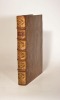
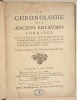
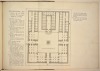
PREMIÈRE ÉDITION FRANCAISE de cette histoire des premières grandes civilisations, à savoir celles des Grecs, Egyptiens, Assyriens, Babyloniens, Mèdes et Perses. L'édition originale, posthume, a été publiée à Londres la même année, et traduite de l'anglais en français par François Granet et Marthan. COMPLET des TROIS PLANCHES dépliantes gravées sur cuivre, représentant des plans du Temple de Salomon. Composé par Isaac NEWTON (1643-1727) pour son propre délassement, ce système chronologique a été publié à son insu par un certain Abbé Conti, à qui Newton en avait confié une copie. Il se trouva ainsi obligé, contre son intention, d'en donner une édition plus fidèle, mais il ne put que la préparer, la mort le surprenant avant sa publication. Pierre Daunou (1761-1740) a donné dans la "Biographie Universelle" de Michaud une longue note érudite à propos de cet ouvrage, note qu'il conclut en ces termes : «En perdant sa base astronomique, le système chronologique de Newton ne repose plus que sur des considérations relatives à l'histoire, à la durée des générations et des règles, aux progrès des sociétés, des arts et de l'idolâtrie. Quelques graves que soient ces observations, et quelque incertitude qu'elles puissent répandre sur la chronologie vulgaire, elles ne suffisent point assurément pour en établir une nouvelle. Mais ce système est un très grand fait dans l'histoire de la science chronologique ; et il sert au moins à confirmer ce qu'à dit Varron, que l'âge historique ne commence qu'à la première olympiade » (Tome XXX, pages 397 à 400). Exemplaire de Louis-Nicolas-Jean-Joachim de CAYROL (1775-1859), député de 1820 à 1822, commissaire des guerres sous la Révolution, puis commissaire ordonnateur et sous-intendant militaire. Grand bibliophile, il fut l'ami de Gérard de Nerval. BEL EXEMPLAIRE, conservé dans sa reliure de l'époque. NICE COPY. PICTURES AND MORE DETAILS ON REQUEST.
La Methode des Fluxions, et des Suites Infinies Par le Chevalier Newton. (Translated by G. Louis Le Clerc, ount de Buffon). - [THE CALCULUS - THE INFINITESIMAL METHOD]
Paris, De Bure, 1740. 4to. Contemporary half calf, raised bands, richly gilt spine and and red speckled edges. Leather title-label to spine. Corners neatly repaired. Title in red/black. (2), III-XXX, (2) Errata, 148 pp., many diagrams. The ""Preface"" and the first 18 leaves of the text with a foxing to lower margin and right corners. The ""Preface"" is an historical account of Newton's method ""la sublime méthode"", written by Buffon. Without the leaf ""Extrait des Registres"".
The influential first French edition of Newton's important work, which constitutes the most extensive description of the mathematical method he used in his famous ""Principia"", the method of infinitesimals, which was already written about 1671, but not published until 1736, i.e. posthumously, with the title ""Method of Fluxions and Infinite Series..."". In this work ""Newton stated clearly the fundamental problem of the calculus: the relation of quantities being given, to find the relation of the fluxions of these, and conversely. In conformity with this problem and the new notation, Newton then gave examples of his method....In this book Newton introduced his characteristic notation and conceptions. He regarded his variable quantities as generated by the continuous motion of points, lines and planes, rather than as aggregates of infinitesimal elements, the view which had appeared in ""De analysi""...The rate of generation Newton called a ""fluxion"", designating it by means of a letter with a dot over it, a ""pricked letter"", the quantity generates he called a ""fluent"".( Boyer, The History of the Calculus.).Colson (in his preface to the first edition from 1736) says: ""I gladly embraced the opportunity that was put into my hands, of publishing this posthumous work, because I found it had been composed with that view and design. And that my own Country-men might first enjoy the benefit of this publication, I resolved upon giving it an English translation, with some additional remarks of my own, I thought it highly injurious to the memory and reputation of the real Author, as well as invidious to the glory of our own Nation, that so curious and useful a piece should be any longer suppress'd and confined to a few private hands, which ought to be communicated to all the learned World for general Instruction.It was through the French translations of his works that Newton came to play the seminal role as the most important of mathematicians that he did in France, and particularly the years around 1740, when the present work appeared in French for the first time were seminal to the scientific development in France, where the likes of Voltaire had only just made the nation acquinted with the work of the great mathematician. Gray No 236. Babson No 173.
?La Méthode des fluxions et des suites infinies
?Paris, Debure?, 1740, in-4, XXX-[2]-148-[2] pp, Veau havane marbrée, dos à nerfs orné de caissons dorés, pièce de titre rouge, tranches rouges, Édition originale de la traduction française par Buffon dont le nom n'est mentionné que dans les Extraits des registres de l'Académie royale des sciences, in fine. Elle est traduite sur la traduction anglaise de John Colson parue en 1736 (sans son commentaire), elle-même traduite sur l'édition originale en latin de Newton qui ne fut jamais publiée. Elle est illustrée de figures en noir dans le texte. Dans sa longue préface, il explique vouloir donner un "Newton clair, plus traitable, & à la portée du commun des géomètres", donne une courte notice historique des mathématiques pré-newtoniennes, critique sévèrement ses rivaux, notamment lorsqu'il évoque la controverse avec Liebniz et expose la méthode de calcul de Newton. Dans cet ouvrage le célèbre physicien anglais expose sa méthode de calcul infinitésimal dans sa première partie, lui donne une notation propre et propose ses applications dans la seconde. Bien que cet ouvrage fut relativement confidentiel lors de sa rédaction et sa première circulation via manuscrits, il est aujourd'hui reconnu comme fondamental dans l'histoire des mathématiques. Petits manques et épidermures, quelques taches. Complet de son errata. Gray, 236; Babson, 173. Couverture rigide
Bon XXX-[2]-148-[2] pp.
La méthode des fluxions et des suites infinies. Traduit par M. de Buffon
Paris, Librairie Scientifique et Technique Albert Blanchard, 1966. 510 g In-4 broché, [1] ff., xxx-[2]-148 pp., [1] ff.. Réimpression de l'édition de 1740. Exemplaire partiellement coupé. . (Catégories : Mathématiques, )

Optice: sive de Reflexionibus, Refractionibus, Inflexionibus & Coloribus Lucis, Libri tres. Latine reddidit Samuel Clarke, S.T.P. Editio Secunda, auctior.
London, Impensis Gul. & Joh. Innys, 1719 (colophon: Londini: Ex Officina Gulielmi Bowyer, 1718). 8vo. Contemp. full calf. Corners, fronthinge and spineends professionally repaired. Inner hinges reinforced. Gilt lineborders on back. Titlelabel in red leather with gilt lettering. Old owners name stamped on titlepage (small).Instead of htitle is bound ""Catalogus Librorum prostantium apud Gul. & Joh. Innys"" (1 leaf), the Cataloque is furthermore bound at end, but with a different typography. (2),XI,(1),415 pp. and 12 folded engraved plates. Very light brownning to a few margins. Printed on good paper, in general fine and clean internally.
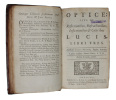
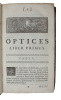
Scarce second Latin edition of Newton's ""Optics: or a Treatise of the Reflections, Refractions, Inflections, and Colours of Light. London 1704."", one of the great books in the history of science. ""Newton's Optics did for Light what his Principia had done for Gravitation, namely, placed it on a scientific basis."" (E.W. Brown). The translation was brought to light ""At the request of Newton, Dr. Samuel Clarke prepared a Latin edition of his Optics which appeared 1706, and he was generously presented by Sir Isaac with GBP 500, or GBP 100 for each of his five children, as a token of the appreciation and gratitude of the author. DeMoivre is said to have secured and taken charge of this translation, and to have spared neither time nor trouble in the task. Newton met him every evening at a coffe-house, and when they have finished their work he took De Moivre home with him to spend the evening in philosophical conversation.""(Brewster in his ""Newton"", 1855"").""In the accumulation of optical phenomena from his first paper (the short memoir in Philosophical Transaction, 1672) until the above book (the Optics,..) 33 years later, Newton had gathered explanations to many problems. The rainbow is fully explained and also ""Newton's rings"", produced by pressing the flat side of a plano-convex glass against a double convex lens of long focal lenght, producing rings of alternating brightness and darkness"" his explanation was not valid, as he did not know optical interference. He speculated on the double refraction of Icelandic spar...."" (Dibner in Heralds of Science No 148) - G.J. Gray No 180.