Write to the booksellers
-
Type
Artists book (1)
Autograph (3)
Book (5991)
Magazine (15)
-
Latest
Last 3 days (2)
Last month (41)
Last week (16)
-
Language
Dutch (6)
English (2)
French (5998)
Italian (4)
-
Century
16th (2)
17th (3)
18th (10)
19th (174)
20th (1034)
21st (182)
-
Countries
Belgium (652)
Canada (13)
Côte d'Ivoire (10)
France (5291)
Switzerland (44)
-
Syndicate
ALAC (13)
CLAM (12)
CLAQ (3)
ILAB (340)
NVVA (17)
SLACES (17)
SLAM (287)
SNCAO (7)
Introduction au YI-KING.
Editions Du Rocher Paris 1983 In-8 ( 230 X 140 mm ) de 271 pages, broché sous couverture illustrée. Bon exemplaire.
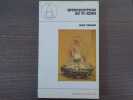
Saint Jacques à Compostelle.
Ouest France Paris 1985 In-4 ( 230 X 155 mn ) de 157 pages, broché sous couverture illustrée. Illustrations dans et hors-texte. Très bel exemplaire.
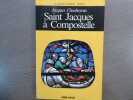
Histoire de la MAGIE et de ses Dogmes. La Magie dans la Bible - la Science des Chaldéens la Doctrine secrète de l'Ancienne Egypte - La Magie en Extrême-Orient - La Grèce et Rome - La Magie Médiévale en Europe - la Magie dans les Temps Modernes.
Payot Paris 1949 In-8 ( 230 X 140 mm ) de 312 pages, broché sous couverture imprimée. Bon exemplaire.
Huê la mystérieuse.
Paris, Mercure de France, 1943. In-8°, front.-312 pp., ill. n&b, intérieur frais (ex-libris en p. de garde sup., envoi manuscrit sur la p. de faux-titre, qqs. rares traits marginaux au stylo). Br. (couv. lég. défr., qqs. pâles taches au dos).
Avec trente illustrations et un frontispice en 2 couleurs. Deuxième édition.
La loi de la relation et l'erreur séparatiste en science et en philosophie.
Bibliothèque Chacornac Paris 1923 In-8 ( 225 X 145 mm ) de 392 pages, broché sous couverture imprimée. EDITION ORIGINALE. Bon exemplaire.
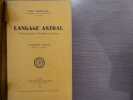
LANGAGE ASTRAL ( Traité sommaire d'Astrologie scientifique ).
Charconac, Editeur Paris 1940 In-8 ( 225 X 140 mm ) de 300 pages, broché sous couverture imprimée. Illustrations dans le texte. Intérieur frais. Bon exemplaire.
Tables des Positions Planétaires de 1850 à 1950.
Charconac, Editeur Paris 1953 In-8 ( 230 X 145 mm ) de 184 pages, broché sous couverture imprimée. Petites décharges de papier collant sur les gardes. Bon exemplaire.
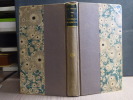
LA PSYCHOLOGIE DU PURGATOIRE. Psychologie Surnaturelle.
P. Lethielleux, Libraire-Editeur Paris 1901 In-12 ( 180 X 100 mm ) de XI-215 pages, demi-percaline gris-souris à la bradel, dos lisse orné d'un fleuron doré, pièce de titre de maroquin olive ( Reliure de l'époque ). Edition originale. Bon exemplaire.
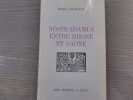
NOSTRADAMUS entre RHONE et SAONE.
Ger Editeur Lyon 1971 In-8 ( 210 X 140 mm ) de 81pages, broché sous couverture illustrée. Bel exemplaire.
Dictionnaire abbrégé de la Fable, pour l'intelligence des Poëtes, des Tableaux et des Statues, dont les sujets sont tirés de l'Histoire Poëtique. Neuvième édition.
P., Desaint et Saillant, 1760, petit in 12 relié plein veau ancien, dos lisse orné, 393 pages ; qq. rousseurs ; reliure frottée, coins émoussés ; tache sombre sur le dos et partie du plat supérieur.
Bon exemplaire. Fermeture du 1er au 23 Août


Phone number : 04 77 32 63 69
Dictionnaire abbrégé de la Fable, pour l'intelligence des Poëtes, des Tableaux et des Statues, dont les sujets sont tirés de l'Histoire Poëtique. Nouvelle édition.
1808 A Nismes, Gaude, 1808, in 12 relié demi-basane fauve à coins, dos lisse orné de filets dorés, étiquette rouge, XI-346 pages ; reliure très frottée
Bon exemplaire malgré les frottis de cette impression de Nîmes. Fermeture du 1er au 23 Août
Phone number : 04 77 32 63 69
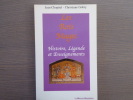
Les Rois Mages. Histoire, Légende et Enseignements.
Le Mercure Dauphinois Grenoble 2002 In-8 ( 220 X 140 mm ) de 158 pages, broché sous couverture illustrée. EDITION ORIGINALE. Bel exemplaire.
Perceval le Gallois ou le Conte du Graal.
Editions A.-G. Nizet Paris 1970 In-8 ( 180 X 135 mm ) de XXX-221 pages, broché sous couverture imprimée. Petite décharge de papier collant sur les gardes, bon exemplaire. De la bibliothèque Séverin BATFROI ( Nom Ex-libris Manuscrit sur une garde ).
Le premier homme et le premier roi dans l'histoire légendaire des Iraniens. ( Archives dÉtudes Orientales, publiées par A. Lun-dell, Nos 17 et 27 ). Complet des 2 parties.
Kungl. Boktryckeriet - E.J. Brill Stockholm - Leide 1918-1934 2 parties reliées en 1 volume in-8 ( 245 X 160 mm ) de 219 et 196 pages, demi-percaline chocolat à la bradel. Dos lisse avec pièce de titre manuscrite sur étiquette contrecollée, titre également manuscrit sur le premier plat. EDITION ORIGINALE. Bon exemplaire, très rare complet des 2 parties.- Les types du premier homme et du premier roi dans l'histoire légendaire des Iraniens. Partie I. GajMmard, Masja[g] et Masjna[g], HMsang et Ta[ch]mMruw.- Les types du premier homme et du premier roi dans l'histoire légendaire des Iraniens. Partie II. Jim.Christensen présente dans ces deux fascicules parus à seize années d'intervalle plusieurs études sur des personnages légendaires de la littérature persane.

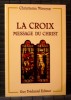
LA CROIX MESSAGE DU CHRIST
Paris : G. Trédaniel, 1991. In-8 (21 cm), couverture souple illustrée, illustrations en noir dans le texte, 153 pages, 205 gr.
Très bon état.
James Ensor
Christian Fayt Gallery, Knokke-Heist, 1978. In-8, broché sous couverture illustrée en couleur, non paginé [100 pp. env.].
Avec 50 planches en noir et en couleur en hors texte.Texte français/anglais. --- Plus d'informations sur le site archivesdunord.com
How Do Images Work? Strategies of Visual Communication in Medieval Art
, Brepols, 2022 Hardback, iv + 244 pages, Size:216 x 280 mm, Illustrations:31 b/w, 140 col., Language(s):English, German, Italian. ISBN 9782503595870.
Summary How did historical images work and interact with their beholders and users? Drawing on the results of an international conference held in Vienna in 2018, this volume offers new perspectives on a central question for contemporary art history. The fourteen authors approach working imagery from the medieval and early modern periods in terms of its production, usage, and reception. They address wide-ranging media?architecture, sculpture, painting, metalwork, stained glass?in similarly wide-ranging contexts: from monumental installations in the most public zones of urban churches to exquisite devotional objects and illuminated books reserved for more exclusive settings. While including research from West European and American institutions, the project also engages with the distinctive scholarly traditions of Eastern Europe and Israel. In all these ways, it reflects the interests of the dedicatee Michael Viktor Schwarz, whose introductory interview lays out the parameters of the subject. TABLE OF CONTENTS How Do Images Work? An Interview with Michael Viktor Schwarz Editors' Introduction PART I: VISUAL ELOQUENCE Can We Grasp Wordless Images? ? Milena Bartlov Gothic Art, Realism and magniloquentia: Thoughts on Erich Auerbach ? Paul Binski The Scaling Turn: Experiencing Late Medieval Artifacts? Assaf Pinkus and Einat Klafter ?Where the Wild Things Are?. Die Wilden Leute des sp ten Mittelalters und der fr hen Neuzeit im Raum des Dekorativen ? Hans K rner Das Kultbild und sein Rahmen: Zur Funktion von Stildifferenzen (zwei schlesische Beispiele aus dem Anfang des 16. Jahrhunderts) ? Romuald Kaczmarek PART II: IMAGERY IN BOOKS In cerchio: Illuminating the Trojan Legend and the Commedia between the Veneto and Naples (with some conjectures on Madrid, BNE, MS 10057) ? Rosa M. Rodr guez Porto Wie die Bilder im Roman d'Alexandre en prose die dubiose Herkunft des Helden diskutieren ? Lieselotte E. Saurma-Jeltsch Bonaventure and Monastic Images of St Elizabeth ? Ivan Ger t PART III: IMAGERY IN SPACE In Praise of the Pigeon: Interpretive Adventures in Naumburg Cathedral ? Jacqueline E. Jung Bilder und Kult als Ausdruck bisch flicher Macht: Berthold von Buchegg und die Katharinenkapelle im Stra burger M nster? Marc Carel Schurr Eye of the Donkey: Visual Strategies on the Choir Threshold of St Laurence's in Nuremberg ? Tim Juckes Bildkonzepte im Widerstreit. Donatellos Judith als ?naturalisierte Allegorie?? Ulrich Pfisterer Inhaltliche Vielfalt durch motivische Zur ckhaltung. Zur Wandmalerei in der camera pape im Papstpalast von Avignon ? Tanja Hinterholz Storia, mito e allegoria: I portali del Santo Sepolcro a Brindisi ? Valentino Pace
Les oiseaux messagers cosmiques
Arista 1989 in8. 1989. Broché. Cet ouvrage explore le symbolisme des oiseaux comme messagers divins à travers les traditions du monde entier en examinant particulièrement le concept de réincarnation à la lumière des écritures sacrées et des connaissances scientifiques
Bon état taches sur la première/dernière page intérieur très propre
Mythologie de la Suisse Ancienne. 2 volumes.
Librairie De L Université Georg Genève 1963 2 volumes in-4 ( 270 X 200 mm ) de 139 et 170 pages, brochés sous couvertures illustrées. Planches hors-texte. Bons exemplaires.
PROPHETES DU XIXe Siècle.
La Colombe Paris 1954 In-8 ( 210 X 140 mm ) de 194 pages, broché sous couverture imprimée. Bel exemplaire.
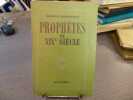
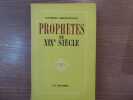
Prophètes du XIXe siècle.
La Colombe Paris 1954 In-8 ( 210 X 140 mm ) de 190 pages, broché sous couverture imprimée. Bon exemplaire.
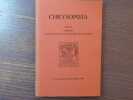
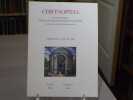
CHRYSOPOEIA. Revue publiée par la SOCIETE D'ETUDE DE L'HISTOIRE DE L'ALCHIMIE. Tome I, fasc.1. Janvier / Mars 1987.
SOCIETE D'ETUDE DE L HISTOIRE DE L ALCHIMIE Paris 1987 In-8 ( 210 X 155 mm ), agrafé sous couverture imprimée. Très bel exemplaire.
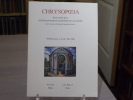
CHRYSOPOEIA. Revue publiée par la SOCIETE D'ETUDE DE L'HISTOIRE DE L'ALCHIMIE. Tome II, fasc.2. Avril/Juin 1988.
Arché - Bailly Milan - Paris 1988 In-8 ( 210 X 155 mm ), broché sous couverture illustrée en couleurs. Très bel exemplaire.
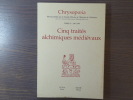
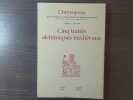
CHRYSOPOEIA. SOCIETE D'ETUDE DE L'HISTOIRE DE L'ALCHIMIE. Tome VI 1997-1999. Cinq traités alchimiques médiévaux.
S.E.H.A. - Arché - "Textes Et Travaux De Chrysopoeia" Paris - Milan 2000 In-8 carré ( 240 X 170 mm ) de XII-352 pages, broché sous couverture imprimée. Très bel exemplaire. +++Table des matières:- S. MATTON, Avant-propos : Éditer des textes alchimiques médiévaux - F. HUDRY, Le De secretis nature du pseudo-Apollonius de Tyane, traduction latine par Hugues de Santalla du Kitâb sirr al-halîqa de Balînnûs.- A. Calvet, Le De secretis naturæ du pseudo-Arnaud de Villeneuve ( texte et traduction ). - A. Calvet et S. MATTON, Quelques versions de la Flos Florum pseudo-arnaldienne : Le livre de Roussinus Liber perfecti magisterii Opus magisterii Perfectum magisterium Parvum Rosarium per O. Fineum transcriptum. - R. CROUVIZIER et S. MATTON, Deux traités de Valerand du Bois-Robert : Épître à Madame de Bourgogne Épître à Maître Abraham. ( texte latin et version française du XVIe siècle ).
Liturgie de St JEAN CHRYSOSTOME telle qu'elle célèbre dans toute l'église orthodoxe d'Orient et au Saint Mont Athos.
Dumont, Libraire-Editeur Paris 1843 In-8 ( 220 X 140 mn ) de II-107 pages, broché sous couverture imprimée. Rousseurs. Bon exemplaire.