 Write to the booksellers
-
Type
Book (7293)
Disk (45)
Drawings (1)
Engraving (9)
Magazine (89)
Maps (4)
Music sheets (136)
New book (4)
Old papers (1)
Photographs (19)
Posters (1)
-
Latest
Last 24h (2)
Last 3 days (5)
Last month (122)
Last week (9)
-
Language
Czech (1)
Dutch (9)
English (158)
French (7420)
German (4)
Italian (2)
Japanese (1)
Latin (3)
Russian (4)
-
Century
16th (17)
17th (43)
18th (199)
19th (882)
20th (2485)
21st (1571)
-
Countries
Belgium (1156)
Canada (34)
China (56)
Côte d'Ivoire (7)
Denmark (1063)
France (4933)
Germany (1)
Netherlands (181)
Switzerland (155)
United Kingdom (12)
United States of America (4)
-
Syndicate
ALAC (27)
CLAM (25)
CLAQ (2)
ILAB (2251)
NVVA (15)
SLACES (15)
SLAM (1038)
SNCAO (4)
Bienvenue en caverne préhistorique - Les mathématigres ! GS/CP 5/6 ans
HATIER JEUNESSE 2020 32 pages 14x19x0 5cm. 2020. pocket_book. 32 pages.
Très bon état
Bienvenue en caverne préhistorique - Les mathématigres ! GS/CP 5/6 ans
HATIER JEUNESSE 2020 32 pages 14x19x0 5cm. 2020. pocket_book. 32 pages.
Très bon état
Bienvenue en caverne préhistorique - Les mathématigres ! GS/CP 5/6 ans
HATIER JEUNESSE 2020 32 pages 14x19x0 5cm. 2020. pocket_book. 32 pages.
Très bon état
[ANONYME] - British Association for the Advancement of Science
Reference : 8357
(1889)
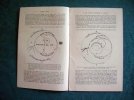
Report of the committee appointed for the investigation of the volcanic phenomena of Vesuvius and its neighbourhood.Newcastle-Upon-Tyne Meeting, 1889
London, Spottiswoode 1889. 12 pages. Avec quelques croquis dans le texte.Cahier cousu. Bon état. Format in-8° (21x14).
ANONYME
[ANONYME] - British Association for the Advancement of Science
Reference : 8358
(1891)
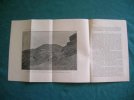
Report of the volcanic phenomena of Vesuvius and its neighbourhood.Cardiff Meeting, 1891.
London, Offices of the Association Burlington House 1891. 9 pages. With a plate.Cahier cousu. Bon état. Format in-8° (21x14).
ANONYME
British Museum. A Guide to the Egyptian Galleries (Sculpture)
With 39 plates and 46 illustrations in the text, 8vo hardcover quarter green morocco with corners, Printed by Order of the Trustees, 1909, 351 pp.
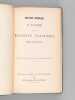
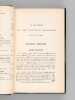
Fine copy in its quarter morocco binding.
The classical tradition.
Ldn., British Museum Publ. Ltd., (1976).
4to. 298 p.; ills. Cl. (St. on title) (Contrib. by Higgins, Carson and others)
AGENDA DU THE
CHENE. 1992. In-8. Relié. Bon état, Couv. convenable, Dos satisfaisant, Intérieur frais. Non paginé, environ 80 pages. Nombreuses illustrations en noir et blanc et en couleurs dans le texte et hors texte. Reliure d'éditeur moderne.. . . . Classification Dewey : 633.7-Plantes alcaloïdes (tabac, thé, cacao, café, pavot)
Classification Dewey : 633.7-Plantes alcaloïdes (tabac, thé, cacao, café, pavot)


Agenda du thé.
Paris, éditions Du Chène, 1992, 1 Cartonnage éditeur illustré. in-8 carré de 152 pp., illustrations;
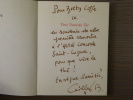
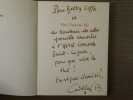
Petit traité du Thé.
La Table Ronde Paris 1997 In-16 carré ( 140 X 110 mm ) de 151 pages, broché sous couverture illustrée en couleurs rempliée. Edition originale. Très bel exemplaire enrichi d'un bel envoi autographe signé de l'auteur à Betty COFFE. De la bibliothèque de Jean-Pierre COFFE avec son timbre humide.
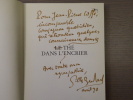
Le thé dans l'encrier.
Aubier Paris 1990 In-8 ( 240 X 155 mm ) de 165 pages, broché sous couverture illustrée en couleurs rempliée. Illustrations en couleurs hors-texte. Edition originale. Très bel exemplaire enrichi d'un envoi autographe signé de l'auteur et de l'illustrateur à Jean-Pierre COFFE. De la bibliothèque de Jean-Pierre COFFE avec son timbre humide.
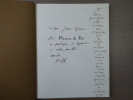
Plaisirs de Thé.
Editions Du Chêne Paris 1998 In-4 ( 295 X 235 mm ) de 175 pages, cartonnage sous jaquette illustrée en couleurs. Très nombreuses photographies en couleurs dans et hors-texte. Texte de Gilles Brochard, Recettes de Michèle Carles, Photographies de Christine Fleurent et Stylisme de Marie-France Michalon. Edition originale. Très bel exemplaire enrichi d'un double bel envoi autographe signé de Michèle CARLES et Gilles BROCHARD à Jean-Pierre COFFE. De la bibliothèque de Jean-Pierre COFFE avec son timbre humide.
Agenda du Thé.
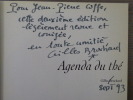
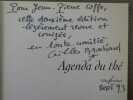
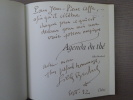
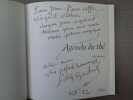
Société Nouvelle Des Editions Du Chêne S.L. 1993 In-8 carré ( 205 X 200 mm ), broché sous couverture illustrée en couleurs rempliée. Très nombreuses illustrations en couleurs dans et hors-texte. Deuxième édition. Très bel exemplaire enrichi d'un bel envoi autographe signé de l'auteur à Jean-Pierre COFFE. De la bibliothèque de Jean-Pierre COFFE avec son timbre humide.
Agenda du Thé.
Société Nouvelle Des Editions Du Chêne S.L. 1992 In-8 carré ( 205 X 200 mm ), cartonnage illustré en couleurs. Très nombreuses illustrations en couleurs dans et hors-texte. Edition originale. Très bel exemplaire enrichi d'un très bel envoi autographe signé de l'auteur à Jean-Pierre COFFE. De la bibliothèque de Jean-Pierre COFFE avec son timbre humide.
Brochard, Gilles (texte) ; Carles, Michele (recettes) ; Fleurent, Christine (photographies) ; Michalon, Marie-France (stylisme)
Reference : 46419
(2005)
ISBN : 2842770951
Plaisirs de Thé
Chene 2005 in-4, cartonnage editeur sous jaquette illustree, 175 pp., illustrations en couleurs.
Très bon état d’occasion
"BRODIE, B.C. - THE ATOMIC DEBATE IN CHEMISTRY. - ""BOOLEAN CHEMISTRY""
Reference : 43745
(1866)
The Calculus of Chemical Operations"" being a Method for the Investigation, by means of Symbols, of the Laws of the Distribution of Weight in Chemical Change. Received April 25, Read May 3, 1866. Part I-II. (I. On the Construction of Chemical Symbols. ...
(London, Taylor and Francis, 1866 a. 1877. 4to. No wrappers as extracted from ""Philosophical Transactions"", Vol. 156 - Part II a. vol. 167 - Part I. Pp. 781-859 a. pp. 35-116. Clean and fine.
First appearance of both papers, controversial as Brodie here tries to established a new chemical philosophy, refusing atomism and founding the calculation of chemical processes on Boolean Algebra, defining chemical symbols with mathematical terms and notations. The work is a remarkable attempt to set chemistry on a rational deductive basis. - The introduction in the second paper meets the main points raised by his critics.""In 1866 the Royal Society began to publish Brodie’s ""The Calculus of Chemical Operations"" (Philosophical Transactions, 156 [1866], 781-859"" 167 [1877], 35-116) which introduced Greek symbols for the chemical elements to replace the roman alphabet (Berzelian) symbols that contemporary chemists used to represent atomic weights. Brodie’s symbols, however, represented operations on space (volumes), not weights for, besides its revolutionary symbolism, the calculus also demanded an appreciation of George Boole’s algebraic logic, which Brodie had studied after the publication of Boole’s Investigation of the Laws of Thought in 1854. In this an equation such as y = xy is a symbolic statement that y is a subset of x in which the symbol x is an operator on y. Although professional mathematicians like William Donkin and Henry Smith later advised Brodie, it appears that he developed the system without professional help. The principal difficulty about the calculus for the present-day historian and philosopher of science is the need to explain it before going on to discuss it and the difficulty of giving any concise description of it. Boole had developed the concept of symbolic operators in algebraic analysis. These provided a code as to how the symbols were to be understood and manipulated. Brodie exploited this in the idea of a chemical operator, or chemical operations, that he symbolized by Greek letters. It is probably unwise, therefore, to interpret Brodie’s philosophy as analogous to Percy Bridgman’s later operationism. He proposed that if two substances with the empirically-derived weights, x and y combined to form a new compound with weight xy, then x + y = xy. From such weight equations he constructed a symbolic algebra that bypassed any atomistic interpretation.""(William H. Brock in ""Hyle Biography"").
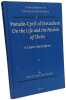
Pseudo-Cyril of Jerusalem on the Life and the Passion of Christ: A Coptic Apocryphon (Vigiliae Christianae Supplements Band 118)
BRILL ACADEMIC PUB 2012 217 pages 16x1 8x24 2cm. 2012. Cartonné. 217 pages. Il s'agit d'une édition critique avec introduction traduction et notes d'une homélie copte attribuée à fausse à Cyrille de Jérusalem intitulée 'Sur la Vie et la Passion du Christ'. Le texte est présenté comme une collection d'histoires apocryphes sur la vie et la passion du Christ offrant un aperçu des traditions narratives chrétiennes non canoniques
Comme neuf
"BROGLIE (DEBROGLIE), LOUIS de. - COINING THE TERMS 'ANTIPARTICLE' AND 'ANTINEUTRINO'.
Reference : 48952
(1934)
Sur la nature de photon.
(Paris, Gauthier-Villars), 1934. 4to. No wrappers. In: ""Comptes Rendus hebdomadaires des Séances de L'Academie des Sciences"", tome 198, No 2. Pp. (129-) 212. (Entire issue offered). De Broglie's paper: pp. 135-138. A stamp to the first page. Disbound.
First apperance of de Broglie's importent paper on antiparticles and the Neutrino of light. The antiparticle having the same mass as another but opposite values for its other properties.""In a communication dated January 8, 1934 (the paper offered)... de broglie stated that this new particle is an 'antiparticle which is related to (the neutrino) like the positive electron to the negative electron in the whole theory of Dirac'. In this note the terms 'antiparticle' and 'antineutrino' enter physics for the first time.""(Pais in ""Inward Bound"", p. 418).
"BROGLIE (DE BROGLIE), LOUIS DE . - DISCOVERY OF THE WAVE THEORY OF MATTER AND CREATION OF WAVE-MECHANICS
Reference : 49718
(1923)
Ondes et quanta. Note de M. Louis de Broglie, présentée par M. Jean Perrin. (Séance du 10 Septembre 1923). (+) Quanta de lumière, diffraction et interférences. Note de M. Louis de Broglie, transmise par M. Jean Perrin. (Séance du 24 Septembre 1923). (...
Paris, Gauthier-Villars et Cie, 1923. 4to. Bound in one contemp. full buckram. Spines gilt and with gilt lettering. In: ""Comptes Rendus Hebdomadaires des Séances de L'Academie des Sciences"", Tome 177. Bound with orig. printed front-wrapper to No. 1, half-title and title-page to vol. 177. 1513 pp. (Entire volume offered). De Broglie's papers: pp. 507-510, pp. 548-551 a. pp. 630-32. Clean and fine. A punched stamp on foot of title-page.
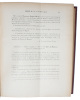
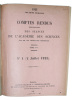
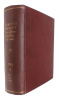
First edition of these papers which ESTABLISHED A NEW ERA IN PHYSICS by introducing the epochal new principle that particle-wave duality should apply not only to radiation but also to matter and thus CREATING QUANTUM MECHANICS. These 3 papers were extended to form his doctoral thesis of 1924 ""Recherches sur la Théorie des Quanta.""De Broglie relates ""After long reflection in solitude and meditation, I suddenly had the idea, during the year 1923, that the discovery made by Einstein in 1905 should be generalized by extending it to all material particles and notably to electrons"" (Preface to his PhD thesis 1924).""He made the leap in his September 10, 1923, paper: E=hv should hold not only for photons but also for electrons, to which he assigns a 'fictitious associated wave'. In his September 24 paper, he indicated the direction in which one 'should seek experimental confirmations of our ideas': a stream of electrons traversing an aperture whose dimensions are small compared with the wavelenght of the electron waves 'should show diffraction phenomena' .""(Pais ""Subtle is the Lord"", pp. 425-436).In the third paper (October 8) he discusses ""The interplay between the propagation of the particle and of the waves could be expressed in more formal terms as an identity between the fundamental variational principles of Pierre de Fermat (rays), and Pierre Louis Maupertuis (particles) as de Broglie discussed it further in his last communication . Therein he also considered some thermodynamic consequences of his generalized wave-particle duality. He showed in particular how one could, using Lord Rayleigh’s 1900 formula for the number of stationary modes for phase waves, obtain Planck’s division of the mechanical phase space into quantum cells.Louis de Broglie achieved a worldwide reputation for his discovery of the wave theory of matter, for which he received the Nobel Prize for physics in 1929. His work was extended into a full-fledged wave mechanics by Erwin Schrödinger and thus contributed to the creation of quantum mechanics. After an early attempt to propose a deterministic interpretation of his theory, de Broglie joined the Copenhagen school’s mainstream noncausal interpretation of the quantum theory.""(DSB).""This idea [i.e. de Broglie's that matter might behave as waves] was tested and confirmed by Davisson and Germer in 1927... Thus the duality of both light and matter had been established, and physicists had to come to terms with fundamental particles which defied simple theories and demanded two sets of 'complementary' descriptions, each applicable under certain circumstances, but incompatible with one another."" (Printing and the Mind of Man, 417).
"BROGLIE (DEBROGLIE), LOUIS de. - DISCOVERY OF THE WAVE THEORY OF MATTER AND CREATION OF WAVE-MECHANICS.
Reference : 46949
(1923)
Ondes et quanta. Note de M. Louis de Broglie, présentée par M. Jean Perrin. (Séance du 10 Septembre 1923). (+) Quanta de lumière, diffraction et interférences. Note de M. Louis de Broglie, transmise par M. Jean Perrin. (Séance du 24 Septembre 1923). (...
Paris, Gauthier-Villars et Cie, 1923. 4to. Bound in 2 contemp. full cloth. Spines gilt and with gilt lettering. In: ""Comptes Rendus Hebdomadaires des Séances de L'Academie des Sciences"", Tome 177. With htitle a. titlepage. 1513 pp. (Entire volume offered). De Broglie's papers: pp. 507-510, pp. 548-551 a. pp. 630-32. Clean and fine. A stamp to verso of titlepage.
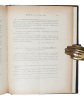
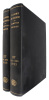
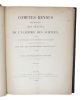
First edition of these papers which ESTABLISHED A NEW ERA IN PHYSICS by introducing the epochal new principle that particle-wave duality should apply not only to radiation but also to matter and thus CREATING QUANTUM MECHANICS. These 3 papers were extended to form his doctoral thesis of 1924 ""Recherches sur la Théorie des Quanta.""De Broglie relates ""After long reflection in solitude and meditation, I suddenly had the idea, during the year 1923, that the discovery made by Einstein in 1905 should be generalized by extending it to all material particles and notably to electrons"" (Preface to his PhD thesis 1924).""He made the leap in his September 10, 1923, paper: E=hv should hold not only for photons but also for electrons, to which he assigns a 'fictitious associated wave'. In his September 24 paper, he indicated the direction in which one 'should seek experimental confirmations of our ideas': a stream of electrons traversing an aperture whose dimensions are small compared with the wavelenght of the electron waves 'should show diffraction phenomena' .""(Pais ""Subtle is the Lord"", pp. 425-436).In the third paper (October 8) he discusses ""The interplay between the propagation of the particle and of the waves could be expressed in more formal terms as an identity between the fundamental variational principles of Pierre de Fermat (rays), and Pierre Louis Maupertuis (particles) as de Broglie discussed it further in his last communication . Therein he also considered some thermodynamic consequences of his generalized wave-particle duality. He showed in particular how one could, using Lord Rayleigh’s 1900 formula for the number of stationary modes for phase waves, obtain Planck’s division of the mechanical phase space into quantum cells.Louis de Broglie achieved a worldwide reputation for his discovery of the wave theory of matter, for which he received the Nobel Prize for physics in 1929. His work was extended into a full-fledged wave mechanics by Erwin Schrödinger and thus contributed to the creation of quantum mechanics. After an early attempt to propose a deterministic interpretation of his theory, de Broglie joined the Copenhagen school’s mainstream noncausal interpretation of the quantum theory.""(DSB).""This idea [i.e. de Broglie's that matter might behave as waves] was tested and confirmed by Davisson and Germer in 1927... Thus the duality of both light and matter had been established, and physicists had to come to terms with fundamental particles which defied simple theories and demanded two sets of 'complementary' descriptions, each applicable under certain circumstances, but incompatible with one another."" (Printing and the Mind of Man, 417).
Jane Eyre (Vintage Classics)
Vintage Classics 2007 560 pages 13x19 7x4 2cm. 2007. Broché. 560 pages.
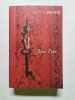
Etat correct
[The Bronx Parkway Commission] - Bronx Parkway Commission ; New York State
Reference : 42137
(1922)
Report of the Bronx Parkway Commission. 1922
1 vol. in-8 br., The Bronx Parkway Commission, December 31 1922, 89 pp.
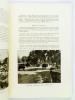
Etat satisfaisant (mq. au dos en tête). With the card "Compliments of Bronx Parkway Commission". Small lack at the top of spine.
Bronzes and Ivories from the old kigdom of benin. Exhibition from november 25 to december 14 - 1935.
M. Knoedler And Company New York 1935 In-8 ( 275 X 215 mm ) broché sous couverture imprimée. Planches dans le texte et hors-texte Très bel exemplaire.
"BROOKE, CHARLES. - THE INVENTION OF THE PHOTOGRAPHIC MAGNETOMETER.
Reference : 43535
(1847)
On the Automatic Registration of Magnetometers, and other Meteorological Instruments, by Photography. Received June 16, - Read June 18, 1846. (+) On the Automatic Registration of Magnetometers,....Supplement. 1846.(2 Papers).
(London, Richard and John E. Taylor, 1847). 4to. No wrappers as extracted from ""Philosophical Transactions"" 1847 - Part I. Pp. 59-68 a. pp. 69-77, 5 lithographed plates (one folding), depicting the photographic magnetometer. Clean and fine.
First printing of an importent paper in the history of meteorology, describing the invention of the Brooke-magnetometer. This new photographic drum method ensured continuous recording of geomagnetic elements, and rapidly gained use all over the world.The instrumental developments by Ronalds and Brooke establishedthe standard technique employed for magnetic observatory recording for more than a century.In 1845 Charles Brooke devised a self-recording photographic magnetometer with a light-source, a mirror for amplifying the magnet’s movement, and a drum of photographic paper. This system gradually replaced the older manual method of taking eye-observations through vertical microscope which scanned the ends of a magnetic needle" the magnetic needle itself was suspended by a bunch of silk fibersWheeler Gift No 2858..

