 Write to the booksellers
-
Type
Any type (2)
Art print (7)
Autograph (1)
Book (32537)
Disk (1)
Drawings (265)
Engraving (10)
Magazine (126)
Old papers (1)
Photographs (15)
Posters (1)
-
Latest
Last 24h (12)
Last 3 days (175)
Last month (481)
Last week (24)
-
Language
Dutch (78)
English (54)
French (32790)
German (6)
Italian (18)
Portuguese (9)
Spanish (11)
-
Century
16th (14)
17th (46)
18th (197)
19th (1536)
20th (9666)
21st (1695)
-
Countries
Belgium (10889)
Brazil (6)
Canada (111)
China (1)
Côte d'Ivoire (138)
Denmark (209)
France (18501)
Germany (1)
Greece (1)
Switzerland (3109)
-
Syndicate
ALAC (102)
CLAM (142)
CLAQ (97)
CNE (3)
ILAB (10606)
NVVA (1145)
SLACES (1145)
SLAM (7998)
SNCAO (10)
La cité naturelle. Recherche d'un urbanisme humain. Préface de Raul Dautry.
In-4, demi-chagrin brun, dos lisse, titre doré, couvertures et dos conservés, 177 p., 31 plans dans le texte. Paris, Paul Dupont, 1945.
Plusieurs cartes et plans concernent la reconstruction et le réaménagement des villes de Caen et du Mans.Bon exemplaire.
Petits et Grands Theatres du Marquis de Sade
Paris, Paris Art Center, 1989 Reli , Couverture rigide, 259 pages, 31 x 23 cm. Fran ais.
Presentes avec la collaboration de Jean Benoit, Patrick Besnier, Philippe Boucher, Michel Camus, Sylvian - Christian David, Simone Debout, Michel Gourevitch, Noelle Guibert, Radovan Ivsic, Claude Lefort, Camille Naish, Pierre Naville, Jean - Jacques Pauvert, Jacques Proust, Francois Roustang, Thibault de Sade et Isabelle Stengers par Annie le Brun.
LES US ET COUTUMES DE LA VILLE DE TOULOUSE, avec des Instructions pour connoître les matériaux, et généralement tout ce qui concerne la Bâtisse. Par feu M. LEBRUN, [...]. Où l'on a ajouté plusieurs Règlements relatifs ausdites Coûtumes.
1753 Toulouse, Pijon, 1753. In-12 (148 x 93 mm) basane marbrée, dos cinq nerfs, pièce de titre ocre, tranches rouges (Reliure de l'époque) ; (6) ff., 230 pages, (5) ff. de tables et privilège. Un coin émoussé, petites épidermures aux plats, manque angulaire sans atteinte au texte du dernier feuillet de l'"Avis de l'éditeur".
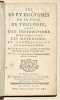
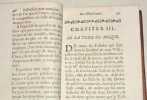
ÉDITION ORIGINALE de cet ouvrage dédié à Monseigneur Jean-Emmanuel de GUIGNARD, vicomte de Saint-Priest (1714-1785). Il contient de nombreuses instructions pour connaitre les matériaux, leur prix, celui des ouvrages de maçonnerie et de charpente, les règlements de construction des batiments spécifiques à la ville de Toulouse, etc. LEBRUN (Limouzin-Lamothe, 120). SÉDUISANT EXEMPLAIRE conservé dans sa reliure d'époque, en BEL ÉTAT. GOOD COPY. PICTURES AND MORE DETAILS ON REQUEST.
Ook uit blauwe lucht valt regen. De linke infiltranten van Lebuin D'Haese.
S.l., Lebuin D'Haese, 2008 Hardcover, 111 pages., 30.5x33.5cm., rijkelijk ge llustreerd in kleur, als nieuw. ISBN 6096511798745.
Lebu n communiceert via zijn werk met het publiek, dat op die manier inzicht krijgt in zijn denkwereld. Want kunstenaarschap is voor hem niet vrijblijvend. l'Art pour l'art, kunst omwille van de kunst, is aan hem niet besteed. Hij is een ge ngageerd kunstenaar met slechts n enkel onderwerp: de mens. Lebu n communicates through his work with the audience, which gets an insight into his ideas and opinion. Being an artist is not free obligation for him. Art for art's sake is not his concern. He is a committed artist with only one subject: the human being. [GUY KESTENS]
Ik tel letters tot Z - Lebu n D'Haese.
, Vrijdag, Uitgeverij, 2015 softcover, 64 pages, met illustraties van Lebu n D'Haese. ISBN 9789460013546.
De po zie van Lebu n D'Haese is gebeeldhouwd tussen de stenen van de stad en de klei van de opstandige ondergrond. De gedichten zijn ritmisch en nemen de vorm aan van een geboetseerd beeld. Je leest de taal van een beeldhouwer die mijmert en verlangt. Uit de pori n van de woorden sijpelt een uitnodiging tot zachte opstand en obstructie. De taal die verlangen naar verandering uitademt klinkt vrouwelijk. Het is niet het staccato van het marsorder. Maar eerder het ruisen van de rietstengels. - Dominique Willaert, artistiek leider van Victoria Deluxe
LE GUIDE DE CEUX QUI VEULENT BATIR - PREMIERE PARTIE
BENOIT MORIN. 1781. In-8. Broché. Etat d'usage, Livré sans Couverture, Dos satisfaisant, Mouillures. 320 pages. Quelques bandeaux, culs-de-lampe en noir et blanc.. . . . Classification Dewey : 720-Architecture
Ouvrage dans lequel on donne les renseignements nécessaires pour réussir dans cet Art, et prévenir les fraudes. Classification Dewey : 720-Architecture
Traité sur la force des bois, ouvrage essentiel, qui donne les moyens de procurer plus de solidité aux édifices, de connaitre la bonne et la mauvaise qualité des bois, de calculer leur force & de ménager près de moitié sur ceux qu'on emploie ordinairement
A Paris Chez l'auteur & Benoit Morin, imprimeur-libraire. 1782 372p 1 volume IN8. Reliure d'époque en plein veau blond. Dos lisse orné de filets dorés avec pièce de titre. Ouvrage orné de deux planches h.t dont une dépliante.Mors sup. Légèrement fendu.
Description des eaux de Chantilly et du hameau.
1783 Paris, chez l’auteur - B. Morin - Belin, 1783.
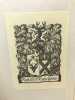
1 volume in-8 (19 x 12 cm), demi basane fauve (reliure postérieure), dos à nerfs orné, pièce de titre en basane rouge, gardes renouvelées, ex-libris aux armes de Richard d’Oyly Carte, 126-[6] pages (complet). Rares rousseurs. État très correct. ÉDITION ORIGINALE. Nicolas Le Camus de Mézières (1721-1789) est un architecte et théoricien de l'architecture français, célèbre pour son aménagement de la halle aux blés sur l'emplacement de l'ancien hôtel de Soissons (1763) et de l'hôtel de Beauvau (1768) à Paris. Il rédige ici un court traité architectural sur le château de Chantilly, et particulièrement son approvisionnement en eau et son fonctionnement. Agréable exemplaire.
The Genius of Architecture. Or the Analogy of That Art with Our Sensations
Getty Publications, coll. « Texts & documents » 1992 Livre en anglais. In-4 broché 26 cm sur 18,9. 223 pages. Très bon état d’occasion.
Très bon état d’occasion
Recueil des plans, coupes et élévations du nouvel Hôtel de Ville de Rouen, dont la construction a été commencée en mai 1757, avec les plans d'un accroissement et autres ouvrages projetés pour cette ville.
Paris, 1758, in-folio demi-toile (reliure moderne), 9 page de texte + 6 planches dont 1 dépliante et 2 doubles montées sur onglets.
bon
UNE VISITE A LA CATHEDRALE D'ALBI.
EDITIONS DU LANGUEDOC. 1936. In-12. Broché. Etat d'usage, Couv. légèrement passée, Dos satisfaisant, Intérieur frais. 98 pages. premier plat illustré en noir et blanc. Nombreuses photos en noir et blanc hors texte. code au dos, tampon d'institution.. . . . Classification Dewey : 720-Architecture
"Monuments, célébrités, évenements et activités d""Occitanie Classification Dewey : 720-Architecture"
SAINT-ETIENNE DE BOURGES. ARCHITECTURE ET VITRAUX.
IMPRIMERIE FORTIN NEVERS. 9 MAI 1958. In-12. Broché. Bon état, Couv. légèrement passée, Dos satisfaisant, Intérieur acceptable. 89 pages. 14 gravures en noir et blanc et 16 vitraux en couleurs.. . . . Classification Dewey : 720-Architecture
Tous les clichés qui ne portent pas la mention d'origine sont de André CHICHEREAU Classification Dewey : 720-Architecture
Les Energies douces et la maison québécoise, Etude présentée par Pierre Le Chapellier au Gouvernement du Québec, Ministère des Richesses naturelles, Direction de l'Energie, le 20 octobre 1977
Québec l'auteur 1977
in-4 illustré, pagination erratique, [313]p. Couverture illustré. :: Tapuscrit reprographié (format légal). Première édition (pages 100 et 101 distinctes). L'auteur, architecte et ingénieur (Ecoles de Paris), adapte ses précédentes recherches à la maison québécoise. Il est bien connu pour son ouvrage sur la Bio-Construction (Pars, Trédaniel, 1993, revue 2009). :: Bon état.
Les Energies douces et la maison québécoise, Etude présentée par Pierre Le Chapellier au Gouvernement du Québec, Ministère des Richesses naturelles, Direction de l'Energie, le 20 octobre 1977
Québec l'auteur 1977
in-4 illustré, pagination erratique, [313?]p. Couverture illustré. :: Tapuscrit reprographié (format légal). Deuxième édition (pages 100 et 101 réunies en une seule). L'auteur, architecte et ingénieur (Ecoles de Paris), adapte ses précédentes recherches à la maison québécoise. Il est bien connu pour son ouvrage sur la Bio-Construction (Pars, Trédaniel, 1993, revue 2009). :: Exemplaire de la "Bibliothèque Boule de neige, Librairie des Ressources, Montréal." avec corrections manuscrites. Bon état.
Les Énergies douces et la maison québécoise.
Étude présentée par Pierre Le Chapellier, architecte diplômé de l’École Spéciale d’Architecture de Paris et Ingénieur diplômé de l’École Spéciale des Travaux Publics de Paris au Gouvernement du Québec, Ministère des Richesses naturelles, Direction de l’Énergie. Québec, le 20 octobre 1977. Sans lieu ni éditeur, 1977. Grand in-folio (35,8 x 21,6 cm) (1) feuillet, 308 pages, (1) feuillet, illustré de dessins, cartes et tableaux. Broché. Dos muet de toile bleue. Bas de la couverture froissé et sali d’une tache marginale.
Nevers pas à pas
NEVERS, Centre imprimerie Avenir - 1979 - Grand In-4 - Cartonnage éditeur sous jaquette illustrée - Gardes illustrées - Edition numérotée, Tirage limité, Ex. N° 575 - Frontispice - Nombreuses illustrations Nb en texte - 530 pages + Table - Bel exemplaireJOINT : coupure de presseEnvoi manuscrit de l'auteur
Cnformément à nos conditions générales de vente :Les frais de port sont affichés à titre indicatif. Il se peut que nous devions vous contacter pour vous informer du coût de laffranchissement supplémentaire en fonction du poids et du nombre de livres, surtout pour les envois internationaux Cependant vu l'augmentation des tarifs postaux à l'internationale, nous pouvons expédier les ouvrages en point relais MONDIAL RELAY pour les pays suivants : Allemagne, Autriche, Belgique, Espagne, Italie, Luxembourg, Pays-Bas, Pologne, et Portugal. Merci de nous indiquer en retour le point relais choisi ainsi que votre numéro de téléphone mobile & adresse Courriel pour assurer le suivi du colis.N'hésitez pas à nous interroger.In accordance with our general terms and conditions of sale:Shipping costs are displayed for informational purposes only. We may need to contact you to inform you of the additional postage costs depending on the weight and number of books, especially for international shipments.However, given the increase in international postal rates, we can ship books via Mondial Relay to the following countries: Germany, Austria, Belgium, Spain, Italy, Luxembourg, Netherlands, Poland, and Portugal. Please provide us with your chosen Mondial Relay point, as well as your mobile phone number and email address to ensure package tracking.Please feel free to contact us with any questions
Les styles français.
P., Quantin (Bibliothèque de l'Enseignement des Beaux arts), 1892, in 8° cartonnage illustré de l'éditeur, 377 pages.
Très nombreuses figures in et hors-texte. PHOTOS SUR DEMANDE. ...................... Photos sur demande ..........................


Phone number : 04 77 32 63 69
Les Styles Français
Ancienne Maison Quantin Librairies-Imprimeries Réunies 1892 375 pages in8. 1892. reliure éditeur demi chagrin dos à nerfs. 375 pages. Ouvrage publié en 1892 par l'ancienne maison Quantin analysant les différents styles français à travers l'histoire avec un focus sur le décor le pastiche et les influences étrangères. Le livre contient de nombreuses illustrations en noir et blanc
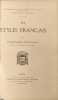
Très bon état coins légèrement frottés tranches dorées
Les styles français.
Couverture rigide. Reliure pleine toile de l'éditeur. 377 pages. 14 x 21 cm.
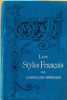
Livre. Abondamment illustré. Librairies-imprimeries réunies. Ancienne maison Quantin (Collection : Bibliothèque de l'enseignement des Beaux-arts), Vers 1890.
LECHEVALLIER-CHEVIGNARD, Professeur à l'Ecole Nationale des Arts Décoratifs
Reference : 101
LES STYLES FRANCAIS
A. QUANTIN, Imprimeur-Editeur PARIS - BIBLIOTHEQUE DES BEAUX-ARTS.Reliure éditeur vert -377 pages - 97 figuresEtat moyen
Cnformément à nos conditions générales de vente :Les frais de port sont affichés à titre indicatif. Il se peut que nous devions vous contacter pour vous informer du coût de laffranchissement supplémentaire en fonction du poids et du nombre de livres, surtout pour les envois internationaux Cependant vu l'augmentation des tarifs postaux à l'internationale, nous pouvons expédier les ouvrages en point relais MONDIAL RELAY pour les pays suivants : Allemagne, Autriche, Belgique, Espagne, Italie, Luxembourg, Pays-Bas, Pologne, et Portugal. Merci de nous indiquer en retour le point relais choisi ainsi que votre numéro de téléphone mobile & adresse Courriel pour assurer le suivi du colis.N'hésitez pas à nous interroger.In accordance with our general terms and conditions of sale:Shipping costs are displayed for informational purposes only. We may need to contact you to inform you of the additional postage costs depending on the weight and number of books, especially for international shipments.However, given the increase in international postal rates, we can ship books via Mondial Relay to the following countries: Germany, Austria, Belgium, Spain, Italy, Luxembourg, Netherlands, Poland, and Portugal. Please provide us with your chosen Mondial Relay point, as well as your mobile phone number and email address to ensure package tracking.Please feel free to contact us with any questions
Viaduc de Millau : Le Collector . Complet De Son Plan Dépliant En Feuille Libre . Hors Série
Montpellier La Dépêche / La Gazette 2004 In Quarto Norman Foster architecte , Michel Virlogeux concepteur . Plus long pont d'Europe : 2640 mètres , plus haut du monde : 270 mètres . De beaux voiliers suspendus sur 7 piles , superbe ouvrage . Autoroute . Régionalisme . - 74 p. , 750 gr.
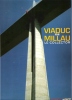
Couverture souple Parfait État . Jaquette en très bon état 1° édition
Abhandlung der Bau=Kunst mit nützlichen Anmerkungen und Betrachtungen jungen Personen die sich dieser schönen Kunst wiedmen wollen zum Besten abgefasst. Als ein Anhang ist beygefüget eine Übersetzung einer Academischen Abhandlung von den Triglyphen, v...
Nürnberg, Christoph Weigel, 1759. Small 4to. Contemp. hcalf. Gilt spine. Titlelabel with gilt lettering. A paperlabel pasted on spine. Stamps on title-page. (8),48,(4),58,26,(2) pp., 183 engraved plates. Clean and fine.
First German edition.
Le mobilier Normand (ensemble & détails).
Paris Ch.Massin & cie, éditeurs. sd " 1 volume in4 en feuilles sous chemise illustrée à lacets. 10 pages de texte explicatif, suivies de 40 planches en héloigravures. Collection de l""art régional en France.Manque planches 11 & 12."
Le Musée François-Pilote
La Pocatière Musée François-Pilote
(c.1990), in-8 illustré, 136p. Couverture illustrée. :: Réédition revue et augmentée. :: Broché. Bon état.
Manuel d'archéologie chrétienne depuis les origines jusqu'au VIIIe siècle. 2 tomes.
Paris, Letouzey et Ané, 1907, 1 br., tome 1 plat inf. en partie détaché. 2 forts volumes in-8 de (8)-591 pp. et 681-(3) pp., illustrations ;

