Write to the booksellers
-
Type
Any type (1)
Art print (7)
Autograph (1)
Book (32050)
Disk (1)
Drawings (264)
Engraving (10)
Magazine (125)
Old papers (1)
Photographs (15)
Posters (1)
-
Latest
Last 24h (10)
Last 3 days (6)
Last month (371)
Last week (56)
-
Language
Dutch (78)
English (56)
French (32298)
German (6)
Italian (18)
Portuguese (9)
Spanish (11)
-
Century
16th (14)
17th (47)
18th (201)
19th (1527)
20th (9522)
21st (1688)
-
Countries
Belgium (10916)
Brazil (6)
Canada (115)
China (1)
Côte d'Ivoire (140)
Denmark (209)
France (17990)
Germany (1)
Greece (1)
Switzerland (3097)
-
Syndicate
ALAC (106)
CLAM (144)
CLAQ (101)
CNE (3)
ILAB (10573)
NVVA (1145)
SLACES (1145)
SLAM (7969)
SNCAO (10)
égyptologie - DESROCHES-NOBLECOURT (Christiane) - KUENTZ (Charles)
Reference : 54116
(1968)
Le Petit temple d’Abou-Simbel. étude archéologique et épigraphique Essai d’interprétation
Le Caire, Ministère de la Culture Centre de Documentation et d’étude sur l’Ancienne égypte 1968 Premier tome, texte seul. In-folio. Reliure de l’éditeur pleine soie moirée vert pâle, reproduction en couleurs de hiéroglyphes contrecollée sur le premier plat, dos lisse avec titre doré, frontispice en couleurs, XIX + 243 pp. Exemplaire en bon état.
Préfaces en français et en arabe. Introduction. - étude archéologique et épigraphique. - Essai d’interprétation. - Notes. - Bibliographie. Bon état d’occasion
Les caves anciennes de Bayonne
Imprimerie du "Courrier" | Bayonne 1929 | 15.50 x 24.50 cm | agrafé
Edition originale imprimée à petit nombre de ce tiré à part. Brochure ornée de 3 illustrations. Rare et agréable exemplaire. - Photographies et détails sur www.Edition-Originale.com -


Brésilbaroque : entre ciel et terre 1999-2000
, Union latine, 1999 Softcover, 518 pages, Texte en Francais, 300 x 240 x 40 mm, Tres belle exemplaire, beaucoup illustrations en couleur / n/b. ISBN 9782909290218.
Religious Transformations in New Communities of Interpretation in Europe (1350?1570). Bridging the Historiographical Divides
, Brepols, 2023 Hardback, 275 pages, Size:156 x 234 mm, Language: English. ISBN 9782503601779.
Summary This volume brings together medievalist and early modernist specialists, whose research fields are traditionally divided by the jubilee year of 1500, in order to concentrate on the role of the laity (and those in holy orders) in the religious transformations characterizing the 'long fifteenth century' from the flourishing of the Devotio Moderna to the Reformation and Counter-Reformation. Recent historiography has described the Christian church of the fifteenth century as a world of 'multiple options', in which the laity was engaged with the clergy in a process of communication and negotiation leading to the emergence of hybrid forms of religious life. The religious manifestations of such 'new communities of interpretation' appear in an array of biblical and religious texts which widely circulated in manuscript before benefiting from the new print media. This collection casts a spectrum of new yet profoundly historical light on themes of seminal relevance to present-day European society by analysing patterns of inclusion and exclusion, and examining shifts in hierarchic and non-hierarchic relations articulated through religious practices, texts, and other phenomena featuring in the lives of groups and individuals. The academic team assembled for this collection is internationally European as well as interdisciplinary and multidisciplinary in its methodology. TABLE OF CONTENTS List of Contributors Introduction: Investigating and Reconsidering Medieval and Early Modern Divides and Connections ? IAN JOHNSON Lay and Clerical Cultures in Heaven and on Earth: Divides, Interactions, and Negotiations Gertrude More's 'Confessiones Amantis' and the Contemplative Identity of the Cambrai Benedictine Community? MARLEEN CRÉ Helper Saints and their Critics in the Long Fifteenth Century? OTTÓ GECSER Censoring Popular Devotion in French Protestant Propaganda: The Reformer Pierre Viret, the Rosary, and the Question of the Proper Honouring of the Virgin Mary? DANIELA SOLFAROLI CAMILLOCCI Lay Literacy and the Press: Forms and Transformations of Religious Writing and Rewriting Changes in the Grammar of Legibility: Influences on the Development of 'New Communities of Interpretation'? ? MARCO MOSTERT Biblical Genres through the Long Sixteenth Century: Italy as a Case Study? ERMINIA ARDISSINO Vernacular Culture and Ecclesiastical Censorship Printed Italian Vernacular Biblical Literature: Religious Transformation from the Beginnings of the Printing Press to the Mid-Seventeenth Century? ÉLISE BOILLET Communities of Interpretation of the Bible along the European Margins: Hussite Teachings, the Hussite Bible, and the Bogomils, from the South of Hungary to the Periphery of Eastern Europe in the Long Fifteenth Century? MELINA ROKAI Political and Religious Cultures Language as a Weapon: Hilarius of Litom??ice and the Use of Latin and the Vernacular Language in Religious Polemics in Fifteenth-Century Bohemia? VÁCLAV ??REK The Legitimacy of Making Alliances between Christians and Infidels: Arguments of Polish Jurists in the First Half of the Fifteenth Century? WOJCIECH ?WIEBODA Confessional Coexistence, Conversion, and Confusion Peasants and 'Sectarians': On the Ineffectiveness of Evangelical Persuasion in Sixteenth-Century Poland? WALDEMAR KOWALSKI Religious Transformation on the Early Modern Periphery: Law and Gospel: Image, Place, and Communication in the Multi-Confessional Community of Sixteenth-Century Moravian Ostrava? DANIELA RYWIKOVÁ Index of Persons and Places
doute dans l'Europe moderne
, Brepols, 2022 Paperback, 266 pages, Size:156 x 234 mm, Illustrations:3 b/w, 2 col., Language(s):French, English, Italian. ISBN 9782503588186.
Summary L'époque moderne, depuis l'Humanisme et la Renaissance jusqu'aux Lumières, fut propice au doute et largement travaillée par celui-ci. La découverte de nouvelles techniques, l'exploration de nouveaux espaces, le développement de nouvelles disciplines, la formulation de nouvelles doctrines religieuses et politiques, la circulation accélérée et élargie des productions écrites par la voie de l'imprimerie ont favorisé, notamment dans les villes, la pluralité et la confrontation des idées et des opinions et l'émergence du doute dans tous les domaines. L'ambition de ce volume est de contribuer à une histoire culturelle du doute, qui reste largement à construire à partir de l'exploration de ses divers aspects. Là où le scepticisme, qui renvoie d'abord à un système, une position ou un argument philosophique, oriente l'enquête vers l'histoire intellectuelle, le doute, qui désigne un état de l'esprit ou une attitude mentale, s'applique à tous les modes de la connaissance, théoriques et pragmatiques, et invite à élargir son étude à l'histoire des émotions, des mentalités, des comportements et des pratiques. S'agissant de l'époque moderne, il a paru particulièrement opérant de privilégier le fil directeur du rapport à la religion, considérée aussi bien comme croyance que doctrine et église. En effet, loin de refermer l'enquête sur l'histoire confessionnelle, ce rapport ouvre sur les différents champs culturels, du droit aux sciences et à la littérature, et contribue à révéler les enjeux anthropologiques de la question. Les développements du doute au début de l'époque moderne semblent bien avoir introduit des attitudes que l'on retrouve dans le monde contemporain : le relativisme culturel ; la suspicion envers une information souvent surabondante et/ou peu fiable ; un élément personnel dans l'adhésion aux croyances religieuses ; la prédominance dans l'espace public de l'opinion sur le savoir. Une raison qui rend d'autant plus nécessaire la construction d'une histoire culturelle du doute à l'époque moderne. TABLE OF CONTENTS Élise Boillet & Marco Faini ? Introduction. Pour une histoire culturelle du doute 1. Le doute : mises en perspective historique et disciplinaire Corinne Leveleux-Texeira ? La vérité incertaine. La gestion du doute par le droit savant médiéval Jean-Pierre Cavaillé ? Que croire, c'est quand même douter. Remarques anthropologiques sur croire et douter au début de l'époque moderne Sylvia Giocanti ? Le doute comme manière d'être au monde (XVIe-XXe siècles) Vincent Jullien ? Le doute comme marqueur du progrès des sciences 2. Doute, croyance religieuse et incroyance Christian Trottmann ? « Dubium » dans l'oeuvre de Nicolas de Cues Matthieu Arnold ? L'assertio contre le doute : le débat entre Érasme et Luther au sujet du libre arbitre (1524-1525) Hélène Michon ? Doute, inquiétude et foi : une problématique pascalienne Luca Addante ? Douter de la religion dans un long XVIe siècle : le cas italien 3. Doute, savoirs et milieux culturels Craig Martin ? Doubt, History, and Politics in the Philosophy of Pietro Pomponazzi Paolo Procaccioli ? Un cultore del dubbio nell'Italia del Rinascimento: Ortensio Lando Marco Faini ? Allegorie e personificazioni del dubbio nell'Italia del Cinque e Seicento Bibliographie Index des noms
Innovation and Medieval Communities. The Circulation of Ideas and Practices in and out of the Town (1200-1500)
, Brepols, 2026 Hardback, Pages: 288, Size:178 x 254 mm, Illustrations:1 b/w, 39 col., 4 tables b/w., Language: English. ISBN 9782503596471.
Summary It has to be said that when it came to innovation medieval culture demonstrated its mastery of the art of the paradox. Medieval people were compelled to innovate, driven by the dissatisfaction that is part of their nature, leading to changes that could generate not only enthusiasm, but also mistrust and sometimes fear. In a world where innovation was ordinarily perceived in a negative light, societies developed discursive strategies to legitimize such developments, even going so far as to make the old out of the new. This book interrogates this gap between cultural assumptions and practical necessity. Drawing on numerous examples from the towns and cities of Western Europe between the thirteenth and the fifteenth centuries, it examines in context and in practice both sophisticated conceptions and unexamined habits of thought concerning innovation. These offered a range of possibilities for dealing with the new, often imposing novelty quietly, as the only means of maintaining the old state of affairs... at least in appearance. TABLE OF CONTENTS Introduction Élodie Lecuppre-Desjardin (Lille University, IRHiS) & Nils Bock (Münster University) Part 1. Mastering Innovation: Communities and Individuals Municipal law in the monastery. On becoming and being citizens in the later Middle Ages. Anne Diekjobst (Kiel University CAU) Burghers' reactions to new town books in Southwestern Germany in the Late Middle Ages. Olivier Richard (Fribourg University) Innovation and ways of relating to time in memory writings by German townspeople at the dawn of the Early Modern Period. Aude-Marie Certin (Haute Alsace University) Innovation in the Great Municipal Charter of Paris (1416) Boris Bove (Rouen-Normandie University) Part 2. Technological innovation at the heart of the circulation of knowledge and political intentions Innovations catalysed by the papal court and the reconfiguration of local communities in and around early 14th-century Avignon. Valérie Theis (ENS Ulm, Paris) The dukes of Burgundy's Trésor de l'Épargne and reactions to it within princely administration. Rudi Beaulant (Franche-Comté University) Technological innovation, social identities and the Dynastic State. Gunpowder Artillery in the Burgundian Polity (late 14th- early 16th c.) Michael Depreter (University of Oxford) Innovation and migration: The Economic impact of immigrant craftspeople in Late Medieval England Bart Lambert (Vrije University of Brussels) Social incentives for innovation in Flemish artistic workshops: Social Network Analysis in late medieval art production Joannes Van den Maagdenberg (UGent-ULB-Fondation Périer-d'Ieteren) Plague Policies in the Fifteenth-Century Low Countries: Duplication, adaptation and Integration. Claire Weeda (Leiden University) Part 3. Think different: pioneering ideas from artists and scholars Ecclesiological Innovations in the days of the Reform Councils of the Fifteenth-Century. Bénédicte Sère (Paris Nanterre University) Mediaeval sacred song: creative impulses and innovation in repertoire, musical notation and transmission. Kristin Hoefener (University Nova of Lisbon, Centro de Estudos de Sociologia e Estética Musical) "A desire to see more clearly": theological device and sociological innovation of scholars in thirteenth-fifteenth centuries Antoine Destemberg (Artois University) Van Eyck's Fictive Frames and Reinventions of Memorialisation Andrew Murray (The Open University)
Éluard, Paul (Text), Pablo Picasso (Ill.) und Lucien Clergue (Fotogr.),
Reference : 67916
Corps mémorable. Couverture par Pablo Picasso et douze photographies par Lucien Clergue.
Paris, Pierre Seghers, 1960 Hardcover with original dustjacket by Picasso, 35 pages, 27 x 18 cm, photo's Lucien Clergue, French text. *Near fine condition.
Corps mémorable. Couverture par Pablo Picasso et douze photographies par Lucien Clergue.
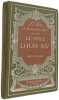
L'Art de Reconnaître les Styles: Le Style Louis XIV
Garnier Frères in12. Sans date. Cartonné. Cet ouvrage d'Émile Bayard historien d'art analyse en détail les caractéristiques du style Louis XIV dans l'architecture le mobilier et les arts décoratifs. Il s'inscrit dans une série sur la reconnaissance des styles artistiques mettant en lumière l'interaction entre les formes et les idées d'une époque
Bon Etat intérieur propre
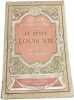
L'Art de reconnaître les styles. Le style Louis XIV ouvrage orné de 180 gravures
Garnier Frères 1923 343 pages in8. 1923. broché. 343 pages. Ce livre est un manuel pratique faisant partie de la collection 'L'art de reconnaître les styles' consacré spécifiquement au style Louis XIV. Il vise à enseigner au lecteur comment identifier ce style dans divers domaines artistiques comme la peinture la sculpture l'architecture et les arts décoratifs à l'aide de nombreuses illustrations
Bon état tampon de bibliothèque sur certaines pages
À l'aube de la théorie des quanta. Notes inédites d'Émile Borel sur un cours de Paul Langevin au Collège de France (1912-1913)
, Brepols, 2020 Hardback, xviii + 335 pages, Size:200 x 260 mm, Illustrations:73 col., Language: French. ISBN 9782503586380.
Summary Émile Borel et Paul Langevin représentent deux facettes de la science française, en mathématiques et en physique, au début du XXe siècle. La physique quantique naissante qui à l'époque bouleverse les conceptions scientifiques, les a réunis par la voie d'un cours au Collège de France en 1912-1913. Langevin ne publiant pas ses cours, aucune trace de celui-ci ne nous était parvenue. La découverte fortuite du carnet de notes de Borel, auditeur de Langevin, permet de combler cette lacune. TABLE OF CONTENTS Avant-Propos Historique du manuscrit I Le contexte 1 le socle du cours 2 Le public du cours 3 Borel et la prise de notes Conclusions II Le cahier de Borel Principes de l'édition 4 Rayonnement thermique et axiomatique 5 Les lois thermodynamiques du rayonnement 6 Échanges d'énergie entre matière et rayonnement. Mouvement brownien 7 La théorie de Rayleigh-Jeans. De Lorentz à Langevin 8 Mécanique statistique et hypothèse quantique Conclusion générale Bibliographie III Annexes Résumé cours de Marcel Brillouin Collège de France (1900-1901) Résumés cours de Langevin Collège de France (1902-1914) Cours de Langevin Collège de France et cahiers d'élèves (1902-1939) Quelques théorèmes de la mécanique statistique
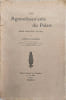
Les agrandissements du Palais sous Philippe le Bel
Bibliothèque de l'Occident 1913 46 pages in8. 1913. broché. 46 pages.
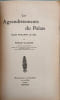
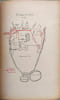
Bon état dos usagé avec léger manque en partie sup. coiffes légèrement usées intérieur propre ensemble propre et solide
L'Art religieux de la fin du Moyen Âge en France. étude sur l’iconographie du Moyen âge et ses sources d’inspiration
Librairie Armand Colin 1925 Troisième édition. In-4. Reliure de l’éditeur demi-chagrin vert à coins, dos à 5 nerfs, auteur et titre dorés, tête dorée. V + 512 pp., 265 figures en noir dans le texte. Dos insolé, sinon bel exemplaire.
Avec “L'Art religieux de la fin du Moyen Âge en France”, émile Mâle développe ses curiosités aussi bien du côté de la théologie et de la mystique qu'en direction du théâtre et des récits légendaires. L’ouvrage demeure la meilleure introduction à l'étude de l'iconographie chrétienne à la fin du Moyen Âge. Bon état d’occasion
James Ensor / Emile Verhaeren
, M. Waknine, 2021 Original publishers paper-covered boards, 65 Pages, 160 mm x 220 mm. Texte en Francais ISBN 9791094565810.
Un vrai artiste trouve en lui-même la justification de ses excès. Ce qui s'est fait avant lui ne lui est qu'un conseil : ce ne peut jamais lui être un ordre, ni une sorte d'ultimatum. L'art est libre, libre ! s'écrie quelque part James Ensor. Il n'y a que les médiocres qui ne comprennent pas et ne comprendront jamais la profondeur et la sincérité d'une telle revendication ardente. Heureusement que les routes supérieures de l'humanité en marche sont plantées de grandes oeuvres qui l'affirment et la crient à leur tour.
Archidoc 04. Émile-José Fettweis architecte
, Archidoc, 2019 softcover, 143 pages, Illustrated. FR. ISBN 9782960192230.
Dirigé par Aloys Beguin, professeur au sein de la Faculté d?architecture (ULiège) et ancien collaborateur d?Émile-José Fettweis, l?ouvrage développe un discours critique tant sur la biographie de l?homme que sur la production de l?architecte tout au long de sa carrière. La biographie ainsi que l?analyse d?une sélection de bâtiments est portée par Émilie Hugo, ancienne étudiante en architecture, et dont le mémoire intitulé Émile-José Fettweis, une unité de styles avait suscité enthousiasme du jury en 2014. L?analyse des bâtiments est en outre soutenue par un texte critique montrant la position de Fettweis dans le contexte de la remise en question du modernisme. Plusieurs chercheurs s?expriment également sur des axes méconnus ou peu étudiés comme les questions urbaines et territoriales ou la portée pédagogique de l??uvre de l?architecte verviétois. L?ouvrage est aussi l?occasion de redécouvrir le travail de Noël Randaxhe, plasticien dont les rapports avec l?architecture font l?objet d?une première étude critique et sensible.
Solus homo nudus, solum animal sapiens. Théories humanistes du nu (XVe-XVIe siècles)
, Brepols, 2022 Paperback, 499 pages, Size:156 x 234 mm, Illustrations:33 col., Language: French. ISBN 9782503596365.
Summary L'ouvrage est une synthèse des théories du nu dans les traités d'art de la Renaissance en langue latine et italienne. Il soutient aussi une thèse : les humanistes, qui furent les premiers à employer le mot nudus comme un adjectif substantivé au singulier, ont inventé le nu en art à partir de trois sciences anciennes (les mathématiques, la médecine et la philosophie morale) et, plus précisément, en renouvelant trois doctrines qui constituent à la Renaissance les parties de l'art du nu, la symétrie, l'anatomie et la physiognomonie. Se plaçant sous le triple patronage de Vitruve, de Galien et d'Aristote, les théoriciens de l'art humanistes concevaient à la fois le nu comme un corps géométrisé, comme une « belle machine » et comme un miroir de l'âme. Ainsi existe-t-il au moins trois critères à l'aune desquels, à la Renaissance, les spécialistes de l'art reconnaissent et jugent un nu : le premier est le rapport de proportion qui règle ses parties entre elles et chacune d'elle avec la totalité du corps ; le second est la conformité de l'organisation anatomique et le troisième l'efficacité affective de l'image. Les artistes et théoriciens de l'art de la Renaissance fournissent eux-mêmes une définition du nu assez solide pour combler le vide laissé par la critique de celle de Kenneth Clark (The Nude, Washington, 1956).
Traité de L'Art de la Charpenterie. [Text volume + plates]. - [SEMINAL WORK ON TIMBER CONSTRUCTIONS]
Bruxelles, Meline, Cons et Comp., 1841-42 (Text vol.] Paris, Anselin, Gaeury & V. Dalmont, 1841 (Plates). Text volume: Royal8vo. Two volumes bound in one contemporary half calf. Library stamp pasted on to lower part of spine and library stamp to title page. Hinges with some wear but firmly attached. Internally very fine and clean. [Vol. 1]: (2), 575 pp" (4), 670 pp.Plates: Folio-oblong both bound in contemporary half calf, with gilt lettering to spine. Spine with wear and hinges loose. First plates with a 5 cm long tear. Plates are fine and clean with occasional marginal brown spots. 157 engraved plates.
![Traité de L'Art de la Charpenterie. [Text volume + plates]. - [SEMINAL WORK ON TIMBER CONSTRUCTIONS]. ÉMY, A.R. (AMAND ROSE).](https://static.livre-rare-book.com/pictures/LLX/44106_7_thumb.jpg)
![Traité de L'Art de la Charpenterie. [Text volume + plates]. - [SEMINAL WORK ON TIMBER CONSTRUCTIONS]. ÉMY, A.R. (AMAND ROSE).](https://static.livre-rare-book.com/pictures/LLX/44106_8_thumb.jpg)
![Traité de L'Art de la Charpenterie. [Text volume + plates]. - [SEMINAL WORK ON TIMBER CONSTRUCTIONS]. ÉMY, A.R. (AMAND ROSE).](https://static.livre-rare-book.com/pictures/LLX/44106_9_thumb.jpg)
First edition of the first work on laminated timber engineering, being one of the most famous and influential books on the construction of timber roofing and large wood constructions in general. This is the first book since 1567 (De l'Orme. Le premiere tome dell'architecture) to deal with this subject in a scientific and analytical context. Emy's work was organized as a manual describing concrete working phases and procedures and avoiding the usual philosophical and ethic speculations on the reasons to build. He gave precise instructions on minimize wood usage, waste reduction in the workmanship and realization processes of architectonic elements, manufacture assembling speed and work site cleaning. ""Armand Rose Emy's essay is one of the most interesting points of reference in the French and European cultural debate on timber construction [...]. Emy suggested a new wood coverage system inspired by the inventions of de l'Orme, architect and counsellor to the Court of King Henry II who wrote in 1561 Le nouvelles inventions pour bien bastir et a petit fraiz."" (Mongelli. A New Wood Roofing System: Marac's Barracks and Colonel Armand Rose Emy's Innovative System)""The greatness of Emy's work, the precision and the correctness of his studies and the validity of his invention led Emy to realise many barracks using this roofing system. Photographs show that the Marac barracks was in existence until the 1960s. Today, he must to be remembered for another reason. [...], it is Emy who should arguably be seen as the true father of this technique, as can be seen by his the first careful reflections and experimentation using this type of construction. In fact, studying the Wiebeking's bridge realized at Bemberga, Emy had even evaluated the possibility of introducing the blood-albumen glue between the thin plates to strengthen his semi-circular arch."" (Ibid.).
Traité de la charpenterie. Éléments de charpenterie métallique. Atlas seul
Paris, Dunod, 1873. In-folio, 30 pl., cartonnage de l'époque de percaline chagrinée verte, filets à froid en encadrement sur les plats (cartonnage défraîchi mais solide, mouillures, petite déchirure marginale de la pl. 29-30).
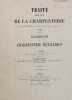
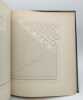
Deuxième édition de l'atlas seul de la partie relative aux Éléments de charpenterie métallique du Traité de la charpenterie. Il est composé de 30 planches en noir (la dernière est double) dessinées par Barré et gravées par Lemaître. Il a été ajouté depuis l'édition originale les coupes et plans de la grande nef du Palais de l'Exposition universelle de 1867, démonté à la fin de l'exposition. Voir photographie(s) / See picture(s). * Membre du SLAM et de la LILA / ILAB Member. La librairie est ouverte du lundi au vendredi de 14h à 19h. Merci de nous prévenir avant de passer,certains de nos livres étant entreposés dans une réserve.
Women in Late Antiquity and the Early Middle Ages. Studies from Western Europe and North Africa
, Brepols, 2025 Hardback, Pages: 330, Size:156 x 234 mm, Illustrations:7 b/w, 5 col., Language: English. ISBN 9782503617732.
Summary This collection of essays examines the lives of women of all classes during the centuries during and after the 'fall of Rome' across the various 'Barbarian' kingdoms of the Western Mediterranean and Europe. In order to address an important gap in current scholarship on women and gender in the post-Roman Western kingdoms, these contributions were assembled based on a series of panels presented at the Leeds International Medieval Conference in 2022. The volume focuses particularly on a bottom-up perspective, to analyse the place, role, and experiences of women in the daily life of the period, and on how such an approach might alter our view of the social, cultural, and religious history of these kingdoms. Limited by our sources, however, we also investigate the absence of women and gender concerns in our texts, and look for alternative fonts of knowledge, such as material culture, archaeology, poetry and epigraphy. The collection enriches our knowledge of women and gender in early medieval Western Europe and North Africa, especially by paying close attention to the social and cultural realities of lower-class women during this period. TABLE OF CONTENTS Women in Late Antiquity and the Early Middle Ages: An Introduction MAIJASTINA KAHLOS AND ÉRIC FOURNIER 'Forced Mobility' of Servants and Slave-Girls in Late Antique Christianity JESSICA VAN'T WESTEINDE Has geminas artes: Textiles and Poetry in the Work of Attusia Lucana Sabina HOPE WILLIARD Women in Vandal Africa ERIC FOURNIER Seeking Female Experience in the Verse of Vandal-Era Carthage MARK TIZZONI Some Preliminary Evidence from the Letters of Avitus of Vienne on Women and Gender in the Burgundian Hegemony BECCA GROSE Grace, Free Will, and 'Unavoidable' Sex: Women in Service in the Early Medieval West LISA BAILEY Images of Women Dissident Ritualists in the Post-Roman World: Comparisons and Continuities MAIJASTINA KAHLOS The Late Antique Widow: Liberalitas, Exemplarity and Conflict MICHAEL HANAGHAN Memories of Women Martyrs in Late Antique and Visigothic Iberia MAR MARCOS Threshold Spaces: Making Female Ascetic Communities in Visigothic-Era Baetica JAMIE WOOD Material Perspectives on Women's Monasticism in Visigothic Iberia GRACE STAFFORD Secular Women in the Lombard Kingdom LAURY SARTI Conclusions BONNIE EFFROS Index
Dirk Braeckman: Évidences possibles.
, Frac Auvergne, 2022 softcover, 192 pages, Illustrated 188 images in b/w and colour, . 29x21cm, Texte en Francais / English. *New. ISBN 9782907672368.
Dirk Braeckman's photographs are vibrations of tones delicately contained between the absolute blackness of a charcoal powder and the irradiating whiteness of the glare of lamps, of solar rays or the dazzling glare of pulsing flashes. From the most opaque blacks to the most strident whites, the granularity of light neutralized by gray or by the twilight extinction of color makes the details of the world rest on a surface of total dullness. On a strictly technical level, these photographs are photographic, that is undeniable, but they nevertheless escape the genre and are imbued with an intonation which is that of painting. Dirk Braeckman was first a painter, and this initial practice was decisive in the way in which photography subsequently became the catalyst for a painter?s gaze. Dirk Braeckman?s art does not produce images because images have no surface, unlike his works whose granulation matters as much as a painter?s touch.
Himalaya
, Lannoo, 2010 Hardcover, 400 pag. NL, 250 x 200 x 40 mm, in Nieuwstaat !, fantastische foto's in kleur. ISBN 9789020991840.
Heruitgave van deze fotoklassieker uit 2002 waarvan in Nederland en Vlaanderen in enkele weken tijd 5000 exemplaren werden verkocht. Himalaya is een hommage van een topfotograaf aan een volk dat voortdurend strijd moet leveren om te overleven. Een beklijvend verhaal over de botsing tussen traditie en de moderne wereld, weergegeven in een reeks van overweldigende foto's. Herwerkte editie op klein formaat en tegen een scherpe prijs
Le Faubourg Poissonnière. Architecture, élégance, décor.
P., Délégation à l'Action artistique de la ville de Paris, 1986, pt in-4°, 313 pp, présentation de B. de Andia, très nombreuses illustrations (photos, plans, dessins, croquis), broché, couv. illustrée, bon état (Coll. Paris et son patrimoine)
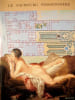
"L'étude du Faubourg-Poissonnière est menée de main de maître par P. Étienne, à qui sa profession d'architecte permet de fournir des plans de reconstitution tout à fait passionnants. Ce quartier un peu excentré est un magnifique exemple de l'urbanistique privée à l'époque des Lumières. A part l'hôtel des Menus-Plaisirs qui sert d'entrepôt et d'atelier pour les spectacles de Cour, la « Nouvelle France » est un quartier de résidence bourgeois, où se mêlent le négoce enrichi et la finance avant de devenir sous l'Empire le lieu de prédilection de la nouvelle aristocratie militaire. La famille des Sanson, exécuteurs des hautes œuvres à titre héréditaire, y mène une vie discrète et confortable à l'image du quartier. Mais de grands bouleversements se préparent souterrainement autour des domaines aliénés par les Filles-Dieu. Des bourrasques spéculatives traversent la « Villeneuve-sur-Gravois ». A côté de projets monumentaux avortés comme la construction de la nouvelle Comédie-Italienne en bordure du boulevard – mais Choiseul imposa ses propres terrains hérités des Crozat, vers la rue de Richelieu – , le quartier fut surtout la proie de lotisseurs privés, dont le plus efficace fut l'architecte Lenoir. Constructions, aménagements, destructions se succèdent à un train d'enfer, même si le principe chronologique des notices a tendance à grossir le trait. On voit apparaître de véritables promoteurs, acquérant les parcelles par l'intermédiaire de prête-noms (pour ne pas donner l'alarme) et bâtissant maisons de rapport ou hôtels fournis clés en main à leur acheteur, lequel, bien souvent, modifiera par acquisition et revente l'aspect de son bien. On ne respecte pas l'architecture du passé ; on est moderne, de son siècle. Magnifique leçon d'histoire sur quelques lieues carrées du vieux Paris." (François Moureau, Dix-Huitième Siècle, 1988) Désormais les frais d'envoi sont de 6 € seulement pour les livres jusqu'à 1 kg (colissimo suivi), pour la France métropolitaine.
Ur Ragnar Östbergs Skissbok 1897.
(Stockholm, Nordisk Rotogravur, 1941). 4to. Orig. omslag. Ubeskåret. Ren, men ryggen repareret med tape. 53 pp. samt talrige plancher. Et af 250 eksemplarer.
Bohemian Visual Culture in fin-de-siècle Norway. Scenes from Christian Krohg's Studio
, Brepols, 2024 Hardback, 212 pages, Size:216 x 280 mm, Illustrations:13 b/w, 109 col., Language: English. ISBN 9782503606187.
Summary The Norwegian painter, author, and journalist Christian Krohg (1852-1925) is known for his naturalist paintings about the sick and the poor and prostitution. Lesser known are his many studio paintings, portraits of artist friends, and late self-portraits from his studio. This book shows the importance of Krohg's studio as a space not only for art making but also as a place where some of the most pioneering and radical artists, authors, playwrights, and actors met. The circle of friends and colleagues meeting in Krohg's studio were part of the scandalous artist group known as the Kristiania Bohemians. In this study the reader will meet not only Krohg, but also his painter wife, the mythical Oda Krohg, the young Edvard Munch, the anarchist Hans Jæger, playwright Gunnar Heiberg, and the forgotten muse Constance Bruun - one of Henrik Ibsen's favorite actresses. The close and complex relationship between Krohg and Munch will surprise many readers. This book will be a necessary read for anyone interested in Scandinavian nineteenth-century art and culture. TABLE OF CONTENTS Foreword Introduction. Setting the Scene: Bohemianism in Kristiania Chapter 1. Kristiania as a City of Free Love Chapter 2. A Corner in My Studio as an Allegory of Norwegian Modernism Chapter 3. The Image of Oda Krohg as une vraie princesse de la Bohême Chapter 4. Free Love On and Off the Stage Chapter 5. Back to the Studio, 1912-25 Afterword. Krohg and Munch Bibliography Index
Академия архитектуры СССР - Académie d’architecture de l’URSS
Reference : 136983
(1953)
Русская архитектура. Nамятники aрхитектуры. 10-15 век. рисунки и фотографии [Architecture russe. Monuments architecturaux. 1. Des X - XVème siècle.[à] 7. Seconde moitié du XIX - début du XX
Moscou 1953 7 volumes in-4, en feuilles sous chemise rempliée, dessins & photographies légendés. Chemises usées, intérieur frais. Texte en russe.
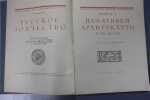
1 : Des X - XVème siècle, 34 planches ; 2 : XV - XVIème, 34 planches ; 3 : XVII ; 4 : Première moitié du XVIIIème, 28 planches ; 5 : Seconde moitié du XVIIIème, 45 planches ; 6 : Première moitié du XIXème, 43 planches ; 7 : Seconde moitié du XIX - début du XXème., 46 planches