 Write to the booksellers
-
Type
Any type (1)
Art print (7)
Autograph (1)
Book (32428)
Disk (1)
Drawings (264)
Engraving (11)
Magazine (125)
Old papers (1)
Photographs (15)
Posters (1)
-
Latest
Last 24h (3)
Last 3 days (17)
Last month (482)
Last week (12)
-
Language
Dutch (78)
English (56)
French (32677)
German (6)
Italian (18)
Portuguese (9)
Spanish (11)
-
Century
16th (14)
17th (46)
18th (201)
19th (1533)
20th (9495)
21st (1692)
-
Countries
Belgium (10932)
Brazil (6)
Canada (116)
China (1)
Côte d'Ivoire (139)
Denmark (209)
France (18354)
Germany (1)
Greece (1)
Switzerland (3096)
-
Syndicate
ALAC (107)
CLAM (143)
CLAQ (102)
CNE (3)
ILAB (10487)
NVVA (1145)
SLACES (1145)
SLAM (7883)
SNCAO (10)
WEY, Francis - Gravures exécutées d'après les dessins de Viollet-le-Duc, E. Delaunay, Crépon, P. Sellier, J. Lefebvre, Nelie Jacquemart, etc
Reference : 121994
Rome. Description et souvenirs. Troisième édition revue et corrigée augmentée d'un voyage à Rome en 1874 et suivie d'un index général analytique.
Editions Librairie Hachette et Cie, Paris - 1875 - Fort in-folio, pleine percaline rouge, titre doré au dos - 760 pages - Nombreuses gravures sur bois dessinées par nos plus célèbres artistes et un plan
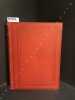
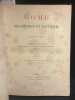
Bon état - Légères rousseurs sur les premières pages et en marge du texte - Menus frottements sur la reliure - Coiffes frottées et abimées
VIEILLES MAISONS FRANCAISES N°143 - ÉDITORIAL,par Pierre de Fayet.INTRODUCTION,par Lucien Weygand.VISAGES ET PAYSAGES,par Marie-Christine Rémy.ANTIQUES DEMEURES,par Gaétan Congés, Nuria Nin, Jean-Paul Jacob.PROVENCE ROMANE
VIEILLES MAISONS FRANCAISES. JUIL 1992. In-12. Broché. Bon état, Couv. convenable, Dos satisfaisant, Intérieur frais. 130 pages. Nombreuses photos en couleur et noir et blanc dans et hors texte.. . . . Classification Dewey : 720-Architecture
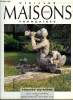
Sommaire : ÉDITORIAL,par Pierre de Fayet.INTRODUCTION,par Lucien Weygand.VISAGES ET PAYSAGES,par Marie-Christine Rémy.ANTIQUES DEMEURES,par Gaétan Congés, Nuria Nin, Jean-Paul Jacob.PROVENCE ROMANE,par Andréas Hartmann-Virnich.SENTINELLES MÉDIÉVALES,par Elisabeth Sauze.L'OCRE, LE VERT ET L'AZUR,par Martine Vasselin.BASTIDES ET JARDINS,par Nerte Dautier.HÔTELS EN VILLES,par Martine Vasselin.LE CLASSIQUE EST TOUJOURS NOUVEAU,par Régis Bertrand.SIÈCLE DE GRANDEUR A MARSEILLE,par Madeleine Villard.AIX, VILLE D'EAUX,par Françoise Boichon.TRÉSORS SACRÉS,par Marie-Christine Rémy.PARCOURS D'EAU,par Roger de Morant.LE CABANON,par Claudie Gontier.LES MALHEURS DU PATRIMOINE,par Gabrielle de Foresta.MAS EN CRAU,par Suzanne Tamisier.AVOIR EN BOUCHES-DU-RHÔNE CARTEMANIFESTATIONS CULTURELLESFISCALITÉRénovation de la taxe d'habitation.ACTUALITÉBloc-notes.SPÉCIAL PARISLe palais du Luxembourg, par Richard Flahaut.SAUVEGARDER« Chefs-d'œuvre en péril » 1991, par Pierre de Lagarde.RESTAURERPrix du Master Art 1992.LIRELu pour nous, par Éric Ollivier.Sélection VMF.S'INFORMERPatrimoine.Expositions.VMF en bref. Mots croisés. Palmarès. Friends of VMF.VMF Jeunes. Liste des délégués. Activités départementales. Carnet. Annonces. Classification Dewey : 720-Architecture

Aspecten van de rituele kunst, kultuurhistorische bijdrage over bindmiddelen in de rituele kunst
, , 1981 Gekartonneerd met stofomslag, 151 pagina's, 29 x 23 cm, Nederlands. Mooie staat. . ISBN 9789062550821.
Aspecten van de rituele kunst, kultuurhistorische bijdrage over bindmiddelen in de rituele kunst
Villas & Jardins d'Italie
Gérard-Julien Salvy, Editeur, Paris, 1986. In-4, reliure pleine toile éditeur sous jaquette illustrée en couleur, 164 pp. Introduction - Les villas florentines - Les villas siennoises - Les villas romaines - Les villas proches de Rome - Les villas gênoises - Les villas lombardes - Les villas de Vénétie - Index des livres cités - Index des ...
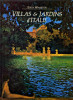
Abondante iconographie en noir et en couleur (aquarelles de Maxfield Parrish).Traduit de l'Anglais par Michèle Hechter. --- Plus d'informations sur le site archivesdunord.com
Anthony van Dyck: Thomas Howard, The Earl of Arundel
, GB Gardners Books , 1996 softcover, 84 pages, Illustrated. 23.5x19cm. good condition. ISBN 9780892363421.
Anthony van Dyck produced his portrait of Thomas Howard. It marked the beginning of van Dyck's brilliant international career. Thomas Howard, a prominent member of the court of James I, was to become one of the greatest and most enlightened collectors and patrons England has ever known. In this probing study, White provides a history both of Howard, and of van Dyck, whose canvases established the grand tradition of portraiture both in England and on the Continent. This volume in the Getty Museum Studies in Art series offers not only a complete study of a great painting but also a primer on how great collections are formed and great careers are launched.
Peking the Beautiful
Shanghai, The Commercial Press, 1927. 154 pp., cartonnage éditeur de soie bleue ornée d'un encadrement brodé d'arabesques rouge et orange, et d'une représentation brodée d'un temple en couleurs en son centre, dos lisse orné d'idéogrammes brodés en jaune (effilochages, quelques taches, petites rousseurs, pâles décharges).
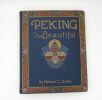
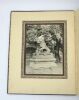
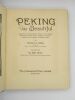
Édition originale de ce monumental ouvrage consacré à la capitale chinoise. Il est illustré de 70 photographies contrecollées, la plupart tirées en noir, en vert ou bistre et dont 11 d'entre elles sont en couleurs. Les photographies sont contrecollées dans un encadrement brun orné d'une frise végétale et d'une légende en chinois. Elles représentent les monuments principaux de Pékin et de ses alentours tels le Palais d'été, la Pagode de porcelaine ou la chambre de l'impératrice douairière dans la Cité interdite. Chaque lieu est accompagné de notes explicatives et historiques en anglais. Le texte est imprimé en brun et est orné d'une lettrine et d'une petite illustration représentant un détail de paysage chinois, en bas à gauche de la page. Ce livre est le fruit d'une collaboration entre Herbert White et son frère jumeau Henry qui sont tous deux à l'origine des photographies et qui furent conseillés par Juliet Bredon, elle-même auteur de travaux sur la Chine et Pékin, ses traditions et ses monuments. White, dans sa préface, remercie également la princesse Der Ling, dame de compagnie de l'impératrice douairière Cixi, de la dynastie Qing, dernière dynastie impériale chinoise. Sa résidence à la Cité interdite auprès de l'impératrice lui permit de conseiller White et elle encouragea la présente publication. Grâce à cet ouvrage, il est aujourd'hui possible d'admirer certains monuments qui furent depuis détruits. Voir photographie(s) / See picture(s) * Membre du SLAM et de la LILA / ILAB Member. La librairie est ouverte du lundi au vendredi de 14h à 19h. Merci de nous prévenir avant de passer,certains de nos livres étant entreposés dans une réserve.
Islamic Glass in The Corning Museum of Glass (Vol. 1+2)
, Corning Museum of Glass, 2014 Two volumes, Cloth binding under dustjacket, 430 + 333 pages, 31 x 23 cm, English. Richly illustrated. *As new.
This beautifully illustrated book presents 595 objects and fragments that were made in the Islamic world from the eighth to the 11th centuries. Each entry consists of a color photograph and a detailed description, usually accompanied by a comment on the history and significance of the object and by a listing of similar pieces in other collections. Most of the pieces presented here were in the collection of Ray Winfield Smith, who acquired an extensive assortment of fragments and display pieces. - This is the second volume in the catalog of the Islamic glass collection in The Corning Museum of Glass. It is the largest and richest collection of early Islamic Glass in the United States. This volume describes and illustrates 482 objects and fragments made in the Islamic world from the eighth to the 14th centuries. Of these pieces, 108 were formerly in the collection of Ray Winfield Smith (1897-1982), whose deep interest in the early history of glass led him to become an enthusiastic collector of potentially informative fragments as well as "museum-quality" display pieces. Many of these are published here for the first time. The Museum's collection was also enriched by the aquisition of objects that were formerly in the collections of Maurice Nahman of Cairo, Egypt, and Jerome Strauss. Each catalog entry consists of a detailed decription, usually accompanied by a comment on the history and significance of the object and by a listing of similar pieces in other collections. Every object and fragment is illustrated with a color photograph and a line drawing that shows the profile. The book also provides concordances and an extensive bibliography.
Roman Glass in the Corning Museum of Glass, Volume one
, Hudson Hills Press, 2002 Faux-linnen binding under dustjacket, 381 pages, 31 x 23.5 cm, English text, richly illustrated in colour. *Very fine condition. ISBN 9780872901391.
Roman Glass in the Corning Museum of Glass, Volume one
Cy Twombly Treatise on the Veil 1970
, Yale University Press, 2019 Hardcover oblong, 90 pages, 36.5x28.5cm, . ISBN 9780300244571.
A breathtaking exploration of one of Twombly?s largest paintings, the second version of his Treatise on the Veil. One of the most important American postwar artists, Cy Twombly (1928?2011) engaged with mythological and poetic source material, setting him apart from other artists of his generation. In 1970, Twombly revisited his 1968 painting Treatise on the Veil and, in a short period of focused creativity, produced a painting?Treatise on the Veil (Second Version)?on a single, 33-foot canvas along with more than a dozen related drawings. This handsomely produced oversize book features three essays that examine these works in relation to Twombly?s oeuvre, contemporaneous explorations of time, the Orpheus myth, and a musical composition that Twombly cited as an influence. Large images and details bring us in close to Twombly?s magnificent meditation on time and space.
Big Four Remembered
Leicester, Haynes Manuals Inc 1995, 1995 Hardcover, 464 pages, English, 285 x 225 mm, book in good condition, with multiple illustrations in b/w. ISBN 9781856481793.
The L M S remembered. -- Oxford publishing co., 1979 ; The L N E R remembered. -- Oxford publishing co., 1979 ; The Southern remembered. -- Oxford publishing co., 1979 ; The great Western remembered. -- Oxford publishing co., 1985
Ferro-Cement Boat Construction
Cornell Maritime Press Cartonné avec jaquette 1971 In-4 (18,5 x 26 cm), cartonné toilé avec jaquette, 125 pages, texte en anglais, figures en noir ; jaquette jaunie et abîmée (déchirures et frottements au dos et sur les bords, rousseurs et traces aux plats), traces de décoloration sur les plats, petite entaille au cartonnage sur le bord latéral du quatrième plat, rousseurs aux gardes, par ailleurs intérieur frais, état moyen. Livraison a domicile (La Poste) ou en Mondial Relay sur simple demande.
McKim, Mead & White : the masterworks. Photographs by Jonathan Wallen.
New-York Rizzoli 2003 Grand in-4 (h. 34 cm.) 304 pp. reliure cartonnée, jaquette illustrée.
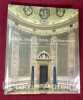
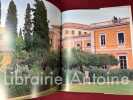
Ces architectes sont d'illustres représentants de la Renaissance architecturale américaine entre 1876 et 1917, marquée par l'influence du style antique. Ils sont les architectes de nombreux bâtiments publics emblématiques de l'époque. Rare. Très bon état. Libraire membre du S.L.A.M. (Syndicat national de la Librairie Ancienne et Moderne) et de la L.I.L.A. (Ligue Internationale de la Librairie Ancienne). N'hésitez pas à prendre contact par mail pour des photographies et des détails supplémentaires, pour des recherches ou des estimations de livres anciens et rares.
THE SMALL HOUSE : TODAY AND TOMORROW,
, London, Leonard Hill, 1957, Bound, cloth with silverimprint on front and spine, photo - frontispice, 190 x 250mm., 218pp., b/w documentation and LXIX b/w picture - plates.
Book was written in collaboration with Johannes Schreiner. First edition. Good condition.
Le Petit Salon. The journey of an 18th century room from Paris to Vermont.
Middlebury, 2025 in-8 broché (192 pages).
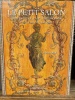
Les boiseries de l'Hôtel de Crillon-Polignac, (place de la Concorde). NEUF afrique
Wohnhausbauten von Curjel & Moser. Ill. Katalog.
o.J. (um 1920), in-4to, 40 S. s./w. und garbig illustriert + 1 Tafel h.-t., hs. Ueberreicht von Curjel & Moase Carlsruhe, illustrierte Original-Broschüre.

(SLACES, NVVA)
Phone number : 41 (0)26 3223808
Alan Davie.
London, Lund Humphries, c1967. 175 Seiten. Mit zahlreichen Illustrationen. Farbiger illustrierter Leinenband.
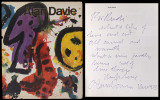
Mit 9-zeiiger Widmung und Unterschrift von Alan Davie. - Tadellos erhalten.
Harlekin. Ein Gedankenspiel.
o.O., 1980. Folio. Mit 65 Etüden von Hermann Rastorfer. Orig.-Leinenband.
Mit Originalbrief und Einladung zur Präsentation von Hermann und Hedi Rastorfer. Nr. 16 von 500 Exemplaren. Von Max Kaindl-Hönig und Hermann Rastorfer signiert. – Fester und fliegender Vorsatz gebräunt und berieben. Ohne Schutzumschlag.
Scapa - Temps - Zeit - Time.
Bern, Edition Parlevent, 2009. Quer-4°. 126 S., mit zahlreichen Illustrationen von Scapa. Leinenband mit illustriertem Schutzumschlag.
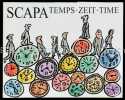
Mit Widmung und ganzseitiger Zeichnung von Scapa. - Sehr gut erhalten.
Das eigene Leben.
Berlin, J. Bard, 1931. 8°. Frotnispiece-Porträt, 204 S., mit Illustrationen. Mit Titel und Autor bedrucktem Leinenband.
Mit handschriiftlicher Widmung von Emil Nolde: "E.L. Kirchner, gerne sende ich Ihnen diesen kleinen Lebensabriss. Ihr E.N. - Seebüll 5.10.31. Historisch interessantes Unikat. Es handelt sich um das verschollen geglaubte Geschenk Noldes, für das sich Kirchner wenige Tage nach dessen Erhalt 1931 bei ihm bedankte (Delfs 2572) und dieses auch in Briefen an an Hagler und Schiefler erwähnt (Delfs 2573, 2577).
Phone number : 41 (0)44 261 57 50
Hours of Henry VIII : A Renaissance Masterpiece by Jean Poyet
USA, George Braziller and The Pierpont Morgan Library, 2001 Softcover, 196 pages, 28 x 21.5 cm, colour and black and white illustrations, English text. *fine condition. ISBN 9780807614853.
A product for the royal court of France, the Hours of Henry VIII, created around 1500 by Jean Poyet, is one of the most splendid Books of Hours from this period. This magnificently illustrated lay book of daily devotions and prayers contains fifty-five exquisitely hand-painted images all reproduced here together and in color for the first time. The previously little-known Poyet (active ca. 1483-1503) enjoyed the patronage of the courts of three French kings. Not only an illuminator of manuscripts of the highest quality, Poyet also created panel paintings, elaborate drawings, and designed theatrical spectacles, all in a style that links Fouquet to Poussin. Author Roger Wieck provides a thorough explanation of the importance both of this grand manuscript within its art historical context and of Poyet's artistic achievements, which fluidly merged the cool, late Gothic aesthetic of his native northern France with the avant-garde Renaissance style of northern Italy. All Poyet's known works are discussed and illustrated. Also detailed commentaries by William M. Voelkle and K. Michelle Hearne on each section of the Book of Hours, and an analysis of the fascinating history of the manuscript (tradition holds that it was once in the collection of Henry VIII, hence its name today)
L'escalier au fil du Rhône. Valais - Vaud - Genève. Treppen entlang der Rhone. Wallis - Waadt - Genf. Staircases along the Rhône. Valais - Vaud - Geneva.
Association Edelweiss - Infolio 2016, 225x225mm, 228pages, reliure d'éditeur. Dédicacé. Très bel exemplaire.
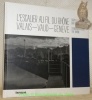
photos couleurs et n/b, édition trilingue: français - allemand - anglais, Pour un paiement via PayPal, veuillez nous en faire la demande et nous vous enverrons une facture PayPal
Walter Kurt Wiemken. Das gesamte Werk.
Basel und München, Reinhardt und Prestel, 1979. 4°. 471 S. Mit zahlr. Abb. Orig.-Leinenband mit farb. Schutzumschlag
Aus der Reihe: "Oeuvrekataloge Schweizer Künstler", Nr. 5. - Werkverzeichnis. - Sehr gut erhaltenes Exemplar.
PONTIGNY
Zodiaque. 1964. In-16. Broché. Bon état, Couv. convenable, Dos satisfaisant, Intérieur frais. 63 pages. Illustré de nombreuses photos héliogravées en noir et blanc hors texte. Etiquette de code sur le dos. Tampons et annotation de bibliothèque en 1re page.. . . . Classification Dewey : 720-Architecture
Photos de Zodiaque. Classification Dewey : 720-Architecture
Broken Woman. 21 Pastels and 12 Poems.
o.O., Black Sparrow Press., 1999. (60) S. Mit 21 Abb. nach Werken von Francesco Clemente. Orig.-Broschur mit Schutzumschlag (berieben und bestossen).
Bernhard Huber. Transition Glasprojekte. Hrsg.: Myriam Wierschowski Deutsches Glasmalerei Museum Linnich.
Stuttgart. Arnoldsche Art Publishers, 2007, in-4to, 168 S., reich ill. mit farbigen photogr. Abb., Original-Leinenband, farb. ill. OU.
(SLACES, NVVA)
Phone number : 41 (0)26 3223808

