 Write to the booksellers
-
Type
Any type (1)
Art print (7)
Autograph (1)
Book (32223)
Disk (1)
Drawings (264)
Engraving (11)
Magazine (125)
Old papers (1)
Photographs (15)
Posters (1)
-
Latest
Last 24h (4)
Last 3 days (17)
Last month (480)
Last week (12)
-
Language
Dutch (78)
English (56)
French (32472)
German (6)
Italian (18)
Portuguese (9)
Spanish (11)
-
Century
16th (14)
17th (46)
18th (199)
19th (1525)
20th (9435)
21st (1683)
-
Countries
Belgium (10932)
Brazil (6)
Canada (116)
China (1)
Côte d'Ivoire (139)
Denmark (209)
France (18149)
Germany (1)
Greece (1)
Switzerland (3096)
-
Syndicate
ALAC (107)
CLAM (143)
CLAQ (102)
CNE (3)
ILAB (10476)
NVVA (1145)
SLACES (1145)
SLAM (7872)
SNCAO (10)
Voyage pictoresque de Paris, ou indication de tout ce qu'il y a de plus beau dans cette grande Ville en Peinture, Sculpture, & Architecture
1749 A Paris, Chez De Bure, l'aîné, Libraire - 1749 (Première édition) - Avec Approbation et Privilège du Roi - In-12 (10x16,5cm environ), reliure pleine peau, 5 nerfs, fleurons, filets et pièce de titre dorés au dos, tranches rouge - 277 pages + Table des matières et approbation - Cul-de-lampe

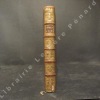
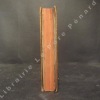
Bon état intérieur (rares rousseurs), malgré cuir légèrement érodé et éraflé - Petit manque de matière à la coiffe inférieure - Trou probablement dû à bibliophage au dos (sans report) - Seconde charnière à nue, dû à déchirure du papier recouvrant les gardes (réparation possible) - Etiquette du propriétaire sur le second plat
National Gallery, London Vol. III
Turnhout, Brepols, 1967 Hardcover with dustjacket, 68 pages, 23 x 29 cm, English text. * New.
The National Gallery, London Vol. III, Corpus of 15th-Century Painting in the Former Southern Netherlands, vol. 11
L'ABBAYE DU BEC-HELLOUIN
CAISSE NATIONALE DES MONUMENTS HISTORIQUES. 1964. In-12. Broché. Bon état, Couv. convenable, Dos satisfaisant, Intérieur frais. 58 pages. Nombreuses photos et reproductions anciennes en noir et blanc, dans le texte et hors texte.. . . . Classification Dewey : 720-Architecture
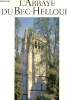
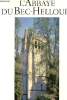
Ex-libris P. Dumont. Classification Dewey : 720-Architecture


L'Architecture Usuelle (notes indiquant années: 16-17-19 un livre sans note possiblement année 18 + planches connexes et une table des monographies années 17 à 20)
Emile Thézard et Fils Editeurs in4. Sans date. Broché.
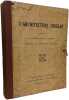
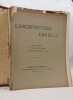
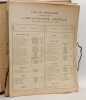
chemises souples en mauvais état notes indiquant années: 16-17-19 un livre sans note possiblement année 18 + planches connexes et une table des monographies années 17 à 20 vendu en l'état
M. Desgodets, Architecte du roi - M. GOUPY, Architecte-Expert, bourgeois
Reference : 49610
(1777)
Les lois des Bâtiments, suivant la Coutume de Paris, traitant de ce qui concerne les servitudes réelles, les rapports des jurés-experts, les réparations locatives, douairieres, usufruitieres, bénéficiales etc, Enseignés par M. Desgodets, Architecte du roi - avec les Notes de M. GOUPY, Architecte-Expert, bourgeois - Nouvelle Edition, augmentée de la conférence des Coutumes sur chaque Article
1777 PARIS, de Bure, fils - 1777 - Reliure plein veau raciné de l'époque (coins émoussés) - Dos à 5 nerfs à caissons fleuronnés - Pièce de titre bordeaux - Titre doré - Filets dorés sur les coupes - toutes tranches rouges - XXXII-364 pages & 200 pages -petite épidermure sur un plat - Bel exemplaire - Envoi rapide et soigné - 49610
M. Desgodets - M. Goupy Cnformément à nos conditions générales de vente :Les frais de port sont affichés à titre indicatif. Il se peut que nous devions vous contacter pour vous informer du coût de laffranchissement supplémentaire en fonction du poids et du nombre de livres, surtout pour les envois internationaux Cependant vu l'augmentation des tarifs postaux à l'internationale, nous pouvons expédier les ouvrages en point relais MONDIAL RELAY pour les pays suivants : Allemagne, Autriche, Belgique, Espagne, Italie, Luxembourg, Pays-Bas, Pologne, et Portugal. Merci de nous indiquer en retour le point relais choisi ainsi que votre numéro de téléphone mobile & adresse Courriel pour assurer le suivi du colis.N'hésitez pas à nous interroger.In accordance with our general terms and conditions of sale:Shipping costs are displayed for informational purposes only. We may need to contact you to inform you of the additional postage costs depending on the weight and number of books, especially for international shipments.However, given the increase in international postal rates, we can ship books via Mondial Relay to the following countries: Germany, Austria, Belgium, Spain, Italy, Luxembourg, Netherlands, Poland, and Portugal. Please provide us with your chosen Mondial Relay point, as well as your mobile phone number and email address to ensure package tracking.Please feel free to contact us with any questions
Les LOIX des BATIMENTS SUIVANT la COUTUME de PARIS
Un ouvrage de 596 pages, format 135 x 205 mm, relié pleine basane d'époque, publié en 1775, Chez de Bure Fils (Paris)
Nouvelle édition augmentée de la Conférence des Coutumes sur chaque Article
Phone number : 04 74 33 45 19
L'EGLISE DU MOUTIER D'AHUN ET SES BOISERIES
IMP HENRI BASUYAU & CIE. 1930. In-8. Broché. Etat d'usage, Couv. légèrement passée, Dos satisfaisant, Intérieur acceptable. 16 pages. Nombreuses illustrations en noir et blanc hors texte.. . . . Classification Dewey : 720-Architecture
Classification Dewey : 720-Architecture
À propos de l'influence de l'architecture bourguignonne en brabant-l'église abbatiale de Villers / extrait du bulletin de la com. royale des monuments et des sites T. 6/1977
Com. royale des monuments et des sites 1977 in4. 1977. Broché.

Bon état correcteur sur le premier plat intérieur propre
Londres et ses environs, ou guide des voyageurs, curieux et amateurs dans cette partie de l’Angleterre, qui fait connoître tout ce qui peut intéresser & exciter la curiosité des Voyageurs, des Curieux & des Amateurs de tous les états; avec des Instructions indispensables à connoître avant d’entreprendre ce Voyage, & une Notice des principales Villes les plus Commerçantes & les plus Manufacturières des trois Royaumes: on y a joint les Vues des principaux Edifices & Maisons Royales, & une Carte, gravés en taille-douce. Ouvrage fait à Londres, par M.D.S.D.L. Seconde édition. Tome second. Environs de Londres; Notice des Villes commerçantes.
Paris, Buisson 1790, 165x105mm, 323pages, reliure basane. Encadrement, fleurons, filets, titre, tomaison et ornementations dorés au dos. Pages de garde marbré. Belle reliure. Bel exemplaire.
5 planches n/b dépliantes, Pour un paiement via PayPal, veuillez nous en faire la demande et nous vous enverrons une facture PayPal
Art du Cartier. [Extract from Descriptions des Arts et Metiers.] 1762
S.l., , 1762 Modern paperbound, 38pp., avec 5 full pages planches gravees hors texte, in-folio 42.5x27.5cm, bon etat.
Extrait du "Descriptions des art et metiers".
LA CATHEDRALE DE NOTRE DAME D'AMIENS
POIRE CHOQUET. 1987. In-4. Cartonné. Bon état, Couv. convenable, Dos satisfaisant, Mouillures. 160 pages. Premier plat illustré en couleurs. Nombresues photos en couleurs dans et hors texte.. . . . Classification Dewey : 720-Architecture
Classification Dewey : 720-Architecture
Les Vosges et les bords du Rhin
notes de voyage par M.in 16 broché,35 pages,Bar le Duc Contant Laguerre 1880
ALAIN SARFATI.
Paris, Moniteur 1990, 240x220mm, 95pages, broché. Bel exemplaire.
photos n/b, Pour un paiement via PayPal, veuillez nous en faire la demande et nous vous enverrons une facture PayPal
[Imprimeries Gounouilhou] - MEAUDRE DE LAPOUYADE ; [ JULLIAN, Camille ; MALE, Emile ]
Reference : 64702
(1912)
La Statue de Clément V à la Cathédrale Saint-André [ Edition originale enrichie de 2 lettres autographes signés de Camille Jullian et Emile Mâle ]
Tiré à 25 exemplaires, 1 vol. in-4 reliure de l'époque bradel demi-vélin blanc, couverture conservée, De l'Imprimerie G. Gounouilhou, Paris, 1912, 7 pp. avec 3 planches hors texte, 1 L.A.S. de Camille Jullian datée de mars 1912 : "Avec mes plus amicaux remerciements pour votre travail [...] si bien observé. Je l'avais déjà lu et j'avais été très étonné d'y être cité, ayant complètement oublié cette enquête", et 1 L.A.S. d'Emile Mâle datée d'avril 1913 : "Je vous remercie de l'excellent article que vous avez eu l'obligeance de m'envoyer. Vous avez clos une interminable discussion. Grâce à vous, il est désormais établi que deux têtes ont été refaites. On ne parlera plus du portrait de Clément V. A-t-on même le droit de parler de Clément V ? Pour moi, le pape [...] au trumeau n'a jamais été Clément V. Les doutes que vous émettez à ce sujet sont tout à fait légitimes. J'avoue que l'article publié récemment par M. Leroux ne m'a pas convaincu [ ... ]"
![La Statue de Clément V à la Cathédrale Saint-André [ Edition originale enrichie de 2 lettres autographes signés de Camille Jullian et Emile Mâle ]. ...](https://static.livre-rare-book.com/pictures/CDL/64702_thumb.jpg)
![La Statue de Clément V à la Cathédrale Saint-André [ Edition originale enrichie de 2 lettres autographes signés de Camille Jullian et Emile Mâle ]. ...](https://static.livre-rare-book.com/pictures/CDL/64702_2_thumb.jpg)
![La Statue de Clément V à la Cathédrale Saint-André [ Edition originale enrichie de 2 lettres autographes signés de Camille Jullian et Emile Mâle ]. ...](https://static.livre-rare-book.com/pictures/CDL/64702_3_thumb.jpg)
Bel état pour ce rare exemplaire de l'auteur, enrichis de deux importants courriers autographes des deux grands historiens Camille Jullian et Emile Mâle
Monuments et sites historiques de l'Iran
sd Publié par l'Organisation Nationale de la Protection des Monuments Historiques de l'Iran - Sans date - In-8 broché - 315 pages et une carte dépliante de l'Iran - Nombreuses illustrations en N&B dans le texte, une illustration en N&B hors-texte en première page et une en couleurs à la deuxième
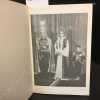
Bon état - Quleques frottements sur les coins, coiffes et les tranches latérales - Intérieur frais Bon
Medard Tytgat.
BE - , IBM Belgium, sans date, In-gr. folio en ff. sous couv. et rel. d"edition, etui, 23pp de texte bilbigue Francais-Neerlandais, .
12 reproductions de peintures de l"artiste en coul. a pleine page, chacune a l"interieur d"une chemise legendee, tirage limite a 750 ex., un des 690 ex. numerotes sur velin Aquarel Torchon, edition originale. n? . 533. Bel ex. Fine copy. Toiles reproduites : Marine bleue - Damme aux corbeaux - Plat pays - Ciel d"orage - Crevettier hollandais - La quarantaine - Horizon - Lever de soleil - Portrait de Michel de Chelderode - Mere de l"artiste - Portrait de Jean Ray - La visiteuse. Medard Tytgat (1871-1948) was a Belgian painter, lithographer, book illustrator and poster artist known for portraits, nudes, and landscapes..
DIX SIECLES D'ARCHITECTURE HOSPITALIÈRE EN EUROPE.
Ingelheim am Rhein, C.H. Boehringer Sohn, 1967 ; in-4, 124-250 pp., cartonnage de l'éditeur. Très bon état avec sa jaquette UNE HISTOIRE DE L'ARCHITECTURE HOSPITALIÈRE.
Très bon état avec sa jaquette UNE HISTOIRE DE L'ARCHITECTURE HOSPITALIÈRE.
Faith in a Beam of Light. Magic Lantern and Belief in Western Europe, 1860-1940
, Brepols, 2022 Hardback, 291 pages, Size:178 x 254 mm, Illustrations:34 b/w, 37 col., 5 tables b/w., Language(s):English, German, French. ISBN 9782503599083.
Summary An early visual mass medium, the magic lantern was omnipresent in most Western societies between 1880 and 1930. The Christian Church, especially the Catholics, spiritual associations such as the Freemasons, political interest groups, and teaching institutions all made use of lectures enriched by projected images to disseminate information, convictions, and doctrines. Moreover, the lantern often featured as a concealed aid in stage spectacles. Nineteen authors analyse the effects of "the beam of light in the dark" in the context of religion, faith, and belief. Attention is paid to the wide spectrum of locations where projections took place, as well as to the lantern's impressive versatility. The lavishly illustrated chapters collected in this volume range from analyses of religious propaganda to fundraising lectures for missionary work in China, from the fight against alcoholism to the secularisation of society, and from the lantern's application in spiritualist sessions to its use in science and teaching. TABLE OF CONTENTS Introduction Part 1. An Overview of the Archives: Religious Lantern Heritage and its Historical Discursive Frameworks Isabelle Saint-Martin, The Paupers' Bible by Lantern Slides: Christian Pedagogy and the Magic Lantern Pierre V ronneau, Le Fascinateur and Maison de la Bonne Presse: Catholic Media for Francophone Audience Bart G. Moens, New Light on Maison de la Bonne Presse and its Service des Projections Greet de Neef, Mission Projections: Glass Positives in the Archives of the Religious Institutes in KADOC Wouter Egelmeers, Making Pupils See: The Use of Optical Lantern Slides in Catholic Geography Teaching in Belgium Part 2. Catholic Projections in a Modern Light: Infrastructure, Theory, Strategies Margo Buelens-Terryn, Iason Jongepier, and Ilja Van Damme, Shine a Light: Catholic Media Use, Transformations in the Public Sphere, and the Voice of the Urban Masses (Antwerp and Brussels, c. 1880 - c. 1920) Frank Kessler, and Sabine Lenk, Teaching Faith with the Lantern: Audio-visual Lantern Performances by the Clergy in France and Belgium Around 1900 Natalija Majsova, The Bijou Collection: A Multimedial Constellation for Multimodal Experiences Adeline Werry, and S bastien Fevry, The Editorial Strategy of the Bijou Collection: When Media Diversification Reinforces an Edifying Ambition Dominique Nasta, and Bart G. Moens, Religious Temperance Propaganda and Multimodal Aesthetics of Emotion: The Lantern Slide Set 'Un poison mortel' and Early Film Adaptations of mile Zola's L'Assommoir Natalija Majsova, and Philippe Marion, The Edifying Structures of the Bijou Imaginary: An Investigation into Images, Rhetoric, Memory, and Politics Part 3. Projecting Aspirations, Challenges, and Fears: The Spiritual Lantern Kurt Vanhoutte, Deep Time Through the Lens of the Magic Lantern: Genesis and Geology Nelleke Teughels, Films fixes, the Forgotten Medium of the Catholic Battle Against Secularization in Interwar Belgium Evelien Jonckheere, 'Hidden Lanterns' in fin-de-si cle France and Belgium: (Dis)Belief in Spiritualist Apparitions at the Fairground, Music-hall and Artistic Cabaret Sabine Lenk, Masonic Slide Cultures: Teaching, Meditation, Optimisation Part 4. Historical Articles on Slide Performances by the Church Bou. 'La R demption', Journal de Roubaix, 30 December 1908, quoted in Anonymous. 'Causerie du mois', Le Rayon 1 (January 1909): 2-4 (facsimile) Neue evangelische Garnisonskirche. 'Lichtbilderpredigt ber das Leben Jesu, I. Teil', printed by Ernst Schimk nig, Berlin 1909 (facsimile)
A Handbook of Chinese Art
G. Bell and Sons Ltd, London, 1973. In-8, broché sous couverture illustrée en couleurs, 140 pp. Preface - Chinese Dynasties and Reigns - Bronzes - Buddhism - Ceramics - Decoration - Jade and Hardstones - Painting - Miscellaneous - Illustrations.
Avec 16 pp. d'illustrations en noir et blanc en hors texte.Texte en langue anglaise. --- Plus d'informations sur le site archivesdunord.com
Jean-Baptiste Alexandre Le Blond, architecte 1679-1719 : De Paris à Saint-Pétersbourg
Alain Baudry & Cie 2007 In-8 relié 24,4 cm sur 16,4. 359 pages. Très bon état d’occasion.
Très bon état d’occasion
Promenades à Bruxelles : Art Nouveau.
Bruxelles, Racine, 1996. 16 x 23, 181 pp., nombreuses illustrations en N/B, broché, bon état.
LUSTRUM A(rt)SSENEDE '98. kunst en poezie manifestatie.
Assenede, VZW A(rt)SSENEDE, 1998 softcover originele uitgeversomslag in kleur, 29.6x21 cm., pagina's zonder nummering, geillustreerd in z/w.
IA(rt)SSENEDE is een gratis tentoonstellingsfeest en een ontmoetingsplaats waar kunst in vele vormen dichter bij het publiek wordt gebracht, het is uitgegroeid tot een van de grootste kunst- en poeziemanifestaties in de Benelux en wordt ondersteund door een grensoverschrijdende en ruime belangstelling vanuit de media. (Dag- en vakbladen, Radio en TV). 117 kunstinstallaties in de dorpskom, 28 dichters, 1 kunst- en poeziecatalogus. 1 tentoonstellingsfeest voort : publiek, gemeente, kunstenaars, dichters & muzikanten.
DE BEGIJNHOFKERK VAN LIER. BOUWGESCHIEDENIS EN INVENTARIS VAN HET KUNSTPATRIMONIUM VAN DE SINT-MARGARETAKERK,
, Liers Genootschap voor Geschiedenis, 1999, softcover, geillustreerde kartonomslag, 155 x 230mm., 503pp., ongelooflijk uitgebreid geillustreerd in kleur en z/w.
Als een schrijn van devotie bewaart de Sint-Margaretakerk nog een zeer rijk roerend patrimonium dat getuigt van de devotie van vele generaties Lierse begijnen. Als een rijk, weelderig, barok kleinood vormt de Lierse begijnhofkerk een onvervreemdbaar stuk cultureel werelderfgoed. Boek is in goede staat.
Pol Mara catalogue 1990
, Campredon art et culture , 1990 softcover, 81 pages, illustre a couleur. Texte en Francais
Pol Mara catalogue 1990 - Campredon art et culture
Les grands travaux sous François Mitterand 1981 - 1991
Du Rocher 1991 In-4, cartonnage éditeur, 119pp., illustrations en noir et en couleurs.
Bon état d’occasion

