 Write to the booksellers
-
Type
Book (30429)
Disk (1)
Engraving (1)
Magazine (1070)
Old papers (2)
Photographs (2)
Reprint (4)
-
Latest
Last 24h (1)
Last 3 days (146)
Last month (493)
Last week (8)
-
Language
Chinese (1)
Dutch (82)
English (52)
French (31334)
German (15)
Italian (16)
Latin (5)
Portuguese (1)
Spanish (3)
-
Century
16th (3)
17th (14)
18th (60)
19th (1702)
20th (12260)
21st (1384)
-
Countries
Belgium (4087)
Brazil (2)
Canada (6)
China (14)
Côte d'Ivoire (192)
Denmark (483)
France (22565)
Greece (7)
Netherlands (1711)
Switzerland (2442)
-
Syndicate
ALAC (6)
CLAM (107)
ILAB (11456)
NVVA (1063)
SLACES (1063)
SLAM (9770)
SNCAO (71)
Maria-Consiglia-Miriam Anzivino, Furio Durando, Sofia Pescarin, Alberto Trombetta,
Reference : 55416
Voyage archéologique en Italie
, GRUND , 2001 Hardcover, 320 pages, Texte en Francais, 335 x 250 x 28 mm, jaquette illustreé, Comme Neuf !, illustrations en couleur ! ISBN 9782700024524.
Le patrimoine archéologique de l'Italie a de tout temps suscité un intérêt constant. Carrefour entre l'Europe, l'Afrique et l'Asie, la péninsule vit s'épanouir de nombreuses cultures préhistoriques, fut habitée par les Celtes, les Etrusques, les peuples italiques, les Phéniciens, les Grecs et les Carthaginois. Puis commença l'extraordinaire aventure de Rome, qui fondit dans son propre langage artistique le génie des Grecs et le pragmatisme italique, de sorte que l'architecture et l'art romains sont aujourd'hui encore considérés comme l'une des étapes essentielles de l'histoire de l'art occidental. A cette Italie du passé et à ses précieux vestiges, il fallait un ouvrage prestigieux. Les sites sélectionnés, célèbres ou méconnus, permettent de parcourir, dans le temps et dans l'espace, le riche passé archéologique de l'Italie, depuis les gravures préhistoriques des peuples alpins aux magnifiques mosaïques de la fin de l'Empire romain, en passant du rude climat des vallées du Nord à la splendeur radieuse de la Sicile et de la Sardaigne. Ils possèdent en commun la possibilité de séduire et d'intéresser l'ensemble des lecteurs. Accompagné d'illustrations de qualité, le texte rigoureux fient compte des dernières découvertes tout en offrant une lecture agréable.
Vestiges de la Grèce antique dans leur cadre naturel :Tome 1, L'Attique et les Iles
, Rossolis , 2006 Hardcover , 188 pages, Texte en Francais, 295 x 230 x 20 mm, Comme Neuf !, illustrations en couleur. ISBN 9782940365111.
Consacré à la Grèce antique, ce livre montre avec poésie et en images comment les sites archéologique se fondent en toute harmonie dans les paysages qui les entourent, et à quel point ils marquent le voyageur qui les parcourt. Ses pages invitent à la visite des monuments et à la communion avec leur site. Le travail exceptionnel des photographes Maria Fakidi et Dora Minaïdi, au-delà des vestiges eux-mêmes, rend hommage aux lieux et à leur magie. Le texte de l'archéologue Maria Beloyanni ajoute à l'image le socle de la connaissance. Le tome I parcourt l'Attique et les îles de la mer Égée. Les tomes II et III sont consacrés à la Grèce continentale et au Péloponnèse.
Leptis Magna
Raggi Verlag / Basel 1966 in8. 1966. Cartonné. iconographie en noir et blanc
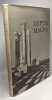
Bon état jaquette défraîchie bords un peu frottés intérieur propre
Ricerche archeologiche nell'isola sacra - Istituto nazionale d'archeologia e storia dell'arte - Il pons matidiae - La basilica di S. Ippolito / Monografie II
Istituto nazionale d'archeologia et storia 1975 in4. 1975. Cartonné. iconographie en noir et blanc
Bon état jaquette défraîchie bords frottés abîmés intérieur propre
Felix Ravenna - Terza serie - fascicolo 16° (LXVII) Aprile 1955 - Un bronzetto etrusco nel Museo Nazionae di Ravenna Ricordo di Corrado Ricci
Ravenna 1955 in8. 1955. Broché. iconographie en noir et blanc
Bon Etat de conservation cependant agrafe oxydées et page titre abîmé au niveau de la charnière intérieur propre bonne tenue par ailleurs
Marc Aurel Liebieghaus Monographie - band 2
Beck & Peter 1978 in8. 1978. Broché. Marc Aurel Liebieghaus Monographie - band 2
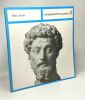
Bon état cependant couverture défraîchie ternie intérieur propre
Foggia Medievale
FOGGIA CLAUDIO GRENZI 1997 Un volume in-4°, 223 pp. Reliure cartonnée à la Bradel de l'éditeur, plat illustré, dos titré. (dos décoloré et présentant un très léger tassement en sommet et en pied). Texte sur deux colonnes. Catalogue d'exposition accompagné d'une riche iconographie en noir & blanc et en couleurs. En cas de commande merci de prévoir des frais de port supplémentaires (poids du volume : 1,8 kg).
Nerone e l'egitto - messaggio politico e continuità culturale / Studi di storia antica 12
CLUEB / Bologna 1989 in8. 1989. Broché.
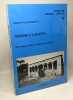
Très Bon Etat de conservation
Les monuments de l'acropole - guide archéologique
Antiquités et de la restauration 1978 in12. 1978. Broché. illustrations en noir et blanc et en couleurs
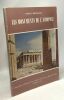
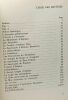
couverture frottée intérieur propre
Les monuments de l'acropole - guide archéologique
Antiquités et de la restauration 1978 in8. 1978. Broché.
Bon Etat couverture un peu défraîchie intérieur propre
Lampes en bronze a l'epoque paleochretienne
BE, Brepols, 2010 Broche, softcover, 352 pp., 22x 28cm,582 blanche et noir illustrations, etat neuf ! ISBN 9782503533698.
Apres une Maitrise en Histoire de l?Art (1992) obtenue a l?Universite de Paris-I, Maria Xanthopoulou fait dans la meme universite son DEA en archeologie byzantine (1993) et entreprend une these sur ?« Les luminaires en bronze et fer aux epoques paleochretienne et byzantine : typologie, technologie, utilisation ?» qu?elle soutient brillamment en 1997. Parallelement, elle se forme a l?archeologie de terrain a Lattes et participe a la mission greco-francaise d?Itanos (Crete orientale). D?autres chantiers suivent notamment a Eleutherna (Crete centrale), ainsi que, plus brievement, a Philippes (Macedoine orientale). Ses interets la portent sur l?habitat, et, plus encore, sur la ceramique et le materiel metallique, domaines dans lesquels elle a publie plusieurs articles en grec, italien et francais. Apres avoir enseigne a Paris-I comme Maitre de Conferences associe en 1998/9, a l?Universite de Fribourg (2005) et a l?Universite de Crete (2007), elle obtient en 2008 le poste de Maitre de Conferences en Archeologie Byzantine a l?Universite du Peloponnese. Ce livre se fonde sur des depouillements exhaustifs, l?examen personnel dans les musees grecs, francais et anglais de ce materiel, une connaissance approfondie des alliages cuivreux et des techniques utilisees dans leur fabrication, ainsi que sur la lecture minutieuse des sources antiques et byzantines traitant de l?eclairage. Il fournit surtout le premier essai de typologie concernant les lampes et les luminaires metalliques de l?Antique tardive, ouvrant de nouvelles pistes sur leur origine, leur datation et les echanges ou relations dont ils temoignent.
La grande inscription de Kaniska et l'étéo-tokharien. L'ancienne langue de la Bactriane. Inscriptions de Surkh-Kotal (Baghlan)
Extrait du Journal asiatique, 1 vol. in-8 br., Imprimerie Nationale, Société Asiatique, Librairie Orientaliste Paul Geuthner, Paris, 1958, pp. 346-440 et 4 planches hors texte
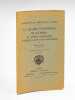
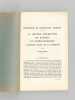
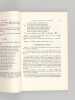
Bon état (dos lég. frotté, ancien cachet d'ex-libris). Il s'agissait de la première inscription en bactrien, découverte en 1957 près de Baghlan par la Délégation Archéologique Française en Afghanistan.
architecture grecque Tome 1: les principes de la construction
, Picard, 2002 Couverture lin, 351 p., ill. en noir et en coul., jaquette ill. en coul. *Nouveau. ISBN 9782708406063.
Si l'architecture grecque est aisément assimilée, dans l'esprit du public cultivé, au parthénon et en général à une haute colonne cannelée, terminée par un couronnement évasé, il semble qu'elle soit mal distinguée de l'architecture romaine, tant s'impose l'image des constructions romaines parfois bien conservées en france, et tant sont présentes les interprétations des modèles antiques, offertes par les architectes de la renaissance et par ceux qui adhérèrent au courant néo-classique du xixe siècle. Certes, chacun se représente sans-difficulté les grandes lignes d'un temple grec, mais à l'évidence, les étapes de sa construction, ses caractéristiques, ses multiples variations, sa polychromie, toutes ces questions ne sortent guère du cercle étroit de quelques spécialistes. pourtant, nos connaissances ont beaucoup évolué depuis que des architectes-archéologues ont entrepris, à partir de la fin du xixe siècle, d'écrire des manuels d'architecture grecque. C'est cette actualité toujours renaissante, à la lumière de fouilles récentes et de sources écrites, qui est proposée dans ce tome i. il rassemble les principes de la construction grecque : après avoir examiné la formation et les méthodes de travail des architectes (d'après l'étymologie grecque, ce sont des " maures-charpentiers "), comment et avec quels financements les artisans construisaient, nous ferons monter un édifice depuis ses fondations jusqu'à la charpente et aux tuiles ; sans oublier l'indispensable décor, sculpté ou peint. L'analyse de la signification des " ordres " grecs et du " canon " dorique était aussi nécessaire. une fois ces principes admis, il sera alors possible, dans les tomes qui suivront, d'exposer le développement et la diffusion des différents types de bâtiments. car la grèce antique - ce volume le montre déjà -, ce ne sont pas seulement des temples, ce sont aussi des tombes voûtées, des enceintes avec des portes en arc brisé, ainsi que des murs et des plafonds peints en trompe-l'oeil architectural dans de riches demeures organisées autour d'une cour péristyle
Le Givetien et le Frasnien du Massif de la Vesdre - stratigraphie et paléogéographie - académie royale de Belgique
Palais des académies - Bruxelles 1973 in4. 1973. Broché. illustrations en noir et blanc planches in-fine
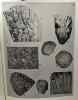
Bon état ternissures sur la couverture intérieur propre
Marie-Hélène Corbiau, Baudouin Van den Abeele, Jean-Marie Yante, Anne-Marie Bultot-Verleysen (eds)
Reference : 65427
route au Moyen Âge. Réalités et représentations
, Brepols, 2021 Paperback, vi + 316 pages, Size:160 x 240 mm, Illustrations:7 b/w, 23 col., 4 tables b/w., 7 maps b/w, Language: French. ISBN 9782390370048.
Summary Qu'elles soient politiques, commerciales, religieuses ou culturelles, les routes structurent et dynamisent les paysages et témoignent de l'appropriation humaine de ceux-ci. Fréquemment, l'existence d'un réseau médiéval a été, sinon niée, en tout cas largement sous-estimée. Des travaux des dernières décennies conduisent à relativiser la pérennité longtemps affirmée de l'héritage romain. Les hommes l'ont adapté aux nécessités et priorités du moment, ont hissé au rang de voies majeures des diverticula et autres liaisons secondaires, et ont emprunté des tronçons de facture incontestablement ou vraisemblablement médiévale. Résolument pluridisciplinaire, associant archéologues, historiens, histo- riens de l'art, spécialistes de la littérature et toponymistes, le colloque organisé par l'Institut d'études médiévales de l'Université catholique de Louvain, à Louvain-la-Neuve, livre des regards croisés et une stimulante confrontation des méthodes. Sous-titrées « Réalités et représentations », ces journées ont été soucieuses de scruter la perception de la route et du réseau viaire chez les contemporains, tant dans des oeuvres littéraires que dans des productions artistiques. Succédant à une approche historiographique assortie de perspectives de recherches et à une orientation bibliographique, la douzaine de contributions émanant de chercheurs au recrutement international s'articulent autour de trois thématiques. La première partie est dédiée à quelques enquêtes historiques relatives à des aspects politiques et fonctionnels. Suit l'éclairage particulier de recherches consacrées à l'apport des mots et des textes concernant le sujet. Une dernière partie regroupe quelques témoignages archéologiques et iconogra- phiques illustrant plus concrètement la matérialité de la route. Il serait difficile et quelque peu présomptueux de tenter pour l'heure un bilan des connaissances. Bien des secteurs demeurent à investiguer, des sources à repérer, à critiquer et à mettre en oeuvre. Le présent volume a par contre l'am- bition de révéler des approches inédites, de dégager des pistes de recherches, de susciter de nouvelles enquêtes. C'est à ce prix seulement que la route médiévale retrouvera la place qui était sienne dans le vécu et l'imaginaire des contem- porains. La publication réunit les contributions de Jean-Marie Cauchies (Bruxelles), Pierre-Henri Billy (Paris), Franck Brechon (Perpignan), Olivier Bruand (Clermont- Ferrand), Marie-Hélène Corbiau (Namur), Wolfgang Haubrichs (Saarbrücken), Perrine Mane (CRH-CNRS), Franco Morenzoni (Genève), Jacques Paviot (Paris), Georges Raepsaet (Bruxelles), Thomas Szabó (Göttingen), Jean-Claude Vallecalle (CIHAM), Jean-Marie Yante (Louvain-la-Neuve). TABLE OF CONTENTS Avant-propos par Marie-Hélène CORBIAU et Jean-Marie YANTE La route au Moyen Âge. Historiographie et perspectives de recherche par Jean-Marie YANTE La route au Moyen Âge. Orientation bibliographique par Jean-Marie YANTE ENQUÊTES HISTORIQUES Populations, pouvoirs et réseau routier en Gaule du nord entre le VIIe et le Xe siècle par Olivier BRUAND Attelages et convois en Lorraine et dans le Luxembourg. L'apport des comptes de péages (XVe-XVIe siècles) par Jean-Marie YANTE La route dans la législation des communes italiennes par Thomas SZABÓ Les routes en Vivarais au Moyen Âge : structuration et fonctionnement d'un réseau viaire par Franck BRECHON APPORT DES MOTS ET DES TEXTES La terminologie routière dans la toponymie et l'hodonymie germanophones entre Meuse, Moselle et Rhin par Wolfgang HAUBRICHS Les noms de chemins au Bas Moyen Âge : essai de typologie par Pierre-Henri BILLY La route entre imaginaire et réalité dans la prédication du XIIIe siècle par Franco MORENZONI La route dans les récits de pèlerinage et de voyage (XIIe-XVe s.) par Jacques PAVIOT La route dans l'imaginaire épique et romanesque (XIIe-XIVe siècles) par Jean-Claude VALLECALLE DE L'ARCHÉOLOGIE À L'ICONOGRAPHIE Routes et véhicules dans l'archéologie médiévale : quelques découvertes récentes et anciennes par Marie-Hélène CORBIAU La technologie du charroi de l'Antiquité au Moyen Âge. Quelques brèves réflexions par Georges RAEPSAET Routes et chemins dans les enluminures médiévales par Perrine MANE CONCLUSIONS Chemins pour des hommes, hommes sur les chemins par Jean-Marie CAUCHIES Index des noms de lieux
EGYPTE. VISION D'ÉTERNITÉ.
, AGDE 1999, 1999 Softcover, 144 pages, Texte en Francais, 300 x 210 mm, une bon exemplaire,.
Catalogue de lŽexposition du Musée de lŽEphèbe (Sept.1999-Janv.2000). Conception religieuse et perception de lŽAu-delà les rites funéraires la tombe et le mobilier funéraire les masques et les derniers portraits les sarcophages les images idéales,...
MARIE Jean, ALESSANDRI J., DELAYE Th. J., BARRE, LAURE H., LUXEL C.
Reference : 9980
(1953)
LA REVUE MARITIME FEVRIER 1953
1953 revue (magazine) grand in-octavo, dos bleu (blue spine), couverture illustrée en couleurs (cover illustrated in colours), illustrations in et hors-texte (in text and full page engraving), de la page 145 à la page 271, Février 1953 à Paris les Editions Ozanne,
Revue "La Revue Maritime" Nouvelle Série, numéro 82 - Extrait du sommaire (contents) : Le paquebot son avenir - Régime juridique de l'archéologie sous-marine - Acev la 5 B2 - Ravitaillement en pétrole du Japon (2) - La frousse - Destin de l'Amiral Dumont d'Urville - Etc. - légèrement défraîchie (lightly fair condition)
Hymnes et prières aux Dieux de Babylonie et d'Assyrie
CERF 1976 In-8 broché 19,5 cm sur 12,3. 564 pages. Bon état d’occasion.
Bon état d’occasion
Salamine de Chypre VI Les petits objets - Université Lyon II Maison de l'Orient Méditerranéen Ancien
DIFFUSION DE BOCCARD 1975 in8. 1975. Cartonné. Cet ouvrage est le sixième volume de la série 'Salamine de Chypre' publié en 1975 par Marie-José Chavane. Il présente un catalogue détaillé de 629 petits objets découverts lors des fouilles archéologiques de Salamine illustrant la vie quotidienne et l'influence grecque à Chypre durant l'époque classique
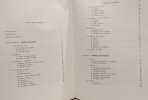
Bon état intérieur propre
Rome, ses origines et son empire.
(Mariemont 1966).
89 p. 29 pls., fold. map. Pb. (Trésors inconnus du musée de Mariemont, I. Exhibition guide)
Belgica Antiqua - De stempel van Rome
Antwerpen, Mercatorfonds s.d. [1980] 525pp., rijkelijk geïllustreerd in zw/w en kleur, gecart. uitgeversband, stofwikkel, in foedraal van uitgever, 31cm., 2 stempeltjes op titelblad, verder in zeer goede staat, gewicht: 3.7kg., B106883
Belgica Antiqua - De stempel van Rome
Antwerpen, Mercatorfonds s.d. [1980] 525pp., rijkelijk geïllustreerd in zw/w en kleur, gecart. uitgeversband, in foedraal van uitgever, 31cm., goede staat, gewicht: 3.7kg., B108482
BELGICA ANTIQUA, de stempel van Rome.
, Antwerpen, Mercatorfonds, 1980., Linnen, met origibeel geillustreerde (foto) omslagwikkel in kleur, 26x33,5cm, 524pp, rijkelijk geillustreerd in kleur en z/w. ISBN 9061531063.
een archeologie handboek. Romeinse Archeologie in Belgie, In foedraal. in goede staat !
BELGICA ANTIQUA, l'empreinte de Rome
Anvers, Mercatorfonds, 1980 toile, jaquette et etui, 26x33,5cm, 524pp, tres bien illustre en couleur et noir/blanc ISBN 9061531055.
Bel exemplaire, archeologie romaine en Belgique
La sculpture à l'époque romaine.
Bruxelles, Éd. du cercle d'art, 1945.
36 p.; 32 pls. H.cl. (Rebound; pencil & inkunderl.)

