 Write to the booksellers
-
Type
Book (30238)
Disk (1)
Engraving (1)
Magazine (1072)
Old papers (2)
Photographs (2)
Reprint (4)
-
Latest
Last 24h (8)
Last 3 days (7)
Last month (238)
Last week (24)
-
Language
Chinese (1)
Dutch (82)
English (52)
French (31146)
German (15)
Italian (16)
Latin (4)
Portuguese (1)
Spanish (3)
-
Century
16th (3)
17th (13)
18th (58)
19th (1675)
20th (12271)
21st (1413)
-
Countries
Belgium (4074)
Brazil (1)
Canada (6)
China (14)
Côte d'Ivoire (202)
Denmark (483)
France (22366)
Greece (7)
Netherlands (1715)
Switzerland (2452)
-
Syndicate
ALAC (6)
CLAM (107)
ILAB (11485)
NVVA (1063)
SLACES (1063)
SLAM (9799)
SNCAO (71)
[Kraus Reprint Co, Millwood ] - ALBRIGHT, William Foxwell
Reference : 59515
(1974)
The vocalization of the Egyptian syllabic orthography
1 vol. in-8 br., reprint from : American Oriental Society, New Haven, Connecticut, 1934, Kraus Reprint Co, Millwood New York, 1974, 67 pp.
Good condition.
Album du Dauphiné ou Recueil de Dessins représentant les sites les plus pittoresques, les villes, bourgs et principaux villages, les églises, châteaux et ruines les plus remarquables du Dauphiné, avec les portraits des personnages les plus illustres de cette ancienne province. Ouvrage accompagné d'un texte historique et descriptif par MM. Cassien et Debelle, et une Société de Gens de Lettres.
1836 Grenoble, Prudhomme, Imprimeur-Libraire - 1836 - Deuxième année - Un volume in-4, reliure demi cuir, dos lisse avec titre et roulette en dorée ainsi que filets et fleurons estampés à froid - 200 pages + 51 planches en N&B hors-texte
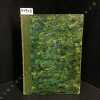
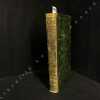
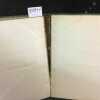
Assez bon état - Rousseurs dans l'ouvrage - Coins émoussés - Frottements sur les tranches et au dos - Début de désolidarisation de la reliure avec les feuillets (voir photos) Assez bon
Album du Dauphiné ou Recueil de Dessins représentant les sites les plus pittoresques, les villes, bourgs et principaux villages, les églises, châteaux et ruines les plus remarquables du Dauphiné, avec les portraits des personnages les plus illustres de cette ancienne province. Ouvrage accompagné d'un texte historique et descriptif par MM. Cassien et Debelle, et une Société de Gens de Lettres.
1839 Grenoble, Prudhomme, Imprimeur-Libraire - 1839 - Quatrième année - In-4, reliure demi veau, dos lisse avec titre, filets et roulettes en dorée ainsi que filets et fleurons estampés à froid - 184 pages + 47 planches en N&B hors-texte
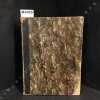
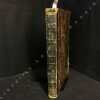
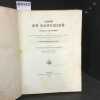
Bon état général - Dernière page désolidarisée - Crayon à papier sur certaines pages vierges - Rousseurs dans l'ouvrage - Coins et coiffes émoussés - Menus frottements sur les tranches - Epidermures et craquelures au dos (voir photos) Bon
Album du Dauphiné - MM. Cassien et Debelle - Préface de J. Marigny
Reference : 124422
(1835)
Album du Dauphiné ou Recueil de Dessins représentant les sites les plus pittoresques, les villes, bourgs et principaux villages, les églises, châteaux et ruines les plus remarquables du Dauphiné, avec les portraits des personnages les plus illustres de cette ancienne province. Ouvrage accompagné d'un texte historique et descriptif par MM. Cassien et Debelle, Dessinateurs, et une Société de Gens de Lettres.
1835 Grenoble, Prudhomme, Imprimeur-Libraire - 1835 - Première année - In-4, reliure demi veau, dos lisse avec titre, filets et roulettes en dorée ainsi que filets et fleurons estampés à froid - 185 pages + 48 planches en N&B hors-texte
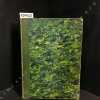
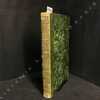
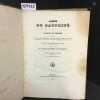
Bon état général - Rousseurs dans l'ouvrage - Auréole grasse sur l'ensemble des coins supérieur - Coins et coiffes émoussés - Menus frottements sur les tranches - Epidermures au dos Bon
Iconographie choisie et commentée par Pierre Gascar
,Paris, Gallimard 1989, 318 pp., 1 vol. in 12 relié plein cuir avec jaquette rhodoïd et étui cartonné illustré (reliure éditeur), joint le catalogue analytique 1989 de La Pléiade (158 pp.). Très bon état.

L'ART PRECOLOMBIEN.
Citadelles & Mazenod Paris 1978 Fort in-4 carré ( 320 X 255 mm ) de 613 pages, pleine toile sous jaquette illustrée en couleurs et étui maroquiné taupe. Superbe et abondante iconographie en couleurs et en noir dans et hors-texte. Très bel exemplaire en parfait état.

L'art précolombien. ‘L'art et les grandes civilisations’.
Paris, Editions d'art Lucien Mazenod, 1978, gr. in-4to, 613 p., rich. ill., planches pliées, reliure en toile originale, avec jaquette.

(SLACES, NVVA)
Phone number : 41 (0)26 3223808
Placing the Gods: Sanctuaries and Sacred Space in Ancient Greece (Clarendon Paperbacks)
Clarendon press 1996 284 pages 15 34x1 83x22 81cm. 1996. Broché. 284 pages.
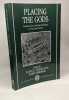
Comme neuf
Jewels of the Pharaos. Egyptian jewelry of the dynastic period. Abridged.
N.Y., Ballantine, 1978.
128 p., ills. Stiff wrs. 28 cm
The temple of Dendur.
New York, Metropolitan Museum of Art, 1978.
78 p., illustrations. Stiff wrappers. 28x21.5 cm (The Metropolitan Museum of Art Bulletin, Volume XXXVI,1, summer 1978)
AKHENATON - LE PHARAON MYSTIQUE
TALLANDIER. 1970. In-8. Relié toilé. Etat d'usage, Coins frottés, Dos frotté, Intérieur acceptable. 271 pages augmentées de nombreuses illustrations en noir et blanc dans et hors texte.. . . . Classification Dewey : 930.1-Archéologie
NOUVEAUX ASPECTS DE L'ARCHEOLOGIE COLLECTION DIRIGEE PAR SIR MORTIMER WHEELER Classification Dewey : 930.1-Archéologie

Akhenaton roi d'Egypte.
Paris, Ed. du Seuil, 1997. In-8 broché, couv. ill. en coul., 327 pp., front., 29 fig. en n/b., 48 pl. de reprod. photogr. en n/b. légendées, bibliographie, index.
Très bon ex. - Frais de port : -France 6,8 € -U.E. 9 € -Monde (z B : 14 €) (z C : 24 €)
Le Monde Egyptiens. LES PHARAONS. l'EMPIRE DES CONQUERANTS. l’ Egypte au Nouvel Empire ( 1560-1070 ).
Gallimard NRF "L Paris 1979 In-4 carré ( 280 X 220 mm ) de 337 pages, pleine toile rouge sous jaquette illustrée en couleurs et étui. Superbe et abondante iconographie dans et hors-texte en couleurs et en noir, cartes et documentation, certaines en dépliant. Très bel exemplaire.
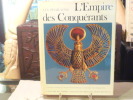
ALDRED Cyril - BARGUET Paul - DESROCHES-NOBLECOURT Christiane - LECLANT Jean - M LLER Hans-Wolfgang
Reference : 70749
L'Empire des Conqu rants. L' gypte du Nouvel Empire (1560-1070). Le Monde gyptien. Les pharaons. Tome II
Paris, Gallimard, 1979 Couverture rigide sous jacquette, 337 pages, 28 x 23 cm. Fran ais. En bon tat.
Le Monde gyptien. Les pharaons. Tome II: L'Empire des Conqu rants. L' gypte du Nouvel Empire (1560-1070).
Aldred, Cyril. - Cenival, Jean-Louis. - Debono, Fernand. - Lauer, Jean-Philippe. - Vercoutter, Jean. - Barguet, Paul. - Desroches-Noblecourt, Christiane. - Leclant, Jean (sous la direction de). - Müller, Hans-Wolfgang. - Dumas, François.
Reference : 89408
Le monde égyptien. Les Pharaons. Collection L’Univers des Formes dirigée par André Malraux. Tome I: Le temps des pyramides. De la Préhistoire aux Hyksos, 1560 av. J.-C. Tome II: L’empire des Conquérants. L’Egypte au Nouvel Empire (1560-1070). Tome III: L’Egypte du Crépuscule. De Tanis à Méroé, 1070 av. J.-C. - IVe siècle apr. J.-C.
Paris, Gallimard 1978, 1979, 1980, 280x225mm, 355 + 337 + 345pages, reliure d'éditeur sous jaquette. Bel exemplaire.
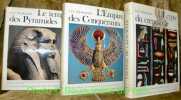
photos en héliogravure, et en couleurs, Pour un paiement via PayPal, veuillez nous en faire la demande et nous vous enverrons une facture PayPal
Le Monde Egyptiens. LES PHARAONS. LE TEMPS DES PYRAMIDES. De la Préhistoire aux Hyskos ( 1560 av. J.-C. ).
Gallimard NRF "L Paris 1978 In-4 carré ( 280 X 220 mm ) de 347 pages, pleine toile rouge sous jaquette illustrée en couleurs. Superbe et abondante iconographie dans et hors-texte en couleurs et en noir, cartes et documentation, certaines en dépliant. Petits défauts à la jaquette, très bel exemplaire.
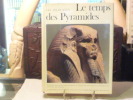
ALDRED Cyril, DAUMAS François, DESROCHES-NOBLECOURT Christiane, LECLANT Jean
Reference : 82822
ISBN : 207010981X
"L'Egypte du crépuscule; les pharaons de Tanis à Méroé, 1070 av. J.-C. - IVe Siècle Apr. J.-C. Collection : L'univers des formes."
Paris, Gallimard, 1980. 22 x 28, 347 pp., 391 illustrations et plans, en couleurs et en N/B, reliure d'édition pleine toile + jaquette, bon état.
ALDRED Cyril, FISCHER Henry G., DE MEULENAERE Herman, NOLTE Birgit & RUSSMANN Edna R.
Reference : C103335
(1977)
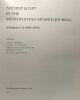
Ancient Egypt in The Metropolitan Museum Journal, volumes 1-11 (1968-1976)
New York, The Metropolitan Museum of Art 1977 [8] + 201pp., with illustrations in text, 29cm., publisher's hardcover in red cloth with gilt lettering, good condition, C103335
Aldred Cyril Fischer Henry G. De Meulenaere Herman Nolte Birgit Russmann Edna R
Reference : 100087160
(1994)
Ancient Egypt in the Metropolitan Museum Journal - VOLUMES 1*-11 (1968-1976)
Metropolitan Museum of Art 1994 23x28x3cm. 1994. Relié. iconographie en noir et blanc
couverture défraîchie sous rhodoïd intérieur propre ex libris
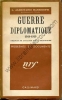
Guerre diplomatique 1914-1919 - traduit de l'italien par F. Cravoisier
,Paris, Gallimard 1939, 347 pp., 1 vol. in 8 br.
Proceedings of the XVI International Numismatic Congress, 11?16.09.2022, Warsaw: Vol. II. Roman Numismatics. 11.1 Coinage, 11.2 Circulation
, Brepols, 2025 Paperback, Pages:2 vols, 848, Size:216 x 280 mm, Illustrations:112 b/w, 30 col., Languages: English, French, Spanish. ISBN 9782503616728.
Summary The XVI International Numismatic Congress, held in Warsaw, Poland, in September 2022, was a landmark event, drawing the largest number of participants in its history. With over 550 papers presented during thematic sessions and round tables, this congress showcased the latest advancements and research in the field of numismatics from leading experts and scholars in their field. A curated selection of papers from the conference have now been drawn together into peer-reviewed conference proceedings, representing a comprehensive spectrum of numismatic studies from antiquity to modern times. Each paper is meticulously illustrated with high-quality images, often of unique specimens, along with detailed diagrams, maps, and die/typological chains. Topics covered include coins and coin finds, medals, tokens, banknotes, the history of collections and collecting, and cutting-edge chemical analyses and technologies used in coin examination. This volume, the second in four thematic volumes, focuses on Roman coinage. Divided into two separate volumes, covering respectively forty-four chapters on coinage and forty on circulation, the contributions gathered here explore not only Rome and the Imperial mints, but also local phenomena from Spain to Asia Minor, including graffiti, imitations, and copies of Roman coinage. TABLE OF CONTENTS List of Illustrations Introduction Jaros?aw Bodzek, Aleksander Bursche, Anna Zapolska 11.1 Coinage 1. The Celtic Small Silver Coinage of the Upper Danube Markus M ller 2. The Contribution of 3D Digitisation to the Study of the Riedones Celtic Coins (Fr, 35) Katherine Gruel, Caroline Plumel, Benjamin Houal, Olivier Masson, Thierry Lejars 3. 3D Scanning of Celtic Coins and Deep Learning to Identify Monetary Dies Sofiane Horache, Katherine Gruel, Jean-Emmanuel Deschaud, Fran ois Goulette, Thierry Lejars 4. Image Recognition Applied to the Hoard of Le C tillon II Chrisowalandis Deligio, Karsten Tolle, Philip de Jersey 5. The Manerbio Hoard (Lombardy, Italy) and 3D Digitisation: The Rediscovery of Cisalpine Gaul's Drachmas Elodie Paris, Ermanno A. Arslan, Katherine Gruel, Joseph Lleres 6. The Roman Republican Die Project (RRDP). History and New Methodologies Lucia F. Carbone, Liv M. Yarrow, Alice Sharpless 7. The Roman Republican Die Project (RRDP). Methods and Preliminary Findings Alice Sharpless, Lucia Carbone, Liv Yarrow 8. The Debasement of the Denarius in the 80s BC Kevin Butcher, Matthew Ponting 9. Un caso singular de la monetizaci n del SO de Hispania en poca republicana: Mesas do Castelinho (Almod var, Portugal) Amilcar Guerra, Carlos Fabi o, Susana Estrela, Bartolom Mora 10. Minting in the Middle Ground. Counterfeited Roman Coins in the Lake Geneva Region (60-20 BC) Charles Parisot-Sillon 11. Tracing Roman Gold Stocks with LA-ICP-MS Analysis of Coins from the Second Punic War to the End of the First Century AD Arnaud Susp ne, Maryse Blet-Lemarquand 12. Non-Destructively Determining the Composition of Coinage from Rome and the Mediterranean, from 200 BC to 64 AD Adrian D. Hillier, Toluwalase Agoro, Katsu Ishida, Matthew Ponting, Kevin Butcher 13. The Representation of Sicily on the Roman Coinage from the Republic to Augustus Manon Larue 14. Decades Without Bronze Minting in the First Century AD: Their Significance and Impact on Coin Circulation Johan van Heesch 15. Una riconsiderazione di un Aureo a nome di Plotina Aug Divi dalla collezione di Campana Maria Cristina Molinari 16. The Return of the Pious Son. Additional Evidence on the Restored Denarius Issue Signed by Hadrian Bernhard E. Woytek 17. Einhaltung eines Gewichtsstandards in der antiken M nzpr gung am Beispiel der Cistophoren Wolfgang Bretz, Gunther Eggeler, Jan Frenzel, B rbel Morstadt, Clara Pohl 18. The Antonines: An Economy of Silver, not Gold Gilles Bransbourg 19. The Antonine Denarii from Mesopotamia: Preliminary Observations and Interpretations of Two Series from Edessa and Carrhae Edward Dandrow 20. Numi plumbei antino nsi Giovanni Maria Staffieri 21. A Die Study of the Alexandrian Coinage of Commodus Mona Ashour 22. Natus vincere: the Image of Emperor Gallienus (AD 253-268) through Rome's Mint Coinage David Serrano Ordozgoiti 23. Die aeternitas Augusti im Licht der M nzen Katarzyna Balbuza 24. A Spanish Charioteer on a New Contorniate from Rome? Claudia Ferro 25. Numismatic Panorama: Mythical Founding Heroes in the Third Century AD Agata Aleksandra Kluczek 26. Theomorphic Ruler Images of the Counter-Emperor Postumus. Frontality as an Element of Ruler Representation in the Crisis Period of the 260s AD Michele Lange 27. La frappe de l'aureus dans les ateliers balkaniques et orientaux entre 293 et 313 Jay Dharmadhikari 28. Multiple in dit de 2 solidi de Constantin Ier l'atelier de Tr ves Marie-Laure Le Brazidec, Laurent Schmitt 29. Two Silver Ingots from the Mid-Fourth Century AD Alenka Mi?kec 30. The SM Mark on Honorius Age Bronze Issues Stefano Bruni 31. Coins of Antioch and the Transition from Late Antiquity to Early Byzantium (324-610 AD) Pavla Gkantzios Drapelova 32. A Taxonomy of Bilingual Coins from Augustus to the Mid-third Century AD Bartosz Awianowicz 33. The Coins of Nicopolis ad Istrum Kept in the Medagliere of the Veneranda Biblioteca Ambrosiana (Ambrosian Library): A Preliminary Report Giancarlo Alteri, Eleonora Giampiccolo 34. Mythical Past of Thrace and its Reflection in the Selected Monetary Issues of Hadrianopolis Marek Jurkowski 35. Rare Coin Types of Pautalia and Serdica Nikolay Dimitrov 36. Iconographic Interactions between the Roman Provinces of Thrace, Pontus Bithynia, and Asia Minor Marina Tasaklaki 37. Countermarks on the Coins of Bithynia and Pontus in the Roman Period: Some General Observations Barbara Zaj?c 38. The Identity of the Warrior God on the Coins of Ariassos Esra T t nc 39. A New Year of an Old Era? Christian Schinzel 40. More Than Just a Scratch. A Preliminary Categorisation of Graffiti on Roman Gold Coin Friederike Stahlke 41. Not Only Postumus. Roman and Byzantine Gold Coins with Graffiti in the Collection of the Ossolineum Adam Degler 42. Los nuevos plomos monetiformes de Eucleratus David Mart nez Chico 43. Ancient Ponderal items from the Roman Camp in C ceres el Viejo (C ceres, Spain) Diego Barrios, Cruces Bl zquez 11.2 Circulation 44. The Coin Finds Hub - Italy Project: Management and Use of Numismatic Data from Archaeological Contexts Renata Cantilena, Federico Carbone, Giacomo Pardini 45. The Coin Hoards of the Roman Republic [Online] Database: Reflections and Development after Nine Years Kris Lockyear 46. Differences in the Circulation Patterns of Roman Republican Coinage in the Imperial Period with a Particular Focus on the Denarii Serrati Katharina Huber 47. La pr sence des deniers r publicains en M diterran e orientale durant les troisi me et deuxi me si cles avant J.-C. Eleni G. Papaefthtymiou 48. The Underwater Coin Deposit of Gran Carro, in Lake Bolsena Samuele Ranucci, Barbara Barbaro 49. Preliminary Report on the 2019 Varzi Hoard (Northern Italy, Province of Pavia) Alessandro Bona, Florence Caillaud, Alessandro Cavagna, Cecilia Norfini, Claudia Perassi 50. Coin Circulation in Mediolanum between the First Century BC and the Second Century AD: New Data from Archaeological Contexts Alessandro Bona 51. The Coin Treasure from the Cardus IV Excavation of Herculaneum (Ancient Campania) in the Coin Cabinet of the Museo Archeologico Nazionale at Naples-Italy (562 AR): a Preliminary Report Emanuela Spagnoli 52. The Coin Hoards of the Roman Empire Project. 10 Years On! Unum Fiat ex Pluribus. The Case of Sicily Mariangela Puglisi 53. Late Roman Empire Coin Hoards from Archaeological Excavations in Lamego's Castle (PORTUGAL) Alice Baeta 54. La continuidad en el uso de nummi tardorromanos cortados y recortados en el Castillo de Viguera (La Rioja) Fernando L pez S nchez, Jos Mar a Tejado Sebasti n 55. The Roman Hoard of Tomares: Preliminary Results of a 'Too Big' Monetary Find Ruth Pliego, Enrique Garc a-Vargas 56. Nummi tardoantiguos en Gallaecia y Lusitania: conjuntos monetales en el siglo V d. C. Alberto Mart n Esquivel, Cruces Bl zquez Cerrato 57. L'affirmation du pouvoir par la monnaie sous Gunthamund (484-496) et Thrasamund (496-523) Aur lien Ros 58. Las monedas del yacimiento tardoantiguo (ss. VI-VII d.C.) de Val ncia la Vella (Riba-roja de T ria, Val ncia, Espa a) scar Cald s Aquili 59. Hallazgos de moneda antigua en contexto arqueol gico de la bah a de Algeciras (C diz, Espa a) Alicia Ar valo-Gonz lez, Elena Moreno-Pulido 60. Monedas romanas bajoimperiales y tardoantiguas de la excavaci n de la plaza de la catedral de Tortosa (Tarragona, Espa a) Xavier Sicart Chavarria, scar Cald s Aquili , Ramon Ferr Anguix 61. El conjunto monetario hallado en el balneum de la villa romana de Vilauba (Catalunya) Pere Castanyer Masoliver, Marc Bouzas Sabater, Joan Frigola Torrent, Joaquim Tremoleda Trilla, Andrea Ferrer Welsch 62. The Beaurains (Arras) Hoard: A Hundred Years Later Vincent Drost 63. Usages et usagers des monnaies d'or en territoire duen sous l'Empire romain K vin Charrier 64. Initiators, Status, Degree of Tolerance of Authorities and Other Key Features of Irregular Radiates: An Updated Overview Fabien Pilon 65. Usages et circulation mon taires dans le sud de la Gaule aux Ve et VIe si cles : le cas des monnayages de bronze Marie-Laure Le Brazidec 66. The Monetization of the Rural Countryside in the German Rhineland Rahel Otte 67. The Coin Hoards of the Roman Empire and Switzerland Rahel C. Ackermann 68. Coin Finds from the Insulae 3, 13 and 15 in Aventicum/Avenches (Switzerland) Isabella Liggi Asperoni 69. The Roman Hoard of Ueken 2015 (Canton of Aargau, Switzerland) Fanny Puthod, Markus Peter, Pierre Zanchi 70. The Claustra Alpium Iuliarum: A Frontier for Monetary Circulation in the Late-Roman Period Andrea Stella 71. Coin Hoards from the 4th Century AD Found in the Administrative Territory of Augusta Traiana/Beroe Mariana ?inkova 72. First Insights of Roman Monetary Circulation in Ancient Armenia Anahide K f lian 73. Roman Denarius Hoards in Denmark: A methodological critique Rasmus Holst Nielsen 74. Large Imperial Gold Medallions from the Fourth Century - the Hoard from Vindelev, Denmark Helle W. Horsn s 75. The Manufacture and Use of Roman Imperial Denarii Subaerati by Barbarian Inhabitants of Central, Eastern, and Northern Europe, an Overview Arkadiusz Dymowski 76. Multidisciplinary Studies of Counterfeit Roman Imperial Denarii from Belarus Vital Sidarovich 77. Irregular Roman Coins from Roman and Migration Period Settlements in Western Lesser Poland Jaros?aw Bodzek, Jan Bulas, Szymon Jellonek, Barbara Zaj?c 78. From individual finds to a broader picture - the influx and circulation of solidi in Polish part of Barbaricum (Poland) Anna Zapolska 79. Cast Copies of Roman Imperial denarii Discovered in Western Moldavia (Romania) Lucian Munteanu 80. Some Aspects of the Distribution of Cast Copies of Roman Denominations in the 'Barbarian' Territories of South-Eastern Europe Oleh Pohorilets', Oleksandr Nadvirnyak 81. Ancient Coins from Pest County Lajos Juh sz 82. Updating Roman Coins from India: ultra posse nemo obligatur Paula J. Turner 83. The Movement of Roman Coins into Southeast Asia. What Does it Mean? Brigitte Borell 85. Interference in Ancient Numismatics in the Ossolineum in Wroclaw and the National Museum in Warsaw Anna Anzorge-Potrzebowska
Ecologies of Crusading, Colonization, and Religious Conversion in the Medieval Baltic. Terra Sacra II
, Brepols, 2019 Paperback, xx + 246 pages, Size:216 x 280 mm, Illustrations:73 b/w, 9 col., 22 tables b/w., 20 maps b/w, Language: English. ISBN 9782503551333.
Summary In the thirteenth century, crusading armies unleashed a relentless holy war against the pagan tribal groups of the Eastern Baltic, whose territories were conquered and reorganized into Christian states run by the Teutonic Order, bishops, and their cathedral chapters. Castles were built, towns established, and colonists encouraged to settle under the leadership of the new Christian theocracy. But the changes introduced alongside Christianity not only transformed the culture of eastern Baltic societies, but also had a profound and - for the Baltic tribes, who saw many aspects of the natural world as sacred - deeply significant impact on the local environment. This seminal period in the environmental history of north-eastern Europe has been the focus of the ERC-funded research programme, 'The Ecology of Crusading', which explored the physical and conceptual ecological transformations associated with warfare, colonization, and religious conversion. This second Terra Sacra volume draws together a series of case-studies on Livonia and Prussia that provide a unique snapshot of recent research into environmental change during the Baltic Crusades and also explore long-term trends in landscape organization and environmental exploitation. The volume covers six key themes: building-construction in the conquered territories; food supply to the houses of the Teutonic Order; life in the multi-cultural towns of the eastern Baltic; transforming the physical landscape; transforming the spiritual landscape; and the Baltic Ordensland in its regional context. It forms a companion to Environment, Colonization, and the Baltic Crusader States: Terra Sacra I. TABLE OF CONTENTS Preface Acknowledgements Glossary List of Illustrations Introduction: Multi-Scalar Impacts of Crusading on the Environments of the Eastern Baltic -ALEKSANDER PLUSKOWSKI The Environmental Setting of the Earliest Teutonic Order Stronghold in Elbl?g - JOANNA FONFEREK Timber and its Use from the Late Iron Age to the End of the Medieval Period in Latvia - M?RIS ZUNDE Resources for Castle Building in Medieval Prussia and Livonia - K.?M.?J. HAYWARD with a contribution by STUART BLACK Animal Exploitation in Karksi and Viljandi (Estonia) in the Late Iron Age and Medieval Period - EVE RANNAM E AND LEMBI L UGAS Written Evidence Concerning the Resources of the Teutonic Order in Livonia: The Cases of Karkus and Fellin - JUHAN KREEM Carbon and Nitrogen Stable Isotope Evidence for Animal Husbandry and Environmental Change in the Medieval Kulmerland - CHARLOTTE SCULL, GUNDULA M LDNER, AND DANIEL MAKOWIECKI The Plant Element in the Diet of the Inhabitants of Danzig (Gda?sk), Elbing (Elbl?g), and Marienburg (Malbork) During the Rule of the Teutonic Order: Historical and Archaeobotanical Perspectives - MONIKA BADURA AND BEATA MO?EJKO A Foul Perspective: Analysis of Invertebrate Remains in a mid-Fourteenth-Century Latrine from Riga, Latvia - GARY?A. KING Parasites and Baltic Crusading in Medieval Riga: Insights into Disease, Diet, and Hygiene - HUI-YUAN YEH AND PIERS?D. MITCHELL Evidence of Human Impact and Vegetation Change during the Late Iron Age and the Medieval Livonian Period at Some Sites along the Lower Course of the River Daugava - LAIMDOTA KALNI?A, AIJA CERI?A, KRISTAPS KIZIKS, KARINA STANKEVI?A, AGNESE PUJ?TE, AND ANDA DRU?KA Palaeoecological Evidence of Crusades and Subsequent Impact on the Livonian Landscape - NORMUNDS STIVRI??, SIIM VESKI, AND TRIIN REITALU Sacred Landscapes of Medieval Livonia: Lands of the Teutonic Order in Southern Estonia - HEIKI VALK Surkapurn and Kreken: The Phenomena of Name and Place and the Organization of Sacred Space in Prussia Using Archaeology and Other Sources - SEWERYN SZCZEPA?SKI Continuity and Discontinuity in the Sacral Landscape of Lithuania - VYKINTAS VAITKEVI?IUS Reorganizing the Livonian Landscape: Some Issues and Research Perspectives - KASPARS K?AVI?? Exploiting Animals in the Medieval North-Western Russian Frontier - MARK MALTBY The Teutonic Order's Role in the Development of a Medieval Eastern Baltic Cod Fishery: Evidence from Fish Bone Isotopes - DAVID ORTON, EVE RANNAM E, LEMBI L UGAS, DANIEL MAKOWIECKI, SHEILA HAMILTON-DYER, ALEKSANDER PLUSKOWSKI, TAMSIN O'CONNELL, AND JAMES BARRETT
Environment, Colonization, and the Baltic Crusader States. Terra Sacra I
, Brepols, 2019 Paperback, xxviii + 548 pages, Size:216 x 280 mm, Illustrations:189 b/w, 8 col., 41 tables b/w., 51 maps b/w, Language: English. ISBN 9782503551326.
Summary In the thirteenth century, crusading armies unleashed a relentless holy war against the pagan tribal groups of the Eastern Baltic, whose territories were conquered and reorganized into Christian states run by the Teutonic Order, bishops, and their cathedral chapters. Castles were built, towns established, and colonists encouraged to settle under the leadership of the new Christian theocracy. But the changes introduced alongside Christianity not only transformed the culture of eastern Baltic societies, but also had a profound and - for the Baltic tribes, who saw many aspects of the natural world as sacred - deeply significant impact on the local environment. This seminal period in the environmental history of north-eastern Europe has been the focus of the ERC-funded research programme, 'The Ecology of Crusading', which explored the physical and conceptual ecological transformations associated with warfare, colonization, and religious conversion. This is the first of two Terra Sacra volumes, which share the aim of changing our understanding of the environmental impact of crusading and colonization in northeastern Europe. The present volume provides a detailed inter-disciplinary comparison of the environmental transformations associated with the emergence of the crusader states of Livonia and Prussia. It draws on and integrates a range of archaeological, paleoenvironmental, historical, and cartographic sources in order to highlight the diverse impact of colonization and landscape reorganization that followed in the wake of the Baltic Crusades. The companion Terra Sacra volume complements this survey by presenting a number of case studies from across the eastern Baltic region. TABLE OF CONTENTS Preface Acknowledgements Glossary Abbreviations List of Illustrations Introduction: Terra Sacra in the Eastern Baltic - ALEKSANDER PLUSKOWSKI Methodology and Interpretative Framework - ALEKSANDER PLUSKOWSKI, ALEXANDER BROWN, ROWENA BANERJEA, AND KEVIN HAYWARD Chronology - ALEKSANDER PLUSKOWSKI, ALEXANDER BROWN, AND STUART BLACK Sites in Livonia: The Historical and Archaeological Background - ALEKSANDER PLUSKOWSKI, HEIKI VALK, JUHAN KREEM, AND GUNDARS KALNI?? Vegetation Change in Livonia: The Palynological Data - ALEXANDER BROWN Farming, Hunting, and Fishing in Medieval Livonia: The Zooarchaeological Data - MARK MALTBY, ALEKSANDER PLUSKOWSKI, EVE RANNAM E, AND KRISH SEETAH Settlement Life in Livonia and the Impact on their Territories: The Geoarchaeological and Archaeobotanical Evidence - ROWENA BANERJEA AND MONIKA BADURA Reorganizing the Livonian Landscape - ALEKSANDER PLUSKOWSKI, KASPARS K?AVI??, EVA EIHMANE, AGRIS DZENIS, AND JUHAN KREEM The Environmental Impact of the Conquest of Livonia - ALEKSANDER PLUSKOWSKI Sites in Prussia: The Historical and Archaeological Background - ALEKSANDER PLUSKOWSKI, MARC JARZEBOWSKI, MA?GORZATA KARCZEWSKA, AND MACIEJ KARCZEWSKI Vegetation Change in Prussia: The Palynological Data - ALEXANDER BROWN Farming, Hunting and Fishing in Medieval Prussia: The Zooarchaeological Data - DANIEL MAKOWIECKI, MIROS?AWA ZABILSKA-KUNEK, KRISH SEETAH, MARC JARZEBOWSKI, AND ALEKSANDER PLUSKOWSKI Exploiting Plants: Macrobotanical Remains from Prussia - ALEKSANDER PLUSKOWSKI, MONIKA BADURA, AND MARC JARZEBOWSKI Settlement Life in Prussia at the Microscopic Scale and the Impact on their Territories - ROWENA BANERJEA Reorganizing the Prussian Landscape - MARC JARZEBOWSKI, ALEKSANDER PLUSKOWSKI, TOMASZ NOWAKIEWICZ, AND MACIEJ KARCZEWSKI The Environmental Impact of the Conquest of Prussia - ALEKSANDER PLUSKOWSKI The Environmental Impact of the Crusades in the Eastern Baltic - ALEKSANDER PLUSKOWSKI Appendix 1: Accelerated Mass Spectrometry (AMS) Radiocarbon Dates from Poland, Latvia, and Estonia - ALEXANDER BROWN Appendix 2: Uranium Series Dating - ALEXANDER BROWN Appendix 3: Enrichment Factors for Major and Trace Elements within Pit Deposits, ?wi?ta G ra, Poland - ROWENA BANERJEA Appendix 4: Enrichment Factors for Major and Trace Elements within Pit Deposits, ?wi?ta G ra, Poland - ROWENA BANERJEA Index
Aleksandra Kubiak-Schneider, Rubina Raja, Julia Steding, Jean-Baptiste Yon
Reference : 70417
The Palmyrene Banqueting Tesserae. An Updated Corpus
, Brepols, 2026 Hardback, Pages: viii + 211, Size:216 x 280 mm, Illustrations:1217 b/w, 316 col., 1 tables b/w., Language: English. ISBN 9782503609584.
Summary Banqueting tesserae - small, moulded terracotta tokens - were used in the religious sphere of Palmyra in the first three centuries AD, conveying a vivid iconographic language that underpinned sacral banquets held in the city's sanctuaries and banqueting halls. Found today in those locations, these artefacts offer a rare glimpse into the overwhelmingly rich ritual and social lives of Palmyrene society. This book and corpus provides the first comprehensive revision to the study of banqueting tokens since the 1955 publication Recueil des tess res de Palmyre, which catalogued 1132 types. Building on that foundational work, this publication updates the original corpus with 168 newly identified tesserae types, including numerous previously unpublished examples from the Palmyra Museum and a private collection in Damascus. Each new type is presented with detailed descriptions of motifs and inscriptions. The book examines the rich iconographic and epigraphic landscape of tesserae, which feature depictions of priests, deities, animals, and symbolic imagery, while also casting light on some of the individuals who financed these feasts. With extensive indices on the iconography and epigraphy of the new types, as well as a translation of the indices from the Recueil des tess res de Palmyre, this new corpus presents a comprehensive overview and systematic study of this overlooked yet revealing class of material culture, which provides a unique source for our understanding of Palmyrene religious life. TABLE OF CONTENTS List of Illustrations The Palmyrene Tesserae - An Updated Corpus The Palmyrene Banqueting Tesserae An Addition to the RTP and the Structure of the Catalogue The First Discoveries and History of Research Vocabulary and Meaning From Collections to New Interpretations Prosopography Paleography Inscribed Tesserae The Iconography of the Tesserae - RTP and New Corpus Conclusion Acknowledgements Catalogue of New Tesserae Types Unpublished Tesserae Published since 1955 Abbreviations Works Cited Index: Epigraphy of New Types Index: Epigraphy of New Tesserae Types RTP Index: Epigraphy RTP Index: Iconography Appendix 1: Overview of Tesserae, Unpublished or Published after 1955, Following One of the Types Known from RTP Appendix 2: Total Count of RTP Types Plates
Les monnaies des rois Parthes de la collection de M. le Comte Prokesch-Osten --- Mémoires de la société française de numismatique et d'archéologie --- section d'atributions numismatiques 1874-1875
Siège de la société française de numismatique 1875 in4. 1875. Relié. iconographie en noir et blanc
Bon état couverture défraîchie bords frottés intérieur propre qques rousseurs bonne tenue

