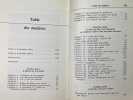
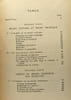
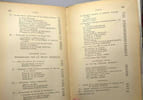
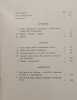
Payot 2025 in8. 2025. Broché.
manque garniture sur le dos par endroits intérieur propre
London, Macmillan & co 1945 xii + 362pp., cloth with dustwrapper, 1st ed., small stamp on frontpage, else VG, E41835
OXFORD UNIVERSITY PRESS. 1944. In-12. Broché. Etat d'usage, Couv. défraîchie, Dos satisfaisant, Intérieur frais. 32 pages. Traces de mouillures.. . . . Classification Dewey : 330-Economie

Etudes Internationales. Collection Oxford. Classification Dewey : 330-Economie
De Médicis. 1947. In-8. Broché. Etat d'usage, Couv. légèrement passée, Dos plié, Papier jauni. 380 pages.. . . . Classification Dewey : 330-Economie
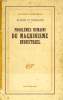
Trad. de l'anglais par M. Th. Génin. Classification Dewey : 330-Economie
Berlin, Verlag von Georg Reimer, 1916. Royal8vo. Bound in a nice contemporary half calf binding with five raised bands and gilt lettering to spine. Stamps to titlepage, otherwise fine. XX, 435 pp. + one folded plate.
First German edition of Fisher's seminal work in which he introduced his famous equation of exchange, known as the Fisher Equation. ""No other mathematical formulation in economics, perhaps no other in history save that of Albert Einstein, has enjoyed a greater vogue, and this continues without diminution to our own time."" (Galbraith. A History of Economics, Pp. 152-3).The Fisher Equation states MV=PT. (M=stock of money, V= the velocity of circulation of money, P=price level, T=amount of transactions carried out using money).In theory this means that by varying the supply of money, while the velocity and the volume of trade remained the same could raise or lower the level of prices. Upward movements could be arrested by reducing the money supply.""This was a mojor, even awe-inspiring, step in the history of economics. [...] Later, in the early years of the Great Depression, Fischer and his disciples would be at the center of policy"" they would urge and, in some measures, create a plan to arrest the punishing price deflation of the time. [...] With Fisher the long history of money is brought into the modern era.""Irving Fisher is regarded as being one of the earliest American neoclassical economists and the first celebrity economist. Fisher was also the first economist to distinguish clearly between real and nominal interest rates and he was by Milton Friedman called ""the greatest economist the United States has ever produced.""
[Menasha, Wisconsin], The Econometric Society, 1933. Royal8vo. In a contemporary black half calf binding with gilt lettering to spine. In ""Econometrica"", Vol. 1, 1933. Entire volume offered. Light wear to extremities and small stamp to title-page. A fine copy. Pp. 339-357. [Entire volume: (4), 448 pp.].
First edition of Fisher's seminal work in which he introduced the concept of 'Debt deflation': a theory of economic cycles that holds that recessions and depressions are due to the overall level of debt shrinking (deflating): the credit cycle is the cause of the economic cycle.The theory was developed by Irving Fisher following the Wall Street Crash of 1929 and the ensuing Great Depression. The debt deflation theory was familiar to John Maynard Keynes prior to Fisher's discussion of it, but he found it lacking in comparison to what would become his theory of liquidity preference. The theory, however, has enjoyed a resurgence of interest since the 1980s, both in mainstream economics and in the heterodox school of post-Keynesian economics, and has subsequently been developed by such post-Keynesian economists as Hyman Minsky and Steve Keen and by the mainstream economist Ben Bernanke. ""During the Great Depression, observing the catastrophes of the world around him, which he shared personally, Fisher came to quite a different theory of the business cycle from the simple monetarist version he had espoused earlier. This was his 'Debt-deflation theory of depression', summarized in the first volume of Econometrica, the organ of the international society he helped to found. The essential features are that debt-financed Schumpeterian innovation fuel a boom, followed by a recession between excessive real debt burdens and deflation. Note the contrast to the Pigou real balance effect, according to which prices declines are the benign mechanism that restores full-employment equilibrium. The realism is all on Fisher's side. This theory of Fisher's has room for the monetary and credit cycles of which he earlier complained, and for the perversely pro-cyclical real interest rate movements mentioned above.""
New York, Macmillan, 1911. 8vo. In the original full cloth. Library-label (University Club of Chicago) pasted on to pasted down front free end-paper. Wear and soiling to extremities. Text on spine faded and ""F1"" wirtten in white to spine. Cloth loosend to back of spine and a 2 cm long tear to the middle of spine. Book-block, however, firmly attached. Internally fine and clean. XXII, (2), 505 pp.
First printing of Fisher's seminal work in which he introduced his famous equation of exchange, known as the Fisher Equation. ""No other mathematical formulation in economics, perhaps no other in history save that of Albert Einstein, has enjoyed a greater vogue, and this continues without diminution to our own time."" (Galbraith. A History of Economics, Pp. 152-3).The Fisher Equation states MV=PT. (M=stock of money, V= the velocity of circulation of money, P=price level, T=amount of transactions carried out using money)In theory this means that by varying the supply of money, while the velocity and the volume of trade remained the same could raise or lower the level of prices. Upward movements could be arrested by reducing the money supply.""This was a mojor, even awe-inspiring, step in the history of economics. [...] Later, in the early years of the Great Depression, Fischer and his disciples would be at the center of policy"" they would urge and, in some measures, create a plan to arrest the punishing price deflation of the time. [...] With Fisher the long history of money is brought into the modern era.""Irving Fisher is regarded as being one of the earliest American neoclassical economists and the first celebrity economist. Fisher was also the first economist to distinguish clearly between real and nominal interest rates and he was by Milton Friedman called ""the greatest economist the United States has ever produced.""
New York, Macmillan, 1930. 8vo. In the original red full cloth and with the the original dust-jacket. Dust-jacket price-clipped and missing 2 cm of lower part of spine, spine discoloured. Internally very fine and clean. Binding likewise very fine and clean. xxvi, (2), 286 pp.
First edition of this seminal work tracing the causes of the 1929 Stock Market Crash, here in scarce original dust-jacket..Irving Fisher is considered one of the earliest American neoclassical economists and the first celebrity economist. Fisher was also the first economist to distinguish clearly between real and nominal interest rates, and Milton Friedman called him ""the greatest economist the United States has ever produced.""Considered ""the father of monetary economics"" (Pressman, 91), ""Irving Fisher was, in the opinion of many, the leading economic theorist in the United States during the first half of the 20th century. Although his contributions to economic theory and to the development of econometrics ensure him a preeminent position among contemporary economists, he was a versatile man. In his day he was equally well-known as social philosopher, teacher, inventor, businessman, and passionate crusader for many social causes"" (DAB).
UN MONDE DIFFERENT. Non daté. In-12. Broché. Etat d'usage, 1er plat abîmé, Dos satisfaisant, Intérieur frais. 156 pages. Trace de colle sur le 1er plat.. . . . Classification Dewey : 330-Economie
Classification Dewey : 330-Economie
SEUIL 1991 224 pages in8. 1991. Broché. 224 pages.
Bon état couverture jaunie intérieur propre
Fisher Roger Ury William Patton Bruce
Reference : 500073348
(1999)
ISBN : 9780099248422
Random House London 1999 224 pages 13x2x19 4cm. 1999. Broché. 224 pages.
Bon état
Bremen, Schünemann, 1957, gr. in-8vo, 5 Bl. + 271 S. Ex libris "Jacob Polak" a.V., Original-Broschüre. - Deutsch-englische Parallelausgabe.
Phone number : 41 (0)26 3223808
Cujas. 1973. In-8. Broché. Etat d'usage, Couv. convenable, Dos satisfaisant, Intérieur frais. 294 + env. 80 pages. Scotch jauni au dos des plats. Tranche légèrement passée. Annotations au crayon dans le texte.. . . . Classification Dewey : 330-Economie

'Connaissances économiques'. Préface de R. FRUIT. Prix 1972 de l'Association française des Sciences économiques, etc. Classification Dewey : 330-Economie
Arléa. 1995. In-8. Broché. Etat d'usage, Couv. convenable, Dos satisfaisant, Intérieur acceptable. 318 pages.. . . . Classification Dewey : 330-Economie

Classification Dewey : 330-Economie
Fitoussi (Jean-Paul, Gaffard (Jean-Luc) et Quéré (Michel), eds.
Reference : 81725
(2006)
Revue de l'OFCE - Observatoire français des Conjonctures Economiques - Presses de Science Po Malicorne sur Sarthe, 72, Pays de la Loire, France 2006 Book condition, Etat : Bon paperback, editor's white wrappers, titles in blue grand In-8 1 vol. - 398 pages
few black and white text figures 1st edition, 2006 Contents, Chapitres : 1. Industrial dynamics : Jackie Kraft : Introduction - Innovation, industrial dynamics and industry evolution : Progress and the research agendas - How problems of organisational growth in firms affect industry entry and exit - On the life cycle of knowledge intensive sectors - Industrial organization and the organization of industries : A American perspective - Innovation, productivity gains and the evolution of market structure - The evolution of geographic structure in new industries - Innovation and stock prices : A review of some recent work - 2. New directions in productivity analysis : Flora Bellone : Introduction - Information technology and the G7 economies - Capital obsolescence, growth accounting and total factor - A time to sow, a time to reap for the European countries : A macro-econometric glance at the RTD National action plans - On entry and growth : Theory and evidence - The effects of subsides on investment, an empirical evaluation of ICT in Italy - The dynamic of price cost margins : Evidence from UK manufacturing - Productivity and market selection on French manufacturing firms in the Nineties - Productivity in information service industries, a panel analysis of Japanese firms - Creative destruction and the measurement of productivity change minor wear on the border of the wrappers which remains near fine, top right corner of the volume very lightly folded, else near fine, no markings, inside is clean - Dynamique industrielle, productivité et croissance (Text in English)
Nancy 1933, In-8 Nancy 1933, In-8 broché. 190 pages. Bon état.
Toutes les expéditions sont faites en suivi au-dessus de 25 euros. Expédition quotidienne pour les envois simples, suivis, recommandés ou Colissimo.
EDITIONS BERGER LEVRAULT. 1932. In-12. Broché. Bon état, Couv. légèrement passée, Dos satisfaisant, Rousseurs. 427 pages. Pages non-coupé.. . . . Classification Dewey : 330-Economie
Classification Dewey : 330-Economie
In 4 broché,faux-titre,titre,XXXIV,68 pages,1 page de table des matières,plan détaillé, dépliant 70x37 cm,du nouveau tracé du canal de la Marne au Rhin entre Saint- Dizier et Void,1 plan général dépliant,44 x48cm canal de la Marne à la Meuse.Profils longitudinaux de divers tracés 47 x 69 cm.Librairie scientifique et industrielle de L. Mathias 1838.Petites rousseurs habituelles,quelques pâles mouillures,sans gravité en fin de volume.
Montchrestien. 1976. In-12. Broché. Etat d'usage, Couv. convenable, Dos plié, Quelques rousseurs. 647 pages. Illustré de graphiques et cartes en noir et blanc dans le texte. Scotch jauni au dos des plats et traces en pages de garde. Annotations en page de garde.. . . . Classification Dewey : 330-Economie
Collection 'Université nouvelle'. Précis Domat. Classification Dewey : 330-Economie
Montchrestien. 1976. In-8. Broché. Etat d'usage, Couv. légèrement pliée, Dos plié, Papier jauni. 647 pages - coins frottés.. . . . Classification Dewey : 330-Economie
Collection Université nouvelle. Classification Dewey : 330-Economie
Presses Universitaires de France Edition originale Première édition 1er trimestre 1972. 1972. In-12. Broché. Bon état, Couv. convenable, Dos satisfaisant, Intérieur frais. 128 pages illustrées de quelques dessins en noir et blanc. . . . Classification Dewey : 330-Economie
La première encyclopédie de poche fondée en 1941 par Paul Angoulvent, traduite en 43 langues, diffusée, pour les éditions françaises, à plus de 160 millions d'exemplaires, la collection Que sais-je? est l'une des plus importantes bases de données internationnales, construite pour le grand public par des spécialistes. 3800 titres ont été publiés depuis l'origine par 2500 auteurs. Classification Dewey : 330-Economie
Presses Universitaires de France Edition originale Première édition Décembre 1985. 1985. In-12. Broché. Bon état, Couv. convenable, Dos satisfaisant, Intérieur frais. 128 pages illustrées de quelques dessins en noir et blanc. . . . Classification Dewey : 330-Economie
La première encyclopédie de poche fondée en 1941 par Paul Angoulvent, traduite en 43 langues, diffusée, pour les éditions françaises, à plus de 160 millions d'exemplaires, la collection Que sais-je? est l'une des plus importantes bases de données internationnales, construite pour le grand public par des spécialistes. 3800 titres ont été publiés depuis l'origine par 2500 auteurs. Classification Dewey : 330-Economie
Dalloz. 1952. In-8. Broché. Etat d'usage, Couv. légèrement passée, Dos satisfaisant, Papier jauni. XII + 231 pages - une planche dépliante hors texte. 2e plat taché.. . . . Classification Dewey : 330-Economie
Préface de Jean-Marcel Jeanneney. Classification Dewey : 330-Economie
Presses Universitaires de France Edition mise à jour. 1970. In-12. Broché. Bon état, Couv. convenable, Dos satisfaisant, Intérieur frais. 128 pages illustrées de quelques dessins en noir et blanc. . . . Classification Dewey : 330-Economie
La première encyclopédie de poche fondée en 1941 par Paul Angoulvent, traduite en 43 langues, diffusée, pour les éditions françaises, à plus de 160 millions d'exemplaires, la collection Que sais-je? est l'une des plus importantes bases de données internationnales, construite pour le grand public par des spécialistes. 3800 titres ont été publiés depuis l'origine par 2500 auteurs. Classification Dewey : 330-Economie
Presses Universitaires de France Edition revue et mise à jour. 1978. In-12. Broché. Bon état, Couv. convenable, Dos satisfaisant, Intérieur frais. 128 pages illustrées de quelques dessins en noir et blanc. . . . Classification Dewey : 330-Economie
La première encyclopédie de poche fondée en 1941 par Paul Angoulvent, traduite en 43 langues, diffusée, pour les éditions françaises, à plus de 160 millions d'exemplaires, la collection Que sais-je? est l'une des plus importantes bases de données internationnales, construite pour le grand public par des spécialistes. 3800 titres ont été publiés depuis l'origine par 2500 auteurs. Classification Dewey : 330-Economie