 Write to the booksellers
-
Type
Autograph (1)
Book (432)
Engraving (2)
Magazine (4)
New book (1)
Old papers (2)
-
Latest
Last month (7)
Last week (1)
-
Century
18th (1)
19th (110)
20th (95)
21st (12)
-
Countries
Belgium (14)
Brazil (1)
Denmark (17)
France (395)
Netherlands (4)
Switzerland (11)
-
Syndicate
CLAM (2)
ILAB (169)
NVVA (4)
SLAM (149)
SNCAO (2)
Traité de l'association domestique-agricole. 2 Vols. (+) Sommaire du traité de l'association domestique-agricole ou attraction industrielle. - [FOUNDING UTOPIAN SOCIALISM AND COINING ""FEMINIST""]
Paris, Bossange père"" Londres, Martin Bossange et Comp., 1822 & 1823. 8vo. [Traité:] Two lovely contemporary, uniform half calf bindings with gilding and blindstamped ornamentations to spines. ""E. C."" in gilt lettering to top of spine on both volumes + [Sommaire:] a bit later red half cloth with marbled paper over boards. Gilt title to spine. [Traité]: signed by the author on verso of half-title in vol. 1: ""Ch Fourier"". Title-page of vol. 1 with a small light brown stain (probably candle-starin), far from affecting lettering. Both volumes in lovely condition, with only very light occassional brownspoting. LXXX, 592 pp."" VIII, 648 pp. [Sommaire:] Title-page slightly browned, evenly. Otherwise very nice, clean, and fresh. 16 pp, pp. (1329) -1448 + 4 ff. (= (A8 (unnumbered) - on two leaves, first recto and second verso blank) + B8, C8, D8, E8).A lovely set.
Scarce first edition of Fourier's milestone work of political theory, which is considered a founding work of Utopian Socialism and a main inspiration for Marx. The work, which contains ""the essence of Fourier's doctrine"" (David Owen Evans, Social Romanticism in France 1830-1848, p. 129.), is here presented together with the exceedingly rare complete supplement, which was published the following year.It is in the ""Traité..."" that Fourier presents the revolutionary ideas that Marx were to adopt and use in his ""Kapital"", namely the theory of poverty and exploitation and its relation to the means of production. These same ideas are those that made Marx speak of Fourier's ""Gargantuan view of man"".It is due to the ""Traité de l'association"" that Fourier is considered one of the founding fathers of Utopian Socialism (being by far the most utopian of them)"" in his quest for a more equal society, he became one of the very first to defend things such as same-sex sexuality and the rights of women - in fact, it is Fourier that later coins the word ""Feministe"", while stating that the position of women in society was equal to that of slaves. Many of his publications preceded those of de Saint-Simon, Owens, and Marx, but his ideas seemed to find greater influence when interpreted by others. Due to the lack of success of the ""Traité"", Fourier decided, the following year, to publish the ""Sommaire"", in an attempt to draw attention to his revolutionary ideas in the ""Traité"". The ""Sommaire"" constitutes a short, more easily understood, summary, though also containing some additional new work. The ""Sommaire"" is often referred to as ""The Appendix"" to the ""Traité"" and is considered as belonging to that work. One of the central themes of the work is the thought of ""harmony"": ""The word harmonisme - here fully explained and described for the first time - was first applied to the highest of the passions or motives of humankind" then (as a synonym for Harmonie) to the ultimate stage of social evolution. The fortunate inhabitants of the perfected world he called harmoniens, a word coined in the present work. These words were duly translated by the Fourierites of other lands. Harmony, the Harmonic state, Harmonization, or integral contrasted association, were the terms used in the earliest English translations in 1841 to describe Fourier's proposed social system and Harmonism was employed in the 1850's. The inhabitants were spoken of as Harmonians" and Fourier's philosophy as a whole was sometimes described as the Harmonian Doctrine. Even the word harmonious was called into service as a technical term, one English disciple writing of a Harmonious Phalanx."" (Bestor, The Evolution of the Socialist Vocabulary, p. 264).Charles Fourier claimed to find inspiration in the exorbitant price of an apple in a Parisian restaurant and he convinced himself that he could design a more efficient way to produce and deliver goods. Unlike other socialists of his day, Fourier believed that the pursuit of self interest served as an effective incentive to productive work. He simply did not believe that the market economy of his day successfully mobilized the pursuit of self interest for the common good and he was offended by the low productivity of labor. He argued that most people were employed in deadening jobs that failed to fully utilize their energies, and that nearly two thirds of all workers were performing virtually useless tasks. A more efficient economic organization promised enormous benefits to all if only a benefactor capitalist would advance the money necessary to set up the first community or ''phalanstery''.Phalanxes, structures called Phalanstères or ""grand hotels"", were four level apartment complexes where the richest had the uppermost apartments and the poorest occupied the ground floor residence. Wealth was determined by one's job, jobs were assigned based on the interests and desires of the individual. There were incentives: jobs people might not enjoy doing would receive higher pay. Fourier considered trade, which he associated with Jews, to be the ""source of all evil"" and advocated that Jews be forced to perform farm work in the phalansteries. Furthermore he believed that there were twelve common passions which resulted in 810 types of character (it is not clear why exactly this number), so the ideal phalanx would have exactly 1620 people. One day there would be six million of these, loosely ruled by a world ""omniarch"", or a World Congress of Phalanxes.Fourier and his contemporaries such as Owen and Saint-Simon were named utopian socialist because of their visions of imaginary ideal societies. Many saw them as not being grounded in the material conditions of society and as reactionary. Despite Fourier's lacking sense of practicality his ideas profoundly influenced all later socialist political and economic though"" Not only was he immortalized by Marx, ""John Stuart Mill shared the same enthusiasm for Fourier as did the German Marx and Engels and the American George Ripley. Fourier's was ""the most skillfully combined, and with the greatest foresight of objections, of all the forms of Socialism."" (Feuer, The Influence of the American Communist Colonies on Engels and Marx, P. 466). Fourier's views inspired in the mid 19. century the founding of the communities in Utopia, Ohio, La Reunion near present-day Dallas, Texas and several other communities within the United States of America, including the North American Phalanx in Red Bank, New Jersey"" Brook Farm in West Roxbury, Massachusetts and the Community Place and Sodus Bay Phalanx in New York State.In the mid 20th Century, Fourier's influence began to rise again among writers appraising socialist ideas outside the Marxist doctrines. After the Surrealists had broken with the French Communist Party, André Breton turned to Fourier, writing Ode à Charles Fourier in 1947.""Traité de l'association domestique-agricole "":Kress C864 Goldsmiths 23694 Einaudi 1960 (including both works). ""Sommaire du traité"":Kress C1060Goldsmiths 23997.
C'est de fatigue que se ferment les yeux des femmes.
Couverture souple. Broché. 149 pages.

Livre. Editions Bartillat, 2002.
Il n'est feu que de grand bois [Paperback] Fourier, Claire
Editions de La Différence BROCHE
Merci de nous contacter à l'avance si vous souhaitez consulter une référence dans notre boutique à Authon-du-Perche.
JARDIN VOLUPTUEUX -LE-
CANOE EDITIONS DU
LIVRE A L’ETAT DE NEUF. EXPEDIE SOUS 3 JOURS OUVRES. NUMERO DE SUIVI COMMUNIQUE AVANT ENVOI, EMBALLAGE RENFORCE. EAN:9782490251629
L'amante océane
Jean Paul Rocher Jean Paul Rocher, 2008. In-8 broché, couverture à rabats de 60 pages. Très bon état

Toutes les expéditions sont faites en suivi au-dessus de 25 euros. Expédition quotidienne pour les envois simples, suivis, recommandés ou Colissimo.
METRO CIEL
CANOE EDITIONS DU
LIVRE A L’ETAT DE NEUF. EXPEDIE SOUS 3 JOURS OUVRES. NUMERO DE SUIVI COMMUNIQUE AVANT ENVOI, EMBALLAGE RENFORCE. EAN:9782490251445
Métro Ciel - Suivi De Vague Conjugale - Récits
Actes Sud POCHE COMME NEUF.
Merci de nous contacter à l'avance si vous souhaitez consulter une référence dans notre boutique à Authon-du-Perche.
TOMBEAU POUR DAMIENS - LA JOURNEE SERA R
CANOE EDITIONS DU
LIVRE A L’ETAT DE NEUF. EXPEDIE SOUS 3 JOURS OUVRES. NUMERO DE SUIVI COMMUNIQUE AVANT ENVOI, EMBALLAGE RENFORCE. EAN:9782490251001
Tombeau pour Damiens. La journée sera rude
Du canoë 2018 Ouvrage Neuf - Illustré avec 8 peintures de Milos Sobaïc. In-12 broché 18 cm sur 12. 318 pages.
« La journée sera rude », dit seulement Damiens le 28 mars 1757 à l’annonce du supplice qu’on lui réserve pour le crime de régicide dont il est accusé. Ces mots, entrés dans la légende, authentiques ou non, ont retenu l’attention de Claire Fourier. Ils scandent comme une antienne le récit de la vie et de la mort de Damiens, personnage hors du commun, dont elle retrace le destin cruel. Figure incompréhensible pour son époque qui en a fait, Voltaire le premier, l’exemple même du fanatique, il est l’incarnation de la grandeur populaire qui veut signifier au Roi Louis XV que s’il ne s’amende pas, il mènera le Royaume de France à sa perte. Pour le mettre en garde, il le blesse sans dessein de le tuer. Son geste, qui annonce la Révolution Française, est puni, en plein siècle des Lumières, d’un supplice épouvantable, l’écartèlement. Très bon état d’occasion
Ligny-en-Barrois en 1610, avec le panorama inédit de la ville par Duviert.
Paris, Emile Gaillard, s.d. (circa 1930). In-8 br., 47 pp., front., qq. blasons dans le texte. Envoi autographe de l'auteur.
Bonne condition. - Frais de port : -France 4,9 € -U.E. 7 € -Monde (z B : 11 €) (z C : 21 €)
"Griffe au nez" ou donner "have ou art". Ecriture inconnue de Charles Fourier.
Anthropos, 1974, gr. in-8°, 174 pp, une illustration et un fac-similé hors texte, broché, bon état
Ouvrage d'une des spécialistes de Charles Fourier (1772-1837) qui, entre autres, a été chargée de l'édition des oeuvres complètes en 12 volumes (Anthropos entre 1966 et 1968). Dans cet ouvrage, Simone Debout exhume et commente l'étrange lettre de Fourier du 24 aout 1827 [Ça me dit, 24 AH ! OU DIX HUIT S’EN VINTTE CETTE] , et tente de comprendre les essais un peu fous de Fourier, en relation directe avec le sens qu’il entendait donner au monde ; Simone Debout nous révèle comment ce texte fou, cette plaisanterie pouvait dissimuler une cohérence formelle d’écriture. Désormais les frais d'envoi sont de 6 € seulement pour les livres jusqu'à 1 kg (colissimo suivi), pour la France métropolitaine.
"griffe au nez" ou donner "have ou art. Ecriture inconnue de Charles Fourier.
Paris, Editions anthropos, 1974. In-8, broché, couverture blanche glacée, 174 pp.
Bel exemplaire. Photos sur demande.
Charles Fourier e la Scuola Societaria. (1801-1922) Saggio Bibliografico.
Milano, Felrinelli, 1957. With portrait and plate. 2, 111 pp. 8vo. Original publishers cloth. Esteemed bibliography.


(NVVA, )
Phone number : 31 20 698 13 75
Les coups d'Archet
Marches de l'Est. Non daté. In-8. Relié demi-cuir. Etat d'usage, Coins frottés, Dos frotté, Intérieur frais. 190 pages. Dédicace de l'auteur- voir photo.. . . . Classification Dewey : 820-Littératures anglaise et anglo-saxonne
Classification Dewey : 820-Littératures anglaise et anglo-saxonne
Théorie de quatre mouvemens et des destinées générales. Prospectus et annonce de la découverte.
1808 A Leipzig [Lyon], s. n. e. [Pelzin], [7 avril] 1808. Un volume in-8° (132 x 205 mm) de [4]+425+[3] pages, très grand tableau dépliant en page 56. Reliure de lépoque en demi-basane marron à coins, dos lisse orné de filets, pièce de titre rouge, tranches jaunes.
EDITION ORIGINALE TRÈS RARE du premier traité de Charles Fourier (Besançon,1772-Paris, 1837), où il expose sa conception du «mouvement universel [, qui ] se divise en quatre branches principales []. 1° le mouvement social: sa théorie doit expliquer les lois selon lesquelles Dieu régla lordonnance et la succession des divers mécanismes sociaux dans tous les globes habités. 2° le mouvement animal: sa théorie doit expliquer les lois selon lesquelles Dieu distribue les passions et instincts à tous les êtres de création passée ou future dans les divers globes. 3° le mouvement organique: sa théorie doit expliquer les lois selon lesquelles Dieu distribue les propriétés, formes, couleurs, saveurs, etc., à toutes les substances créées ou à créer dans les divers globes. 4° le mouvement matériel: sa théorie déjà expliquée par les géomètres modernes, a fait connaître les lois selon lesquelles Dieu régla la gravitation de la matière pour les divers globes». A partir de ce cadre de base, Fourier reconstruit lévolution des sociétés humaines, passées, présentes et, surtout, futures, dans un «exposé incomplet, bancal, déséquilibré de son système de pensée» (Gaston Bordet), fourmilllant dincises, de notes de pied de page pléthoriques, dadditions et de développements multliples. Paru alors que le régime impérial était à son apogée on y note une anglophobie qui aurait pourtant dû plaire au pouvoir en place louvrage se révéla néanmoins un insuccès total, et les «Six mémoires sur lattraction passionnée [...], chacun denviron 150 pages» (annoncés en page 425), destinés à compléter la «Théorie des quatre mouvements», ne verront pas le jour, faute de souscripteurs. Quoi quil en soit, elle reste un monument fondamental de celui que Karl Marx et Frédéric Engels considéraient comme une figure du «socialisme critico-utopique».
Rectifications à Courtépée, document pour servir à l'histoire de l'Abbaye de Saint-Seine.
Dijon, impr. Darantière 1895, in-8 br. couv. neuve, extrait des Mémoires de la Société Bourguignonne de Géographie et d'Histoire, pages 273 à 280.
Fourier et son système. 5e édition.
P., Capelle, 1841-42, in 12 broché, XII-384 pages ; des rousseurs ; couverture défraichie, dos renforcé.
PHOTOS sur DEMANDE. ...................... Photos sur demande ...................
Phone number : 04 77 32 63 69
Additions and corrections to Giuseppe del Bo's bibliography 'Charles Fourier e la Scuola Societaria (1801-1922)'.
Hilversum, 1983. With portrait and plates. 16, 35 pp. 8vo. Cloth. (Supplements to existing handbooks, 1)
(NVVA, )
Phone number : 31 20 698 13 75
La pensée de Fourier.
P., PUF, 1974, in 12 broché, 156 pages.
...................... Photos sur demande ...................
Phone number : 04 77 32 63 69
Catalogue raisonné de la Librairie Sociétaire, rue de Seine, N°10, bureaux de la Phalange et de la Démocratie Pacifique...Ouvrages classés par noms d'auteurs.
1845 in-16, 50 pp. sans couv. Paris 1845
Plaquette débrochée d'un recueil.
FOURIERISME - BRIANCOURT (Mathieu), CONSIDERANT (Victor), RENAUD (Hippolyte)
Reference : 37640
1- BRIANCOURT (Mathieu). L'organisation du travail et l'association. Paris, Librairie Sociétaire, 1846. (vj)-152 p.2- CONSIDERANT (Victor). Bases de la politique positive. Manifeste de l'Ecole sociétaire, fondée par Fourier. Paris, Bureau de la Phalange, 1842. 218 p.3- RENAUD (Hippolyte). Solidarité. Vue synthétique sur la doctrine de Ch. Fourier. Paris, Librairie Sociétaire, 1847. (6), 230 p.
3 ouvrages reliés en un volume in-12, demi-percaline chagrinée vert bronze de l'époque, dos lisse orné de filets dorés, titre doré, tranches mouchetées.

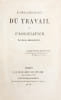

1- Edition originale. Ouvrier teinturier, militant et propagandiste phalanstérien, l'auteur revendique comme fouriériste l'idée de l'organisation du travail et affirme qu'en dehors de cette doctrine, il n'y a pas d'organisation de travail qui soit réalisable. "Ce livre est de nature à aider puissamment à la propagation des doctrines économiques de l'Ecole sociétaire, notamment parmi les industriels" (Catalogue raisonné de la Librairie Sociétaire). (Del Bo, p. 21. Maitron, I, 302).2- Seconde édition considérablement augmentée de ce célèbre manifeste de l'Ecole Sociétaire dans lequel Victor Considérant expose le programme du Parti auquel il imprime sa propre vision. Cf. analyse in : Dommanget, 'V. considérant', p. 22 et s.3- "Troisième édition". Condisciple de Victor Considérant à l'École Polytechnique, gagné à la cause phalanstérienne par celui-ci, H. Renaud devint l'un des disciples les plus orthodoxes de l'École. Il donne dans cet ouvrage un "résumé fidèle de la doctrine de Fourier", des conceptions philosophiques qui ont conduit son maître à élaborer son système et tire les ultimes conséquences politiques et sociales de l'application de la "loi de l'harmonie universelle". (Del Bo, p. 41. Maitron, III, p. 296).Rousseurs au dernier titre. Papier des plats frotté.Bon exemplaire, relié, de ce recueil de trois essais "canoniques" dans l'histoire du fouriérisme.
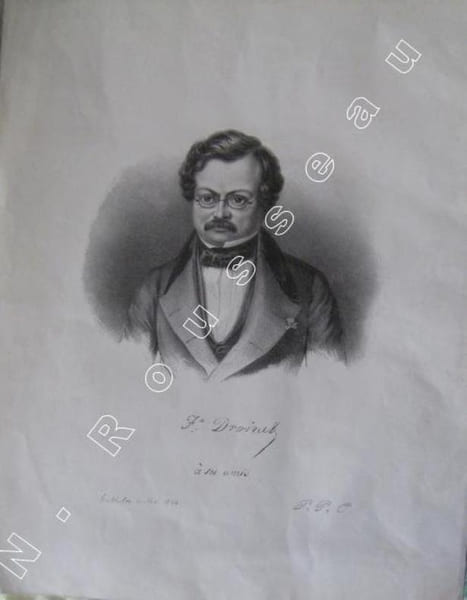
Portrait . Félix Droinet à ses amis.
Lithographie originale de 40, 5 cm x 31,5 cm , datée de Stockholm 10 mai 1840, légendée " Félix Droinet à ses amis" et signés des initiales P. P. C au crayon. Très beau portrait lithographié signé au crayon d'un monogramme que nous n'avons pu identifié.
Originaire de Reims, où il nait en 1801, Félix Droinet , fouriériste, fut entrepreneur dans le domaine du gaz de ville et , pour développer son industrie , il vécut ou séjourna dans plusieurs pays étrangers : les Pays-Bas où il rencontra sa seconde femme, la Russie, la Suède. Il rédige en 1842 une " Notice sur Stockholm". Il est en rapport avec l'école sociétaire dans les années 1840. On suppose qu'il a rencontré Considérant aux Pays-bas en 1839, et qu'ils sont ensuite restés en contact. A la même époque le fouriériste Marie-Eugène Bour , originaire de Besançon est également actif aux Pays-Bas . Droinet fut l'ami du Phalanstérien Sauzet. Très rare portrait en bon état. ( cart Gr)
Le materialisme et la nature.
Paris, Librairie des Sciences Sociales, 1870, in-8, br., VII-83 p. Edition originale.
Analyse des équations déterminées.
P., Firmin Didot, 1831, un volume in 4 relié en demi-basane verte, dos orné de filets dorés (reliure de l'époque), (2), 24pp., 258pp., 1 planche dépliante
---- EDITION ORIGINALE de cet ouvrage de J.B.J. FOURIER dans lequel apparaît pour la premièe fois le "théorème de FOURIER" ---- BON EXEMPLAIRE ---- "At the time of his death, Fourier was trying to prepare these and many other results for a book to be called Analyse des équations déterminées; he had almost finished only the first two of its seven livres. His friend Navier edited it for publication in 1831 inserting an introduction to establish from attested documents (including the 1789 paper) Fourier’s priority on results which had by then become famous. Perhaps Fourier was aware that he would not live to finish the work, for he wrote a synopsis of the complete book which also appeared in the edition. The synopsis indicated his wide interests in the subject, of which the most important not yet mentioned were various means of distinguishing between real and imaginary roots, refinements to the Newton-Raphson method of approximating to the root of an equation, extensions to Daniel Bernoulli’s rule for the limiting value of the ratio of successive terms of a recurrent series, and the method of solution and applications of linear inequalities. Fourier’s remarkable understanding of the last subject makes him the great anticipator of linear programming." (DSB V, p. 98) ---- Cajori, A History of Mathematics, p. 433**8679/ARM3
Analyse des équations déterminées
Paris, Firmin Didot, 1830, in-4, de (4), XXIV, 258 pages et 1 planche, demi-chagrin marron postérieur, tête dorée, Très rare premier état à la date de 1830. Edition originale de la première, et seule partie parue, de l'ultime oeuvre mathématiques de Fourier publiée posthume par son ami Navier. "In constrast with the famous work on heat diffusion, Fourier's interest in the theory of equations is remarkably little know. Yet it has a much longer personal history, for it began in his sixteenth year when he discovered a new proof of Descarte's rule of sign and was just as much in progress at the time of his death [...]. Fourier's proof was based on multiplying f(x) by (x + p), thus creating a new polynomial which contained one more sign in its sequence and one more positive (or negative) root, according as p was less (or greater) than zero, and showing that the number of preservations (or variations) in the new sequence was not inscreased relative to the old sequence. Hence the number of variations (or preservations) is increased by at least one, and the theorem follows. The details of the proof may be seen in any textbook dealing with the rule, for Fourier's youthful achievement quickly became the standard proof, even if its authorship appears to be viertually unknown[...]". "Fourier appears to have proved his own theorem while in his teens and he sent a paper to the Academy in 1789. However, it disappeared in the thrumoil of the year in Paris, and the pressure of administrative and other scientific work delayed publication of the resultats untiel the late 1810's. Then he became involved in a priority row with Ferdinand Budan de Bois-Laurent, a part-time mathematician who had previously published similar but inferior result. At the time of his death, Fourier was trying to prepare thse and many other result for a book to be called Analyse des équations déterminées ; he had almost finished only the first two of its seven "livres". His friend Navier edited it for publication in 1831 [sic], inserting an introduction to establish from attested documents (including the delayed 1789 paper) Fourier's priority on results which had by then become famous. Perhaps Fourier was aware that he would not live to finish the work, for he wrote a synopsis of the complete book which also appeared in this edition. The synopsis indicated his wide interests in the subject, of which the most important not yet mentioned were various means of distinguishing between real and imaginary roots, refinements of the Newton-Raphson method of approximating to the root of an equation, extensions to Daniel Bernoulli's rule for the limiting value of the ratio of successive terms of a recurrent series, and the method of solution and applications of linear inequalities. Fourier's remarkable understanding of the last subject makes him the great anticipator of linear programming." On trouve à la suite, deux extraits d'articles de Fourier tirés des Mémoires de l'Académie des Sciences portant sur le sujet de la théorie des équations : -Sur la distinction des racines imaginaires, et sur l'application des théorèmes d'analyse algébrique aux équations transcendantes qui dépendent de la théorie de la chaleur (Mémoires de l'Académie royale des sciences de l'Institut de France, tome VII, Paris, Didot, 1827, pages 605 à 624) ; -Remarques générales sur l'application des principes de l'analyse algébrique (lues à l'Académie des Sciences le 9 mars 1829 et publiées dans les Mémoires de l'Académie Royale des Sciences de l'Institut de France, tome X, Paris, Didot, 1831 ; pages 119 à 146). Bel exemplaire, à toute marge, portant l'ex-libris imprimé du bibliophile Henri Viellard et l'estampille, annulée, de l'Institut Catholique de Paris. DSB, V, p. 93-99. Couverture rigide
Bon de (4), XXIV, 258 pages et 1

