 Write to the booksellers
-
Type
Autograph (1)
Book (52941)
Magazine (146)
Manuscript (2)
Maps (1)
New book (1)
Old papers (1)
-
Latest
Last 24h (36)
Last 3 days (125)
Last month (795)
Last week (87)
-
Language
Dutch (2)
English (30)
Finnish (1)
French (52992)
German (13)
Greek (5)
Italian (15)
Japanese (2)
Latin (21)
Polish (1)
Portuguese (1)
Russian (1)
Spanish (7)
Swedish (2)
-
Century
16th (66)
17th (201)
18th (1268)
19th (3594)
20th (22234)
21st (3835)
-
Countries
Belgium (6756)
Brazil (28)
Canada (6)
China (2)
Côte d'Ivoire (63)
Denmark (1017)
France (40374)
Germany (4)
Greece (3)
Italy (55)
Netherlands (281)
Switzerland (4503)
United States of America (1)
-
Syndicate
ALAC (6)
CLAM (5)
CNE (6)
ILAB (21851)
NVVA (1010)
SLACES (918)
SLAM (19563)
SNCAO (41)
Vera philosophia Studies in Late Antique medieval and Renaissance Christian Thought,
Turnhout, Brepols, 2008 Paperback, 416 p., 2 colour ill., 16 x 24. ISBN 9782503525464.
This volume includes a collection of reworked articles which the author, during the last twenty years, dedicated to the origins and conditions constitutive of Christian philosophical-theological thought. From the earliest centuries of the Christian era, human reason was submitted to a particular formal conditioning, in so far as it was necessarily obliged to confront the contents of a divine revelation recognized as necessarily 'true'. The medieval Latin scholar was induced by the social and cultural peculiarities of his time to confront a model of thought which imposes a decisive subordination of natural knowledge ? demonstrated to be imperfect and inconclusive ? to the certainties assured by the faith. The production of this model of philosophia, sensibly different from the dominant paradigms in the classical period, rooted itself in the critical redimensioning of reason introduced into the West by Cicero. Departing from the observation of the failure of the philosophical aspirations of antiquity, the Christian intellectuals effected an operative 'overturning' of the conditions of veridical knowledge. The new wisdom was not the result of a pure interference of religion in the field of rational science; it was, however, directed by a conscious 'conversion' of the philosophers and fulfilled on two sides: on that of the faith, which requires earthly knowledge in order to defend itself from misunderstandings and heresies; and on that of reason, which allows itself to draw upon supernatural revelation for the possession of regulatory principles which guide it in the study of natural things. This book investigates the development of this approach during the course of the centuries which precede, in the West, the rediscovery of Aristotelian epistemology: from Augustine to Boethius, from John Scottus Eriugena to Anselm of Aosta. It moves to the point of describing the return of this methodological approach, at the end of the Medieval Scholastic period, in the results of the anti-Aristotelian critique carried out by the men of the Renaissance in the recovering of a model of thought which had dominated in the Patristic and Early Medieval periods. Languages : English.
vie communautaire. Traduction annotee des Sermons 355-356,
Turnhout, Brepols, 1996 Paperback, 63 p., 10,5 x 17. ISBN 9782851211569.
Languages : French.
ZEHN JAHRE REAL - EXISTIERENDES FREIES GEISTESLEBEN.
, Flensburg, Flensburger Hefte, 1991., Taschenbuch, 14,5x20,5cm, 92pp.
Antroposophie im Gesprach n? 9. Zur Geschichte der Gadeke - Studie Hintergrunde, Fakten.
Lidée directrice. Lévolutionnisme dans Saint Augustin. Introduction du Dr Ch. Fiessinger.
P., Vigot, 1934, in 12 broché, 109 pages.
...................... Photos sur demande ..........................


Phone number : 04 77 32 63 69
Schema Praelectionum. Delineantur Introductio generalis in universam philosophicam et Theoria Cognitionis critica (ad usum privatum auditorum)
Romae, Apud Aedes Universitatis Gregorianae 1932 412pp., cloth binding, few stamps, else VG
DISCOURS DE LA METHODE - précédé de : Desacrtes par Geneviève Lewis - et suivi de : Descartes et son temps par Etienne Souriau
LE LIVRE MONDIAL. NON DAT. In-8. Relié. Etat d'usage, Couv. légèrement passée, Dos satisfaisant, Intérieur frais. 94 pages. . . . Classification Dewey : 100-PHILOSOPHIE ET DISCIPLINES CONNEXES
Classification Dewey : 100-PHILOSOPHIE ET DISCIPLINES CONNEXES
L'expérience intérieure de la liberté.
P., PUF, 1924. Quelques paragraphes proprement soulignés par Jean Brun.
Éléments pour une éthique.
P., PUF, 1943. Quelques paragraphes proprement soulignés par Jean Brun.
NABOKOV, Vladimir - DAVET, Yvonne (Traduit de l'anglais par)
Reference : 125355
(1961)
Autres rivages
1961 Editions Gallimard / NRF - Collection "Du Monde Entier" - 1961 - In-8 broché - 342 pages
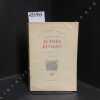
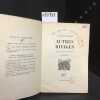
Bon état - Plis de lecture au dos - Légers frottements sur les coiffes - Deux petits manques de matière sur la ranche de tête de la page de faux-titre - Petits défauts sur la page de titre (voir photo) sinon intérieur bien frais Bon
Marx, Engels et le singe - Collection ouverture philosophique.
L'Harmattan. 2000. In-8. Broché. Bon état, Couv. convenable, Dos satisfaisant, Intérieur frais. 128 pages.. . . . Classification Dewey : 100-PHILOSOPHIE ET DISCIPLINES CONNEXES
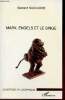
Collection ouverture philosophique. Classification Dewey : 100-PHILOSOPHIE ET DISCIPLINES CONNEXES
Le sentiment d'amour dans l'oeuvre de Pierre Corneille
Paris, Gallimard, NRF, Bibliothèque des idées, 1961 In-8 (220x135mm) broché, 418 p. Quelques petites marques au crayon de papier (très facilement effaçables). Très bon état général.
Le Sentiment de l’amour dans l’Oeuvre de Pierre Corneille
Gallimard, NRF, coll. « Bibliothèque des Idées » 1973 In-8 broché. 418 pages. État correct d’occasion.
Etat correct d’occasion
La théorie de la structure sociale. Traduction et présentation de Jeanne Favret.
1970 P., Editions de Minuit (Collection "Le Sens Commun"), 1970, in 8° broché, 229 pages.
...................... Photos sur demande ..........................
Phone number : 04 77 32 63 69
Le Système Philosophique de MU'TAZILA (Premiers Penseurs de L'Islam).
(Beyrouth), 1956. Orig. printed wrappers. XX,354 pp.
(Recherches...Institut de Lettres Orientales de Beyrouth Tomo III).
Naked Science: Anthropological Inquiry into Boundaries Power and Knowledge
Routledge 1996 336 pages in8. 1996. Broché. 336 pages.
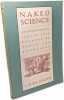
proche du neuf intérieur propre bonne tenue
Entre philosophie et politique : Giovanni Gentile : Un philosophe engagé sous le fascisme
Editions L'Harmattan, 2001. 290 pages.
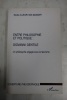
Exemplaire en très bon état. Dos un peu passé. Intérieur frais.
Centres and Peripheries in the History of Philosophical Thought. Essays in Honour of Loris Sturlese
, Brepols, 2021 Hardback, xlii + 319 pages, Size:156 x 234 mm, Illustrations:28 b/w, Language(s):Italian, English, German. ISBN 9782503594088.
Summary This volume is an homage to the great intellectual contribution made by Loris Sturlese to the field of history of medieval philosophy. Its point of departure lies in a methodological line, which Sturlese has maintained throughout his whole academic career: the importance in the historical and conceptual reconstruction of medieval philosophical thought of focusing not only on the classical, most famous centers of knowledge production and transmission, but also on the often-neglected peripheries, which during the Middle Ages were increasingly more relevant in propelling the circulation of texts and ideas. In this volume, the notions of 'center' and 'periphery' are not understood in a merely geographical sense, but also in conceptual, linguistic, historical and literary terms. The richness of this approach is demonstrated by the broad spectrum of the contributions, which range from Islamic philosophy to Italian Renaissance, including the reception of ancient philosophy and of Arabic scientific works in the Latin world, and up to eighteenth-century French geography. Special attention is devoted to the philosophical thought developed in the German area. The volume does not lack in giving space to important medieval figures, such as Dante, as well as to more general philosophical notions, such as the concept of rationality. The volume explores connections, ruptures, relations and affinities through the analysis of paradigmatic figures, places and topics within the micro- and macro-histories of philosophy. TABLE OF CONTENTS Nadia Bray, Diana Di Segni, Fiorella Retucci, Elisa Rubino, Introduction Loris Sturlese, Bibliography Ruedi Imbach, Ein nicht-existierender Gegenstand? Eine gelehrte und nichtsdestotrotz pers nliche Geschichte der Bochumer Schule (1971-1995) Carmela Baffioni, Il Linguaggio di Adamo, la Caduta di Adamo. Walter Benjamin alla luce di un inedito testo arabo medievale Luca Bianchi, L'aristotelismo vernacolare nel Rinascimento italiano: un fenomeno 'regionale'? Charles Burnett, Cleaning up the Latin Language in Mid-Sixteenth-Century Basel: Antonius Stuppa's purgation of Albohazen's De iudiciis astrorum Stefano Caroti, "Est autem testis Melissus pro cunctis temporis sui Philosophis, sed et pro omni antiquitate". Le metamorfosi di Melisso Giulio d'Onofrio, Dante dal centro al cerchio Onorato Grassi, Per l'edizione critica delle opere di Pietro Aureoli Mikhail Khorkov, Nicholas of Cusa's marginalia to Plato's dialogue Phaedrus as one of the forgotten sources of the supposed Cusanian Platonism Catherine K nig-Pralong, Centri, periferie, luoghi e percorsi. Jules Michelet versus Victor Cousin Freimut L ser, On the Margin. Some Notes on Meister Eckhart Pasquale Porro, Da Tommaso al tomismo. Napoli come centro filosofico nel Medioevo Valeria Sorge, Per una microstoria dell'umanesimo rinascimentale. Agostino Nifo e la cultura napoletana del Cinque-cento Andreas Speer, Die Universalit t der Vernunft und die Vielheit ihrer Sprachen Markus Vinzent, The Self-Location of Meister Eckhart Index
Origin and Nature of Language and Logic. Perspectives in Medieval Islamic, Jewish, and Christian Thought
, Brepols, 2020 Hardback, xiv + 422 pages, Size:156 x 234 mm, Languages: English, French. ISBN 9782503588926.
Summary The annual colloquium of the SIEPM in Freiburg, Germany, was groundbreaking in that it featured a more or less equal number of talks on all three medieval cultures that contributed to the formation of Western philosophical thought, the Islamic, Jewish, and Christian traditions. Indeed, the subject of the colloquium, 'The Origin and Nature of Language and Logic in Medieval Islamic, Jewish, and Christian Thought', lent itself to such a cross-cultural approach. In all these traditions, partially inspired by ancient Greek philosophy, partially by other sources, language and thought, semantics and logic occupied a central place. As a result, the chapters of the present volume effortlessly traverse philosophical, religious, cultural, and linguistic boundaries and thus in many respects open up new perspectives. It should not be surprising if readers delight in chapters of a philosophical tradition outside of their own as much as they do in those in their area of expertise. Among the topics discussed are the significance of language for logic; the origin of language: inspiration or convention; imposition or coinage; the existence of an original language; the correctness of language; divine discourse; animal language; the meaningfulness of animal sounds; music as communication; the scope of dialectical disputation; the relation between rhetoric and demonstration; the place of logic and rhetoric in theology; the limits of human knowledge; the meaning of categories; the problem of metaphysical entailment; the need to disentangle the metaphysical implications of language; the quantification of predicates; and the significance of linguistic custom for judging logical propositions. TABLE OF CONTENTS Nadja Germann and Steven Harvey, Introduction 1. The Origin and Nature of Human Language Pierre Larcher, Et Allah apprit Adam tous les noms? (Cor., 2, 31) : L'Origine du langage dans la pens e islamique Warren Zev Harvey, Three Medieval Jewish Philosophers on the Hebrew Language Aviram Ravitsky, Maimonides' Linguistic Thought and Its Greek, Islamic and Jewish Background Beata Sheyhatovitch, The Notion of Wa?? in Shar? al-K??ya by Ra?? al-D?n al-Astar?b?dh? Josef Stern, Profayt Duran's Ma?aseh Efod: The Philosophical Grammar of a Converso 2. Non-Human and Non-Verbal Communication Ziad Bou Akl, Dieu comme locuteur : le bay?n et son report dans les u??l al-?qh Luis Xavier L pez-Farjeat, The 'Language' of Non-Human Animals in al-F?r?b? and Avicenna Th r se-Anne Druart, What Does Music Have To Do With Language, Logic, and Rulership? Al-F?r?b?'s Answer 3. The Nature, Kinds, and Limits of Logic Laurent Cesalli, De quibus est logica ? La position de Gauthier Burley dans le d bat m di val Fouad Ben Ahmed, Ibn ?uml?s on Dialectical Reasoning: The Extent of His Reliance on al-F?r?b? and Averroes Catherine K nig-Pralong, Roger Bacon. Rh torique et sens litt ral Peter S. Eardley, Rhetoric and the Epistemic Status of Theology in the Late-Thirteenth Century Yehuda Halper, Abraham Bibago on the Logic of Divine Science: Metaphysics ? and the Legend of the Pardes 4. The Signi?cance of Language for Logic Pasquale Porro, Keeping Language under Control: Late-Antique and Medieval Interpretations of the First Chapter of Aristotle's Categories Margaret Cameron, The Constraints of Nature(s): Abelard on Modality, Understanding and Linguistic Meaning Charles H. Manekin, Logic, Linguistic Custom, and the Quanti?cation of the Predicate in Gersonides
A Book Forged in Hell : Spinoza's Scandalous Treatise and the Birth of the Secular Age.
Princeton & Oxford, Princeton University Press, 2011. 8vo. In the original blue publisher's cloth binding with gilt title to spine. With the original dust jacket. Ownership signature to inside of front board. Internally clean. XVIII, (2), 279 p.
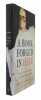
Nadler's treatise on Spinoza's Tractatus Theologico-Politicus (Hamburg, 1690).
Spinoza : A Life.
Cambridge University Press, 1999. 8vo. In the original black cloth publisher's binding with gilt title to spine and front board. With the original dust jacket. Minor traces of use to edges of dust jacket. Ownership signature to inside of front board. XIII, 407 p.
Spinoza's Heresy. Immortality and the Jewish Mind.
Oxford, Clarendon, 2004. 8vo. Paperback. Fresh and clean copy, as new. XI, (4), 225 p.
A companion to early modern philosophy
, Blackwell Publishing 2002 ix + 661pp., editor's hardback, dustwrapper, 26cm., in the series "Blackwell Companions to Philosophy", ISBN 0-631-21800-9, F78253
L'iceberg des autonomes.
Kesselring, 1979. In-8 broché, couverture illustrée par Joëlle Coulombeau. Dos légèrement jauni, quelques rousseurs en bord des premiers feuillets, pour le reste en très belle condition.
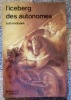
Edition originale de cet ouvrage dans lequel l'auteur dresse un bilan de son parcours politique dans le mouvement autonome.
Karl Philipp Moritz (1756-1793) Seine Aesthetik und ihre menschlichen und weltanschaulichen Grundlagen
Affoltern, Buchdruckerei Weiss 1930 iv + 159pp., 23cm., softcover, text in German, Doctoral Dissertation (Abhandlung zur Erlangung der Doktorwürde der philosophischen Fakultät I der Universität Zürich), stamp at verso of title page, text is clean and bright, F111669

