 Write to the booksellers
-
Type
Autograph (15)
Book (50971)
Magazine (288)
Manuscript (2)
Maps (1)
New book (1)
Old papers (1)
Photographs (1)
-
Latest
Last 24h (11)
Last 3 days (80)
Last month (1161)
Last week (69)
-
Language
Dutch (6)
English (43)
Finnish (1)
French (51150)
German (19)
Greek (5)
Italian (20)
Japanese (2)
Latin (21)
Polish (1)
Portuguese (3)
Spanish (7)
Swedish (2)
-
Century
16th (61)
17th (194)
18th (1294)
19th (3643)
20th (22023)
21st (3738)
-
Countries
Belgium (6728)
Brazil (24)
Canada (6)
China (2)
Côte d'Ivoire (69)
Denmark (1046)
France (38734)
Germany (3)
Greece (3)
Netherlands (268)
Switzerland (4397)
-
Syndicate
ALAC (6)
CLAM (37)
CNE (6)
ILAB (20021)
NVVA (998)
SLACES (907)
SLAM (17688)
SNCAO (41)
PROLEGOMENA zu einer jeden künftigen Metaphysik, die als Wissenschaft wird auftreten können. Hrg. on Karl Vorländer.
Hamburg, Felix Meiner, Philosophische Bibliothek, 1954, in-8 hardcover, no dj, XLI + 200 pp. Cover in very good condition, inside in good condition (notes).
Nombreux titres disponibles en Philosophie.
Prolegomena zu einer jeden künftigen Metaphysik die als Wissenschaft wird auftreten können.
Frankfurt und Leipzig. (O.Dr.). 1794. 222 S., 1 w. Bl. Halblederband der Zeit mit rotem Rückenschild und wenig Rückenvergoldung.
Warda 78. - Nachdruckausgabe nach den 3 Drucken von 1783. - Hübsch gebunden und sauber.
Prolegomena zu einer jeder künftigen Metaphysik die als Wissenschaft wird auftreten können + Die Religion innerhalb der Grenzen der blossen Vernunft. Zweyte vermehrte Auflage + Der Streit der Facultäten in drey Abschnitten.
Riga, bey Johann Friedrich Hartknoch, 1783 + Königsberg, Friedrich Nicolovius, 1794 + 1798. 8vo. Bound together in one slightly later full green cloth binding with gilt title to spine: Kant/ Religion/ und/ Metaphysik. A bit of wear to extremities and a bit of brownspotting throughout. But all in all a harmonious and nice ""Sammelband"" of three of Kant's important works. With stamp (Studentersamfundet"") to front free end-paper and to all three title-pages. 1) Woodcut title-vignette, woodcut flower-and putti-headpiece on p. 3 and woodcut end-vignette (ornamentail piece with flowers). 222 pp. 2) With contemporary ownership-signature to title-page. XXVI, (4), 314, (2, -errata) pp. 3) With contemporary ownership-signature to title-page (same as previous work: v. Holmfeld""). XXX, 205 pp.
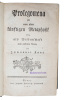
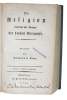
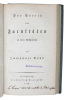
The three works together constitute an excellent introduction to the full range of Kant works and are all of the utmost importance to the understanding of his philosophy:1) First edition, third issue, of Kant's masterpiece, the more popular exposition of the ideas presented in his main work ""Critik der reinen Vernunft"" (1781). Three variants of the first edition are known to exist, distinguishable by head- and tailpieces, and this is the third one listed in Warda, i.e. Warda 77.This work constitutes a more comprehensible exposition of the main thoughts of Kant's ""Critique of Pure Reason"", and it is probably one of the most frequently read and approachable of his works. After having received immense negative critique and having been misunderstood with the first edition of the ""Critique of Pure Reason"", Kant wrote his ""Prolegomena"" as a defense and explanation, and he later incorporated much of it into the second edition of the ""Critique of Pure Reason"""" -it is with the ideas expounded in this work that Kant becomes world-famous. ""Kant's great achievement was to conclude finally the lines on which philosophical speculation had proceeded in the eighteenth century, and to open up a new and more comprehensive system of dealing with the problems of philosophy... The influence of Kant is paramount in the critical method of modern philosophy. - No other thinker has been able to hold with such firmness the balance between speculative and empirical ideas... "" (PMM 226). Warda: 77. 2) The improved and enlarged second edition of Kant's seminal work, in which he develops his religion of reason and most fully accounts for his philosophy of religion.The ""Religion within the Bounds of Mere Reason "" originally appeared in 1793 but was enlarged and revised by Kant himself, and it appeared in the definitive second edition on 1794. It is this second edition which became the standard version of the text.The work is constituted by four essays, in which Kant accounts for relationship between the moral doctrines that he had developed in his works of moral philosophy and his understanding of religion. One of his most frequently cited conclusions is that even though morality in itself does not need religion, morality will still inevitably lead to religion.""The work in which Kant offers his most extensive and systematic treatment of religion from the perspective of his critical philosophy is ""Religion within the Boundaries of Mere Reason"". In addition to its importance in the development of Kant's view of religion as discussed below, this work is notable because of the controversy over censorship that attended its publication, the reprimand then given to Kant in the name of the Prussian emperor, Friedrich Wilhelm II, and Kant's pledge not to publish on matters of religion, which he later considered abrogated upon the death of the emperor in 1797."" (SEP).Warda: 145.3) First edition of the last book that Kant himself published (together with his simultaneously published lecture ""Anthropologie in pragmatischer Hinsicht""), in which he defends the Faculty of Philosophy against those of Theology, Law, and Medicine, claiming that Philosophy is superior in that it is the only of them that pursues truth in stead of usefulness. Criticizing the contemporary practice at the universities, he argues that the disciplines of the humanities and sciences, which are those collected in the Faculty of Philosophy, ought to be free from censorship or any form of state control, both in teaching and research. Warda: 193
Sämtliche Werke. Hrsg. von Felix Gross. In 6 Bänden.
Leipzig, Insel-Verlag, 1923-24, pt. in-8vo, Original-Leinenband. OU. Schönes Exemplar.

(SLACES, NVVA)
Phone number : 41 (0)26 3223808
THE DOCTRINE OF VIRTUE. Part II of The Metaphysic of Morals
Harper Torchbooks, The cloister library, 1964, in-8 softcover, XXXVI + 174 pp. VERY GOOD CONDITION
Nombreux titres disponibles en Philosophie.
Werke. In Gemeinschaft mit H.Cohen, A.Buchenau, Otto Buek, A.Görland, B.Kellermann hrsg. von Ernst Cassirer. 11 Bde.
Berlin, 1922-23. Lex8vo. 11 orig.full cloth.
WERKE. Vierter Band. SCHRISSTEN ZUR ETKIK UND RELIGIONSPHILOSOPHIE
ERSCHIENEN IMINSEL VERLAG, no date () , in-12 hardcover, dustjacket, box, 896 pp VERY GOOD CONDITION
Nombreux titres disponibles en Philosophie.
Über die von der Könogl. Akademie der Wissenschaften zu Berlin für das Jahr 1791 ausgesetzte Preisfrage: Welches sind die wirklichen Fortschritte, die die Metaphysik seit Leibnitzens und Wolf's Zeiten in Deutschland gemacht hat? Herausgegeben von Frie... - [KANT'S PRIZE ESSAY]
Königsberg, Goebbels & Unger, 1804. 8vo. Original blank blue wrappers with handwritten title to spine. A very nice copy. Contemporary owner's name to inside of front board (S. Grubbe) and stamp to title-page (Gothenburg Museum, 1861). 204, (4, -advertisements) pp.
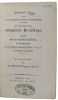

The rare first edition of Kant's famous posthumously published prize essay, written in 1791, answering the question set by the Berlin Royal Academy of Sciences: What are the Actual Advances Metaphysics Has Made in Germany Since the Time of Leibniz and Wolff? Right after Kant's death in 1804, Friedrich Theodor Rink edited and published parts of drafts Kant had written on this topic Kant never published a finished version, and this is all that appeared.Warda: 220.
Traité de pédagogie (Traduction Jules Barni). Avec une préface, des sommaires analytiques et un lexique par Raymond Thamin.
In-12, broché, 132, (8) p. Paris, Félix Alcan, 1901.
Jules Barni est l'un des principaux interprètes du néokantisme, envisagé comme idéologie précurseur de la morale laïque et républicaine.Couverture défraîchie, dos fendu.(Hatchuel, 'Kant en français', n°39).

Opmerkingen over het gevoel van het Schoone en Verhevene
Sneek, J.F. Van Druten 1919 viii + 216 pp., 23cm., blinde omslag, goede staat, [bevat de Nederlandse vertaling, met toelichting door Harry P. Blok: Een inleiding tot de Kantiaansche Philosophie], F102683
KANT, Immanuel (- in neues - reines deutsch übersetzt von Georg Decyke)
Reference : F13938
Critique de la raison pure. Traduit de l'allemand par Jules BARNI. Avec une introduction du traducteur contenant l'analyse de cet ouvrage.
2 volumes in-8, brochés (couvertures défraîchies, dos du vol. II fendu), viii, cxlvii, 393 p. et 480 p. Paris, Germer-Baillière, 1869.
Edition originale de cette traduction. "Barni, le premier, restitue à Kant sa qualité de théoricien des Lumières et en fait le précurseur de la morale républicaine et démocratique, contre le Kant sceptique introduit en France par des émigrés comme Villers" (J.-F. Braunstein in 'Dict. des Philosophes', p. 243). Bon état intérieur. (Hatchuel, 'Kant en français', n°32).
KANT (Immanuel), LORTET (Pierre) traducteur, BOUILLIER (Francisque)
Reference : 29450
Théorie de Kant sur la religion dans les limites de la raison, ouvrage traduit de l'allemand par M. le docteur Lortet ; précédé d'une introduction par M. Francisque Bouillier.
In-12, broché (couverture défraîchie), xlii, (2), 106 p., premiers feuillets fortement brunis. Paris, Joubert et Lyon, Ch. Savy, 1842.
Édition abrégée de "La religion dans les limites de la raison", publiée un an après la première française. Cette version est "généralement attribuée à Kant lui même" selon Francisque Bouiller dans sa préface. (Hatchuel, 'Kant en français', n°17).
Critica della ragion pratica: Testo tedesco a fronte (Testi a fronte)
Bompiani 2000 360 pages 12 6x2 4x19 8cm. 2000. Broché. 360 pages.
Bon état 2e plat un peu marqué intérieur propre bonne tenue
Menschenkunde oder philosophische Anthropologie Nach handschriftlichen Vorlesungen herausgegeben von Fr. Ch. Starke.
Leipzig, 1831. 8vo. In contemporary full empossed cloth with gilt lettering to spine. Spine defective, missing upper part and cloth along the joints. Previous owner's name to front free end-paper. Light occassional brownspotting throughout. A few underlinings in pencil. XVI, 380 pp.
Uncommon first edition of Kant’s “Philosophische Anthropologie”, posthumously published, based on his university lectures on anthropology. Johann Bergk (under the pseudonym of Friedrich Starke) edited the lecture notes in 1831, it is not known where Bergk got the manuscript from and who originally took these notes. “These lectures show that Kant had a coherent and well-developed empirical theory of human nature bearing on many other aspects of his philosophy, including cognition, moral psychology, politics and philosophy of history”. (Wood & Louden, Lectures on Anthropology. Immanuel Kant). The work sets out Kant’s thoughts on the human being, approached in both a practical and a philosophical way. He discusses the powers of the mind, the relationship between body and soul, character and temperament, human behavior and the cultural and moral sides of human life. At the center of the book is Kant’s idea that reason is what defines human beings and forms the basis of freedom and morality. “Menschenkunde” is an important work in Kant’s later philosophy. It connects his critical philosophy with moral thought and early studies of human nature, and it had a strong influence on 19th-century philosophical anthropology and the developing social sciences. Warda 226.
Prolégomènes à toute métaphysique future qui aura le droit de se présenter comme science. Suivis de deux autres fragments du même auteur relatifs à la Critique de la raison pure () traduits de l'allemand d'Immanuel Kant par J. Tissot.
In-8, demi-veau brun de l'époque, dos à faux-nerfs filetés à froid, 3 fers dorés entre-nerfs, 2 pièces de titre de maroquin noir (plats frottés, coins émoussés), vii, 484 p., large auréole claire. Paris, Ladrange, 1865.
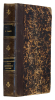
Première édition française de 'Prolegomena zu einer jeden künftigen Metaphysik'. (Hatchuel, 'Kant en français', n° 31).
Critique de la raison pure. Troisième édition en français, comprenant les différences entre la première et la seconde édition, l'analyse de l'ouvrage par Mellin et des notes par J. Tissot.
2 volumes brochés, xxxii, 414 p. et (4), 544 p., rousseurs soutenues. Paris, Ladrange, 1864.
Troisième édition française, revue et corrigée.Couvertures muettes partiellement débrochées.(Hatchuel, 'Kant en français', n°30).
KANT Immanuel (traduction avec une introduction et des notes par J.Gibelin)
Reference : F13934
Le conflit des facultés en trois sections (1798)
, Paris, J.Vrin, 1935, xii + 147pp., qqs. cachets, bon état, F13934
Kritik der Urteilskraft
Hamburg, Felix Meiner 1974 xxxii + 394pp., 19cm., in the series "Philosophische Bibliothek" vol.39a, previous owner's name on first page, reprint of the 6th ed. (1924), softcover, Very good, F66796
Prolegomena zu einer jeden künftigen Metaphysik, die als Wissenschaft wird auftreten können
Hamburg, Felix Meiner 1976 xli + 200pp., 19cm., in the series "Philosophische Bibliothek" vol.40, softcover, Very good, F66795
Kant on Pure Reason
Oxford, oxford University Press 1982 202pp., softcover, in the series "Oxford readings in philosophy", 20cm., bit used, G
Uplysningar öfver Herr Professor Kants Critik af rena Fornuftet, utgifne af Johan Schulze. Öfwersåttning.
Lund, Lundblad, 1799. Samt. hldrbd. Rygforgyldning. 284 pp. + Forlæggerens salgskatalog (4) pp.

