 Write to the booksellers
-
Type
Autograph (15)
Book (51969)
Magazine (288)
Manuscript (2)
Maps (1)
New book (1)
Old papers (1)
Photographs (1)
-
Latest
Last 24h (78)
Last 3 days (44)
Last month (1205)
Last week (60)
-
Language
Dutch (10)
English (57)
Finnish (1)
French (52129)
German (19)
Greek (5)
Italian (20)
Japanese (2)
Latin (22)
Polish (1)
Portuguese (3)
Spanish (7)
Swedish (2)
-
Century
16th (62)
17th (211)
18th (1405)
19th (3708)
20th (22088)
21st (3750)
-
Countries
Belgium (6765)
Brazil (24)
Canada (6)
China (2)
Côte d'Ivoire (69)
Denmark (1046)
France (39695)
Germany (3)
Greece (3)
Netherlands (268)
Switzerland (4397)
-
Syndicate
ALAC (6)
CLAM (74)
CNE (6)
ILAB (20284)
NVVA (998)
SLACES (907)
SLAM (17914)
SNCAO (41)
BIBLIOTHEQUE POPULAIRE ET COMMUNALE. CATALOGUE. VILLE DE VAUVERT. 31 décembre 1910.
Nîmes Imprimerie Coopérative "La Laborieuse" 1910. In-8 broché 16pp + 42ff n ch. Couverture défraîchie recollée avec manques, mouillure claire en bordure inférieure des pages.
Recensement de plus de 5000 titres: romans, histoire, sciences naturelles, mathématiques, sciences appliquées, philosophie, médecine, religion, sciences sociales, beaux-arts, géographie, voyages, dictionnaires... (1605)
Lettres au Conseil Général de l'Ain.
Bourg, Imprimerie J.M. Villefranche, 1878 ; in-12, broché ; 40 pp.
![Lettres au Conseil Général de l'Ain.. [Anonyme - Voltaire]](https://static.livre-rare-book.com/pictures/CLA/16198_1_thumb.jpg)
Édition originale. Ce texte anonyme est signé "Un ennemi de toutes les idôlatries". Violente attaque contre Voltaire par le biais de "lettres" au Conseil Général à qui l'auteur reprochait d'avoir versé une somme pour la célébration du centenaire. Petite auréole, sinon bon exemplaire, bien frais.

Des Reformirten hamburgischen Patrioten erstes - zweytes Stuck. (No. 1 - 156). - [FIRST EDITION OF THE FAMOUS ""DER PATRIOT"" FROM HAMBURG]
(No place but Hamburg, no printer), 1724 - 1726. 4to. In contemporary full calf with four raised bands and gilt lettering to spine. Light wear to extremities. A few leaves closely trimmed slightly touching text, but generally nice and clean. 321 ff. (No. 1 - 156. All that was published).
Exceedingly rare first edition, fully complete, of the famous Hamburg-journal “Der Patriot” – it was the most significant German weekly journal at the beginning of the 18th century and served as an important platform for the emerging Enlightenment. It was published weekly in Hamburg from 1724 to 1726. Due to its popularity it saw four reprints until 1765 and was also translated into Dutch and French. The genre of moral weeklies was inspired by English periodicals, particularly the highly successful publications edited and written by Joseph Addison and Richard Steele, which appeared three times a week or even daily (The Tatler, The Guardian, and The Spectator). Unlike some other German moral weeklies, Der Patriot had an independent editorial team that did not simply translate English counterparts but instead selected and developed its own topics. Many German scholars and writers contributed to Der Patriot, but all published their articles under pseudonyms. Their true identities were not revealed until three years after the last issue was published. “In the course of the seventeenth and especially the eighteenth centuries, Hamburg’s press evolved from a mere supplier of information to a vehicle of public opinion. During the first half of the eighteenth century, Hamburg’s growing print culture was closely connected to the development of the city’s enlightened reform movement, embodied in the first Patriotic Society (1724–1726). For example, Hamburg’s own moral weekly, Der Patriot, a product of the Patriotic Society, informs both the rise of periodical press and the spread of enlightened ideals. Modeled on British periodicals, The Tatler and The Spectator, Der Patriot contained instructive essays on a variety of subjects, generally articulating middle-class norms and values. By appealing to a wide audience and disseminating useful knowledge and enlightened philosophy, such journals aimed to reorient the reader’s moral outlook and lifestyle, in particular to raise the intellectual and moral standards of its readers. Hamburg’s Der Patriot ran from 1724 until 1726, and was so popular that it was published in book form several times between 1728 and 1765. It was the most influential of the German moral weeklies. Der Patriot, seeking to enlighten and influence the morals of its readers, set itself in direct competition with the church. Aiming to “root out or at least expose all ridiculous or dangerous actions, mistakes, abuses and harmful habits through the orderly use of human reason,” Der Patriot's elevation of reason over faith angered Hamburg’s strong orthodox Lutheran church, which initiated a “pamphlet war” denouncing the journal. Der Patriot found both a multitude of detractors and supporters" roughly thirty-five pamphlets against and twenty-one in favor of the periodical appeared. This ‘battle of the pens’ certainly encouraged popular interest in Der Patriot and caused the publisher to print six thousand copies instead of the four hundred initially planned, reflecting both an expanding readership and growing popular interest in Enlightenment tenets. Der Patriot, furthermore, reflects the republic’s civic morality as it strove to promote the common good. If its attitude toward Hamburg’s governance was generally positive, it openly presented concrete proposals for improvement in the republic as well as the dangers of extravagance and excess, the loss of civic-mindedness, and political apathy. Indeed, Der Patriot asserted both the right and the duty of Hamburgers to speak out on any question regarding the welfare of their city-state.” (Aaslestad, Place and Politics).
Wetboek voor de hooge graden van de Orde der Vrije-metselaren, in het Koningrijk der Nederlanden en onderhoorige landen en koloniën [Code of Law for the High Degrees of the Order of Freemasons, in the Kingdom of the Netherlands and its dependent countries and colonies]
A slim book of 135 x 215 mm with 68 pp. In Dutch. Original red hardback. Two rectangles with the space between space filled with floral patterns on both covers, the word "WETBOEK" appearing on the front cover and a Masonic symbol on the back cover. A sticker, which seems decades old, has been placed on the spine. A few words have been penned in black ink with a feather by A. Canneman on April 2, 1859, with a Masonic signature. An esoteric engraving on p.3. 44 "articles" and a Bijladen at the end. This booklet is actually a document from 1835 that establishes the rules and constitutions for the higher degrees (above the Master's degree) within Freemasonry in the Kingdom of the Netherlands. It regulates the operation of the Grand Chapter and its associated chapters, often associated with the Modern or French Rite. It contains the rules for the organization and procedure of the so-called "high degrees" (the fourth through seventh degrees in the 19th-century French rite). The Order of Freemasons under the Grand Chapter of the High Degrees (founded in 1803) is a Dutch obedience that builds on the "blue" or symbolic lodge.
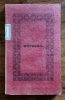
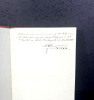
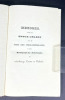
Corners slightly rubbed. The inside is very clean, paper bright and toned. Research shows that only a very few copies seem to have been printed.
Objects of Thought
At the clarendon press 1971 in8. 1971. Cartonné jaquette.
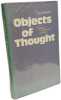
Très bon état dos insolé sous rhodoïd intérieur propre
Hitler conduit le bal.
Paris, Editions de Lutèce, 1939, in-8vo, 632 p., a la fin 4 cartes in-texte, brochure originale illustrée.
La propagande nazie en France e.a. .. la vendte d’une livre que disait le maréchal Lyautey que ‘tout Français devrait avoir lu ce livre. / L'Attitude envers la Tchécoslovaquie / les Déclarations Pacifiques d'Hitler, le Réarmement Allemand, les Revendications Coloniales allemandes... Image disp.

(SLACES, NVVA)
Phone number : 41 (0)26 3223808
L'articulation de la Foi, de la Théologie et des Ecritures.
1 vol. in-8 br., coll. Cogitatio Fidei, 163, Les Editions du Cerf, Paris, 1991, 247 pp.
Bel exemplaire en parfait état (comme neuf). Né à Menton en 1934, doyen de professeur de théologie systématique, l'auteur engage ici un débat avec de nombreux auteurs : Pannenberg, Heidegger, Gödel, Lévi-Strauss et Lacan, Popper, Thom, Tillich, Käsemann, Sesboüé, Kierkegaard
Saint-Simon.
Couverture souple. Broché. 124 pages. Cachets.
Livre. Editions P.U.F (Collection : Philosophes), 1969.
L'homme résistant. Collection : EVO Société.
Bruxelles, Editions Vie Ouvrière, 1995. 14 x 21, 224 pp., broché, très bon état.
Faith in a Hard Ground. Essays on Religion, Philosophy and Ethics by G.E.M. Anscombe
Exeter, Imprint Academic 2008 xxvi + 273pp., 21cm., with short handwritten dedication by co-editor Luke Gormally, softcover, in the series "St Andrews Studies in Philosophy and Public Affairs", very good condition, ISBN 9781845401214, F101308
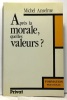
INVITATION A LA SERENITE DU COEUR.
ALBIN MICHEL. 2002. In-12. Broché. Bon état, Couv. convenable, Dos satisfaisant, Intérieur frais. 171 pages. Premier plat illustré en couleurs.. . . . Classification Dewey : 100-PHILOSOPHIE ET DISCIPLINES CONNEXES
Classification Dewey : 100-PHILOSOPHIE ET DISCIPLINES CONNEXES
Il monologo / classici della filosofia
Signorelli in8. Sans date. Broché.
Bon état bonne tenue intérieur propre circa 1960/70
Opes Sacerdotii num Republicae Noxiae. Ex rerum natura, sana politica et communi sensu generis humani examinatum
Impensis Joannis Gastl | Pedepontanum 1753 | 16 x 21.50 cm | relié
Edition originale. Rare. Page de titre en rouge et noir, un fleuron de titre. Reliure en plein vélin d'époque. Dos lisse à filets avec titre à la plume. Tâches, déchirures du vélin en queue. Intéressant ouvrage constituant une étude du coût économique des églises, congrégations et communautés religieuses, ainsi que de l'activité des religieux. Une seconde partie décrit les cultes étrangers et leurs rappports à l'argent et étudie ce même coût chez différentes églises (Juifs, Turcs, Arabes, Indous, Perses, Chinois, Egyptiens,etc.). Les derniers chapitres concernent l'Amérique (Mexique et Pérou). Anselmo Desing fut un érudit et un père bénédictin du monastère d'Ensdorf, il occupa divers postes d'enseignement à lla faculté de Salzbourg. Il est un des premier à employer le mot de Socialisme, né dans le mouvement anti-lumières. NB : Cet ouvrage est disponible à la librairie sur demande sous 48 heures. - Photographies et détails sur www.Edition-Originale.com -
Proslogion, with a reply on behalf of the fool by Gaunilo, and the author's reply to Gaunilo
Notre Dame / London, University of Notre Dame Press 1979 vii + 195pp., 20cm., previous owner's name on first page, softcover, very good, ISBN 0-268-01697-6, [bilingual: Latin-English], F66228
Basic Writings. Proslogium, Monologium, Cur deus homo, Gaulino's In behalf of the fool
La Salle, Open Court Publishing Company 1992 xiii + 328pp., 21cm., in the series "Open court classics", reprint of the 1962 2nd ed., previous owner's name on first page, softcover, Very good, ISBN 0-87548-109-4, [English translation], F66223
ANSELMUS CANTUARENSIS O.S.B. (Anselm of Canterbury) (& EADMER & PICARD & GERBERON Gabriel & SELDEN John)
Reference : R119829
(1675)
Sancti Anselmi ex Beccensi abbate Cantuarensis archiepiscopi Opera : nec non Eadmeri monachi Cantuarensis Historia novorum, et alia opuscula : labore ac studio.. Gabrielis Gerberon.. ad mss. fidem expurgata & aucta
Lutetiae Parisiorum [Paris], Sumpt. Ludovici Billaine et Joannis Du Puis 1675 [56] + 706 + [74] + 214 + [2] pp., with an engrvaing of Saxon seal and alphabet (on p.134, 2nd seq.), title in red and black, with printer's mark on title page, head and tail pieces, erased stamp on title page, text in Latin, 39x27cm., contemporary full leather binding (some loss of leather at corners and at ends of spine, gilt title and decorations on spine), text is clean and bright, some light staining on upper margin of text of some pages, overall a good copy, [Contains the complete of works of Anselm of Canterbury, together with "R.D. Iohannis Picardi ecclesiae S. Victoris Parisiensis Augustiniani canonic, annotations in S. Anselmi Cantuar. Archiepiscopi epistolas tribus libris prioribus contentas" (pp.550-582) & "Iohannis Seldeni in Eadmeri Historiam novorum notae" (pp.104-134, 2nd seq.), with indices], weight: 4.4 kg., cfr. OCLC 1015441124, R119829
Le Dibbouk. Légende dramatique en trois actes.
Paris, Les Editions Rieder (coll. "Judaïsme"), 1927. In-8°, 140p. Broché.
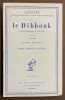
Edition originale de la version française de Marie-Thérèse Koerner. Un des 110 exemplaires de tête numérotés sur vélin pur fil Lafuma (celui-ci un des 10 exemplaires hors commerce lettré A ). A l'état de neuf et non coupé.
The Philosophy of Robert Boyle.
London & New York, Routledge, 2000. 8vo. Hardback. Ownership signature to inside of front board. Internally nice and clean. XV, 231 pp.
L'espèce humaine
Fort in-8 broché en bon état papier jauni et bords un peu émousses 1Ère édition Robert Marin Collection La Cité Universelle
L'espèce humaine.
Couverture souple. Broché. 321 pages.
Livre. Editions Gallimard (Collection : Tel), 2014.
L'espèce Humaine
Gallimard Gallimard, 1995. In-8 broché de 306 pages. Collection Tel. Très bon état
Toutes les expéditions sont faites en suivi au-dessus de 25 euros. Expédition quotidienne pour les envois simples, suivis, recommandés ou Colissimo.
L'Orient au miroir de la philosophie,
Pocket, "Agora", 1994, 340 p., poche, couverture légèrement défraîchie et un peu jaunie, ex-dono en première page, état satisfaisant.
La puce a l'oreille.
Paris, Stock, 1979 ; in-8, 389 pp., broché, couverture illustr. Anthologie des expressions populaires avec leur origine - nouvelle édition, revue et augmentée.
Anthologie des expressions populaires avec leur origine - nouvelle édition, revue et augmentée.
La fort et le droit. Le prétendu droit biologique
Paris, Alcan 1917 194pp., 19cm., dans la série "Bibliothèque de philosophie contemporaine", br.orig. (dos et plat supérieur remplacé) protégée par une couv. de papier cristal, qqs. petits cachets ex-libris du proporiétaire précédent Radetzky, texte en bon état, rare, F88308

