 Write to the booksellers
-
Type
Autograph (15)
Book (50856)
Magazine (289)
Manuscript (2)
Maps (1)
New book (1)
Old papers (1)
Photographs (1)
-
Latest
Last 24h (18)
Last 3 days (45)
Last month (237)
Last week (28)
-
Language
Dutch (8)
English (44)
Finnish (1)
French (51035)
German (18)
Greek (5)
Italian (20)
Japanese (2)
Latin (21)
Portuguese (3)
Spanish (7)
Swedish (2)
-
Century
16th (59)
17th (194)
18th (1278)
19th (3626)
20th (22156)
21st (3777)
-
Countries
Belgium (6777)
Brazil (24)
China (2)
Côte d'Ivoire (136)
Denmark (1009)
France (38524)
Germany (3)
Greece (3)
Netherlands (272)
Switzerland (4416)
-
Syndicate
CLAM (58)
CNE (6)
ILAB (20157)
NVVA (998)
SLACES (907)
SLAM (17848)
SNCAO (41)
Problemas de antropología cultural
Fondo de Cultura Económica 1957 in8. 1957. Broché. Ouvrage d'Erich Rothacker qui explore les fondements théoriques de l'anthropologie culturelle en mettant l'accent sur l'être humain comme agent de culture. L'auteur défend la nécessité d'une anthropologie de la culture au sein du cadre plus large de l'anthropologie générale en analysant des concepts comme la structure des cultures les lois de polarité et la tension entre unité et variété culturelles
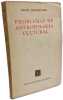
Bon état couverture défraîchie tranche ternie pages non-coupées
LE CHEMIN DES NEUF MONDES. LES INDIENS KOGIS DE COLOMBIE PEUVENT NOUS ENSEIGNER LES MYSTERES DE LA VIE.
ALBIN MICHEL / ESSAIS CLES. 2001. In-8. Broché. Etat d'usage, Couv. convenable, Dos plié, Intérieur frais. 288 pages. Premier plat illustré en couleurs.. . . . Classification Dewey : 100-PHILOSOPHIE ET DISCIPLINES CONNEXES
Classification Dewey : 100-PHILOSOPHIE ET DISCIPLINES CONNEXES


Ericson Richard V. Chan Professor Janet B. L. Baranek Patricia M
Reference : 100145477
(1987)
ISBN : 9780335155149
Visualizing Deviance
Open University Press 1987 424 pages 15 2x2 8x23 2cm. 1987. Broché. 424 pages.
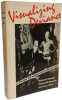
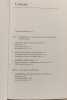
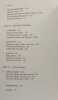
Bon état trace de colle sur le dos trace d'étiquette sur le dernier plat intérieur propre
PHILOSOPHIE POLITIQUE. 2e EDITION.
J. VRIN / LIBRAIRIE PHILOSOPHIQUE. 1966. In-8. Broché. Etat d'usage, Couv. légèrement passée, Dos plié, Quelques rousseurs. 261 pages.. . . . Classification Dewey : 100-PHILOSOPHIE ET DISCIPLINES CONNEXES
2e édition. Classification Dewey : 100-PHILOSOPHIE ET DISCIPLINES CONNEXES
Bartolome Bermejo: The Great Hispano-Flemish Master
1975, Paul Elek. In-8 relié en toile avec jaquette illustré. 159pp. Nombreuses illustrations en n&b 1975, Paul Elek. In-8 Hardcover with illustrated dust cover. 159 pages with numerous illustrations in b&w
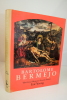
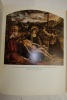
Très bon exemplaire, jaquette en bonne condition. Quelque marques de stockage très legeres et non importantes. Great exemplary overall, dustcover in good condition. Some light and unimportant marking due to storage
De divisione naturae [also known as the Periphyseon]. Libri quinque. Accedit appendix et ambiguis S. Maximi Graece & Latine. - [""WITH HIM TRUE PHILOSOPHY FIRST BEGINS"" (HEGEL)]
Oxford, E Theatro Sheldoniano, 1681. Folio. Nice contemporary full calf with five raised bands and single gilt line-decorations to spine. Gilt title-label and gilt lettering to spine. Double blindstamped borders to boards. All edges of boards gilt. A bit of wear to hinges and capitals, but overall very nice. Internally very clean and fresh with only minimal, light occasional browning. With the book-plate of Gaddesden Library to inside of front board. Engraved device to title-page. (14), 312"" (4), 88 pp.
Rare first edition of the founding work of Western medieval philosophy, the main work by ""the one important philosophical thinker to appear in Latin Christendom between Augustine... and Anselm."" (Encycl. of Phil.). This magnum opus of medieval thought is considered the ""final achievement"" of ancient philosophy (Burch: Early Medieval Philosophy, 1951) and is one of the few true defining moments of medieval philosophy. It not only marks the beginning of Western medieval philosophy, it also anticipates German idealism. Kolakowski identifies ""De divisione naturae"" as the archetype of Hegel's Phenomenology of Mind (see ""Main Currents of Marxism""), the Hegelians considered him the father of German idealism, and Hegel states that ""Scholastic philosophy is considered to begin with John Scotus Erigena who flourished about the year 860, and who must not be confused with the Duns Scotus of a later date... With him true philosophy first begins, and his philosophy in the main coincides with the idealism of the Neo-Platonists."" (From Hegel’s Lectures on the History of Philosophy: Part Two. Philosophy of the Middle Ages). As the dialectical reasoning in the “De divisione naturae” prefigures Hegel, its theory of place and time as defining structures of the mind anticipates Kant. As Gordon A. Leff also points out, Eriugena stands out as the one original thinker in the period from Boethius to Anselm. He is responsible for a revival of philosophical thought which had remained largely dormant in Western Europe after the death of Boethius and creates the only philosophical system to emerge in more than half a millenia. He is the forerunner to speculative idealism, considered a “Proclus of the West” (Hauréau, 1872) and the “Father of Speculative Philosophy” (Huber, 1861). According to The Stanford Encyclopaedia of Philosophy, Eriugena is ""the most significant Irish intellectual of the early monastic period. He is generally recognized to be both the outstanding philosopher (in terms of originality) of the Carolingian era and of the whole period of Latin philosophy stretching from Boethius to Anselm"""" Gersh praises his notion of structure, which places him amongst modern writers rather than medieval ones, stating also that ""(i)n some respects, Western medieval philosophy can be viewed as beginning with the brilliant and controversial ninth-century thinker JohnScotus Eriugena."" (Gersh, p. 125). His magnum opus ""synthesizes the philosophical accomplishments of fifteen centuries and appears as the final achievement of ancient philosophy"" (Burch). Eriugena became extremely influential throughout the later Middle Ages and directly influenced Bernard of Clairvaux, Hildegard van Bingen, and Nicolas of Cusa. He also anticipates Thomas Aquinas in saying that one cannot know and believe a thing at the same time, and exercised a direct influence on modern philosophy. After the rediscovery of his magnum opus, which was printed for the first time in 1681 (the present work), his astonishingly modern train of thought and his immensely important philosophical system came to directly influence some of the most important thinkers of the modern era, most significantly probably Hegel. Eriugena is often referred to as “the Hegel of the 9th century”, and he thus also became a primary influence upon Marx’ dialectical form. Schopenhauer stresses the importance of the rediscovery of Eriugena with the present publication and says in Parerga and Paralopomena (vol. I) “ After Scotus Erigena had been lost and forgotten for many centuries, he was again discovered at Oxford and in 1681, thus four years after Spinoza's death, his work first saw the light in print. This seems to prove that the insight of individuals cannot make itself felt so long as the spirit of the age is not ripe to receive it.” “In the later Middle Ages both Meister Eckhart of Hochheim (c.1260–c.1328) and Nicholas of Cusa (1401–64) were sympathetic to Eriugena and familiar with his “Periphyseon”. Cusanus owned a copy of the “Periphyseon”. Interest in Eriugena was revived by Thomas Gale’s first printed edition of 1687 (recte: 1681). However, soon afterwards, Thomas Gale’s first printed edition, the “Periphyseon”, was listed in the first edition of the “Index Librorum Prohibitorum”, and remained on it, until the Index itself was abolished in the 1960s. In the nineteenth century, Hegel and his followers, interested in the history of philosophy from a systematic point of view, read Eriugena rather uncritically as an absolute idealist and as the father of German idealism. The first critical editions of his major works were not produced until the twentieth century (Lutz, Jeauneau, Barbet) [...] Eriugena is an original philosopher who articulates the relation between God and creation in a manner which preserves both divine transcendence and omnipresence. His theory of human nature is rationalist and intellectualist but also apophatic. His theory of place and time as defining structures of the mind anticipates Kant, his dialectical reasoning prefigures Hegel. But above all, Eriugena is a mystic who emphasizes the ultimate unity of human nature and through it of the entire creation with God.” (SEP). Eriugena - who Bertrand Russel also considered ""the most astonishing person of the ninth century"" - had been commissioned by Charles the Bald to translate the writings that were then thought to be by Dionysius (the learned pagan converted by St. Paul). Eriugena had taught himself Greek and succeeded in an excellent translation. ""He went on to translate various other Greek Christian texts, by Gregory of Nyssa and the seventeenth-century Maximus the Confessor. All these influences along with his wide reading of the Latin fathers (especially Ambrose and Augustine) and his enthusiasm for logic.. are combined in his masterpiece ""Periphyseon (""About Nature"""" it is also sometimes known as ""De divisione naturae"", ""On the division of nature""), written in the 860s. The ""Periphyseon"" has been seen by some as continuing a tradition of Greek Neoplatonic thought, and by some as anticipating nineteenth-century German Idealist philosophy"". (Stephen Gersh, Johannes Scotus Eriugena and Anselm of Canterbury, p. 121. In: Marenbon, Medieval Philosophy, 2004). Although the beautiful Oxford-imprints from the second half of the seventeenth century are usually not rare in themselves, the present work is very scarce indeed. A reason for this might be that the book was placed on the “Index Librorum Prohibitorum” right after publication and remained on it, until the Index itself was abolished in the 1960s. This editio princeps of Eriugena’s main work also contains Eriugena’s translation of one of the works that influenced him the most, namely the “Scholia Maximi in Gregorium Theologium”, which also appears here in print for the first time. Johannes (c.800–c.877), who signed himself as “Eriugena” in one manuscript, and who was referred to by his contemporaries as “the Irishman” (scottus—in the ninth century Ireland was referred to as “Scotia Maior” and its inhabitants as “scotti”) is the most significant Irish intellectual of the early monastic period. He is generally recognized to be both the most outstanding philosopher (in terms of originality) of the Carolingian era and of the whole period of Latin philosophy stretching from Boethius to Anselm… Eriugena’s uniqueness lies in the fact that, quite remarkably for a scholar in Western Europe in the Carolingian era, he had considerable familiarity with the Greek language, affording him access to the Greek Christian theological tradition, from the Cappadocians to Gregory of Nyssa, hitherto almost entirely unknown in the Latin West… Eriugena’s thought is best understood as a sustained attempt to create a consistent, systematic, Christian Neoplatonism from diverse but primarily Christian sources. Eriugena had a unique gift for identifying the underlying intellectual framework, broadly Neoplatonic but also deeply Christian, assumed by the writers of the Christian East… Overall, Eriugena develops a Neoplatonic cosmology according to which the infinite, transcendent, and “unknown” God, who is beyond being and non-being, through a process of self-articulation, procession, or “self-creation”, proceeds from his divine “darkness” or “non-being” into the light of being, speaking the Word who is understood as Christ, and at the same timeless moment bringing forth the Primary Causes of all creation. These causes in turn proceed into their Created Effects and as such are creatures entirely dependent on, and will ultimately return to, their sources, which are the Causes or Ideas in God. These Causes, considered as diverse and infinite in themselves, are actually one single principle in the divine One. The whole of reality or nature, is involved in a dynamic process of outgoing (exitus) from and return (reditus) to the One. God is the One or the Good or the highest principle, which transcends all, and which therefore may be said to be “the non-being that transcends being”. In an original departure from traditional Neoplatonism, in his dialogue Periphyseon, this first and highest cosmic principle is called “nature” (natura) and is said to include both God and creation. Nature is defined as universitas rerum, the “totality of all things”, and includes both the things which are (ea quae sunt) as well as those which are not (ea quae non sunt). This divine nature may be divided into a set of four “species” or “divisions” (divisiones) which nevertheless retain their unity with their source. These four divisions of nature taken together are to be understood as God, presented as the “Beginning, Middle, and End of all things”.” (SEP).
Le canard, la mort et la tulipe.
Genève, La Joie de lire, 2007. Grand in-4. cartonnage couleurs.
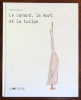
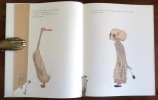
"Curieuse rencontre que celle d un canard et de la mort. « Viens-tu me chercher ? » lui demande le canard. La mort ne lui répond pas vraiment. La discussion est ouverte. Le canard lui fait part de son inquiétude. Les deux protagonistes échangent à propos de ce grave sujet. Ils ont des choses à faire ensemble. Le canard emmène son « amie » à l étang, propose même de la réchauffer. Mais la vraie question demeure et le dialogue continue sans donner vraiment de réponse. Une chose est sûre, la fin est inéluctable. Le canard sans vie est déposé délicatement par la mort sur la rivière. Elle lui confie sa tulipe dont la couleur violette est symbole de transformation, de passage. Alors commence pour le canard un voyage dont le livre ne nous dit rien… Nous sommes loin des collages de Wolf Erlbruch. Le canard est stylisé, la mort délicate et coquette, le décor dépouillé. La simplicité des images contraste avec la gravité du sujet qui est traité d une manière extrêmement subtile. Un chef d oeuvre !" Suite à un accident immobilisant votre libraire pour quelques semaines, le traitement des commandes est bien assuré, mais momentanément ralenti. Merci de votre patience et de votre compréhension.
Wilheim Dilthey: The Critique of Historical Reason
University of Chicago Press 1981 427 pages in8. 1981. Broché. 427 pages.
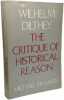
Bon état cependant couverture défraîchie tranche ternie intérieur propre
L'HOMME DEVANT SES OEUVRES
Librairie Académique Didier et Cie, Paris. 1872. In-12. Relié. Etat d'usage, Couv. convenable, Dos satisfaisant, Mouillures. 380 pages. Pièce de titre rouge sur le dos. Auteur, titre, fleuron et filets dorés sur le dos. Etiquette de code sur la couverture. Quelques rousseurs.. . . . Classification Dewey : 100-PHILOSOPHIE ET DISCIPLINES CONNEXES
Vouloir et faire. La volonté. Les actes. Pouvoir et devoir. Classification Dewey : 100-PHILOSOPHIE ET DISCIPLINES CONNEXES
"SAINT JEAN CHRYSOSTOME / COLLECTION ""LA PENSEE ET L'OEUVRE SOCIALE DU CHRISTIANISME - ETUDES ET DOCUMENTS""."
TRALIN A.. 1911. In-12. Broché. Etat d'usage, Couv. convenable, Dos abîmé, Intérieur frais. 191 pages - Qeulqeus manques au dos. . . . Classification Dewey : 210-Philosophie et théorie
Classification Dewey : 210-Philosophie et théorie
La philosophie de Voltaire
Ladrange | Paris 1848 | 11.50 x 18.50 cm | relié
Edition originale. Reliure en demi chagrin chocolat, dos à quatre nerfs orné d'un caisson doré, de caissons à froid et de pointillés dorés, petites éraflures en tête et en pied du dos. Agréable exemplaire. - Photographies et détails sur www.Edition-Originale.com -
Libre philosophie
G. Baillière | Paris 1868 | 11.50 x 18 cm | relié
Edition originale. Reliure à la bradel en demi maroquin vert bouteille, dos lisse, date en queue, reliure signée de Howland. Bel ex-libris de Ludovic Halévy gravé par Stern encollé au verso du premier plat de reliure. Annotations de L. Halévy au crayon de papier. - Photographies et détails sur www.Edition-Originale.com -
Le progressisme en question ( avec hommage de l'auteur )
Non Renseigné 15 pages in8. Sans date. Agrafé. 15 pages.

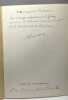
Bon état intérieur propre avec hommage de l'auteur
La passion criminelle. Les drames de la possession amoureuse.
Paris, Ernest Flammarion, 1925. Petit in-8, demi-veau blond, dos lisse avec titre et roulettes dorés, gardes et plats marbrés, couvertures conservées.
![La passion criminelle. Les drames de la possession amoureuse. . Ernest-Charles [Jean]:](https://static.livre-rare-book.com/pictures/TBW/9470_1_thumb.jpg)
![La passion criminelle. Les drames de la possession amoureuse. . Ernest-Charles [Jean]:](https://static.livre-rare-book.com/pictures/TBW/9470_2_thumb.jpg)
Ernest-Charles est le pseudonyme de Paul Renaison, critique littéraire, docteur en droit et avocat: c'est dire s'il maîtrisait le sujet de cet ouvrage... Suite à un accident immobilisant votre libraire pour quelques semaines, le traitement des commandes est bien assuré, mais momentanément ralenti. Merci de votre patience et de votre compréhension.
PASCAL ET LA BIBLE. THESE
ORPHELINS IMPRIMERUS. 1902. In-12. Broché. Bon état, Couv. légèrement passée, Dos satisfaisant, Intérieur frais. 102 pages.. . . . Classification Dewey : 210-Philosophie et théorie
Classification Dewey : 210-Philosophie et théorie
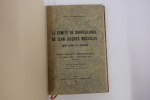
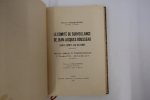
Le comité de surveillance de Jean-Jacques Rousseau, Saint-Esprit-les-Bayonne. Procès verbaux et correspondances, 11 octobre 1793-30 fructidor an II.
1934, Librairie Lipschutz, Paris. In-8, relié, demi-basane havane, dos à nerfs, caissons titre et auteur, XII-338pp. Très bon exemplaire
PHYSIONOMIES DE SAINTS.
PERRIN. 1916. In-12. Broché. Bon état, Couv. convenable, Dos satisfaisant, Intérieur frais. 416 pages. Bandes de papier kraft collées au dos et en bordure des plats. Étiquette et tampons de bibliothèque.. . . . Classification Dewey : 100-PHILOSOPHIE ET DISCIPLINES CONNEXES
7e édition. Classification Dewey : 100-PHILOSOPHIE ET DISCIPLINES CONNEXES
LA DEFINITION DE LA PHILOSOPHIE
FELIX ALCAN / BIBLIOTHEQUE DE PHILOSOPHIE CONTEMPORAINE. 1894. In-8. Broché. Etat d'usage, Couv. légèrement passée, Dos abîmé, Intérieur frais. 289 pages. Manques au dos coupé en 3 parties.. . . . Classification Dewey : 100-PHILOSOPHIE ET DISCIPLINES CONNEXES
Classification Dewey : 100-PHILOSOPHIE ET DISCIPLINES CONNEXES
William of Ware on the Sentences, Teaching Philosophy and Theology in the 13th Century between Thomas Aquinas and Duns Scotus
, Brepols - Harvey Miller, 2025 hardcover, Pages: xxvi + 618 pages, Size:156 x 234 mm, Illustrations:2 col. Language(s):English, Italian, French. ISBN 9782503617473.
The Franciscan William of Ware ? the Magister Scoti ? flourished as a theologian at the end of the thirteenth century. Although he wielded significant influence on fourteenth-century theological and philosophical debates, his thought remains little known and even less studied than it deserves. A major cause for this situation lies in the difficulty of accessing the text of his Questions on the Four Books of the Sentences, which is largely unedited.? This volume is the first entirely devoted to William of Ware. It aims to promote a renewed knowledge of his texts and doctrines. The book includes updated information on studies and editions of Ware's texts, and specific studies on crucial aspects of his doctrines, such as theology, metaphysics, physics, epistemology, Christology, and anthropology. Additionally, the volume presents previously unpublished questions from his Commentary on the Sentences. Overall, the volume serves as an essential reference for the thought and texts of William of Ware and provides a new and illuminating perspective on scholastic culture during the turn from the thirteenth to the fourteenth century. TABLE OF CONTENTS Ernesto Dezza and Antonio Petagine, Introduction Costante Marabelli, William of Ware's Quaestiones in quatuor libros Sententiarum William Short, William of Ware in the Quaracchi Archives Costante Marabelli, William of Ware: His Life, Works, and the Manuscript Tradition of His Commentary on the Sentences Andrea Nannini, Guglielmo di Ware sulla distinzione degli attributi divini. Tra sensibilit teoretica e neoplatonismo Appendix: Guilelmus de Wara, Sent., q. 16 (I, d. 2, q. 3), edited by Garrett R. Smith Russell L. Friedman, William of Ware on the Soul and its Powers Appendix: Guilelmus de Wara, Sent., q. 25 (I, d. 3, q. 7), edited by Russel L. Friedman Garrett R. Smith, William of Ware on Divine Simplicity Appendix: Guilelmus de Wara, Sent., q. 48 (I, d. 8, q. 4), edited by Garrett R. Smith William Duba, Wouter Goris, Chris Schabel, and Garrett R. Smith, William of Ware on Divine Knowledge, Eternity, and the Plurality of Worlds Appendix: Guilelmus de Wara, Sent., q. 108 (II, q. 7) edited by William Duba Guilelmus de Wara, Sent., q. 109 (II, q. 8) edited by William Duba Guilelmus de Wara, Sent., q. 100 (I, d. 35) edited by William Duba Guilelmus de Wara, Sent., q. 101 (I, d. 36) edited by Garrett R. Smith Anik Sienkiewicz-Pepin, Configuration de l'espace et mouvement des substances s par es selon Guillaume de Ware et Jean Duns Scot Alessandro de Pascalis, William of Ware on Prime Matter as a Positive Being Appendix: Guilelmus de Wara, In Sent., q. 151 (II, d. 12, q. 4) edited by Alessandro de Pascalis Witold Grzegorz Salamon, OFM, La teoria della conoscenza di Guglielmo di Ware Appendix: Guilelmus de Wara, In Sent., q. 2 (Prologus, q. 2) edited by Zeffirino Lazzeri-Witold G. Salamon Guilelmus de Wara, In Sent., q. 20 (I, d. 2, q. 7) edited by Zeffirino Lazzeri (revised by Witold G. Salamon) Guilelmus de Wara, In Sent., q. 28 (I, d. 3, q. 4) edited by Zeffirino Lazzeri (revised by Witold G. Salamon) Guilelmus de Wara, In Sent., q. 84 (I, d. 27, q. 2) edited by Zeffirino Lazzeri (revised by Witold G. Salamon) Guilelmus de Wara, In Sent., q. 129 (II, d. 3, pars 2, q. 3) edited by Zeffirino Lazzeri (revised by Witold G. Salamon) Guilelmus de Wara, In Sent., q. 210 (IV, q. 19) edited by Witold G. Salamon Guilelmus de Wara, In Sent., q. 211 (IV, q. 20) edited by Witold G. Salamon Guilelmus de Wara, In Sent., q. 212 (IV, q. 21) edited by Witold G. Salamon Davide Riserbato, Guglielmo di Ware e lo statuto ontologico degli accidenti (Sent., IV, q. 22) Francesco Fiorentino, The Immaculate Conception and Incarnation according to William of Ware Ernesto Dezza, OFM, Naturally Mortal? A Question about the Human Body of Christ in Ware and Scotus Appendix: Guilelmus de Wara, Sent., q. 187 (III, q. 33) edited by Barnaba Hechich (revised by Ernesto Dezza) Antonio Petagine, Being numerically one and the same again. The Challenge of Identity in William of Ware's Account of Resurrection Appendix: Working edition of William of Ware, In Sent., Quaestio 224 (IV, q. 33) edited by Antonio Petagine Monica Brinzei, The Portraits of William of Ware Bibliography Index of Manuscripts
William of Ware on the Sentences Teaching Philosophy and Theology in the 13th Century between Thomas Aquinas and Duns Scotus
, Brepols - Harvey Miller, 2025 hardback, Pages: xxvi + 618 pages, Size:156 x 234 mm, Illustrations:2 col. Language(s):English, Italian, French. *new. ISBN 9782503617473.
The Franciscan William of Ware ? the Magister Scoti ? flourished as a theologian at the end of the thirteenth century. Although he wielded significant influence on fourteenth-century theological and philosophical debates, his thought remains little known and even less studied than it deserves. A major cause for this situation lies in the difficulty of accessing the text of his Questions on the Four Books of the Sentences, which is largely unedited.? This volume is the first entirely devoted to William of Ware. It aims to promote a renewed knowledge of his texts and doctrines. The book includes updated information on studies and editions of Ware's texts, and specific studies on crucial aspects of his doctrines, such as theology, metaphysics, physics, epistemology, Christology, and anthropology. Additionally, the volume presents previously unpublished questions from his Commentary on the Sentences. Overall, the volume serves as an essential reference for the thought and texts of William of Ware and provides a new and illuminating perspective on scholastic culture during the turn from the thirteenth to the fourteenth century. TABLE OF CONTENTS Ernesto Dezza and Antonio Petagine, Introduction Costante Marabelli, William of Ware's Quaestiones in quatuor libros Sententiarum William Short, William of Ware in the Quaracchi Archives Costante Marabelli, William of Ware: His Life, Works, and the Manuscript Tradition of His Commentary on the Sentences Andrea Nannini, Guglielmo di Ware sulla distinzione degli attributi divini. Tra sensibilit teoretica e neoplatonismo Appendix: Guilelmus de Wara, Sent., q. 16 (I, d. 2, q. 3), edited by Garrett R. Smith Russell L. Friedman, William of Ware on the Soul and its Powers Appendix: Guilelmus de Wara, Sent., q. 25 (I, d. 3, q. 7), edited by Russel L. Friedman Garrett R. Smith, William of Ware on Divine Simplicity Appendix: Guilelmus de Wara, Sent., q. 48 (I, d. 8, q. 4), edited by Garrett R. Smith William Duba, Wouter Goris, Chris Schabel, and Garrett R. Smith, William of Ware on Divine Knowledge, Eternity, and the Plurality of Worlds Appendix: Guilelmus de Wara, Sent., q. 108 (II, q. 7) edited by William Duba Guilelmus de Wara, Sent., q. 109 (II, q. 8) edited by William Duba Guilelmus de Wara, Sent., q. 100 (I, d. 35) edited by William Duba Guilelmus de Wara, Sent., q. 101 (I, d. 36) edited by Garrett R. Smith Anik Sienkiewicz-Pepin, Configuration de l'espace et mouvement des substances s par es selon Guillaume de Ware et Jean Duns Scot Alessandro de Pascalis, William of Ware on Prime Matter as a Positive Being Appendix: Guilelmus de Wara, In Sent., q. 151 (II, d. 12, q. 4) edited by Alessandro de Pascalis Witold Grzegorz Salamon, OFM, La teoria della conoscenza di Guglielmo di Ware Appendix: Guilelmus de Wara, In Sent., q. 2 (Prologus, q. 2) edited by Zeffirino Lazzeri-Witold G. Salamon Guilelmus de Wara, In Sent., q. 20 (I, d. 2, q. 7) edited by Zeffirino Lazzeri (revised by Witold G. Salamon) Guilelmus de Wara, In Sent., q. 28 (I, d. 3, q. 4) edited by Zeffirino Lazzeri (revised by Witold G. Salamon) Guilelmus de Wara, In Sent., q. 84 (I, d. 27, q. 2) edited by Zeffirino Lazzeri (revised by Witold G. Salamon) Guilelmus de Wara, In Sent., q. 129 (II, d. 3, pars 2, q. 3) edited by Zeffirino Lazzeri (revised by Witold G. Salamon) Guilelmus de Wara, In Sent., q. 210 (IV, q. 19) edited by Witold G. Salamon Guilelmus de Wara, In Sent., q. 211 (IV, q. 20) edited by Witold G. Salamon Guilelmus de Wara, In Sent., q. 212 (IV, q. 21) edited by Witold G. Salamon Davide Riserbato, Guglielmo di Ware e lo statuto ontologico degli accidenti (Sent., IV, q. 22) Francesco Fiorentino, The Immaculate Conception and Incarnation according to William of Ware Ernesto Dezza, OFM, Naturally Mortal? A Question about the Human Body of Christ in Ware and Scotus Appendix: Guilelmus de Wara, Sent., q. 187 (III, q. 33) edited by Barnaba Hechich (revised by Ernesto Dezza) Antonio Petagine, Being numerically one and the same again. The Challenge of Identity in William of Ware's Account of Resurrection Appendix: Working edition of William of Ware, In Sent., Quaestio 224 (IV, q. 33) edited by Antonio Petagine Monica Brinzei, The Portraits of William of Ware Bibliography Index of Manuscripts Index of Names
¿Qué es una nación
Civitas 1983 in12. 1983. Broché. Conférence prononcée par l'historien et philosophe français Ernest Renan à la Sorbonne en 1882 qui analyse le concept de nation en s'opposant à la vision allemande de l'époque. Renan y examine les différents modes de groupement humains et propose une définition de la nation comme une "âme un principe spirituel" fondé sur un héritage commun et la volonté de vivre ensemble dans le contexte post-1870 de l'annexion de l'Alsace-Lorraine
Bon état
DIALOGUES et FRAGMENTS PHILOSOPHIQUES
Un ouvrage de 335 pages, format 145 x 230 mm, relié cartonnage dos cuir orné, publié en 1895, Calmann-Lévy Editeur, bon état
Quatrième édition
Phone number : 04 74 33 45 19
Dialogues et fragments philosophiques
Calmann-Lévy | Paris 1876 | 14.50 x 23 cm | broché
Edition originale. Un infime manque en tête du dos, un léger accroc sans manque sur le deuxième plat, rousseurs éparses. - Photographies et détails sur www.Edition-Originale.com -
Dialogues philosophiques
Calmann-Lévy | Paris 1876 | 15 x 23.50 cm | relié
Edition originale. Reliure à la bradel en demi-maroquin tête de nègre à grains longs, un miniscule accroc en pied, lieu, date et chiffre du précédent propriétaire en queue, reliure signée de Paul Vié. Quelques rares rousseurs sinon bel exemplaire parfaitement établi. - Photographies et détails sur www.Edition-Originale.com -
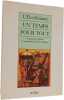
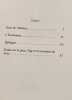
L'Ecclésiaste: Un temps pour tout
Arléa 1990 in8. 1990. Broché. Ce livre présente la traduction de l'Ecclésiaste (ou Cohélet) par Ernest Renan un texte de l'Ancien Testament rédigé en hébreu environ deux siècles avant J.-C. Renan accompagne sa traduction d'une étude postfaciale qui analyse l'âge le caractère et la place historique de ce livre biblique énigmatique connu pour ses aphorismes devenus proverbiales
Bon état pages neuves intérieur propre

