Write to the booksellers
-
Type
Autograph (15)
Book (53759)
Magazine (288)
Manuscript (2)
Maps (1)
New book (1)
Old papers (1)
Photographs (1)
-
Latest
Last 24h (12)
Last 3 days (15)
Last month (267)
Last week (54)
-
Language
Dutch (5)
English (43)
Finnish (1)
French (53940)
German (19)
Greek (5)
Italian (20)
Japanese (2)
Latin (20)
Polish (1)
Portuguese (3)
Spanish (7)
Swedish (2)
-
Century
16th (61)
17th (195)
18th (1290)
19th (3611)
20th (22025)
21st (3743)
-
Countries
Belgium (6716)
Brazil (24)
Canada (6)
China (2)
Côte d'Ivoire (69)
Denmark (1046)
France (41530)
Germany (3)
Greece (3)
Netherlands (269)
Switzerland (4400)
-
Syndicate
ALAC (6)
CLAM (36)
CNE (6)
ILAB (20084)
NVVA (998)
SLACES (907)
SLAM (17754)
SNCAO (41)
Mélanges de littérature, d'histoire et de philosophie . 4ème édition.
1767 Amsterdam , Zacharie Châtelain, 1767; 5 volumes in-12°, pleine basane fauve marbrée de l' époque, dos à nerfs orné de filets, fleurons et petits fers dorés, titre doré sur étiquette de maroquin rouge, tomaison dorée, tranches bleues tachetées de blanc; (iv), xvi, 412pp. et 1 tableau dépliant hors texte ; (iv), 456pp.; (iv),431, 40pp.; xxiv, 610, (1)pp.; (iv), 464pp. Titres imprimés en noir et rouge, tous les faux-titres sont présents.
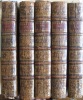
Reliure frottée, coins émoussés, manques de cuir à 5 coiffes, fente au caisson de tête du Tome 1 avec petit manque, et aux 2 caissons de tête du tome 5 sans manque, les 3 premiers et 3 derniers feuillets de chaque volume sont jaunis en bord de feuille, rares piqûres, petit manque de papier angulaire à 5 feuillets ( sans aucune atteinte au texte), charnières des tomes 1 et 2 un peu fragiles, quelques coutures laches. ( Reu-CH1 )


Mélanges de Littérature, d'Histoire, et de Philosophie.
A Berlin, , 1753. 2 vol. in-12 de (2)-XIV-(2)-320 pp. ; (2)-359 pp., veau havane, dos orné à nerfs (reliure de l'époque).
Édition originale rare, la première édition en deux volumes, complète du grand tableau dépliant Système figuré des connaissances humaines, de ce recueil qui constitue, selon Dinah Ribard, « une espèce d'autoédition d'oeuvres choisies de l'auteur » : un véritable dossier de candidature à l'Académie française, à laquelle D'Alembert fut élu en décembre 1754.Le tome I contient la première édition séparée du Discours préliminaire de l'Encyclopédie, texte que D'Alembert publie ici pour le faire circuler en dehors de l'Encyclopédie et lui conférer le statut d'essai personnel, suivi de l'Explication détaillée du système des connaissances humaines et des Éloges historiques de Jean Bernoulli et de l'abbé Terrasson, tirés à part du Mercure de janvier 1751 et mars 1748. Dans l'avertissement placé en tête du recueil, D'Alembert répond aux critiques suscitées par la première publication de 1751 et formule un engagement autobiographique saisissant : « Si le public me refuse son approbation, cet arrêt respectable pour moi, servira tout à la fois de leçon et d'exercice à ma Philosophie ; je cesserai de faire des excursions dans un genre qui n'est pas le mien, je supprimerai mes réflexions bonnes ou mauvaises, je ferai de la Géométrie, et je lirai Tacite ».Le tome II contient trois pièces en édition originale : les Réflexions et anecdotes sur Christine, reine de Suède ; l'Essai sur la société des gens de lettres et des grands, texte qui suscita la célèbre polémique avec Rousseau ; et la Traduction de quelques morceaux de Tacite avec le latin en regard.La reliure du tome I est gauchie. Dinah Ribard, D'Alembert et la "société des gens de lettres.
Mélanges de littérature, d'histoire, et de philosophie.
Berlin, [sans nom], 1753. 2 volumes in-12 de [2]-XIV-[2]-320 et [2]-359 pages, plein veau fauve, dos à nerfs ornés de filets et fleurons dorés, pièces de titre et tomaisons rouges et marron, coins et mors frottés, petites fentes à deux mors, quelques rousseurs. Armes Paul Louis Hyacinthe de Boyer de Cremilles frappées aux centres des plats, ex-libris Jules Lemaitre, avec la devise Inveni Portum.
![Mélanges de littérature, d'histoire, et de philosophie.. [ALEMBERT Jean le Rond d']:](https://static.livre-rare-book.com/pictures/KUA/9089_1_thumb.jpg)
![Mélanges de littérature, d'histoire, et de philosophie.. [ALEMBERT Jean le Rond d']:](https://static.livre-rare-book.com/pictures/KUA/9089_2_thumb.jpg)
![Mélanges de littérature, d'histoire, et de philosophie.. [ALEMBERT Jean le Rond d']:](https://static.livre-rare-book.com/pictures/KUA/9089_3_thumb.jpg)
Le tome premier contient le Discours préliminaire des éditeurs de l'Encyclopédie (première édition séparée); l'Explication détaillée du système des connaissances humaines (bien complet du grand tableau dépliant) et les Eloges historiques de Jean Bernoulli et de l'abbé Terrasson; le tome second contient en édition originale les Réflexions et anecdotes sur Christine, reine de Suède; l'Essai sur la société des gens de lettres et des grands, sur la réputation, sur les mécènes et sur les récompenses littéraires; et la Traduction de quelques morceaux de Tacite (avec le texte latin en regard).
Mélanges de littérature, d'histoire et de philosophie. Nouvelle édition.
1773 Amsterdam, Zacharie Chatelain et fils, 1773 Ensemble de 5 volumes de format in 12 de 412, 456, 472, 464 et 610 pp.. Reliure de l'époque en pleine basane blonde, dos à 5 nerfs, caisons dorés, pièces de titre en maroquin rouge. Tranches marbrées.
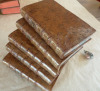
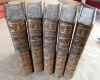
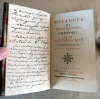
Ex-Libris d'Esclafer de la Rode. Interessants et importants commentaires manuscrits en regard du titre. Bel exemplaire.
MÉLANGES DE LITTÉRATURE D'HISTOIRE ET DE PHILOSOPHIE. Nouvelle édition. Tomes I-II
A Amsterdam Chez Zacharie Chatelain & Fils 1763 in 12 (17x9,5) 2 volumes reliures plein veau fauve marbré de l'époque, dos à nerfs ornés, pièces de titre de cuir rouge, pièces de tomaison de cuir vert, tranches teintées rouge. Tome 1 : Avertissement du libraire; Préface de l'édition de 1759; Discours préliminaire de l'Encyclopédie; Explication détaillée du système des connaissances humaines; Observations sur la division des sciences du Chancelier Bacon; Préface du troisième volume de l'encyclopédie; Essai sur la Société des Gens de Lettres & des Grands, sur la réputation, sur les Mécènes, & sur les récompenses littéraires. XVI et 412 pages, avec un tableau synoptique dépliant. Tome 2 : Réflexions sur les Eloges Académiques; Eloge historique de M. Jean Bernoulli; Eloge de M. l'Abbé Terrasson; Eloge de M. le Président de Montesquieu; Analyse de l'Esprit des Lois, pour servir de suite à l'éloge de M. de Montesquieu; Eloge de M. l'Abbé Mallet; Eloge de M. du Marsais; Mémoires & Réflexions sur Christine, Reine de Suède; Discours de M. d'Alembert à l'Académie Françoise; Réflexions sur l'élocution oratoire, & sur le style en général; Description abrégée du Gouvernement de Genève; Lettre à M. Rousseau, citoyen de Genève. 456 pages. Les 2 premiers tomes seuls sur 5. Bel exemplaire
Très bon Couverture rigide
Oeuvres philosophiques, historiques et littéraires (...).
18 volumes in-8, plein veau raciné de l'époque, dos lisses ornés d'un décor consulat de compartiments entièrement garnis d'une résille et palettes dorées, pièces de titre et de tomaison de maroquin bordeaux et bleu, roulette d'encadrement sur les plats, filets dorés sur les coupes, portrait gravé de l'auteur en frontispice et une planche dépliante. Paris, Jean-François Bastien, An XIII (1805).
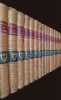
Première édition collective complète des uvres de dAlembert, qui demeurent une source importante pour les toutes les éditions postérieures."[Ces uvres de dAlembert] que le libraire-imprimeur Jean-François Bastien fit paraître à Paris en 18 volumes, tous datés de 1805, se voulaient une édition soignée : une partie du tirage sest faite sur papier vélin ; un portrait gravé de DAlembert est placé en frontispice du tome I ; en tête de louvrage figurent les notices autobiographiques de lauteur et divers textes biographiques, signés de La Harpe, de Marmontel et de Condorcet. Le titre rappelle celui des 'Mélanges' publiés par DAlembert de son vivant, mais la distribution des matières a été réorganisée et Bastien na pas manqué dincorporer à cette première édition complète (ainsi quil la qualifie lui-même dans sa dédicace) les textes publiés en dehors des Mélanges avant et après la mort de lauteur" (Irène Passeron, 'Les uvres complètes de dAlembert', Introduction, p. xxxiv-xxxvii).Bien complet de la planche dépliante "Système figuré des connoissances humaine" avec son explication. (Brunet, II, 471. France littéraire, I, 27. Cioranescu, 7499).Accidents aux reliures et accrocs, sinon exemplaire solide, intérieur frais.
Oeuvres posthumes.
1799 2 volumes in-12 (162 x 98 mm), brochés, couvertures de papier marbré de réemploi, xij, 480 p. et xj, (1), 418 p. Paris, Charles Pougens, An VII, 1799.
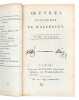
Edition originale des "oeuvres posthumes" de d'Alembert, pour la plupart inédites, constituées pour moitié de correspondances.Les volumes sont présentés par l'éditeur Charles Pougens, ami proche de d'Alembert, comme "pour servir de suite" aux volumes de "Mélanges" publiés du vivant de l'auteur.L'édition a été établie sur les manuscrits cédés par Sophie de Grouchy veuve de Condorcet, légataire de d'Alembert.Correspondance publique et privée, Dialogues, pièces critiques et politiques de circonstance, portraits, "Mémoire sur lui-même", "Aux mânes de Mademoiselle de Lespinasse", articles de l'Encyclopédie, fragments, etc., etc.('France littéraire', I, 27).Petit ex-libris de l'époque manuscrit sur le titre.Bon exemplaire.
L'Anjou
Librairie Hachette 1924 in8. 1924. Broché. Ouvrage historique et géographique sur la région de l'Anjou publié en 1924 dans la collection "Histoire et géographie régionales de la France" illustré de 78 gravures d'après des documents photographiques
Bon état rousseurs de livres intérieur propre
La Philosophie sociale et politique du Maréchal PETAIN. ( Juin 1940-Juin 1942 ).
Charles -Lazauvelle & Cie Limoges-Nancy 1943 In-8 ( 220 X 145 mm ) de 238 pages, broché sous couverture imprimée. Bon exemplaire.
Philosoph und Anatom aus Italien.
ca. 1550. Holzschnitt. Blattgrösse: 15 x 10 cm.
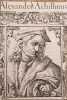
Blatt an den Rändern beschnitten.
Marsilius of Padua. Between History, Politics, and Philosophy
, Brepols, 2023 Hardback, 440 pages, Size:156 x 234 mm, Language: English. ISBN 9782503601335.
Summary Marsilius of Padua (c. 1275-c. 1342) was one of the most influential and controversial political thinkers of the Middle Ages. He is best known for his seminal text Defensor Pacis (1324) in which he attacks the papal theory of plenitude of power and defends an idea of political community based on the strict separation of political and religious authority. Marsilius' work lies at the crossroads of different disciplines, ranging from political philosophy to civil and canon law, to medicine. Indeed, he presents an original synthesis of several contemporary themes and traditions such as Aristotelianism, Augustinianism, the debate on Franciscan property, the communal tradition of the Italian city-states, ecclesiology, medicine, and astrology. This edited volume analyses the life and thought of Marsilius of Padua in his own context and beyond. Gathering many of the leading experts in Marsilian studies across different national and linguistic traditions working today, this volume has two main goals. First, it aims to bring together experts who come from distinct fields in order to investigate the many branches of knowledge present in Defensor Pacis without losing sight of Marsilius as a comprehensive theorist. Second, the volume aims to shed new light on one of the most neglected aspects in Marsilian studies: the Marsilian influence, i.e., his impact in the early modern period during the Renaissance, the Reformation and the Counter-Reformation, up to twentieth century. TABLE OF CONTENTS Preface Introduction ? ALESSANDRO MULIERI Part 1. Marsilius's Sources Marsilius of Padua: A Reader of Aristotle's Politica ? ROBERTO LAMBERTINI 'What More do you want?' The Use of the Roman Trial of Jesus by Augustine and Marsilius of Padua ? GERT-JAN VAN DE VOORDE The Early Politics Commentaries as the Missing Link between Marsilius and Aristotle ? MARCO TOSTE Marsilius of Padua on Human Acts, Law, and the (Strengthless) Law of Christ ? IACOPO COSTA Marsilius of Padua and Collective Prudence ? ALESSANDRO MULIERI Part 2. Marsilisus's Thought and his Contemporaries The Social and Political Functions of Emotions in Marsilius of Padua's Defensor pacis (and Defensor minor) ? JUHANA TOIVANEN The Good Life and the Perfect Life in the Defensor pacis ? FERDINAND DEANINI Ghibelline Marsilius. Remarks on Marsilius of Padua's Ghibelline Politico-Institutional Theory ? GIANLUCA BRIGUGLIA Defenders of the Peace: The Political Thought of Marsilius's Italian Dominican Contemporaries ? CHARLES BRIGGS How History Happens: Contingency and Finality in the Political Philosophy of Marsilius of Padua, John Quidort of Paris, and Dante Alighieri ? JACOB LANGELOH 'The Great Refusal': Pilate and Jesus in the Political Theologies of Dante, Valla, and Marsilius ? DAVID LLOYD DUSENBURY Part 3. The Marsilian Moment Between Venice and Sant'Elmo: Tommaso Campanella, Marsilius of Padua, and a 'Modern Theologian' ? SERENA MASOLINI Papacy, Peace, and Political Science: Collective Action Problems in Marsilius of Padua ? CARY J. NEDERMAN The Defender of the Peace during the Third Reich ? FRANK GODHARDT Marsilius of Padua in The Name of the Rose. Between Historical Fiction and post-1968 Ideology ? GREGORIO PIAIA General Index
Medieval Debates on Foreknowledge: Future Contingents, Prophecy, and Divination. Acts of the XXVII Annual Colloquium of the SIEPM, Trento 12-15 September 2023
, Brepols, 2026 Hardback, Pages: xx + 564, Size:156 x 234 mm, Languages: English, Italian, French. ISBN 9782503619811.
Summary This volume offers a comprehensive examination of medieval conceptions of foreknowledge-understood both as divine prescience and as the human capacity to anticipate future events-across a range of intellectual traditions. It investigates key themes such as future contingents, prophetic discourse (both divinely inspired and natural), divinatory dreams, eschatology, scientific prognostication (in astrology and medicine), and conjectural disciplines such as geomancy, physiognomy, meteorology, and magic. Through historical reconstructions and doctrinal analyses, the contributions illuminate the theoretical frameworks and distinctive positions advanced by medieval authors within diverse cultural and scholarly contexts. Building on an extensive body of prior research, the volume documents the multiplicity of medieval strategies for engaging with the future, thereby challenging the historiographical assumption that the notion of an open and indeterminate future emerged only in the Modern period. TABLE OF CONTENTS Alessandro Palazzo (Universit di Trento), Prognostication in the Middle Ages: Preliminary Remarks Medieval Doctrines and Debates on Future Contingents, Prescience, and Freedom Enrico Moro (Universit di Padova), Anatomia della caduta. Agostino sulla compatibilit tra prescienza divina e libert del primo peccato (lib. arb. III, 3, 6-8) Pasquale Porro (Universit di Torino), Does God Really Know Contingent Events as they Are? Revisiting (once again) the Consolation of Philosophy, Book V Marcia L. Colish (?), Anselm's Boethius: Necessity and Future Contingents in De concordia Josep Puig Montada (Universidad Complutense de Madrid), Aristotle's Peri Hermeneias (c. 9) and its medieval Arabic translation. The first step toward a fruitful reception Ginevra Tozzi, (IMT - Scuola Alti Studi Lucca), Future Contingents in Arabic Logic: Towards a Genealogy of F?r?b?'s and Avicenna's Commentaries on the Ninth Chapter of De Interpretatione Martha Beullens (ULB), Conna tre le futur. Le cas des futurs contingents ut in pluribus chez Albert le Grand Amos Corbini (Universit di Torino), Alcune polemiche di Ugolino di Orvieto sulla preconoscenza divina dei futuri contingenti Riccardo Fedriga and Costantino Marmo (Universit di Bologna), Rodolfo Brito sui futuri contingenti Peter Hartman (Loyola University Chicago), The Presence of the Past: Durand of St.-Pour ain and Peter of Palude on Intuitive Cognition of the Past Gonzalo Tinajeros Arce (Universidade de Bras lia), Future Contingents in arguments of political censorship: Modal propositions in contrast. Solorzano Pereira Stands up to the censors of De Indiarum Iure (1638) Prophecy in Jewish, Islamic, and Latin traditions Meryem Sebti (CNRS), D chiffrer l'Invisible : interpr tation (ta'b?r) et ex g se (ta'w?l) dans la philosophie islamique Germano Gorga (IMT - Scuola Alti Studi Lucca), The Epistemology of Astrology and Prophethood from Ab? Ma??ar to Avicenna's Metaphysics Ying Zhang (Shanghai - East China Normal University), The Most Perfect Prophet for Maimonides: Moses and Abraham in The Guide of the Perplexed Anna Rodolfi (Universit di Firenze), Angels and Prophets in Thirteenth-Century Latin Prophetology Andrea Colli (Universit di Bologna), The Church at the End of Times. Prophecy and Eschatology in Albert the Great's Sermons and Biblical Commentaries Paul Clarke, O.P., Prophecy's Future and Prophecies Past: Thomas Aquinas, Peter of John Olivi, and the Prophetic Economy Prognostic Sciences and Divination Charles Burnett (The Warburg Institute - London) Scientia stellarum ex te et illis est: The Two Sources of Knowledge for Predicting the Future, in Pseudo-Ptolemy's Centiloquium and Michael Scot's Liber introductorius Giulio Navarra (Universit di Foggia), Celestial Influence and Astral Magic. Between the Gh?yat al-?ak?m and the 'Kind?-circle Alexander' Barbora Koc nov (Prague - Czech Academy of Sciences), Non-astrological Methods of Weather Forecasting in Medieval Latin Astrological Works: A Contradiction? Alessandro Palazzo (Universit di Trento), Geomantic Collections: Structure, Meaning, and Function Jens Ole Schmitt (LMU Munich), Barhebraeus on Physiognomical Prognosis Anna Gili (Universit di Padova), Between Tradition and Medical Practice. Prognosis in al-Ma??s?'s Kit?b al-Malak? Mario Loconsole (Universit del Salento), Somnium coadiuvat ad curationem. The Curative Power of Dreams in Pietro d'Abano's Conciliator Roberto Limonta (Universit di Salerno), Malae divinationes: Demons' Foreknowledge and Semiotics of Lying in Augustine's De divinatione daemonum Vesa Hirvonen (University of Eastern Finland), Madmen's special capacities in Nicole Oresme
Della institution Morale. Ne quali egli levando le cose souerchie, & aggiugnendo molt importanti, ha emendato, & à miglior forma, & ordine ridotto tutto quello, che gia scrisse in sua giovanezza della institution dell'huomo nobile
Francesco Ziletti | in Venetia 1583 | 14 x 20 cm | relié
Nouvelle édition après l'originale chez Zilotti en 1560. Rare. Reliure en plein Parchemin d'époque. Dos à nerfs Janséniste. Titre à la plume. Une mouillure en milieu de bas de page courant et s'estompant sur les 15 premiers feuillets. Alessandro Piccolimini (1508-1579) de Sienne, fut un important humaniste italien de la Renaissance, il était à la fois Astronome, mathématicien et philosophe. Ses ouvrages d'astronomie : Sfera del mondo, Delle stelle fisse, Speculazioni dei pianeti, sont demeurés fort célèbres pour avoir proposé la première lecture du monde des étoiles. Il écrivit également des comédies et traduisit de nombreux ouvrages des Anciens dans sa jeunesse. Ouvrage de philosophie proprement humaniste, Della institution morale tente de définir la nature de l'homme dans ses oeuvres, on y distinguera des chapitres sur la nature sociale de l'homme, sur la quête du bonheur, sur la nature de l'amour, mais aussi des chapitres sur l'astrologie, la rhétorique, la géographie, l'astronomie, la mécanique, comme autant de productions du génie de l'homme. Un chapitre traite plus spécifiquement des Passions en guerre contre la raison. - Photographies et détails sur www.Edition-Originale.com -
Qu'en est-il du nihilisme ? ou : style de vie, de mort, de pensée.
P., Aletheia, 1966, gr. in-8°, 112 pp, broché, 4 lignes soulignées sur une page, bon état
Etudes de Kostas Axelos, François Châtelet, Jean-Pierre Cotten, Jean-Claude Quirin, Jean-Michel Rey, Georges Sebbag, Pierre Verstraeten (sur Lucien Sebag), textes de Francine Combelle, poèmes d'Edwin Guerard. Désormais les frais d'envoi sont de 6 € seulement pour les livres jusqu'à 1 kg (colissimo suivi), pour la France métropolitaine.
A Treatise on Language
University of California Press 1959 in12. 1959. Broché. A Treatise on Language d'Alexander Bryan Johnson est un ouvrage philosophique sur le langage initialement publié en 1836. Il s'agit d'une version élargie et révisée de son travail antérieur The Philosophy of Human Knowledge (1828) basé sur des conférences données à Utica en 1825. L'édition analysée est une édition critique publiée par University of California Press
Bon état marque de feutre sur le haut de la tranche intérieur propre
LA PAROLE DONNEE Mémoire et promesse
COLLECTION LA PHILOSOPHIE EN EFFET-IN 8-226 PAGES-(10E)
GALILEE COUVERTURE SOUPLE ETAT NEUF
The Socialist Tradition: Moses to Lenin
Longmans Green and Co 1946 in8. 1946. Cartonné. The Socialist Tradition: Moses to Lenin d'Alexander Gray est un ouvrage classique qui retrace de manière critique l'histoire de la pensée socialiste depuis l'Antiquité jusqu'à l'époque moderne. L'auteur examine les différentes influences les contributions des figures clés et l'évolution des théories socialistes avec une approche érudite et un style littéraire remarquable

Bon Etat couverture défraîchie intérieur propre
Alexander Hamilton James Madison John Jay
Reference : 100145278
(1957)
ISBN : 9789681663711
El Federalista
Fondo de Cultura Económica 1957 in8. 1957. Cartonné. Le Fédéraliste est une série d'essais écrits sous le pseudonyme Publius par Alexander Hamilton James Madison et John Jay pour défendre et promouvoir la ratification de la nouvelle Constitution des États-Unis après la Révolution américaine. L'ouvrage présente une analyse approfondie des principes constitutionnels des arguments pour un gouvernement central fort et des réponses aux critiques de l'époque
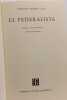
jaquette déchirée au niveau du dos intérieur propre
The Problem of Metaphysics and the Meaning of Metaphysical Explanation. An Essay in Definitions.
New York, 1902, 240x150mm, 131pages, paperback.
Pour un paiement via PayPal, veuillez nous en faire la demande et nous vous enverrons une facture PayPal
VERS LA SOCIETE SANS PERES, essai de psychologie sociale
1969 / 354 pages. Broché Editions Gallimard Collection connaissance de l'inconscient
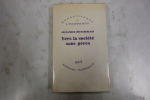
Couverture d'usage, un peu jaunie, dos cassé, intérieur frais sans rousseur. bon état.
Alexander of Aphrodisias: On Aristotle Prior Analytics 1.14-22 (Ancient Commentators on Aristotle)
BRISTOL CLASSICAL PR 1999 2 pages 16 2x2 2x23 8cm. 1999. Relié. 2 pages.
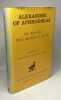
très bon état de conservation intérieur propre bonne tenue 10 dernières pages cornées sur le coin supérieur avec sa jaquette dos insolé
Quaestiones naturales, De Anima, Morales: sive Difficilium dubitationum & solutionum Libri IIII. nuncc primùm in lucem editi. Gentiano Herveto Aureliano interprete. Cum gratia & privilegio Imperiali quinquennium. - [THE HERVET-EDITION OF ALEXANDER'S ""QUAESTIONES""]
Basel, (Iohnnes Oporinus, 1548 - on colophon). 8vo. Contemporary full limp vellum. A bit of soiling and light brownspotting to title-page, otherwise very nice and clean. The printer's name has been removed from the colophon, causing two small holes, which have been neatly repaired from verso. Two small holes corresonding to these to the second-last leaf, causing loss of a couple of letters. All in all a very nice copy. Woodcut initials. (16), 297, (6 - Life of Aristotle) pp.
The scarce first edition of leading French Humanist Catholic Gentian Hervet's important translation of Alexander's hugely influential ""Quaestiones"", presumably with this fourth part (which is not the ""De Fato"" as in other Renaissance editions) for the first time in print. Hervet's edition of Alexander's ""Questiones"" came to have a profound influence on the development of Renaissance Aristotelianism. The ""Questiones"" had appeared earlier, e.g. in 1541, and were by no means unknown to Renaissance thinkers at the time, but Hervet was an authority of a certain character, which meant that his edition was both read in a certain light and preferred by a great deal of thinkers. Furthermore, it seems that the 4th part, being 30 answers to the traditional 69 questions, here appears for the first time in print, making this a very important edition. In addition to the first three parts, it became customary to add a fourth part to Alexander's ""Questiones"", but that traditional fourth part was his ""De Fato"", and not as here the 30 solutions. It is worth noting that Hervet had in fact already translated Alexander's ""De Fato"", which he published in 1544. Alexander's, also known as simply as ""The Commentator"", impact upon the development of philosophy can hardly be overestimated, and his various ""Problems and Questions"", all aimed at establishing the views of Aristotle, came to influence all reading of Aristotle in the Renaissance. ""He was read in the classroom of Plotinus, who probably drew on him to a greater extent than we will ever be able to tell"" and when later Platonists show themselves critical of Aristotle's arguments, they can often be shown to attack Alexander's interpretation of Aristotle rather than Aristotle himself. The physician Galen, whose logic, epistemology and physics bear a distinctive Peripatetic stamp, chose to disagree with Alexander on, for instance, issues of dynamics and psychology."" (p. 244).Although his ""Questions"" were aimed at understanding the views of Aristotle, he established the views of the Stagirite in a version updated to take account of Stoic and other alternatives, as the best and most defensible current (i.e. 2nd-3rd cent.) ideas on their subjects. ""For Alexander, the inspired genius of Aristotle's writings was a sufficient basis, if they were properly interpreted, explicated, and fleshed out, to resolve with complete satisfaction all the questions debated among philosophers of varying schools in his own time."" (Cambr. Comp.). In his seminal ""Questiones"", he quarrelled with both Platonism and Stoicism in his attempts to develop Peripatetic answers to questions Aristotle had not dealt with in any detail.It is a curious but generally accepted conception that with the rise of the Renaissance came the fall of Aristotle. Weather this is actually true can be disputed, but it is a fact that with the recovery of many lost works of ancient literature, the widening of the range of classical studies and the renewed interest in Plato, Aristotle was no longer the sole authority on a huge number of fields. That this should mean a total ignorance of the teachings of Aristotle must be considered somewhat of a myth (though a very frequently repeated one), and in fact with the grand humanists of the late 15th and early 16th century, the study of Aristotle fits perfectly with the broader comprehension of scholarship. The great humanists like Ficino, Pico and Pomponazzi had not forgotten about Aristotle, and the revival of learning did not mean the neglect of the prince of philosophers. On the contrary, with the appreciation of the knowledge of Greek and the invention of the printing, works were being translated and printed like never before, which meant that the greatest of the humanists, many of whom did not themselves know Greek, could be acquainted with the Greek texts of Aristotle and the Greek commentaries of ""The Commentator"", Alexander of Aphrodisias, in Latin translation. ""Equally important for the continued growth of the Peripatetic synthesis was the recovery and diffusion of the Greek commentaries on Aristotle. These treatises, about ten times longer than the works they discuss, were written by pagans and Christians, Platonists and Peripatetics in late antiquity, between the second and seventh centuries in the Greek world of the Eastern Mediterranean, and then again in twelfth-century Byzantium. The most important of the two dozen commentators were Alexander of Aphrodisias, Ammonius, Simplicius, Themistius and John Philoponus. Of these five, only Alexander and Themistius were Aristotelians..."" (Copenhaver & Schmitt, p. 68).One of the most important of these Renaissance Humanists, who with his translations helped spread the knowledge and understanding of Aristotle and his commentators, was Gentian Hervet, who came to play a dominant role in the course of 16th century thought. ""Gentian Hervet (d. 1584) was a committed churchman, who after studies in the universities of Orleans and Paris lived in the household of Reginald Pole, later to become Archbishop of Canterbury and Cardinal, at first in England then - as Pole had, because of the Reformation, to leave England - in Padua, Venice and Rome. Hervet took part with Marcello Cervini (later Pope Marcellus II) in the first sessions of the Council of Trent. He returned to France in 1555 as vicar general to the bishop of Noyon and wrote pamphlets against the Huguenots. In 1561 he entered the service of the Cardinal of Lorraine, Charles de Guise, whom he accompanied to the third period of the Council of Trent (1562-3). In 1564 he took part as canon of the cathedral in the provincial council of Rheims, in which the cardinal published the decrees of the Council of Trent. About the time of his activity in the Council of Trent the focal point of Hervet's translations shifted. He translated not only the Greek Fathers of the Church, but in addition, under the influence of academic scepticism as represented also by Reginal Pole, Sextus Empiricus' ""Adversus Mathematicos"" (Paris, 1569). He had long been active as translator of works connected with the Aristotelian philosophy. During an earlier sojurn in Rome, he published a number of philosophical texts which concerned the controversies surrounding Pietro Pomponazzi. In 1544 he translated into Latin Aristotle's ""De anima"", together with the commentary of Johannes Philoponus. There followed translations of Alexander of Aphrodisias's ""De fato"" (1544) and ""Quaestiones naturales et morales"" (1548) and of Zacharias Scholasticus's ""Ammonius: Dialogus quod mundus non sit Deo coaeternus"" (1546). In these works Hervet described those who denied the immortality of the soul as atheists and as opponents of Aristotle and his commentators."" (Lohr, p. 36). ""Since the Renaissance had to discover or rediscover the tools of philology and history needed for such detective work, the pioneering labours of obscure humanist scholars - Gentian Hervet, who translated sextus, or William Canter, who first published a Greek text of the ""Eclogae"" of Stobaeus - certainly deserve our memory and admiration. It was they who first edited, organized, translated, printed, and disseminated the philosophical remains of antiquity that succeeding centuries have come to take for granted. If Thales and his successors were the fathers of Western philosophy, the humanist scholars of the Renaissance were the midwives of its rebirth in a classical form."" (Copenhaver & Schmitt, p. 18). Adams A:678" Graesse: I:69.
Doctoris irrefragabilis Alexandri de Hales ordinis minorum Summa Theologica seu sic ab origine dicta "Summa fratris Alexandri" [tomus I-IV in 5 physical volumes]
Ad Claras Aquas (Quaracchi), Ex typographia collegii S. Bonaventurae 1924-1948 Complete work [tomus I-IV, bound in 5 physical volumes]: xlv,769 + lxiv,801 + lviii,858 + ccclxx + ix,1170pp., title in red and black, 33cm., text printed in 2 columns, small stamp on title page, nice solid modern and uniform bindings, spines in brown cloth with gilt lettering, text in Latin, interior is clean and bright, [full title of the work: Doctoris irrefragabilis Alexandri de Hales ordinis minorum Summa Theologica seu sic ab origine dicta "Summa fratris Alexandri", Tomus I: liber primus. Tomus II: prima pars secundi libri. Tomus III: secunda pars secundi libri. Tomus IV: liber tertius (prolegomena). Tomus IV: liber tertius (textus)], weight: 15kg., R118512
Doctoris irrefragabilis Alexandri de Hales ordinis minorum Summa Theologica seu sic ab origine dicta "Summa fratris Alexandri" [tomus I-IV in 5 physical volumes]
Ad Claras Aquas (Quaracchi), Ex typographia collegii S. Bonaventurae 1924-1948 Complete work [tomus I-IV, bound in 5 physical volumes]: xlv,769 + lxiv,801 + lviii,858 + ccclxx + ix,1170pp., title in red and black, 33cm., text printed in 2 columns, small stamp on title page, solid hardcover bindings in half-cloth (spines bit soiled, with a vague trace of a removed small label), decorated endpapers, text in Latin, interior is clean and bright, [full title of the work: Doctoris irrefragabilis Alexandri de Hales ordinis minorum Summa Theologica seu sic ab origine dicta "Summa fratris Alexandri", Tomus I: liber primus. Tomus II: prima pars secundi libri. Tomus III: secunda pars secundi libri. Tomus IV: liber tertius (prolegomena). Tomus IV: liber tertius (textus)], weight: 14kg., R120445
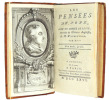
Les pensées de Alexander Pope + les Prédications. Par M***
avec un abrégé de sa vie, extraits de l’Édition Angloise de M.Warburthon par M***, relié à la suite, de la Prédication, (176pp) Alexander Pope (21 mai 1688, Londres-30 mai 1744) est un poète anglais. Alexander Pope est né dans une famille fortunée. Atteint du Mal de Pott, infection des disques intervertébraux due à la tuberculose, dans son enfance, il en a gardé une petite taille. Il fut membre du Scriblerus Club. Ses années de formation ont été studieuses et propices à la création poétique. On le considère généralement comme le plus grand poète anglais du début du XVIIIe siècle, connu pour ses poèmes satiriques et sa traduction d'Homère. Il est l'écrivain anglais le plus souvent cité après William Shakespeare. Son œuvre la plus connue est La Dunciade (The Dunciad), un poème satirique. Son appartenance à la franc-maçonnerie, établie comme certaine par quelques archivistes, reste encore discutée. Table ( extraits); sur Dieu et l'univers, sur l'homme, sur la femme, caractères des hommes, de la nature, des passions, sur la vanité, sur les vices, l'envie, le bonheur, etc.. volume relié in12, 180x100, relié pleine basane époque, bon état intérieur, 312pp A Paris, Chez Grangé MDCCLXVI ref/22