 Write to the booksellers
-
Type
Autograph (15)
Book (51217)
Magazine (288)
Manuscript (2)
Maps (1)
New book (1)
Old papers (1)
Photographs (1)
-
Latest
Last 24h (93)
Last 3 days (21)
Last month (1267)
Last week (37)
-
Language
Dutch (6)
English (43)
Finnish (1)
French (51396)
German (19)
Greek (5)
Italian (20)
Japanese (2)
Latin (21)
Polish (1)
Portuguese (3)
Spanish (7)
Swedish (2)
-
Century
16th (62)
17th (194)
18th (1297)
19th (3640)
20th (22176)
21st (3770)
-
Countries
Belgium (6731)
Brazil (24)
Canada (6)
China (2)
Côte d'Ivoire (66)
Denmark (1043)
France (38979)
Germany (3)
Greece (3)
Netherlands (268)
Switzerland (4401)
-
Syndicate
ALAC (6)
CLAM (37)
CNE (6)
ILAB (20094)
NVVA (998)
SLACES (907)
SLAM (17764)
SNCAO (41)
VALEURS DU TRAVAIL DANS LES SCIENCES SOCIALES EMPIRIQUES ET LA PHILOSOPHIE SOCIALE (THESE)
Valores, Fribourg - E. Nauwelaerts, Louvain. 1964. In-8. Broché. Bon état, Couv. convenable, Dos satisfaisant, Non coupé. 108 pages. Etiquette de code sur le 1er plat. Tampons et annotations de bibliothèque sur le 1er plat et en page de titre.. . . . Classification Dewey : 100-PHILOSOPHIE ET DISCIPLINES CONNEXES
Thèse prés. à la Faculté des Lettres de l'Univ. de Fribourg. Classification Dewey : 100-PHILOSOPHIE ET DISCIPLINES CONNEXES

LA VIE ET LA PENSEE DE T. FALLOT. Tome 1: La préparation (1844-1872). D'aprés sa correspondance et d'autres documents inédits.:
Paris, Berger-Levrault, 1914, in-8vo, 54+386 p., orné de 4 portraits hors-texte, brochure originale.

(SLACES, NVVA)
Phone number : 41 (0)26 3223808
De Cornelii Labeonis aetate.
Regimonti, Hartung, 1913 In-8 broché, 81 p.
Édition originale. Rare. Cachet. Dos refait, sans les couvertures. Bonne condition. Sehr gut. -
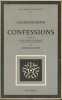
confessions précédé de "Le philosophe Teutonique " ou l'esprit d'aventure
Fayard ,1973, in-8 de 304 pages ,broché ,Bon état , .(2 photos du livre sur mon site https://www.vieuxlivre.fr) .Les frais de port pour la France sont offerts à partir de 25 euros d'achat (Mondial relay ). (colissimo suivi +6,90 ).
"Confessions - Précédé de Le ""Philosophe teutonique"" ou l'esprit d'aventure par Alexis Klimov- ""Documents spirituels"" n°8"
Fayard. 1973. In-8. Broché. Etat d'usage, Couv. convenable, Dos satisfaisant, Papier jauni. XXVI + 304 pages.. . . . Classification Dewey : 100-PHILOSOPHIE ET DISCIPLINES CONNEXES
Classification Dewey : 100-PHILOSOPHIE ET DISCIPLINES CONNEXES
Confessions. Précédé de Le « Philosophe teutonique » ou l'esprit d'aventure, par Alexis Klimov.
Fayard, 1973, in-8°, xxvi-304 pp, préface, notes et commentaires par Alexis Klimov, sources, biblio, index, broché, couv. à rabats, très bon état (Coll. Documents spirituels)
Anthologie d'œuvres traduites avec préface, notes et commentaires par Alexis Klimov. Jacob Boehme (1575-1624) est le fondateur d'une théologie mystique connue sous le nom de théosophie. Le discours théosophique, ce n'est pas seulement le discours de l'homme sur la manifestation divine, c'est aussi et d'abord le discours de Dieu qui s'exprime dans ses œuvres. Le discours de Dieu est réexprimé par le discours de l'homme en qui Dieu s'est engendré. Ainsi se forme le corps spirituel qui est le terme de la révélation. Désormais les frais d'envoi sont de 6 € seulement pour les livres jusqu'à 1 kg (colissimo suivi), pour la France métropolitaine.
Confessions précédé de "Le philosophe Teutonique " ou l'esprit d'aventure
Fayard Fayard, 1973. In-8 broché, couverture à rabats de 304 pages. Collection Documents Spirituels. Couverture légèrement salie en bord sinon Bon état
Toutes les expéditions sont faites en suivi au-dessus de 25 euros. Expédition quotidienne pour les envois simples, suivis, recommandés ou Colissimo.
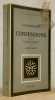
CONFESSIONS. Précédé de LE PHILOSOPHE TEUTONIQUE OU ESPRIT D'AVENTURE par Alexis Klimov
Paris, FAYARD, 1973, in-8 broché, 304 pp. Dos fatigué, sinon couverture en bon état, petites traces de mouillure en coin sur qq pages, sinon intérieur en bon état.
Nombreux titres disponibles en Philosophie.
De l'élection de la Grâce ou de la volonté de Dieu envers les Hommes.
Sebastiani, s.l., 1976. Un volume in-8 broché, couverture illustrée, 286 pages. Bel état.
La librairie est ouverte du mardi au samedi de 9h30 à 12h30 et de 13h30 à 19h00. Commandes par courriel ou téléphone. Envoi rapide, emballage soigné. La librairie est ouverte du mardi au samedi de 9h30 à 12h30 et de 13h30 à 19h00. Commandes par courriel ou téléphone. Envoi rapide, emballage soigné.
De Signatura Rerum (De la Signature des Choses). Miroir temporel de l'éternité. Traduit de l'allemand par Sédir avec des suppléments et un vocabulaire.
In-8 broché sous papier cristal, Bibliothèque Chacornac, coll. "Les classiques de l'occulte", 1908, 210 pp. Un peu frotté et jauni, dos ridé et insolé, fait logiquement son âge, bon exemplaire de lecture. Poids 450 g. Frais d'envoi 4,65 euros sur la France, 8,80 euros UE et Suisse, 10,85 euros pour le reste du monde (tarifs de base hors envois suivis).
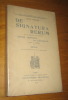
Confessions Précédé de " Le philosophe teutonique" ou l'esprit d'aventure .
Fayard, Documents spirituels 8 17 avril 1973 In-8, broché, couverture rempliée mastic ornée du monogramme de la collection, 245 pages, très agréable exemplaire.
Très bel exemplaire Mise à jour du Samedi 27 Juin 2026. Paiement PayPal immédiat, Mondial Relay pour : France, Allemagne, Autriche, Belgique, Espagne, Italie, Portugal, Luxembourg, Pays-Bas, Pologne (Communiquer votre point ou locker si connu). Une participation supplémentaire peut être demandée pour les colis lourds hors France où les envois compris entre 5 et 25 kg sont dégressifs : 2 à 4 kilogrammes - 7.99 / 5 à 10 kg - 15.99 / 15 -25 kg - 25.99. Certaines de nos collections ( Vian, Céline, Camus (...) peuvent être expédiées en Franco de port. Pour linternational hors Europe (Suisse, Canada, Japon, Etats-Unis, les frais dexpéditions peuvent varier selon le poids (mise à jour : 1 juin 2026).
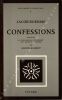
Confessions, précédé de Le “philosophe teutonique” ou L’esprit d’aventure par Alexis Klimov. Préface, notes et commentaires par Alexis Klimov. Collection Documents spirituels, 8, dirigée par Jacques Masui.
Paris, Librairie Arthème Fayard 1973, 215x130mm, XXVI - 304pages, broché. Couverture à rabats. Bel exemplaire.
Pour un paiement via PayPal, veuillez nous en faire la demande et nous vous enverrons une facture PayPal
Eudaimonie en het wezen der ethiek
Leuven, 1949 191pp., in de reeks "Leuvense bibliotheek voor philosophie", moderne linnen band, stempeltje, mooie staat
Paulus en het orfisme
Amsterdam, H.J. Paris 1930 104pp. + uitvouwbare buitentekstplaat + bijgevoegd: 3pp.stellingen, 25cm., enkele stempeltjes, enkele roestvlekjes, goede staat, [doctoraatsthesis, Rijks-Universiteit te Leiden], R70687
L'ultimo eroe. Filottete, straordinarie fortune di arciere greco.
Genova, Il Nuovo Melangolo 2018, 195x115mm, 144pagine, in brossura. Nuevo stato.

Pour un paiement via PayPal, veuillez nous en faire la demande et nous vous enverrons une facture PayPal
Les études classiques au XIXe et XXe siècles. Leur place dans l'histoire des idées
Vandoeuvres Cartonnage éditeur Genêve, Vandoeuvres, 1979. In-8 relié cartonnage éditeur bleu de 346 pages. Avec index locorum. Bon état.
Toutes les expéditions sont faites en suivi au-dessus de 25 euros. Expédition quotidienne pour les envois simples, suivis, recommandés ou Colissimo.
Du mal de Saint-Antoine à Belle-Idée. 2 siècles de psychiatrie à Genève 1800-2000.
Genève, HUG / Georg, 2002. Grand et fort volume in-8 broché, couverture à rabats. En belle condition. Illustrations in-texte en noir.

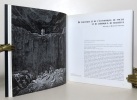
"Retrace la genèse et les péripéties d'une institution aussi controversée pour les uns que nécessaire pour les autres. Il ne s'agit pas de conduire les lecteurs vers des certitudes, mais de les amener au fil des pages à comprendre que les écarts entre idéalisme et réalisme, enfermement et liberté, philanthropie et gestion économique, soins et guérison, se lisent de manière souvent radicale dans un asile psychiatrique. Des sources inconnues jusqu'ici ajoutent de nouveaux éléments à la connaissance historique de l'institution."
Boethius's "De topicis differentiis" - translated with notes and essays on the texte by Eleonore Stump
Cornell university press 1978 264 pages 16 69x23 19x2 82cm. 1978. Relié. 264 pages.
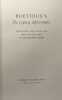
bords jaquette un peu frottés intérieur frais bonne tenue
De Consolatione Philosophiae. Libri quinque. Ioh. Bernartius recensuit & Commentario illustavit.
Antverpiae, ex officina Plantiniana, Apud Ioannem Moretum, 1607. 8vo. Very elegant later (ca. 1850) hcalf in old style w. raised bands, gilt back and blindstamped ornamentations as well as green title-label on back. Woodcut printer's device on t-p. and last blank leaf. Near cont. owner's name (Tauxier) and a crossed out cont. owner's name on t-p. T-p. lacking minor part of lower right corner, far from affecting text. Excellent and near mint copy. Later notes on front end-paper. Additional handwritten 17th cent. index on last leaf, otherwise only containing printer's device. Beautiful woodcut vignettes. (16), 394, (4) pp.
First edition thus. Beautiful and excellent Plantin-edition. ""An elegant and correct edition. The commentary of Bernartius occupies the latter and greater portion of the volume."" (Dibdin I: 352).
Anicii Manlii Severini Boethii Opera. Pars I. Philosophiae consolatio [in: Corpus Christianorum. Series latina, 94]
Turnhout, Brepols 1957 xlii + 121pp. + 1 plate out-of-text, 25cm., in the series "Corpus Christianorum Series latina" volume 94, publisher's hardcover in red cloth with gilt lettering, text and interior are clean and bright, vague trace of two removed labels at spine, small ex-libris at blanco endpaper and at verso of title page, txt is clean and bright, good condition, [introduction and text in Latin], F67727
(De Consolatione Philosophiae / Consolation Philosophiae i.e. The Consolation of Philosophy). Original handwritten Medieval manuscript on paper. - [15TH CENTURY MANUSCRIPT COPY OF THE KEY WORK OF MEDIEVAL PHILOSOPHY]
(Venice, 1470'ies - 80'ies). 4to. 210x240 mm. In a lovely, strictly contemporary Italian binding. Original wooden boards with beveled edges. Top outer edge of front board chipped and a small split at bottom outer edge. Boards with remnants of the original leather previously partially covering boards, revealing the leather cords, and with an exposed spine revealing four strips of Medieval parchment that hold the quires together (along with a bit of restoration glue, barely noticeable). The top strip with red paint and the other three with fourteenth-century Gothic script. Original brass clasps to front board. An excellent, solid, contemporary binding. 70 ff. (f.70 blank), complete (i-v 12, vi 10), 29 lines to a page, mostly with ruling, occasionally only with frame ruling (150 x 77 mm). Vertical catchwords at the bottom of verso of the last folio of each of quire (i.e. ff. 12, 24, 36, 48, 60), surrounded by wave lines. Written in an easily legible, experienced Italian humanist miniscule. Space (sometimes with cue letters) for initials left blank. No rubrication, but majuscule lettering as headlines at new beginnings or major text divisions. Large, detailed drawing of pointing hand on f. 3, in contemporary hand. Ff. 8v and 24v with scribbled border in light brown ink around the textblocks, in an early modern hand. Another later hand, presumably a later owner, has added “Jacopi – che qui anno 1693 i Viterbo 1693” in runny ink on f. 29v. Crudely written calculations in the same hand to ff. 59v and 61r. Front pasted-down end-paper with paste stains, presumably from a previous bookplate, and with a note in 19th century German script to top. Foliation in modern pencil in top right corner throughout. F1 a bit dusty and with brownspotting. Occasional minor brownspotting. Minor damp staining to margins of last two quires, no loss and not affecting text. Otherwise generally in excellent condition. Two different watermarks in the paper: 1) a scale inside a circle (see ff. 52+57, at inner margin) – this is described in Briquet (Les filigranes…, 1923) as “Balance dens un cerele, à plateau concaves”, nr. 2474 – Venice, 1480. 2) the letter P with loop through shaft also (see ff. 64+70, at inner margin). We have not been able to identify this. The text is divided into the major setions divided mostly by Majuscule ""headlines"", and begins thus: 1) “[C]ARMINA QVI Condam studio florente peregi..."", ending (f. 9v) ""hec ubi regnant”"" 2) beginning “[P]POST HEC PAVLIS PER opticuit Atentionem..."", ending (f. 21v) ""Quo celum regitur regat”"" 3) beginning “[I]AM CANTUM illa finierat…"", ending (f. 41) ""Perdit dum videt inferos”"" 4) ""Explicit iii Incipit iiii L"", beginning “[H]EC cum Phylosophia dignitate vultus..."", ending (f. 58) ""Si dera donat”"" 5) beginning “[D]IXERUNT Orationisque cursum ad alia..."", ending (f. 69v) ""cum ante oculos agitis iudicis cuncta cernentis / GRATIAS DEO Amen”. F70 blank. Complete version of the text, with some minor word and orthographic variations in comparison to the printed standard version, and without the printed edition’s few lines in Greek. No space has been left for these and they were clearly not intended to be added later.
A truly magnificent and rare complete Medieval manuscript copy of one of the most significant philosophical texts ever written, Boethius’ magnum opus. The seminal Consolation of Philosophy revolutionized modern thought and influenced medieval and renaissance philosophy to an unprecedented degree. Although one of the most widely read and studied works of the Middle Ages, Medieval manuscript copies of the “Consolation of Philosophy” are very rare on the market. The present manuscript is written in a steady, easily legible, clearly very experienced humanist hand. It does not have the gloss found in most contemporary manuscripts of this sort of text, and is therefore arguably not one of the more usual schoolbooks from the period. It has possibly been copied for the humanist scribe’s own use – in or around Venice during the last quarter of the 15th century – and has thus possibly functioned as a template for other manuscript copies of the text. Boethius (480-ca. 525) is a difficult figure to place in the history of philosophy. Chronologically, he clearly belongs to late Antiquity, but he is a Christian and he writes in Latin. Thus, as a late antique philosopher, a Christian, and one of the thinkers that influenced the middle ages the most, he has come to represent the very centre of a tradition that goes directly back to Plotinus and thereby indirectly back to Plato and Aristotle. As such, he constitutes one of the single most important thinkers in the entire history of philosophy. ""Only Aristotle himself, and perhaps Augustine, were more important and wide-ranging in their influence... In short it would be hard to understand the development of philosophy in the medieval Latin West without looking carefully at Boethius' work..."" (Marenbon pp. 11-12). Accused of treason against the gothic regime as well as of sorcery, Boethius was imprisoned and later executed, in spite of denying the claims against him. His own theory was that his political activity - as a court official known for defending the weak - was at the core of the accusations against him. He was simply too upright and his enemies were too many. According to historians, the most plausible explanation is that Theoderic doubted the loyalty of the Roman aristocracy and thereby especially the outspoken Boethius. While in prison, Boethius wrote what was to become one of the most widely read, commented upon, and influential works in the history of philosophy. This highly original work, composed as a philosophical conversation between Boethius himself and the goddess of Philosophy, paved the way for a genre completely unknown at the time"" both its style, composition, and contents matter has been imitated hundreds of times since its first appearance. Though always true to Christianity, this philosophical magnum opus contains many allusions to pagan neo-platonism. During the Middle Ages, however, all passages of the work were very popularly interpreted, in full accordance with Christianity. Few thinkers have been of such seminal importance to Medieval and Renaissance philosophy and religion as Boethius. Few books were so widely read during the Middle Ages as the ""Consolation of Philosophy"", and virtually no book has been as major a source of ancient philosophy from the early Middle Ages and throughout the Renaissance as this one. As well of being of great textbook value, this work profoundly inspired and influenced a wide range of influential religious, philosophical and literary writers. ""For some writers, such as the Middle English poet, Chauser, the ""Consolation"" seems to have provided a model for writing about serious issues in a way which presupposes no commitment to Christianity, a philosophical precedent for the use of pagan setting in a literary fiction."" (John Marenbon, Medieval Philosophy, 1998, p. 24). With the death of Boethius, ""The first scholastic"" (Copenhaver & Schmitt, p. 130), came also the end of ancient tradition of philosophy in the Latin West, though through his writings, the influence of this philosophical tradition was preserved during the Middle Ages and through to the Renaissance and early modern times. ""The last roman author of significance, Boethius, was not a rhetorician, though he had surely received a rhetorical education, but a trained philosopher thoroughly familiar with Greek philosophy and literature. He was a Christian and wrote a few treatises on theology, but his philosophical works show no Christian influence. The ""Consolation of Philosophy"" is a highly personal and original work imbued with Stoic and Neoplatonic conceptions that has continued to impress its readers to its present day although it is no longer as widely read as it was in former centuries."" (Kristeller, p. 226). ""The crowning work of his life, the ""Philosophiae Consolatio"", was composed in prison not long before his death. It is in the form of a dialogue, and includes 39 short poems in 13 different metres... Throughout the work there is no evidence of distinctively Christian belief, but there are a few phrases of apparently Christian origin... But the absence of all reference to the consolations of religion is much more remarkable than the presence of a few phrases such as these... He does not oppose any Christian doctrine, but his attitude is that of a Theist and not that of a Christian. He supplied the Middle Ages with an eclectic manual of moral teaching severed from dogma and endued with all the charm of exquisite verse blended with lucid prose"" and, as the latest luminary of the ancient world, he remained long in view, while the sources of the light he reflected were forgotten. The masterpiece which was his last legacy to posterity was repeatedly translated, expounded and imitated in the Middle Ages, and these translations were among the earliest literary productions of the vernacular languages of Europe, - English, French, German, Italian and Spanish among the translators being names of no less importance than king Alfred, Chaucer and queen Elizabeth. It was also translated into Greek by Maximus Pledanus (d. 1310). The emperor Otho III, who died in 1002, a hundred years after Alfred, placed in his library a bust of Boëthius, which was celebrated by the best Latin poet of his age, the future pope Silvester II. Three centuries later, he is quoted more than 20 times in the ""Convito"" and elsewhere by Dante, whose best-known lines ""Nessun maggior dolore Che ricordarsi del tempo felice Nelle miseris"", are a reminiscence of Boëthius... Dante places him in the Fourth Heaven among the twelve ""living and victorious splendours"" which are the souls of men learned in Theology... Two hundred years after Dante, the book of Consolation composed by Boëthius in the ""Tower of Pavia"" brought solace to Sir Thomas More in the Tower of London. It has since won the admiration of the elder Scaliger and Casaubon, and has been described as a ""golden volume"" by Gibbon, who eulogises its author as ""the last of the Romans whom Cato or Tully could have acknowledged for their countryman."" (Sandy's I: 256-58).
Boethius(auth), Brian Donaghey, Noel Harold Kaylor, Philip Edward Phillips, Paul E. Szarmach (eds)
Reference : 65980
Remaking Boethius. The English Language Translation Tradition of 'The Consolation of Philosophy'
, Brepols, 2019 Hardback, xxviii + 496 pages, 156 x 234 mm, Language: English. ISBN 9782503584676.
Summary This volume is a reference work, organized chronologically in its sections, with a separate entry for each translator's work. The sections are defined by the type of translations they comprise, whether complete, partial, meters only, etc. The plan of the book is encyclopedic in nature: some biographical material is provided for each translator; the translations are described briefly, as are their linguistic peculiarities, their implied audiences, their links with other translations, and their general reception. Sample passages from the translations are provided, and where possible these are two of the most well-known moments in the Consolatio: the appearance of Lady Philosophy, narrated by the Prisoner, and the cosmological hymn to the Deus of the work, sung by Lady Philosophy. TABLE OF CONTENTS Preface Acknowledgments Prologue: The Foundation of the Tradition: The Latin De consolation philosophiae Part I: Complete Translations into English of De consolation philosophiae Part II: Partial or Abridged Translations into English of De consolation philosophiae Part III: Translations into English of the Meters or Selected Meters of De consolation philosophiae Part IV: Spurious, Mislabeled, or Lost Translations of De consolation philosophiae Part V: Modern English Translations of Old English Prose and Verse Translations of De consolation philosophiae Part VI: An Early Adaptation of Chaucer's Translations into English of De consolation philosophiae with Commentary Interspersed Part VII: Some Minor Uses of Translations or Adaptations of Passages from De consolation philosophiae Part VIII: Two Early Discussions on De consolation philosophiae translation Epilogue: Some Relevant Definitions: Samuel Johnson's Dictionary Notes on the Editors
Anicii Manlii Severini Boethii Opera. Pars I. Philosophiae consolatio [in: Corpus Christianorum. Series latina, 94]
Turnhout, Brepols 1957 xlii + 121pp. + 1 plate out-of-text, with a short handwritten dedication by the editor Bieler, 25cm., in the series "Corpus Christianorum. Series latina" vol.94, publisher's hardcover in red cloth with gilt lettering, text and interior are clean and bright, few foxing on side edges, good condition, [introduction and text in Latin], F67727
Boethii Daci Opera : Modi significandi sive quaestiones super Priscianum maiorem, nunc primum ediderunt
Hauniae [Copenhagen], Gad 1969 xxxix + 410pp., 25cm., publisher's hardcover, in slipcase, in the series "Corpus Philosophorum Danicorum Medii Aevi" Vol.IV, text and interior are clean and bright, ex-libris on title page, good condition, weight: 1.3kg., F117035
Philosophiae Consolatio. Testo con introduzione e traduzione di Emanuele Rapisarda
Catania, Centro di Studi sull'antico christianesimo, Universita di Catania 1961 xxxix + 221 + [2] pp. + frontispiece (portrait), 25cm., softcover, stamp at verso of title page, introduction in Italian, text edition is bilingual: Latin with Italian translation, good condition, F100414

