Write to the booksellers
-
Type
Autograph (15)
Book (52791)
Magazine (288)
Manuscript (2)
Maps (1)
New book (1)
Old papers (1)
Photographs (1)
-
Latest
Last 24h (13)
Last 3 days (15)
Last month (324)
Last week (56)
-
Language
Dutch (5)
English (43)
Finnish (1)
French (52972)
German (19)
Greek (5)
Italian (20)
Japanese (2)
Latin (20)
Polish (1)
Portuguese (3)
Spanish (7)
Swedish (2)
-
Century
16th (63)
17th (200)
18th (1332)
19th (3677)
20th (23036)
21st (4106)
-
Countries
Belgium (6716)
Brazil (24)
Canada (6)
China (2)
Côte d'Ivoire (69)
Denmark (1046)
France (40562)
Germany (3)
Greece (3)
Netherlands (269)
Switzerland (4400)
-
Syndicate
ALAC (6)
CLAM (36)
CNE (12)
ILAB (20370)
NVVA (998)
SLACES (907)
SLAM (18040)
SNCAO (41)
DEUX MONTAGNES ET UNE RIVIERE. Himalaya sans bagages ou leurs heures et malheurs d'un coureur d'aventures.
1954 / 240 pages. Broché avec jaquette. Editions Arthaud
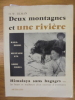
Couverture d'usage, rognée sur le haut du dos, intérieur trés frais sans rousseur. Illustrations noir et blanc. Trés bon état.
ETUDES HISTORIQUES ET CRITIQUES SUR LE RATIONALISME CONTEMPORAIN.
LECOFFRE FILS ET Cie. 1878. In-8. Broché. Etat d'usage, Couv. défraîchie, Dos satisfaisant, Intérieur frais. 466 pages. Manque sur le premier plat partiellement détaché. Un mors fendu. Tampons de bibliothèque.. . . . Classification Dewey : 100-PHILOSOPHIE ET DISCIPLINES CONNEXES
Classification Dewey : 100-PHILOSOPHIE ET DISCIPLINES CONNEXES
LA SOCIETE CIVILE DANS SES RAPPORTS AVEC LE CHRISTIANISME, COMPTE RENDU DES CONFERENCES DE NOTRE-DAME, PRECHEES PAR LE R.P. HYACINTHE, CARME DECHAUSSE, AVENT 1867
Joseph Albanel. 1868. In-8. Broché. Etat d'usage, Couv. défraîchie, Dos abîmé, Mouillures. 144 pages. Etiquette de code sur le dos. Annotation et tampon de bibliothèque sur le 1er plat et en page de titre.. . . . Classification Dewey : 210-Philosophie et théorie
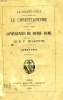
Très rare. 4e édition. De la souveraineté. De la religion dans la vie des nations. La guerre... Classification Dewey : 210-Philosophie et théorie
LES LIEUX, histoire des commodités.
Paris, Editions La découverte, 1985 ; in-8, 208 pp., br. Broché en bon état.
Broché en bon état.
Etre vivant
Veyrier Henri Dos carré collé 1990 In-8 (15.5x24 cm), dos carré collé, 1er plat illustré, 216 pages, figures dans le texte ; coiffes frottées, plats un peu salis, tranches salies, quelques annotations, état correct. Livraison a domicile (La Poste) ou en Mondial Relay sur simple demande.

Introduction à la philosophie de l'histoire de Hegel
Paris, Marcel Rivière & Cie, 1968, in-8, 128 pp, br.
Bel exemplaire
Etudes sur Marx et Hegel.
1965 Paris, Marcel Rivière, 1965, in 8° broché, 205 pages.
...................... Photos sur demande ...................


Phone number : 04 77 32 63 69
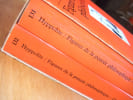
Figures de la pensée philosophique - Ecrits 1931-1968
PUF, coll. Quadrige, 1991. Coffret 2 tomes : VII-1042-III p. Très bon état général de l'ensemble. Coffret un peu frotté, traces de pliures dos du tome I, intérieur très frais, sans annotations (voir photos).


Les prix indiqués sont nets, en euros. Les frais de port, calculés au plus juste, sont à la charge de l'acheteur (envoi par Mondial Relay ou la Poste). Les livres sont expédiés sous emballage soigné dès réception du règlement.
"Genèse et structure de la phénoménologie de l'esprit de Hegel - Tome II - ""Philosophie de l'esprit"""
Aubier/Montaigne. 1963. In-12. Broché. Etat d'usage, Tâchée, Dos plié, Papier jauni. Paginé de 312 à 592. 1er plat taché. Quelques passages soulignés au crayon de papier dans le texte.. . . . Classification Dewey : 190-Philosophie occidentale moderne
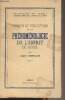
Classification Dewey : 190-Philosophie occidentale moderne
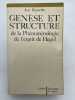
Genèse et structure de la phénoménologie de l'esprit de Hegel .
,Paris, Aubier Montaigne Collection 'Philosophie de l'esprit' 1967, 308 + pp. 309-592 pp., 2 vol. in 8 br.


Genèse et structure de la Phénoménologie de l'esprit de Hegel
Aubier Aubier, 1978. Fort In-8 broché, 592 pages. Quelques passages soulignés. Bon exemplaire. Peu courant
Toutes les expéditions sont faites en suivi au-dessus de 25 euros. Expédition quotidienne pour les envois simples, suivis, recommandés ou Colissimo.
Introduction à la philosophie de l'histoire de Hegel
Poche en bon état de 126 pages Points Seuil
Introduction à la philosophie de l'histoire de Hegel.
Paris, Marcel Rivière et Cie (coll. "Bibliothèque philosophique"), 1948. Gr. in-8°, 98p. Broché.
Nom de possesseur en page de garde.
Logique et existence.
Paris, PUF, Epiméthée Essais philosophiques, 1961. in 8 : 252 pp. br.
Ex Libris.Bon ex.
Le réalisme de la connaissance comme condition pour l'humanisme intégral de Jacques Maritain
Roma, Universita Pontificia Salesiana 2007 149pp., 24cm., softcover, text in French, Doctoral Dissertation ("Estratto della Tesi di Dottorato"), stamp at verso of title page, text is clean and bright (looks unread), good condition, F109781
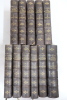
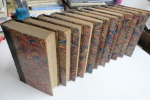
Les origines de la France contemporaine en 11 volumes
11 volumes reliés dos demi-cuir marron, paru en 1909 chez Hachette & Cie, légers états d'usure ( émoussements, frottements, rousseurs ), les 11 volumes restent tout de même très bien conservés et tout à fait lisibles, les intérieurs sont assez frais et les quelques légers défauts sont quasi anodins.

First Latin Treatise on Ptolemy's Astronomy: The Almagesti minor (c. 1200), H. Zepeda
, Brepols - Harvey Miller, 2018 Hardback, X+662 p., 136 b/w ill., 12 b/w tables, 178 x 254 mm, Languages: English, Latin.*new ISBN 9782503581378.
This volume presents a critical edition, translation, and study of one of the most important works of medieval science, the Almagesti minor, the earliest Latin commentary on Ptolemy?s Almagest. This summary of the first half of the Almagest incorporated the astronomy of Islamic astronomers and altered Ptolemy?s work to make it accord with the author?s scientific ideals. The Almagesti minor had a profound effect upon astronomical writings throughout the 13th-15th centuries, including the work of Georg Peurbach, Johannes Regiomontanus, and many others. The Almagesti minor is one of the most important works of medieval astronomy. Probably written in northern France circa 1200, it is a Latin summary of the first six books of Ptolemy?s astronomical masterpiece, the Almagest. Also known to modern scholars as the ?Almagestum parvum?, the Almagesti minor provides a clear example of how a medieval scholar understood Ptolemy?s authoritative writing on cosmology, spherical astronomy, solar theory, lunar theory, and eclipses. The author incorporated the findings of astronomers of the Islamic world, such as al-Batt?n?, into the framework of Ptolemaic astronomy, and he altered the format and style of Ptolemy?s astronomy in order to make it accord with his own ideals of a mathematical science, which were primarily derived from Euclid?s Elements. The Almagesti minor had a profound effect upon astronomical writing throughout the 13th-15th centuries, including the work of Georg Peurbach and Johannes Regiomontanus. In this first volume of the Ptolemaeus Arabus et Latinus text series, Henry Zepeda offers not only a critical edition of this little-studied text, but also a translation into English, analysis of both the text and its geometrical figures, and a thorough study of the work?s origins, sources, and long-lasting influence. Henry Zepeda is a historian of science. He is a Teaching Fellow at Wyoming Catholic College, and he previously worked in the Ptolemaeus Arabus et Latinus project at the Bavarian Academy of Sciences and Humanities. His research is focused upon medieval mathematics and astronomy of the 12th to 15th centuries.
Les philosophies de l'Inde - Collection Payothèque.
Payot. 1978. In-8. Broché. Etat d'usage, Couv. légèrement passée, Dos fané, Intérieur acceptable. 495 pages - coins frottés - rares traces de stylo en marges à l'intérieur de l'ouvrage sans conséquence sur la lecture.. . . . Classification Dewey : 100-PHILOSOPHIE ET DISCIPLINES CONNEXES
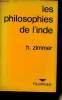
Collection Payothèque - Edité par Joseph Campbell - Traduction de Marie Simone Renou. Classification Dewey : 100-PHILOSOPHIE ET DISCIPLINES CONNEXES
(SLACES, NVVA)
Phone number : 41 (0)26 3223808
Systems Intelligence. A new lens on human engagement and action.
Helsinki, University of Technology 2008, 250x175mm, 219pages, paperback. Exemplar as new.
Pour un paiement via PayPal, veuillez nous en faire la demande et nous vous enverrons une facture PayPal
Ontologie des Gewissens. Ein Beitrag zur Metaphysik der Person. Epimeleia Beiträge zur Philosophie. Band 33.
München, Johannes Berchmans 1984, 220x150mm, 213Seiten, broschiert. Exemplar wie neu.
Pour un paiement via PayPal, veuillez nous en faire la demande et nous vous enverrons une facture PayPal
UNE MORALE POUR LA PERSONNE
Mame. 1973. In-8. Broché. Bon état, Couv. légèrement passée, Dos frotté, Intérieur acceptable. 236 pages. Nombreuses annotations au crayon dans le texte.. . . . Classification Dewey : 100-PHILOSOPHIE ET DISCIPLINES CONNEXES
Trad. de l'américain par André Divault. Classification Dewey : 100-PHILOSOPHIE ET DISCIPLINES CONNEXES
Ai limiti dell'immagine
Lingua italiana, Quodlibet Studio, 2005, 265 pp., brossura editore, alcuni passaggi sottolineati a matita, ex-dono pagina 39, leggere tracce d'uso, condizioni corrette.