 Write to the booksellers
-
Type
Autograph (15)
Book (51199)
Magazine (288)
Manuscript (2)
Maps (1)
New book (1)
Old papers (1)
Photographs (1)
-
Latest
Last 24h (50)
Last 3 days (63)
Last month (1286)
Last week (20)
-
Language
Dutch (6)
English (43)
Finnish (1)
French (51378)
German (19)
Greek (5)
Italian (20)
Japanese (2)
Latin (21)
Polish (1)
Portuguese (3)
Spanish (7)
Swedish (2)
-
Century
16th (62)
17th (194)
18th (1295)
19th (3637)
20th (22163)
21st (3768)
-
Countries
Belgium (6731)
Brazil (24)
Canada (6)
China (2)
Côte d'Ivoire (66)
Denmark (1043)
France (38961)
Germany (3)
Greece (3)
Netherlands (268)
Switzerland (4401)
-
Syndicate
ALAC (6)
CLAM (37)
CNE (6)
ILAB (20091)
NVVA (998)
SLACES (907)
SLAM (17761)
SNCAO (41)
Réponse aux Lettres Provinciales de L. de Montalte ou Entretiens de Cleandre et d’Eudoxe.
Cologne, chez Pierre Marteau 1696, 155x95mm, plein veau de l’époque, dos à nerfs, étiquette de titre en cuir rouge, fleurons dorés, manque le cuir au bas du dos et sur pa partie supérieur du dos.
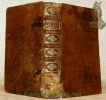
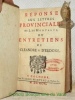
2 ff., 406 pages, Pour un paiement via PayPal, veuillez nous en faire la demande et nous vous enverrons une facture PayPal
Ce qui meurt et ce qui naît
Plon 1937 in12. 1937. Broché.
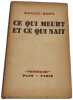
Etat correct bords frottés pages jaunies rousseurs intérieur propre
CHANTS POUR LES ABIMES
Guilde de l'Amitié. 1949. In-12. Broché. Bon état, Couv. convenable, Dos satisfaisant, Intérieur bon état. 285 pages.. . . . Classification Dewey : 100-PHILOSOPHIE ET DISCIPLINES CONNEXES
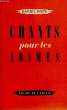
La fin des Atlantes. De quelques témoins. Les deux pôles de notre angoisse. Classification Dewey : 100-PHILOSOPHIE ET DISCIPLINES CONNEXES
Des images de grandeur.
Couverture souple. Broché. 189 pages. Couverture légèrement défraîchie.
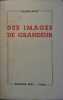
Livre. Editions Spes, 1950.
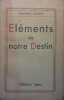
Eléments de notre destin.
Couverture souple. Broché. 253 pages.
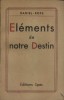
Livre. Essai. Editions Spes, 1934.
Eléments de notre destin.
Couverture souple. Broché. 253 pages.
Livre. Essai. Editions Spes, 1934.
Eléments de notre Destin. Essai.
SPES. Non daté. In-12. Relié. Etat d'usage, Couv. légèrement passée, Dos fané, Intérieur frais. 253 pages. Ouvrage de bibliothèque : dos renforcé par une bande papier, code sur la coiffe en-tête et tampons sur la page de titre et dans quelques marges.. . . . Classification Dewey : 190-Philosophie occidentale moderne
Classification Dewey : 190-Philosophie occidentale moderne
Eléments de notre destin. Essai.
P., Spès, 1934, in 12 broché, 255 pages.
PHOTOS sur DEMANDE. ...................... Photos sur demande ...................


Phone number : 04 77 32 63 69
Les années tournantes
1932 - broché - Editions du Siècle - Les Cahiers d'Occident - 1932 - In-12 (format poche), broché - 261 pages
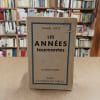
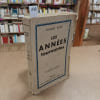
Assez bon état de conservation - Quelques signes d'usure sur la couverture - Légers plis au dos - Coins émoussés - Nom inscrit au stylo + tampon sur la page de garde
Mort où est ta victoire ? Photographies de Charles Egermeier.
1947 Paris, Plon, 1947, grand in 8 carré broché, 385 pages, couverture illustrée (très légèrement fanée avec accroc réparé en tête du dos
...................... Photos sur demande ...................
Phone number : 04 77 32 63 69
Mort où est ta victoire? Photographies de Charles Egermeier.
Paris, Plon, 1947, fort in 12 broché, 553 pages ; couverture fanée.
PHOTOS sur DEMANDE. ...................... Photos sur demande ...................
Phone number : 04 77 32 63 69
PAR DELA NOTRE NUIT / NOUVELLE EDITION - 9e EDITION.
LAFFONT ROBERT. 1945. In-12. Broché. Etat d'usage, Couv. convenable, Dos satisfaisant, Intérieur frais. 253 pages - Tampon sur une des pages en fin de volume.. . . . Classification Dewey : 100-PHILOSOPHIE ET DISCIPLINES CONNEXES
Classification Dewey : 100-PHILOSOPHIE ET DISCIPLINES CONNEXES
"Vouloir". Comment cultiver sa volonté.
Couverture souple. Brochure de 64 pages. Cachets.
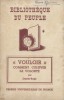
Livre. Presses universitaires de France (Collection : Bibliothèque du peuple N° 8), 1941.
Eine lateinische Rechtfertigungsschrift des Meister Eckhart
Münster i.W., Aschendorff 1923 xix + 68pp. + 1 plate out of text, 25cm., published in the series "Beiträge zur Geschichte der Philosophie des Mittelalters. Texte und Untersuchungen" Band XXIII (23) Heft 5, original softcover, 2 stamps, pages still uncut, text is clean and bright, good condition, F116293
HOLDERLIN L'AUTRE-DER ANDERE HOLDERLIN
ZUR AUSSTELLUNG IM HOLDERLINTURM TUBINGEN VOM 20 MARZ 2005 BIS ZUM 20 MARZ 2006-TEXTE FRANCAIS ET ALLEMAND-212 PAGES-22,7 CM X 27 CM-(100E)
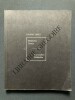
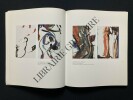
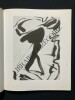
ISELE COUVERTURE SOUPLE ETAT TRES BON
Hölderlin l'autre / Der andere Hölderlin
Eggingen Isele 2006 1 270x227mm, 212p. catalogue d'exposition.Très nombreuses illustrations en noir et en couleur, texte français et allemand. Envoi autographe signé de l'auteur. Etat neuf.
Pas de jaquette Couverture souple Dédicacé par l'auteur
Le groupe inconscient : le lien et la peur
Christian Bourgois Editeur 1980 in12. 1980. Broché. Cet essai de Daniel Sibony psychanalyste et philosophe explore la dynamique inconsciente des groupes. Il analyse ce qui crée le lien au sein d'un collectif en particulier les phénomènes de peur de soumission à des ordres implicites et les paradoxes où les individus s'interdisent ce qui est permis ou s'accusent de crimes non commis
Bon Etat couverture jaunie intérieur propre
Les Trois Monothéismes
Seuil 1992 1992. Juifs Chrétiens Musulmans entre leurs sources et leurs destins


Bom estado
Thomas Reid's Inquiry. The geometry of visibles and the case for realism
Stanford, Stanford University Press 1989 xix + 160pp.with frontispice, 24cm., in the "Stanford series in philosophy", previous owner's name on front endpaper, hardcover (cloth), dustwrapper, VG
Nécessité de l'étrange. Essai traduit du russe par Marc-Didier Chabreuil. Préface d'Albert Ducrocq.
P., Julliard, 1966, in 8°, cartonnage de l'éditeur, 283pp. ; traces de scotch.
PHOTOS sur DEMANDE. ...................... Photos sur demande ...................
Phone number : 04 77 32 63 69
Plus mieux et plus pire
Flammarion 2003 64 pages 2003. 64 pages. Un album jeunesse qui explore les hauts et les bas du quotidien à travers le regard d'une petite fille. Elle raconte les moments agréables et désagréables d'une journée évoquant ce qui est le mieux le pire et parfois le comble dans chaque situation. C'est un livre tendre où petits et grands peuvent se retrouver
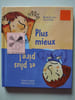
Bom estado
"La culture trahie par les siens (Collection ""Carte blanche"")"
Epi. 1973. In-8. Broché. Bon état, Couv. convenable, Dos satisfaisant, Intérieur frais. 86 pages. Manque en coiffe de pied.. . . . Classification Dewey : 210-Philosophie et théorie
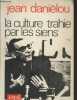
"Collection ""Carte blanche"" Classification Dewey : 210-Philosophie et théorie"
Bericht über die Philosophat-Kurse in Salzburg vom 5. Oktober bis 14 Dezember 1904.
Salzburg, Anton Pustet ohne Jahr, ca. 1905, 235x155mm, 153Seiten, broschiert.
Pour un paiement via PayPal, veuillez nous en faire la demande et nous vous enverrons une facture PayPal
TH. JOUFFROY MELANGES PHILOSOPHIQUES
HEIDELBERG. 1907. In-12. Broché. Bon état, Couv. convenable, Dos satisfaisant, Intérieur frais. 134 pages.. . . . Classification Dewey : 180-Philosophie antique, médiévale, orientale
Franzosische Schriftsteller aus dem Gebiete der philosophie, Kulturgeschichte und naturwissenschaft. Classification Dewey : 180-Philosophie antique, médiévale, orientale

