 Write to the booksellers
-
Type
Autograph (15)
Book (51343)
Magazine (288)
Manuscript (2)
Maps (1)
New book (1)
Old papers (1)
Photographs (1)
-
Latest
Last 24h (6)
Last 3 days (80)
Last month (1304)
Last week (118)
-
Language
Dutch (6)
English (43)
Finnish (1)
French (51522)
German (19)
Greek (5)
Italian (20)
Japanese (2)
Latin (21)
Polish (1)
Portuguese (3)
Spanish (7)
Swedish (2)
-
Century
16th (62)
17th (194)
18th (1293)
19th (3628)
20th (22098)
21st (3990)
-
Countries
Belgium (6737)
Brazil (24)
Canada (6)
China (2)
Côte d'Ivoire (66)
Denmark (1045)
France (39104)
Germany (3)
Greece (3)
Netherlands (268)
Switzerland (4394)
-
Syndicate
ALAC (6)
CLAM (37)
CNE (6)
ILAB (19999)
NVVA (998)
SLACES (907)
SLAM (17665)
SNCAO (41)
LES LOIS SOCIALES ESQUISSE D'UNE SOCIOLOGIE.
FELIX ALCAN. 1898. In-12. Broché. Etat d'usage, Couv. légèrement passée, Dos satisfaisant, Intérieur acceptable. 172 + 16 pages - annotation au stylo noir sur le 1er plat - coins frottés - petit accroc sur le dos.. . . . Classification Dewey : 100-PHILOSOPHIE ET DISCIPLINES CONNEXES
Bibliothèque de philosophie contemporaine. Classification Dewey : 100-PHILOSOPHIE ET DISCIPLINES CONNEXES


Elémens d'idéologie - IVe et Ve parties - Traité de la volonté et de ses effets
Mme Ve Courcier. 1815. In-8. Relié demi-cuir. Etat d'usage, Coins frottés, Dos satisfaisant, Quelques rousseurs. 578 pages. Annotation au crayon de papier en page de garde. Dos cuir à 2 pièces de titre rouges, titre, auteur, filets et motifs dorés. Coiffe en tête frottée.. . . . Classification Dewey : 100-PHILOSOPHIE ET DISCIPLINES CONNEXES
Classification Dewey : 100-PHILOSOPHIE ET DISCIPLINES CONNEXES
INITIATION ESTHETIQUE
Imprimerie de la Vicomté, Rouen. 1924. In-8. Broché. Bon état, Couv. convenable, Dos satisfaisant, Intérieur frais. Plaquette de 13 pages.. . . . Classification Dewey : 100-PHILOSOPHIE ET DISCIPLINES CONNEXES
Le Beau... Classification Dewey : 100-PHILOSOPHIE ET DISCIPLINES CONNEXES
Cucheval, Victor (1830-1912) - Maître de conférences à la Sorbonne (à partir de 1879). Agrégé ès lettres (1856). Docteur ès lettres (1863)
Reference : 27583
Histoire de l'éloquence romaine, depuis la mort de Cicéron jusqu'à l'avènement de l'Empereur Hadrien (43 avant J.-C. - 117 après J.-C.)
Paris, Hachette, 1893 - Deux volumes in-8 - Broché - X-370 + 393 pages - rousseurs d'usage - Envoi rapide et soigné
Cnformément à nos conditions générales de vente :Les frais de port sont affichés à titre indicatif. Il se peut que nous devions vous contacter pour vous informer du coût de laffranchissement supplémentaire en fonction du poids et du nombre de livres, surtout pour les envois internationaux Cependant vu l'augmentation des tarifs postaux à l'internationale, nous pouvons expédier les ouvrages en point relais MONDIAL RELAY pour les pays suivants : Allemagne, Autriche, Belgique, Espagne, Italie, Luxembourg, Pays-Bas, Pologne, et Portugal. Merci de nous indiquer en retour le point relais choisi ainsi que votre numéro de téléphone mobile & adresse Courriel pour assurer le suivi du colis.N'hésitez pas à nous interroger.In accordance with our general terms and conditions of sale:Shipping costs are displayed for informational purposes only. We may need to contact you to inform you of the additional postage costs depending on the weight and number of books, especially for international shipments.However, given the increase in international postal rates, we can ship books via Mondial Relay to the following countries: Germany, Austria, Belgium, Spain, Italy, Luxembourg, Netherlands, Poland, and Portugal. Please provide us with your chosen Mondial Relay point, as well as your mobile phone number and email address to ensure package tracking.Please feel free to contact us with any questions
Systema Intellectuale huius Universi seu de Veris Naturae rerum originibus Commentarii qvibus omnis eorum Philosophia, qvi Deum esse negant, funditus evertitur. Accedunt Reliquua eius Opuscula. Joannes Lavrentius Moshemius,...Omnia ex Anglico Latine v...
Jena, Vidvae Meyer, 1733. Folio. 2 contemp. full calf, richly gilt backs in 8 compartments, raised bands. A few minor nicks to spine ends. Engraved frontispiece (showing Aristotle, Socrates, Strato, Epicur, Anaximander, Pythagoras). (58),1206 pp. + Index Auctorum. Also withbound, and with separate pagination, 4 of the author's other works. 478842"25 pp. Engraved portrait of the author and 3 large engraved vignettes.
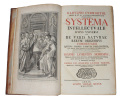
First Latin edition of the author's ""The true Intellectual System of the World"" from 1678. - ""His most important work, The true Intellectual System..., is a fragment of an even larger work he had planned to refute materialism of Epicurus and of Thomas Hobbes. Cudworth believed that a ""rightly understood"" mechanical and corpuscular philosophy did not destroy traditional religion but instead offered it new support. If matter was inert and utterly passive, then a spiritual principle was necesssary to endow the universe with life and acticity. But the principle involved in the ordinary course of nature was not to be equated with God, for then He would be responsible for the ""Errors and bungles"" in nature. Such taks were performed by a subordinate and unconscious ""plastic nature"". Cudworth rejected Cartesian dualism and asserted cosmic continuity."" (P.M. Rattansi in DSB). - Brunet II:437 - Graesse II:305.
Systema Intellectuale huius Universi seu de Veris Naturae rerum originibus Commentarii qvibus omnis eorum Philosophia, qvi Deum esse negant, funditus evertitur. Accedunt Reliqua eius Opuscula. Joannes Lavrentius Moshemius, Omnia ex Anglico Latine vert... - [THE ""PLASTIC MEDIUM""]
Jena, Vidvae Meyer, 1733. Folio. Cont. full calf w. richly gilt back. A bit of wear to extremities, but a very nice and clean copy. Beautiful vignettes and woodcut initials at beginning, as well as woodcut end-vignettes to the larger sections. Title-page printed in red and black. Engraved portrait-frontispiece, engraved frontispiece (depicting Aristotle, Socrates, Strato, Epicur, Anaximander and Pythagoras), (69), 1206" 1 blank leaf, (8), 88 47, (1) (16), 42 (8), 25, (1)" (52, -Index) pp.
First Latin edition of Cudworth's main work, ""The true Intellectual System of the World"" from 1678. The English philosopher Ralph Cudworth (1617- 1688) was the leader of the Cambridge Platonists. In 1678 he published parts of his main work, the ""Intellectual System"", which, according to Cudworth himself, arose out of a discourse refuting determinism, or, as he put it, ""fatal necessity"". Cudworth set out to prove three matters that together constitute the intellectual system of the universe (in opposition to the physical), namely the existence of God, the naturalness of moral distinctions, and the reality of human freedom, thereby disproving atheism, religious fatalism, and the fatalism of the Stoics. In his criticism of materialistic atheism, Cudworth principally aimed at Hobbes, who he necessarily had to refute. Apart from his great attempt to refute atheism and all the philosophers that he could connect with it, a much discussed part of the book is that in which he introduces his conception of the ""Plastic Medium"", which is supposed to explain the laws of nature without referring everything directly back to God, and which very much resembles Plato's ""World-Soul"". This ""Plastic Medium"" resulted in long philosophic controversies.""His [Cudworth's] most important work, The true Intellectual System..., is a fragment of an even larger work he had planned to refute materialism of Epicurus and of Thomas Hobbes. Cudworth believed that a ""rightly understood"" mechanical and corpuscular philosophy did not destroy traditional religion but instead offered it new support. If matter was inert and utterly passive, then a spiritual principle was necessary to endow the universe with life and activity. But the principle involved in the ordinary course of nature was not to be equated with God, for then He would be responsible for the ""Errors and bungles"" in nature. Such tasks were performed by a subordinate and unconscious ""plastic nature"". Cudworth rejected Cartesian dualism and asserted cosmic continuity."" (P.M. Rattansi in DSB). Brunet II:437 - Graesse II:305.
LE SYMPTOME COMPLOTISTE. Aux marges de la culture hypermoderne
Format moyen, couverture souple. 277 pages. Quelques passages soulignés au crayon. Une expédition par Mondial Relay vous sera proposée 2020 ERES

La philosophie religieuse de Jean-Jacques Rousseau et ses sources.
Genève, Librairie A. Jullien 1913, 240x165mm, 244pages, reliure demi-parchemin. Titre et auteur dorés au dos. Plats papier marbré. Couvertures conservées. Dédicacé. Très bel exemplaire.

Pour un paiement via PayPal, veuillez nous en faire la demande et nous vous enverrons une facture PayPal
CE QUE TEILHARD A VRAIMENT DIT
EDITONS MARABOUT COLLECTION UNIVERSITE MU N°251. 1973. In-12. Broché. Bon état, Couv. convenable, Dos satisfaisant, Intérieur frais. 314 pages.. . . . Classification Dewey : 100-PHILOSOPHIE ET DISCIPLINES CONNEXES
Editions Marabout. Collection Université. Classification Dewey : 100-PHILOSOPHIE ET DISCIPLINES CONNEXES
Ce que Teilhard a vraiment dit. Collection : Marabout Université, N° 251/Connaître.
Verviers, Editions Marabout, 1973. 11 x 17, 314 pp., broché, bon état.
Pierre Teilhard de Chardin.
Couverture rigide. Reliure toile club. Environ 500 pages.
Livre. Club des éditeurs (Collection : Hommes et faits de l'histoire), 1958.
Teilhard de Chardin.
Couverture souple. Broché. 192 pages. Format de poche.
Livre. Editions du Seuil (Collection : Ecrivains de toujours), 1962.
LES CERTITUDES IRRATIONNELLES
Planète. 1967. In-8. Broché. Bon état, Couv. convenable, Dos satisfaisant, Intérieur acceptable. 270 pages. Etiquette de code sur le dos. Tampon de bibliothèque en page de titre.. . . . Classification Dewey : 100-PHILOSOPHIE ET DISCIPLINES CONNEXES
'Présence Planète'. Préface d'Aimé MICHEL. Classification Dewey : 100-PHILOSOPHIE ET DISCIPLINES CONNEXES
Nicolas de Cues ou la métaphysique de la finitude
Paris, Seghers, "Philosophes de tous les temps", 1964, 13,5 x 16, 190-XII pages cousues sous couverture souple imprimée. Présentation, choix de textes et bio-bibliographie par Giuseppe Bufo. Avec XII pages de photographies noir & blanc.
Couverture fanée.
Le Coran Tamisé
Puf Paris ,Puf, 2011. In-8 broché de 325 pages. Collection Epiméthée. Texte Latin et traduction. Bon état

Toutes les expéditions sont faites en suivi au-dessus de 25 euros. Expédition quotidienne pour les envois simples, suivis, recommandés ou Colissimo.
Sermons eckhartiens et dionysiens
Les Editions du Cerf Sagesses chrétiennes Dos carré collé 1998 In-12 (12,5 x 19,5 cm), dos carré collé, 126 pages ; dos insolé, par ailleurs bon état. Livraison a domicile (La Poste) ou en Mondial Relay sur simple demande.
Saint Jean de la Croix.
Fayard, 30 septembre 1979 - In-8, br. Couverture souple ill ( portrait dans le tableau et rosaire débordant le cadre ), 264 pages, très bel exemplaire.
Très bon état à neuf . Mise à jour du Samedi 27 Juin 2026. Paiement PayPal immédiat, Mondial Relay pour : France, Allemagne, Autriche, Belgique, Espagne, Italie, Portugal, Luxembourg, Pays-Bas, Pologne (Communiquer votre point ou locker si connu). Une participation supplémentaire peut être demandée pour les colis lourds hors France où les envois compris entre 5 et 25 kg sont dégressifs : 2 à 4 kilogrammes - 7.99 / 5 à 10 kg - 15.99 / 15 -25 kg - 25.99. Certaines de nos collections ( Vian, Céline, Camus (...) peuvent être expédiées en Franco de port. Pour linternational hors Europe (Suisse, Canada, Japon, Etats-Unis, les frais dexpéditions peuvent varier selon le poids (mise à jour : 1 juin 2026).
Les dieux dans la cuisine vingt ans de philosophie en France.
S.l., Aubier, 1978 ; in-8, 248 pp., br.
.
Jules Romains et l'unanimisme
Flammarion. 1935. In-12. Broché. Etat d'usage, Couv. convenable, Dos satisfaisant, Non coupé. 329 pages, jaunies. Quelques rousseurs.. . . . Classification Dewey : 100-PHILOSOPHIE ET DISCIPLINES CONNEXES
Classification Dewey : 100-PHILOSOPHIE ET DISCIPLINES CONNEXES
Aspects du classicisme et de la spiritualité: Mélanges en l'honneur de Jacques Hennequin
Klincksieck 1996 544 pages 14x3 8x20cm. 1996. Broché. 544 pages.

Bon état couverture un peu ternie intérieur propre
Culture technique / Publication du CRCT (Centre de Recherche sur la Culture Technique)
Reference : 8232
CULVERWELL Nathaniel (GREENE Robert A. & MacCALLUM Hugh, eds.)
Reference : F101325
(2001)
An Elegant and Learned Discourse of the Light of Nature
Indianapolis, Liberty Fund 2001 xxi + 252pp., 24cm., publisher's hardcover, dustwrapper, in the series "Natural Law and Enlightenment Classics", very good condition, ISBN 0-86597-327-X, F101325
Traité Philosophique des Loix Naturelles, ou l'on recherche et l'on établit, par la Nature des Choses, la forme de ces Loix, leurs principaux chefs, leur ordre, leur publication & leur obligation: on y refute aussi les Elemens de la Morale & de la P... - [A MAIN ATTACK ON HOBBES IN FRENCH]
Amsterdam, Chez Pierre Mortier & Paris, Chez Huart, 1744. 4to. Beautiful cont. full mottled calf with five raised bands and gilt red title-label to richly gilt back. All edges of boards gilt. A very beautiful and well preserved copy with only minor fowing to a few leaves. Half-title, beautiful engraved frontispiece (a bit ahaved at bottom, where half of the last line of text is cut away - thus not disturbing image, and all text still legible), XXVIII, (1), 435, (1, -errata), (8, -contents) pp.
First edition of the important first French translation of Cumberland's magnum opus, the highly important and influential masterpiece, which not only criticized Hobbes, absorbing and neutralizing many of his insights, but which thus also created a new political and ethical theory, which came to greatly influence later jurists and philosophers of natural law and ethics, e.g. Locke, Pufendorf, Hutcheson, and Shaftesbury, as well as much philosophy of the French Enlightenment. The present work also greatly influenced the understanding and reception of Hobbes in France and affected the French Enlightenment philosophers. ""Traité Philosophique des Loix Naturelles"", originally published in Latin in 1672, the same year as Pufendorf's ""De jure naturae et gentium"", constitutes Cumberland's earliest work, published by him at the age of 40. It was immediately read by the greatest of his contemporaries, exercised a great influence and was soon regarded as one of the three greatest works of the modern natural law tradition, together with Grotius' ""On the Law of War and Peace"" and Pufendorf's ""De jurae naturae"". In a later work Pufendorf commended the ""De legibus"" highly, and with its early utilitarian views and its doctrine of the common good as the supreme law of morality, it anticipated and influenced the direction that much ethical thought was to take in the 18th century. ""Some of the earliest utilitarian thinkers were the 'theological' utilitarians such as Richard Cumberland (1631-1718) and John Gay (1699-1745). They believed that promoting human happiness was incumbent on us since it was approved by God."" (SEP).""His combination of a strong critique of innate ideas and assertion of the moral community with God was a contributing factor in the formation of the kind of empirically based natural providentialism, or natural religious teleology, which soon became the framework or natural law thinking and, indeed, for the mainstream of Enlightenment moral thought."" (Haakonssen, Natural Law and Moral Philosophy"", p. 51).At the age of 60, the English philosopher and theologian Richard Cumberland (1631 - 1718) was appointed bishop of Peterborough (without having applied for it). Before that, he had been educated at Magdalen College in Cambridge and at the University of Oxford. He studied medicine for some time and then theology, becoming Doctor of Divinity in 1680. In 1658 he became rector of Brampton Ash in Northamptonshire, and in 1661 he became one of the 12 preachers of the university. In 1670 he became rector of All Saints at Stamford. He was known for the great effort and time that he put into his work, and it was not until his late thirties that he found time to finish the major work that he had been working on. Thus in 1672, he published his first work, his magnum opus ""De legibus naturae""( ""Traité Philosophique des Loix Naturelles""), which became famous for its vast critique of Hobbes - mainly of that which he saw as his egoistic ethics- and for its propounding of utilitarianism.The main purpose of the ""De legis naturae"" is to refute Hobbes' theories of the constitution of man, morality, origin of society, etc. and to show that the state of nature is not a state of war. According to Cumberland, man's primary end is not self-advantage, and power is not the foundation of society. He puts forth a new doctrine of morality, which is still based on natural law, but which is accompanied by a running criticism of Hobbes' views, which seem to him subversive of religion, morality, and civil society. He sees the law of nature as capable of pointing out that which will promote the common good, and he believes that the law of nature can be inferred by observing physical and mental phenomena. Thus, Cumberland agrees with Hobbes in the attempt to provide a naturalistic account of the normative force of obligation and in the attempt of establishing a rational dictate, but he opposes Hobbes in the way that these can be derived.Another edition of the present work was published simultaneously at Lausanne and Geneva, and it was published again in 1757 in Leyden. The first English translation of the work appeared in 1727, and a new translation into English followed in 1750.Brunet II:442 (only mentioning the present Amsterdam-edition and the 1757 Leyden-edition).
Cours de morale française. Première partie: CLARTES PHILOSOPHIQUES. Exposé des fondements de la morale.
Lyon, Editions Lyonnaises, 1920, 1 br. in-8 de 159-(4) pp., bel envoi autographe, signé de l'auteur au docteur Paul Pouzet de Privas ;
Paul Cuminal était maire de Serrières.

