 Write to the booksellers
-
Type
Book (482)
Magazine (2)
Maps (1)
Music sheets (8)
New book (5)
-
Language
Dutch (1)
English (3)
French (482)
Italian (8)
Latin (1)
Spanish (3)
-
Century
16th (1)
17th (7)
18th (5)
19th (23)
20th (214)
21st (64)
-
Countries
Belgium (31)
Canada (12)
Côte d'Ivoire (2)
Denmark (2)
France (350)
Germany (1)
Switzerland (86)
United Kingdom (12)
United States of America (2)
-
Syndicate
ALAC (6)
CLAM (2)
CLAQ (2)
CNE (1)
ILAB (202)
NVVA (4)
SLACES (4)
SLAM (165)
La niebla y la doncella - Coleccion booket crimen y misterio n°2156.
Destino. 2012. In-8. Broché. Bon état, Couv. convenable, Dos satisfaisant, Papier jauni. 354 pages - petite annotation à l'encre sur la page de titre - une étiquette collée sur le 2ème plat - livre en espagnol.. . . . Classification Dewey : 460-Langues espagnole et portugaise
Coleccion booket crimen y misterio n°2156. Classification Dewey : 460-Langues espagnole et portugaise
Le chagrin du bolchevik.
JC Lattès. 2004. In-8. Broché. Bon état, Couv. convenable, Dos satisfaisant, Papier jauni. 189 pages, exemplaire de bibliothèque, couverture plastifiée, tampons et étiquettes.. . . . Classification Dewey : 860-Littératures espagnole et portugaise
Roman traduit de l'espagnol par Dominique Lepreux. Classification Dewey : 860-Littératures espagnole et portugaise
Noviembre sin violetas - Coleccion Destinolibro n°437.
Destino. 2000. In-12. Broché. Bon état, Couv. convenable, Dos satisfaisant, Papier jauni. 329 pages - livre en espagnol.. . . . Classification Dewey : 460-Langues espagnole et portugaise
Coleccion Destinolibro n°437. Classification Dewey : 460-Langues espagnole et portugaise
La pratica di prospettiva. 2 parts. - [FUNDAMENTAL WORK ON PERSPECTIVE]
Venice, Girolamo Franceschi, 1596. Folio (400x260 mm). Two parts bound in one later (presumably 19th century) sprinkled full calf with blindstamped geometrical ornamentations to boards. Leather on back board renewed. Engraved title-page neatly restored at inner margin, far from affecting imprint" old owner's inscription (""""Ex libris Ludovici A. la...""), crossed-out previous owner's name, and traces after a stamp to title-page. With Medici arms at the top and those of Sirigatti at foot of title-page, repeated on title-page of part two. As with all other copies we have been able to locate, the title-page is trimmed, affecting approximately 1 cm of the allegorical depictions in margin. Large woodcut printer's device at the end of the volume. Light occassional discolouring, but overall in very fine condition. 1 f. (allegorical frontispiece), 3 ff. (of dedication and index), 43 plates numbered with parallel text, 1 f. (large woodcut printer's device), 22 copper engraved plates (including the title-page of the second part) numbered 44-65. I.e. 65 plates in total - fully complete.
![La pratica di prospettiva. 2 parts. - [FUNDAMENTAL WORK ON PERSPECTIVE]. SIRIGATTI, LORENZO.](https://static.livre-rare-book.com/pictures/LLX/52658_1_thumb.jpg)
![La pratica di prospettiva. 2 parts. - [FUNDAMENTAL WORK ON PERSPECTIVE]. SIRIGATTI, LORENZO.](https://static.livre-rare-book.com/pictures/LLX/52658_2_thumb.jpg)
![La pratica di prospettiva. 2 parts. - [FUNDAMENTAL WORK ON PERSPECTIVE]. SIRIGATTI, LORENZO.](https://static.livre-rare-book.com/pictures/LLX/52658_3_thumb.jpg)
The rare first edition of this most important work on the art of perspective: ""Questa e la più elegante delle edizioni di libri prospettici per i tipi, pei caratteri, per la carta"" (Cicognara 860). Sirigatti's work is famous for being one of the very earliest thorough works solely dedicated to the art of perspective. Combining the visual language of the German book tradition of Lencker and Jamnitzer with the Italian tradition of linear perspective treated previously by Serlio and Barbaro and earlier that of Leon Battista Alberti (unillustrated), as applied to stage design and architectural theory, this is one of the seminal Italian works on the subject of perspective. Presumably this work functioned as basis for Galileo’s drawing technique. The book quickly became very popular and several Italian editions were reprinted in the 17th century"" its reputation was so long-lived that an English translation was published no less than 160 years after the original. The work is divided in two parts: The first part is dedicated to the elementary rules of perspective to plane and solid geometric figures (which also contain musical instruments like the lute (plate 41 and 42)). The second part depicts architectural elements, facades of palaces and churches, in polyhedrons of various forms and regular Platonic solids, with several references to Luca Pacioli's ""divina proportione"". Furthermore, Sirigatti famously contributed to the study of theatrical perspective: ""He is the first to mention that the full effect of the perspective frame, for instance in a stage set, can be enjoyed only by those sitting along the main axis. This is a fundamental aspect of absolutist theater that no doubt had been noticed by designers of princely entertainments earlier, but is first commented on in print by Sirigatti, whose observations were taken up more extansively by Pietro Accolti."" (Millard).Two problems were endemic in perspective designs. First, because perspective scenery exploits the difficulty of the eyes in judging the sizes and distances of objects, it works best by assigning the spectator to a single point of vision and manipulating relative magnitudes to make small images represent objects that are larger and farther away. Second, the apparent magnitude and distance of painted objects tended to clash with the fixed size of live actors when applied to the theater, threatening to produce absurd combinations of scale when performers wandered upstage. Sirigatti was first to ""acknowledge the problem of spectator position. Sirigatti proposed a way to combine a painted perspective backdrop with fixed three-dimensional scenery that diminished in size as it neared an upstage vanishing point"". (Camp, The First Frame). Sirigatti was not only influential in the theory of architecture and stage design. ""Galileo ""most certainly studied"" La pratica di prospettiva, which was published in Venice while Galileo was teaching nearbyby in Padova, and that when Galileo and Thomas Harriot simultaneously pioneered the use of the telescope to study the moon's surface, it was Galileo's training in chiaroscuro that led him to see mountains and craters where Harriot only saw ""strange spottedness""."" (The Partnership of Art and Science: The Moon of Cigoli and Galileo).Sirigatti was a member of the Academy of Drawing (Accademia del Disegno), a school for artists and engineers (where Galileo studied as a young man). Any young artist or mathematician working his way through Sirigatti and learning to create the spikes on a ring diagram such as this would master perspective and the handling of light and shadow (chiaroscuro). Each spike must cast an appropriate shadow, not unlike the patches Galileo would later discern through his ""perspective tube"" and interpret as the shadows of mountains protruding up from the surface of the Moon.Adams S-1224Cicognara 860Fowler 336Graesse VI,417 Macclesfield 1896Mortimer 479Millard 129 (the 1625-edition)
Gutenberg 2.0 : Le Futur Du Livre - Six Siècles Après Gutenberg Une Nouvelle Révolution Va Changer Votre Façon De Lire
PEARSON (France) Broché bon état. Contenu propre . 167 pages . 2007. Gutenberg 2.0, le Futur du Livre . PHOTOS SUR DEMANDE
Merci de nous contacter à l'avance si vous souhaitez consulter une référence dans notre boutique à Authon-du-Perche.
Casa de campo (el mueble) N° 130 ; 1998 : casas en calma,
GLN-983, RBA Revistas, Madrid 1998
Assez bon
Sora Omote, ikebe makoto, raggioli lorenzo
Reference : RO20262652
(2008)
ISBN : 2809403686
Metamo kiss - Lot de 3 volumes : Tomes 1 + 2 + 3
PANINI MANGA SHOJO. 2004-2008. In-12. Broché. Bon état, Couv. convenable, Dos satisfaisant, Intérieur frais. Environ 200 pages par volumes - illustrés de BD/ manga en noir/blanc - sens de lecture inversé/japonais - jaquettes correctes. Avec Jaquette. . . Classification Dewey : 843.065-Mangas
9782809403688 + 9782809403275 + 9782809402803 Classification Dewey : 843.065-Mangas
Sorj Chalandon - Jean Jacques Goldman - Lorenzo Mattotti
Reference : 057098
ISBN : 2909566072
Rouge
Editions P.A.U./ COLUMBIA Reliure Rigide Illustrée +/- 100 pages en format 26 -26 cm - dessins en couleurs - montages entre pages avec découpes - renfort sous couverture avant - sans le disque 2-909566-07-2
Très Bon État
ROUGE (SANS LE CD)
COLUMBIA / EDITIONS P.A.U.. 1993. In-8. Cartonné. Bon état, Couv. convenable, Dos satisfaisant, Intérieur frais. Environ 90 pages. Premier plat illustré en couleurs. Nombreuses illustrations en couleurs et noir et blanc dans et hors texte. Couverture cartonnée avec emplacement pour boitier CD (manque le CD). . . . Classification Dewey : 840-Littératures des langues romanes. Littérature française
Classification Dewey : 840-Littératures des langues romanes. Littérature française
Dark Reign : Fantastic 4 - n°1 of 5 - The bridge
Marvel. 2009. In-8. Broché. Très bon état, Couv. convenable, Dos satisfaisant, Intérieur frais. non paginé - bandes dessinées en couleurs - ouvrage en anglais. . . . Classification Dewey : 843.067-Comics

Marvel Limited Series Classification Dewey : 843.067-Comics
Le rime di Lorenzo Setcchetti.
Seconda edizione. Bologna. N. Zanichelli 1905. Fort in-12 (20/12cm). XIII-638 pages. Toile éditeur bordeaux.
2 portraits de l'auteur et 1 fac similé d'écriture. Parfait état.
Postuma canzoniere.Edito a cura degli amici. Trentasettesima edizione.
Bologna, Nicola Zanichelli 1930, 170x100mm, 154pagine, in brossura.
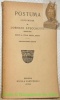
Pour un paiement via PayPal, veuillez nous en faire la demande et nous vous enverrons une facture PayPal
Histoires peu ordinaires à Bordeaux.
Elytis. 2007. In-8. Broché. Bon état, Couv. convenable, Dos satisfaisant, Intérieur frais. 190 pages - quelques illustrations en noir et blanc dans et hors texte.. . . . Classification Dewey : 908.447-Régionalisme : Aquitaine
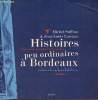
Illustrations de Jean-Michel Charpentier. Classification Dewey : 908.447-Régionalisme : Aquitaine
Voyages de Gulliver
Futuropolis
LIVRE A L’ETAT DE NEUF. EXPEDIE SOUS 3 JOURS OUVRES. NUMERO DE SUIVI COMMUNIQUE AVANT ENVOI, EMBALLAGE RENFORCE. EAN:9782754847018
Le Plongeon
Bamboo; Illustrated édition (13 janvier 2021)
Bande dessinée à l'état de neuf, fleur de coins!
Vita di santa Chiara di Montefalco dell'ordine degli eremiti di S. Agostino
Roma, Tipografia della Pace 1881 270pp.+ frontispice, text in Italian, hardcover (marbled plates, spine in leather, some use at ends), few foxing, good condition, [Monography on Clara of Montefalco], H80710
La Gerusalemme liberata del signore Torquato Tasso : Il Goffredo, poema eroico del signor Torquato Tasso ; con gli argomenti di Orazio Ariosti. In questa nuova impressione corretto e di belle figure ornato, con la vita dell'autore [par Lorenzo Crasso], e con l'aggiunta de' Cinque canti di Camillo Camilli. (Jérusalem délivrée)
In Lucca, per Domenico Marescandoli, 1785. Fort in-12, 23-(1)-663-(1) pp., reliure de l'époque plein vélin de réemploi (reliure un peu ternie, mouillure sur une cinquantaine de pages, pâles rousseurs).
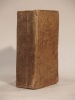
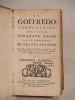
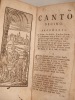
Complet des 20 jolies figures gravées sur bois. * Voir photographie(s) / See picture(s). * Membre du SLAM et de la LILA / ILAB Member. La librairie est ouverte du lundi au vendredi de 14h à 19h. Merci de nous prévenir avant de passer,certains de nos livres étant entreposés dans une réserve.
Terrier-Hermann Philippe Benedetti Lorenzo
Reference : 100122218
(2003)
ISBN : 9075380526
Philippe Terrier-Hermann Fascination/ Romans: Portraits of Roman Men
Artimo Foundation Breda 2003 156 pages 16 41x1 22x24 38cm. 2003. Broché. 156 pages.
bon état de conservation
Commento al libro di Giobbe (Opere di S.Tommaso)
ESD-Edizioni Studio Domenicano 1995 530 pages 14 8x3 4x21 2cm. 1995. Reliure editeur. 530 pages.
Très Bon Etat intérieur propre bonne tenue
TOMMASO D'AQUINO [THOMAS AQUINAS] (& PEROTTO Lorenzo, ed.)
Reference : R104984
(1995)
Commento al Libro di Giobbe (Introduzione, traduzione e riflessioni conclusive a cura di Lorenzo Perotto)
Bologna, Edizioni Studio Domenicano 1995 523pp., 22cm., publisher's hardcover with gilt lettering, very good condition, R104984
"La vie en fleurs version Twingo".
1995 Dessin au crayon et pastel signé en bas à droite, 1995, 25 x 23 cm., encadré.
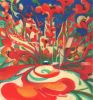
Lorenzo MATTOTTI (né en Italie en 1954), après des études d'architecture à Venise, se tourne vers le graphisme, la bande dessinée et l'illustration de mode. Son style empreint de poésie s'arme de couleurs flamboyantes. Cette Twingo circule dans cette ville imaginaire, tel Gulliver au pays des coquelicots, fleur fétiche de Kenzo, (Voir "Traits séduisants" pages 202 et 203).
"Voiture à vivre".
1995 Dessin au crayon et pastel signé en bas à droite, 1995, 20 x 22.5 cm.
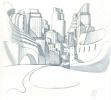
Lorenzo MATTOTTI (né en Italie en 1954), après des études d'architecture à Venise, se tourne vers le graphisme, la bande dessinée et l'illustration de mode. Son style empreint de poésie s'arme de couleurs flamboyantes. Une Twingo évolue dans une cité moderne construite d'immenses buildings, (Voir "Traits séduisants" pages 202 et 203).
[Gilon Paul ] - Valenti Jean,Lorenzo Ina - Maridès Léo - François Max
Reference : 18151
(1945)
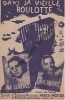
Sur le plaisir. Présentation de Michel Onfray.
2004 La Versanne, Encre Marine, 2004, grand in 8°, reliure souple de l'éditeur, XII-261 pages.
...................... Photos sur demande ...................


Phone number : 04 77 32 63 69
Ludwig Mies Van Der Rohe. Gestalter unserer Zeit.
Luzern, Kunstkreis, 1974, in-4to, 95 p., reich ill., auch farbig, Original-Leinenband, OU.
(SLACES, NVVA)
Phone number : 41 (0)26 3223808

