 Write to the booksellers
-
Type
Book (4702)
Magazine (3)
-
Latest
Last 24h (1)
Last 3 days (1)
Last month (173)
Last week (5)
-
Language
Dutch (98)
English (3)
French (4596)
German (1)
Italian (2)
Latin (4)
Spanish (1)
-
Century
16th (5)
17th (30)
18th (81)
19th (417)
20th (1896)
21st (98)
-
Countries
Belgium (1767)
Brazil (1)
Canada (2)
Côte d'Ivoire (5)
Denmark (564)
France (926)
Netherlands (7)
Switzerland (1433)
-
Syndicate
ALAC (2)
CLAM (202)
ILAB (1418)
NVVA (180)
SLACES (180)
SLAM (440)
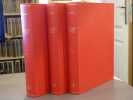
DICTIONNAIRE PROVENÇAL-FRANÇAIS ou DICTIONNAIRE DE LA LANGUE D'OC ancienne et moderne, suivi d'un vocabulaire français-provençal.
Slatkine Reprints Genève 1971 3 volumes in-4 ( 310 X 225 mm ) de 764, 765 ( 1420 pages, pagination continue sur les tomes 2 et 3 ) et 183 pages, pleine toile rouge à la bradel, dos lisses ornés de filets dorés. Très beaux exemplaires en parfait état.
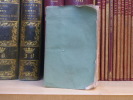
Vocabulaire Français-Provençal.
Repos, Imprimeur-Libraire-Editeur Digne 1848 Très fort in-12 ( 150 X 95 mm ) de XVI-1158 pages, broché sous couverture muette de l'époque. Dos fendu, bon exemplaire non rogné de l'EDITION ORIGINALE de ce Vocabulaire encore plus rare que le fameux dictionnaire d'HONNORAT.
Geschichte des obugrischen Vokalismus der ersten Silbe
Budapest, Akademiai Kiado 1982 227pp., 25cm., hardcover (editor's green cloth), dustwrapper, in the series "Bibliotheca Uralica" volume 6, good condition, rare, ISBN 963-05-2539-9, X82536
A Turkish-English Dictionary. With the Advice of Fahir Iz. Second printing.
Oxford, Clarendon Press, (1972). Orig. full cloth with dustjacket. Jacket with small tears. XII,419 pp.
[Opera]. cum scholiis perpetuis Johannis Bond
Paris, Nicolas Louis Achaintre, 1806 in-8, XXXVI-484-32 pp., avec un frontispice allégorique, veau fauve raciné, dos lisse, pièce de tire cerise, encadrement de simple filet à froid sur les plats, simple filet doré sur les coupes, tranches citron mouchetées de rouge (reliure de l'époque). Dos frotté.
![[Opera]. cum scholiis perpetuis Johannis Bond. HORACE](https://static.livre-rare-book.com/pictures/CFT/187233_1_thumb.jpg)
![[Opera]. cum scholiis perpetuis Johannis Bond. HORACE](https://static.livre-rare-book.com/pictures/CFT/187233_2_thumb.jpg)
Une des très nombreuses réimpressions de l'édition d'Horace publiée à titre posthume en 1614 par John Bond (1550-1612), recteur de l'école de Taunton (Somerset).Brunet III, 323. - - VENTE PAR CORRESPONDANCE UNIQUEMENT - LIEN DE PAIEMENT, NOUS CONSULTER.

Scholiis sive annotationibus, instar commentarii, illustratus à Joanne Bond.
Amsterdam, Blaeu, 1650, 1 pleine basane, dos et plats frottés. in-12 de 285-(3) pp., titre frontispice (griffonné), ex-libris manuscrit: "Le Clerc" ;
Oeuvres d'Horace avec les commentaires de Jean Bond.
Phone number : 06 80 15 77 01
LES DEUX ARTS POETIQUES D'HORACE ET DE BOILEAU; collationnés sur les meilleures éditions de ces deux poèmes.
A Brest, de l'imprimerie Michel,imprimeur du Roi, 1815, 1 br., couverture muette. in-16 de (7)-88 pp., texte en latin et français ;
Edition originale.
Phone number : 06 80 15 77 01
Kunstprinzipien der Satz- und Versgestaltung - Studien zu einer Inhaltbezogenen Syntax und Metrik der deutschen Dichtersprache
Wien, Böhlaus 1968 187pp., in the series "Österreichische Akademie der Wissenschaften, philosophisch-historische Klasse" 258/1, stamp on titlepage, VG
Lexicographica Byzantina. Beiträge zum Symposion zur byzantinischen Lexikographie (Wien, 1.-4. 3. 1989)
Wien, Verlag der Österreichischen Akademie der Wissenschaften 1991 viii + 314pp., 24cm., softcover, in the series "Byzantina Vindobonensia" Band XX, copy from the collection of the belgian byzantinist prof. Justin Mossay (with signature and ex-libris), text clean and bright, good condition, X103485
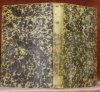
Werke. 2. und 5. durhaus umgearbeitete und verbesserte Auflage. 2 Banden in 1 Band. 1. Band: Oden und Epoden. 2. Band: Satiren und Episteln.
Stuttgart, Krais & Hoffmann 1861, 170x120mm, XXVIII - 156 + 138Seiten, cartonnage papier marbré, étiquette de titre vierge au dos, reliure de l’époque.
Pour un paiement via PayPal, veuillez nous en faire la demande et nous vous enverrons une facture PayPal
Q. Horatius Flaccus, ex recensione et cum notis atque emendationibus.
2 Bde. Leipzig, Gotth. Theophil Georg, 1864. 8°. XVIII, 572 S.; (2) 192, 299 (1) S. (Register). Mit 1 gest. Titelportrait. Halblederbde. d. Zt. mit goldgepr. Rückenschildern (stärker berieben u. bestossen).
Eine von zahlr. Auflagen der Oden, Epoden, Satiren u. Briefe von Horaz in lateinischer Sprache mit lateinischen Kommentaren von Bentley. - Mit alten Namenszügen auf fl. Vorsatz. Durchgehend stärker gebräunt.
Des Quintus Horatius Flaccus Satiren erklärt.
Reutlingen, Johann Jakob Mäcken, 1818. 8°. XII, 494 S. Halblederbd. d. Zt. mit goldgepr. Rückentitel (berieben u. bestossen).
Lateinischer Text mit ausführlichen Kommentaren in Deutsch. - Vorsätze leimschattig. Durchgehend stärker gebräunt u. stockfleckig.
Les Sépultures devant l'histoire, l'archéologie, la liturgie, le droit ecclésiastique et la législation civile.
Paris, JosePh Albanel, 1868. In-8 de IX et 425 pages. Trace angulaire de mouillure claire sur les dix premières pages. Toile rouge. Nombreux tampons de Radio France et ORTF. Couvertures conservées.
Manuel d'hébreu (18 leçons)
Cailly-sur-Eure, 1945-1951 xv + 168pp., 2e édition revue et corrgiée, belle reliure cart., 24cm.
Sprachatlas der deutschen Schweiz. begründet von Heinrich Baumgartner, Rudolf Hotzenköcherle. In Zusammenarbeit mit Konrad Lobeck, Robert Schläpfer und unter Mitwirkung von Paul Zinsli.
11 Bände, 8 Tafelbände; 2 Einführungsbände, Abschlussband mit Register. Bern, Francke, 1962-2003 Quer-Folio, Quarto Orig.-Leinen- und Leberbände (Einführung).
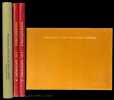
Vollständige Ausgabe des Sprachatlases mit den Einführungs- und Abschlussbänden. - Die Einführungsbände mit handschriftlichen Notizen von Hotzenköcherle - Sehr gut erhalten.

Phone number : 41 (0)44 261 57 50
The Syntax Of Apollonius Dyscolus.
Amsterdam, John Benjamins, 1981. In-8, publisher's hardcover, 281pp, references, index, contents. (Amsterdam studies III, Studies in the history of linguistics, vol. 23)
Very fine condition. - Frais de port : -France 6,8 € -U.E. 9 € -Monde (z B : 14 €) (z C : 24 €)
A bilingual Concordance to the Targum of the Prophets, Volume eighteen (18) : The Twelve (I) Aleph-Zayin
Leiden, Brill 2002 viii + 299pp., 25cm., publisher's hardcover in green cloth with gilt lettering, text and interior are clean and bright, very good condition, R120052
A bilingual Concordance to the Targum of the Prophets, Volume nineteen (19) : The Twelve (II) Chet-Samekh
Leiden, Brill 2002 307pp., 25cm., publisher's hardcover in green cloth with gilt lettering, text and interior are clean and bright, very good condition, R120053
Ejer hay zhoghovrdi patmut'yan ew banasirut'yan (hodvatsneri zhoghovatsu)
Erevan, Haykakan SSH GA Hratarakc'owt'yown 1971 338pp. + 1 portrait out of text, 22cm., publisher's hardcover in black cloth, text fully in Armenian, [with a second titlepage in Russian : "Stanitsy istorii i filologii armianskogo naroda. Sbornik statei"], cfr. OCLC 49892070, good condition, X111629
Une industrialisation sans développement, le bassin de Mons et le charbonnage du Grand-Hornu du milieu du XVIIIe au milieu du XIXe siècle
Louvain-La-Neuve 1980 Université de Louvain Hardcover
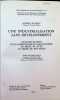
Reliure rigide, 25 x 17 cm, 538 pp., français, état du livre : Très bon Recueil de travaux d'Histoire et de Philologie Université de Louvain, 6e série, fascicule 22 [Cette description peut avoir été traduite par une IA.]
Usumnasirut'iwnk Hayereni p'okhareal barits
Wien [Vienna], Mechitharisten-Buchdruckerei [Mkhit'arean Tparan] 1894 9 + 146pp., text fully in Armenian, bound in solid modern cloth, original frontcover preserved, 20cm., text and interior are clean and bright, in the series "Nationalbibliothek" Band 15, very good condition, [study on loanwords in Armenian, I: the Semitic loanwards in Old-Armenian (by Hubschmann), II: The Greek foreign words in Armenian (by Brockelmann), III: The old Armenian personal names in Armenian (by Tashean, transl.)], X114358
Kleine Schriften zum Armenischen
Hildesheim, Georg Olms Verlag 1976 xiv + 485pp., in the series "Collectanea" vol. XXXVI (36), publisher's hardcover in blue cloth (with few small spots), 23cm., text is clean and bright, good condition, X111398
Praeromanica. Studien zum vorromanischen Wortschatz der Romania mit besonderer Berücksichtigung der frankoprovenzalischen und provenzalischen Mundarten der Westalpen
Bern, A. Francke 1949 xxiv + 130pp., 25cm., softcover, in the series "Romanica Helvetica" vol.30, good condition, T87004
Schläuche und Fässer. Wort- und sachgeschichtliche Untersuchungen mit besonderer Berücksichtigung des romanischen Sprachgutes in und ausserhalb der Romania sowie der türkisch-europäischen und türkisch-kaukasisch-persischen Lehnbeziehungen
Bern, A. Franke 1955 171pp.with some illustrations in text, 25cm., softcover, in the series "Romanica Helvetica" vol.54, good condition, T87005
Huetiana ou Pensées diverses de M. Huet
Amsterdam, Herman Uytwerf, 1723. In-12, XX-[8]-449-[3] pp., veau havane marbré, dos à nerfs, tranches mouchetées (reliure restaurée, quelques petites rousseurs).
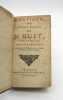
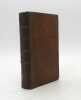
Nouvelle édition, parue l'année suivant l'originale. Elle contient ses critiques littéraires et ses essais en philosophie, histoire ou religion. * Membre du SLAM et de la LILA / ILAB Member. La librairie est ouverte du lundi au vendredi de 14h à 19h. Merci de nous prévenir avant de passer,certains de nos livres étant entreposés dans une réserve.

