 Write to the booksellers
-
Type
Any type (1)
Book (15271)
Magazine (37)
Manuscript (1)
Music sheets (9)
-
Latest
Last 24h (10)
Last 3 days (1)
Last month (87)
Last week (2)
-
Language
Dutch (2)
English (6)
French (15031)
German (2)
Greek (10)
Italian (3)
Latin (260)
Spanish (2)
Swedish (3)
-
Century
16th (82)
17th (312)
18th (486)
19th (2732)
20th (4091)
21st (164)
-
Countries
Belgium (2809)
Canada (11)
Denmark (4)
France (7289)
Greece (3)
Netherlands (4971)
Switzerland (232)
-
Syndicate
ALAC (10)
CLAM (37)
CNE (1)
ILAB (5189)
NVVA (4)
SLACES (2)
SLAM (5118)
SNCAO (10)
Oeconomia Hippocratis, alphabeti serie distincta. In qua dictionum apud Hippocratem omnium, præsertim obscuriorum, usus explicatur, & velut ex amplissimo penu de promitur: ita ut Lexicon Hippocrateum merito dici possit.
1588 Francfort, chez André Wechel, 1588. Un volume in-folio cousu mais non endossé dans une chemise en vélin ivoire, titre manuscrit au dos, 694 pages,texte en grec et latin, sur deux colonnes. Manquent les feuillets de titre, frontispice, et préface, mouillure claire et quelques rousseurs. Mérite restauration.
La librairie est ouverte du mardi au samedi de 9h30 à 12h30 et de 13h30 à 19h00. Commandes par courriel ou téléphone. Envoi rapide, emballage soigné.


VULGATAE EDITIONIS BIBLIORUM SACRORUM CONCORDANTIAE ad rec. jussu Sixti V. Pontif. Max.
BARRI DUCIS. 1875. In-4. Relié. Bon état, Couv. convenable, Dos satisfaisant, Intérieur frais. 1484 pages. Nombreuses illustrations et photogrpahies en couleur, dans le texte. Numéro de classement sur le dos. Tampon de l'institution sainte marie sur la page de titre. Texte en latin.. . . . Classification Dewey : 470-Langues italiques. Latin
Classification Dewey : 470-Langues italiques. Latin
Vulgatae editionis bibliorum sacrorum concordantiae ad recognitionem jussu Sixti V.Pontif.Max. - Bibliis adhibitam recensitae atque emendatae ac plusquam viginti quinque millibus versiculis auctae insuper et notis historicis geographicis chronologicis etc
Barri-Duccis. 1875. In-Folio. Relié cuir dos-coins. Etat d'usage, 2ème plat abîmé, Dos satisfaisant, Quelques rousseurs. XXIII + 1484 pages - ouvrage en latin - textes sur trois colonnes - titre doré sur le dos - dos et coins cuir vélin blanc - textes sur trois colonnes - plats jaspés - quelques rousseurs sans réelle conséquence sur la lecture - coins, tranches et plats frottés - étiquette collée sur la coiffe en pied.. . . . Classification Dewey : 470-Langues italiques. Latin

Vulgatae editionis bibliorum sacrorum concordantiae ad recognitionem jussu Sixti V.Pontif.Max. - Bibliis adhibitam recensitae atque emendatae ac plusquam viginti quinque millibus versiculis auctae insuper et notis historicis geographicis chronologicis locupletatae - Edition Sexta. Classification Dewey : 470-Langues italiques. Latin
Kleine Beiträge zur klassischen Philologie.
Roma, Storia e Letteratura, 1964.
2 vols: 517;624 p. Cloth 25 cm (Including dustjackets) (Heavy book, may require extra shipping costs)
Kleine Beiträge zur klassischen Philologie. Erster Band: zur Sprache, zur griechischen Literatur.
Roma, Storia e Letteratura, 1964.
517 p. Wrs. 25 cm
Noch einmal Kolon und Satz.
München, Bay. Ak. der Wissensch., 1965.
73 p. Wrappers 23 cm (SBAW 1965,2)
DE CONDICIONIBUS MATRIMONIO APPOSITIS
Pontificium Institutum Utriusque Iuris, Romae. 1941. In-12. Broché. Bon état, Couv. légèrement passée, Dos satisfaisant, Non coupé. 118 pages. Etiquette de code sur le dos. Tampons et annotations de bibliothèque sur le 1er plat et en page de titre. Traces de colle sur le 1er plat.. . . . Classification Dewey : 470-Langues italiques. Latin
Pontificium Institutum Utriusque Iuris, Theses ad Lauream, n° 27. Classification Dewey : 470-Langues italiques. Latin
Collegit, disposuit, notis et prolegomenis illustravit indicibus instruxit Carolus Müllerus. (Volumina secundum, tertium & quartum)
Paris, Didot, 1848 - 1851.
3 volumes: XLII,631; (IV),729; (VI),856 p. Half cloth 26 cm (First and last leaves of each volume foxed. Lacking volume 1 & 5) (Heavy book, may require extra shipping costs)
Griechisch und Deutsch von Hermannn Diels. Neunte Auflage herausgegeben von Walther Kranz.
Berlin, Weidmann, 1959 - 1960.
3 volumes: XI,504;428;660 p. Cloth. 22.5 cm (Including worn dustjackets) (Heavy book, may require extra shipping costs)
Deutsch von E. PETERICH.
Florenz, Sansoni, n.d (after 1943).
77 p. Hardb. (t. & tr.)(Hand-made paper)
Musico stilo. Aspects of the Poetry of Ennodius
, Brepols, 2025 Paperback, 309 pages, Size:156 x 234 mm, Illustrations:4 tables b/w., Languages: English, Latin. ISBN 9782503611129.
Summary Since the end of the last century, Ennodius has been the object of increasing interest among scholars of late antiquity. Developments in Ennodian criticism are also addressed in this volume, that presents the results of more than twenty years of research on the relationship - always dialectical and not infrequently innovative - that Ennodius maintains as a poet with the Latin literary tradition, both profane and Christian. The chapters of the book revisit - in English and in one case with substantial modifications - eight of the author's previously published papers on Ennodius, along with one unpublished contribution. Areas that have been specifically investigated include the functions that he assigns to poetry compared to those he assigns to prose, his original re-treatment of some literary genres, and his thematic, stylistic, lexical and metric choices. The last chapter explores the literary influence exerted by Ennodius' poetry on the text of his epitaph. The very fact that its unknown author - certainly a great admirer of the deceased - did his best to imitate his style is a significant testimony to the prestige that Ennodius enjoyed after his death in the diocese of Pavia of which he had been the bishop. TABLE OF CONTENTS Preface Introduction Prose and Poetry in Ennodius The dictio for Epiphanius (carm. I. 9) The dictio Ennodi diaconi quando de Roma rediit (carm. I. 6) The Literary Genres. Tradition and Innovation Ennodius and the Epithalamium. Carm. I. 4 for Maximus Ennodius and Panegyric Poetry. A Eulogy and a Request: carm. I. 2 for Eugenes Ennodius and Travel Poetry. The Itinerarium Brigantionis Castelli (carm. I. 1) Ennodius and Funerary Poetry. The Two Epitaphs for Cynegia. A Variation on the Theme? The Classics and the Bible Pagan and Christian Echoes in the Epitaph of Victor, Bishop of Novara. An Exegesis of carm. II. 95 A Reference to Job? Carm. I. 9. 21-24 Post busta superstes Ennodius in His Epitaph Bibliography List of Abbreviations List of the Ancient Authors and Works
After Ovid. Aspects of the Reception of Ovid in Literature and Iconography
, Brepols, 2022 Paperback, 374 pages, Size:156 x 234 mm, Illustrations:3 b/w, 29 col., 18 tables b/w., Language(s):English, Italian. ISBN 9782503592503.
Summary The 2000th anniversary of Ovid's death, in 2017-2018, led to an upsurge in conferences and publications dedicated to the author's work and afterlife. One of these is the present volume, resulting from the conference Dopo Ovidio. Aspetti della ricezione ovidiana fra letteratura e iconografia, which was held on 7-8 May 2019 at the Department of Human Sciences (DSU) of the University of L'Aquila, and which looked at various aspects of Ovid's fortune, from a diachronic and interdisciplinary perspective. The contributions cover a period of about fourteen centuries, from late antiquity until the end of the eighteenth century, and range from late Latin to medieval literature, from humanistic production to modern English and Italian literature, and from linguistics to the figurative arts. All these studies contribute to a collective appraisal of the multifarious impact of Ovid's works, and especially of the Metamorphoses, the latter's treatment of myth having been a starting point for integrations, developments, (re)interpretations and representations, in isolation or included in an iconographic program. TABLE OF CONTENTS Preface Ovidian Presences in Prudentius' Psychomachia (Stefania Filosini) Ovid in Reposianus and the Complexity of Reception (Maria-Pace Pieri) Allusions to and Quotations from Ovid in the Writing of Isidore of Seville (Donato de Gianni) Geoffrey's musa iocosa: the Vita Merlini as an 'Ovidian' Poem (Francesco Marzella) Il distico della commedia elegiaca latina. L'eredità di Ovidio (Lucio Ceccarelli) Moving through the Metamorphoses. The Linguistic Encoding of Motion in Ovid and his Translators (Luisa Corona) The Reception of the Ovidius moralizatus in Northern Italy in the Late Middle Ages (Giuseppa Z. Zanichelli) The Myth of Narcissus in Painting and Sculpture in the Sixteenth and Seventeenth Centuries: Some Reflections (Michele Maccherini) Ovid and the Aerial Metamorphoses Painted by Sebastiano del Piombo in the Loggia di Galatea (Costanza Barbieri) The Fortunes and Misfortunes of Vulgarized Editions of Ovid's Metamorphoses in Italy and Spain (Giuseppe Capriotti) Folengo and Ovid: the Tempest in the Canto di Giuberto (Fabiola Bartolucci) Mark Alexander Boyd and Ovid's Heroides. Lavinia's Epistle to Turnus (Franca Ela Consolino) Ovid in the Old World and the New: the Metamorphoses as Interpreted by George Sandys (Enrico Botta) ?Orrendo a un tempo ed innocente amore?: the Ovidian Myrrha in Italian Literature (Valeria Merola)
Nel segno di Francesco. A proposito di una raccolta di scritti di Ezio Franceschini.
Firenze, Presso la sede della Fondazione Ezio Franceschini, 1990.
43 p., 4 pls. Wrs. 24 cm
Carolingian Revolution. Unconventional Approaches to Medieval Latin Literature I
, Brepols, 2021 Hardback, xviii + 412 pages, Size:156 x 234 mm, Illustrations:40 b/w, 4 tables b/w., Language: English. ISBN 9782503587998.
Summary This book presents samples of experimental methods for reading medieval Latin texts that have scarcely been adopted, if at all, by mainstream research in the field. It contributes to the discovery of some underestimated aspects of early medieval (especially Carolingian) Latin literature: intertextuality as intercultural relationship (in Biblical epic), intermediality (text-image-sound connections), interdisciplinarity (science, religion, and poetry), hermeneutics (Biblical exegesis as poetry-engine), post-colonial reading (medieval Latin as a second language), socio-literary approaches (monastic epigraphs as witnesses of everyday life, writing as a status symbol of an intellectual class and a whole civilization). It also discusses quantitative methods, which are explored in more detail in a second volume, Digital Philology and Quantitative Criticism of Medieval Literature: Unconventional Approaches to Medieval Latin Literature II): http://www.brepols.net/Pages/ShowProduct.aspx?prod_id=IS-9782503588018-1. The book thus seeks to encourage scholarly interest in obscure or less familiar elements of the Carolingian literary renewal, interpreted here as more a laboratory of innovations than a revival of traditional patterns. TABLE OF CONTENTS Preface Chapter 1. Intercultural Imitation in Christian Latin Poetry as a Path to the Medieval Poetics of Alterity Chapter 2. The Women of the Old Testament in Early Medieval Poetry: Judith and the Others Chapter 3. Ad supplementum sensus: Hermeneutic Plurality and Increase in Meaning in Biblical Poetics from the Middle Ages to Derrida Chapter 4. A Repressed Beauty: Biblical Poetics and the Legitimisation of Poetry in Medieval Culture Chapter 5. The Poetics of Communication in the Carolingian Age Chapter 6. A Lexical Journey through Alcuin's Poetry Chapter 7. Some Linguistic Features of Popular Songs in Medieval and Modern Times Chapter 8. Versus ad picturas in the Carolingian Era Chapter 9. Verse Historiography in the Carolingian Era: The Political Typology of Ingelheim Paintings Chapter 10. The Sense of Time in Carolingian Poetry: Christianising the Zodiac and Astronomical Observation in Pacificus of Verona Chapter 11. Literary Epigraphy in the Carolingian Monastery Chapter 12. Carolingian Verse Collections Chapter 13. The Modern Success and Medieval Marginality of Modoin of Autun's Karolus Magnus et Leo Papa Chapter 14. A 'Postcolonial' Approach to Medieval Latin Literature? Bibliography Indices
Digital Philology and Quantitative Criticism of Medieval Literature. Unconventional Approaches to Medieval Latin Literature II
, Brepols, 2021 Hardback, xii + 279 pages, Size:156 x 234 mm, Illustrations:40 b/w, 4 tables b/w., Language: English. ISBN 9782503588018.
Summary Building on The Carolingian Revolution: Unconventional Approaches to Medieval Latin Literature I (http://www.brepols.net/Pages/ShowProduct.aspx?prod_id=IS-9782503587998-1), this is the second of two volumes proposing ways of reading medieval Latin texts which, up to now, have had little or no attention within literary studies. This volume is founded on the belief that 'the unprecedented empirical power of digital tools and archives offers a unique chance to rethink the categories of literary study' (F. Moretti). The book's first section presents cases studies applying 'quantitative' criticism based on the linguistic and stylistic use of frequency wordlists which, thanks to digital tools and to a larger literature, are becoming more easily accessible and more powerful. The chapters of this section lead the reader from an application of stylometry within a traditional critical exercise, via the structured use of frequency indexing as a warning light for cultural or stylistic phenomena undetectable to the naked eye, to more technical corpus analysis experiments based on linguistic evolution or authorship attribution. The second section explores the encoding problems the author has faced when working on the realisation of digital editing projects such as the Corpus Rhythmorum Musicum, the Archivio della Latinità Italiana del Medioevo (ALIM), Lexicon, and the Eurasian Latin Archive (ELA), and proposes reflections on the typology of digital philological editions. TABLE OF CONTENTS The Mechanic Reader: Instead of an Introduction Quantitative Criticism Chapter 1. Venantius Fortunatus in Medieval Latin Poetry Chapter 2. The Representations of the Book in Carolingian and Ottonian Poetic Texts: The Birth of Paratextual Poetry Chapter 3. Europe's Name is Europa: 'Europe' and 'European' in Early Medieval Latin Texts Chapter 4. The Landscape as a Memory Construction in the Latin Petrarch Chapter 5. Generic Constants and Chronological Variations in Statistical Linguistics on Latin Epistolography Chapter 6. Statistical Indicators of Proximity to the Early Romance Languages: Experimental Applications to Early Medieval Rhythmic Poetry Chapter 7. Computer Analysis of the Lexicon and Identification of the Authors in the Epistolae duorum amantium (Twelfth Century) Digital Philology Chapter 8. Encoding Issues in Philological Digital Editions Chapter 9. Digital Philology, Medieval Texts, and the Corpus Rhythmorum Musicum, a Digital Edition of Music and Poems Bibliography Indices
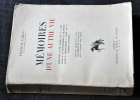
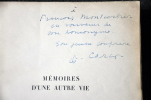
MEMOIRES D'UNE AUTRE VIE. A Voix Basse, De Montmartre Au Quartier Latin, Montmartre à Vingt Ans, Bohème d' Artiste
1942 " Edition definitive avec une preface de l'auteur et huit planches hors texte " , Geneve, EDITIONS DU MILIEU DU MONDE. 1942. In-8 Carré. Broché.. 477 pages. Parfait etat avec un envoi de l'auteur : à François Montcorbier , en souvenir de son Homonyme , son jeune confrere, F. Carco "

Ray T1*
PETRONII ARBITRI SATIRARVM RELIQVIAE / TEXTE EN LATIN
BEROLINI. 1862. In-8. Relié demi-cuir. Etat d'usage, Couv. convenable, Dos satisfaisant, Quelques rousseurs. XXXXVIIII + 237 pages - plats et contre-plats jaspés - 1 signet conservé.. . . . Classification Dewey : 470-Langues italiques. Latin
TEXTE EN LATIN Classification Dewey : 470-Langues italiques. Latin
Francisci Oudendorpii / J.G. Graevii ; J. Gronovii / C.-A. Dukeri
Reference : LRB100212
(1751)
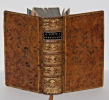
Cajus Suetonius Tranquillus ex recensione Francisci Oudendorpii qui variantes lestiones, suasque animadversiones adjecit, intermixtis J. G. Graevii et J. Gronovii nec non editis Caroli Andrea Dukeri adnotationibus. Lugduni Batavorum - Apud Samuelem Luchtmans et Filios - 1751.
In-8° , plein veau , triple filets sur les plats, dos à nerfs , fleurons sur les caissons, pièce de titre . Signet de soie vieux rose. Tranches tâchetées bleues et blanches. Excellent état, coiffes usées. Titre bicolore. Complet de toutes ses gravures. 21 ff° - 1024p. - 18 ff°
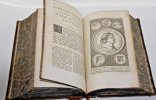
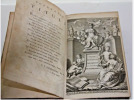
Gravures : César p. 1 - Auguste p. 146 - Tibère p. 346 - Caligula p. 468 - Claude p. 561 - Néron p. 636 - Galba p. 740 - Othon p. 773 - Vitellius p. 794 - Vespasien p. 821 - Titus p. 869 - Domitien p. 891 Un frontispice - un bandeau représentant les armes de Guillaume Charles Henri de Frise, dit Guillaume IV d'Orange-Nassau [1711-1751] (premier Stathouder général et héréditaire des Provinces-Unies) [l'épître est de septembre 1750]. L'édition de Frans Van Oudendorp [1696-1761] est considérée comme l'une des meilleures de Suétone. Johann Georg Graevius (1632-1703) et Johann Friedrich Gronovius (1611-1671) furent professeurs à l'université de Leyde, Karl Andrea Duker (1670-1752) fut curateur de l'université d'Utrecht. Samuel Luchtmans (1724-1780) imprimeur de l'université de Leyde.
Immagini Virgiliane. Del poeta al mago
Edizioni del Tornese Feuilles sous couverture et emboîtage In-plano (34 x 47,5 cm.), feuilles sous couverture rempliée (couverte de papier crystal) et emboîtage en papier cartonné, illustrations sous serpentes, texte en italien, sans date ; étui en papier cartonné frotté aux arêtes et décollé en tête et en queue, quelques pliures aux serpentes, par ailleurs planches intactes, bon état général. Livraison a domicile (La Poste) ou en Mondial Relay sur simple demande.
IN IOANNEM - COMMENTARIUM
ROMAE - TYPIS BERNARDI MORINI. 1857. In-8. Relié demi-cuir. Bon état, Couv. convenable, Dos satisfaisant, Intérieur frais. VI + 233 pages - Plats jaspés - Auteur, titre, filets et roulettes dorés au dos - Etiquette collée en coiffe en pied - 1 accroc a udos et petites épidermures.. . . . Classification Dewey : 470-Langues italiques. Latin
OUVRAGE EN LATIN Classification Dewey : 470-Langues italiques. Latin
Institutiones catholicae in modum catecheseos in quibus quidquid ad religionis - Tomus decimus quartus - Nova editio ad normam ultimae editionis nemausi (avenione) excusae anno 1765 diligenter elaborata.
E typographia J.P.G. Michel. 1774. In-8. Relié demi-cuir. Etat d'usage, Coins frottés, Coiffe en tête abîmée, Papier jauni. 421 pages - ouvrage en latin - plats jaspés - dos à 5 nerfs - titre, tomaison dorés sur pièce de titre - caissons dorés sur le dos - coiffe en pied frottée - tampons sur la page de titre - 2 photos disponibles.. . . . Classification Dewey : 470-Langues italiques. Latin

Ouvrage en latin - Institutiones catholicae in modum catecheseos in quibus quidquid ad religionis historiam & ecclesiae dogmata mores sacramenta preces usus & caeremonias pertinet totum id brevi compendio ex sacris fontibus scripturae & traditionis explanatur ex gallico idiomate in latinum sermonem translate adjectis singulis è scriptura & traditione petitis probationibus & testimoniis. Classification Dewey : 470-Langues italiques. Latin
"COMMENTARIUS IN EXODUM ET LEVITICUM - ""CUM APPROBATIONS SUPERIORUM""."
LETHIEULLEUX P.. 1897. In-8. Relié demi-cuir. Bon état, Couv. convenable, Dos fané, Intérieur frais. 247 + 352 pages + 3 planches en couleur depliantes - Plats et contre-plats jaspés - Coins émoussés - Auteur, titre et roulettes dorés au dos - Dos insolé.. . . . Classification Dewey : 470-Langues italiques. Latin
OUVRAGE EN LATIN / COLLECTION 3Commentariorum in Vet. Test. PAr I in Libros historicos (VOL. II : EXODUS ET LEVITICUS). Classification Dewey : 470-Langues italiques. Latin
"COMMENTARIUS IN GENESIM - ""CUM APPROBATIONS SUPERIORUM""."
LETHIEULLEUX P.. 1895. In-8. Relié demi-cuir. Bon état, Couv. convenable, Dos fané, Intérieur frais. 612 pages - Plats et contre-plats jaspés - Coins émoussés - Auteur, titre et roulettes dorés au dos - Dos insolé.. . . . Classification Dewey : 470-Langues italiques. Latin
OUVRAGE EN LATIN / COLLECTION 3Commentariorum in Vet. Test. PAr I in Libros historicos (VOL. I : GENESIS). Classification Dewey : 470-Langues italiques. Latin
"COMMENTARIUS IN NUMEROS - ""CUM APPROBATIONS SUPERIORUM""."
LETHIEULLEUX P.. 1899. In-8. Relié demi-cuir. Bon état, Couv. convenable, Dos fané, Intérieur frais. 386 pages - Plats et contre-plats jaspés - 1er plat abimé en tete - Coins émoussés - Auteur, titre et roulettes dorés au dos - Dos insolé.. . . . Classification Dewey : 470-Langues italiques. Latin
OUVRAGE EN LATIN / COLLECTION 3Commentariorum in Vet. Test. PAr I in Libros historicos (VOL. III : NUMERI). Classification Dewey : 470-Langues italiques. Latin
JURIS CANONICI UNIVERSI per faciliorem methodum ad veram praxim sincere redacti COMPENDIUM EX PROBATISSIMIS AUCTORIBUS CATHOLICIS - Tomus posterior
MIGNE EDITOREM. 1863. In-4. Relié toilé. Bon état, Couv. convenable, Dos satisfaisant, Quelques rousseurs. 1143 pages. Dos toile grené rouge avec etiquette de classement, couverture toilé grise.. . . . Classification Dewey : 470-Langues italiques. Latin
Classification Dewey : 470-Langues italiques. Latin

