 Write to the booksellers
-
Type
Any type (1)
Book (15269)
Magazine (37)
Manuscript (1)
Music sheets (9)
-
Latest
Last 24h (1)
Last 3 days (4)
Last month (46)
Last week (2)
-
Language
Dutch (2)
English (6)
French (15028)
German (2)
Greek (10)
Italian (3)
Latin (261)
Spanish (2)
Swedish (3)
-
Century
16th (83)
17th (311)
18th (486)
19th (2731)
20th (4100)
21st (162)
-
Countries
Belgium (2808)
Canada (11)
Denmark (4)
France (7284)
Greece (3)
Netherlands (4974)
Switzerland (233)
-
Syndicate
ALAC (10)
CLAM (37)
CNE (1)
ILAB (5207)
NVVA (4)
SLACES (2)
SLAM (5136)
SNCAO (10)
Novum Testamentum regulis illustratum, seu Canones Scripturae Sacrae certa methodo digesti, ad Novi Testamenti intelligentiam potissimum accommodati
Parisiis, Apud Joannem de Nully Relié 1696 In-12 (10 x 16,5 cm), reliure plein veau, dos à 5 nerfs orné de caissons dorés et d'une pièce de titre, tranches mouchetées, 461 pages, texte en latin ; petits manques de cuir aux coins et à la coiffe supérieure, épidermures au quatrième plat, coupes frottées, par ailleurs assez bon état général. Livraison a domicile (La Poste) ou en Mondial Relay sur simple demande.


PRAELECTIONES PHILOSOPHICAE - TOMUS TERTIUS AESTHETICAM, ETHICAM ET HISTORIAM PHILOSOPHIAE / TEXTE EN FRANCAIS ET LATIN
CLAROMON-FERRANDI. 1849. In-12. Relié demi-cuir. Etat d'usage, Coins frottés, Dos frotté, Quelques rousseurs. XI + 422 pages - plat et contre-plats jaspés - 1 tampon sur la page de faux-titre - 2 tampons sur la page de titre - 1 etiquette sur le 1er plat et au dos.. . . . Classification Dewey : 470-Langues italiques. Latin
TEXTE EN FRANCAIS ET LATIN Classification Dewey : 470-Langues italiques. Latin
P. Virgilii maronis bucolicon liber - La vie de Virgile.
non précisé. non daté. In-12. Relié. Etat d'usage, Coins frottés, Mors fendus, Quelques rousseurs. 190 pages, livre en français et en latin - papier jauni, tranches et plats frottés, déchirure sur le dos partiellement manquant, page de titre manquante. . . . Classification Dewey : 470-Langues italiques. Latin
Classification Dewey : 470-Langues italiques. Latin
P Virgilius maro accurante nic. Heinsio dan. fil
Sumptibus Societatis. Non daté. In-16. Broché. Etat d'usage, Plats abîmés, Dos abîmé, Papier jauni. 349 pages augmentées de quelques illustrations en noir et blanc,dans le texte. Texte en latin.. . . . Classification Dewey : 470-Langues italiques. Latin
Classification Dewey : 470-Langues italiques. Latin
Selectae E Veteri Testamento Historiae
PARISIIS. 1742. In-18. Relié plein cuir. Etat passable, Plats abîmés, Dos à nerfs, Mouillures. 131 pages. Couveture : fleurons dorés. Ecrit en latin.. . . . Classification Dewey : 470-Langues italiques. Latin
Envoi à la fin du livre. Classification Dewey : 470-Langues italiques. Latin
S. Gregorri Magni papae primi de cura pastorali liber
Parisiis, Apud Méquignon Juniorem, Biblipolam Facult. Theologiae ; via majorum augustinianorum, n°9 Relié 1826 In-16 (6,5 x 11 cm), relié plein veau brun, décors empressés à froid, fleurons empressé, dorures et trois nerfs au dos, quelques ors aux plats et coupes, tranches dorées, tranchefile, double-signet, papier à la cuve aux gardes, 332 pages, texte en latin, Editio nova, accurate emendata, note manuscrite sur la page de garde ; légers frottements aux coins, bords et plats, quelques rousseurs, bel état pour cette jolie reliure. Livraison a domicile (La Poste) ou en Mondial Relay sur simple demande.
Versions latines de première année contenant trente fables choisies de la Fontaine et une grande partie des mésaventures de Jean-Paul Choppart.
Edition Belin Frères,1 vol. broché, dim: 11x18 cm
Bon état.
[Société Littéraire de France] - Anonyme ; [ Charles Lucas de Pesloüan]
Reference : 36491
(1920)
Amicitiae in hortis
1 vol. in-8 cartonnage bradel de l'époque, couv. cons., Société Littéraire de France, Paris, 1920, 339 pp.
![Amicitiae in hortis. Anonyme ; [ Charles Lucas de Pesloüan]](https://static.livre-rare-book.com/pictures/CDL/36491_thumb.jpg)
![Amicitiae in hortis. Anonyme ; [ Charles Lucas de Pesloüan]](https://static.livre-rare-book.com/pictures/CDL/36491_2_thumb.jpg)
![Amicitiae in hortis. Anonyme ; [ Charles Lucas de Pesloüan]](https://static.livre-rare-book.com/pictures/CDL/36491_3_thumb.jpg)
Exemplaire enrichi d'un envoi, peut-être de l'auteur. Etat très satisfaisant (coiffes frottées, bon état par ailleurs)
Varia Philosophica et Medica. De Atomis. De Circulari sanguinis motu. Adversus Pyrrhonios. De Generatione hominis. De Usu lienis. De Causa motus pulmonum in ispiratione. Anatomica quaedam. [ Edition originale ]
1 vol. in-12 reliure de l'époque pleine basane mouchetée, Apud Jacobum Lucas [ Jacques Lucas ], Rothomagi [ Rouen ], 1674, 156 pp., 2 ff., pp. 158-239
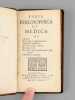
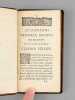
Rare exemplaire de l'édition originale, en bon état dans sa reliure d'origine. Dans son "Manuel du Bibliographe Normand", Edouard Frère cite Floquet qui raconte que "David de Caux, habile médecine religionnaire, fut repoussé du Collège médical, et qu'un arrêt du Parlement, rendu en 1663, défendit qu'il y eut dans Rouen plus de deux médecins religionnaires. Ce médecin était sans doute parent de David de Caux, originaire et pasteur de la ville de Dieppe en 1613, puis pasteur de Pont-Audemer où il termina sa carrière" (Frère, I, 203). Bon état (reliure lég. frottée avec petits mq. en coiffes, très bon état par ailleurs).
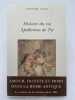
Histoire du roi Apollonius de Tyr
Anatolia éditions Anatolia éditions, 1996. In-8 broché, couverture à rabats de 121 pages, Carte. Bandeau conservé. Très bon état
Toutes les expéditions sont faites en suivi au-dessus de 25 euros. Expédition quotidienne pour les envois simples, suivis, recommandés ou Colissimo.
Traité de physiognomie. Texte établi, traduit et commenté par Jacques André. Collection des Universités de France, publiée sous le patronage de l’Association Guillaume Budé.
Paris, Société d’Edition Les Belles Lettres 1981, 200x130mm, 154pages, reliure cartonnage de l’éditeur. Nom du possesseur sur le bas de la page de garde supérieure, autrement bel exemplaire.
édition bilingue: français - latin, Pour un paiement via PayPal, veuillez nous en faire la demande et nous vous enverrons une facture PayPal
ANONYME - Par l'auteur des Soirées Helvétiennes, & des Tableaux
Reference : 110749
(1771)
Traduction en prose de Catulle, Tibule et Gallus. Tome Premier + Tome Second (2 volumes)
1771 A Amsterdam, Et se trouve à Paris, Chez Delalain, Libraire - 1771 - 2 volumes In-8, reliure pleine peau brune, 5 nerfs, titre, tomaison, fleurons et filets dorés aux dos, tranches marbrées, filets dorés encadrant les plats - 327 + 327 pages - Avec quelques gravures, bandeaux et cul-de-lampes
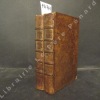
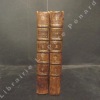
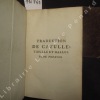
Bon état, reliure compacte malgré cuir du dos légèrement érodé avec petites fentes et manques aux coiffes - Coins frottés
Quand de Diane la lampe et autres poèmes
1984 - broché - Editions La Délirante - Publié avec le concours du Centre National des Lettres - 1984 - In-8 (24 x 15,5 cm) broché - 44 pages - Traduction de Pascal Charvet - Ouvrage tiré à 3000 exemplaires sur Ingres mbm d'Arches. Sans justificatif de tirage


Bon état - Couverture quelque peu ternie (petites taches)
L'Etna.
Paris, Société d'édition Les Belles Lettres, coll. des Universités de France, 1923. In-8 broché de [2]-XXXIV-82+43[6] pages, couverture orange imprimée en noir, premier plat orné de la louve. Petit manque en tête manque en tête, tampon à la page de titre. Non coupé.
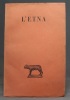
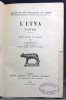
Le texte est en latin, avec la traduction en regard. Poème descriptif et scientifique attribué successivement à Virgile, Ovide, Sénèque, Pline l'Ancien, Quintilius Varus et d'autres encore.
Cambridge Gloss on the Apocalypse. Cambridge University Library Dd.X.16
, Brepols, 2020 Paperback, 167 pages, Size:156 x 234 mm, Illustrations:1 col., Language: English. ISBN 9782503582405.
Summary The Glossa in Apocalypsin (Cambridge Gloss on the Apocalypse) is a recently-discovered anonymous Hiberno-Latin (that is, authored by an Irish cleric writing in Latin) commentary on the Apocalypse of John found in a tenth-century manuscript at Cambridge University Library. This gloss is written in a similar style to other Irish-authored exegetical texts of the same period. That is, the author proceeds verse by verse through the entire Apocalypse, citing short phrases or even single words of the biblical text, followed by brief explanations that serve to clarify meaning and are often moral or allegorical in nature, as well as offering alternative interpretations of a given passage. The text has a marked dependence on the hermeneutical method of the fourth-century Donatist Tyconius as laid out in his Liber Regularum (Book of Rules), and applied in his Exposition on the Apocalypse. The Cambridge Gloss promotes an ecclesiological and spiritual interpretation of the Apocalypse, muting speculation about an imminent endtime scenario. The gloss contains numerous references to heretics, emphasises the hierarchy and the privileged role of teachers within the church, and likely dates from the eighth century, the 'Northumbrian Golden Age', exemplified by the works of Bede the Venerable and Alcuin of York. This English translation (accompanied by numerous notes) is intended to give readers an insight into understanding the viewpoint that medieval exegetes held in explaining the Apocalypse of John. The source text of this volume appeared in Corpus Christianorum, Series Latina as Glossa in Apocalypsin e codice Bibliothecae Vniuersitatis Cantabrigiensis Dd.X.16 (CC SL, 108G). References to the corresponding pages of the Corpus Christianorum edition are provided in the margins of this translation.
Utilización de las mareas de la costa patagónica.
1928 381 p., num. figs, num. folded maps at rear, paperbound. Library stamp.
Anonymus, Attilio Bartoli Langeli (ed), Eleonora Rava (ed), Filippo Sedda (ed)
Reference : 65451
Vita et Miracula Rosae de Viterbio
, Brepols, 2021 Hardback, lxxii + 154 pages, Size:155 x 245 mm, Illustrations:13 b/w, 20 tables b/w., Language(s):Latin, Italian. ISBN 9782503589985.
Summary Le poche notizie che si hanno sulla vita e i miracoli di Rosa da Viterbo, la fanciulla nata attorno al 1233 e morta nel 1251 o 1252, che diede testimonianze della sua fede al tempo di Federico II, sono note da tempo. Tutti coloro che hanno scritto di Rosa da Viterbo hanno attinto, direttamente o pi spesso indirettamente, dal verbale del processo di canonizzazione svoltosi a Viterbo al tempo di papa Callisto III, a distanza di due secoli e poco pi dalla morte della beata. Questa fonte per non conosciuta in maniera scientifica. Gli atti del processo di canonizzazione del 1457 non sono mai stati pubblicati. La Vita che vi contenuta fu pubblicata (piuttosto malamente) per la prima volta nel 1742 dal canonico viterbese Feliciano Bussi nella sua Istoria della Citt di Viterbo. Migliore, naturalmente, ma perfettibile l'edizione che della Vita e dei Miracula fecero nel 1868 i padri Bollandisti nei loro Acta Sanctorum. Nel 1952 pubblic ottimamente la Vita Giuseppe Abate. Infine, la Vita e i Miracula di Rosa hanno fatto oggetto del primo anno di attivit (2016-2017) del Laboratorio di agiografia (sottotitolo: Filologia, edizione, interpretazione delle fonti) aggregato alla Scuola superiore di studi medievali e francescani della Pontificia Universit Antonianum, ed stato pubblicato un volume che riproduce il lavoro seminariale. Della Vita e dei miracoli di Rosa si hanno, per , altri due altri testimoni, uno conservato a Parigi e uno a Parma, certamente legati al processo. Questa edizione si basa per la prima volta sul trattamento contestuale di tutti i prodotti documentari e librari ad oggi connessi all'iniziativa del 1456-57.
Extractiones de Talmud, per ordinem sequentialem
, Brepols, 2019 Hardback, cx + 712 pages, Size:155 x 245 mm, Illustrations:3 b/w, 1 tables b/w., Languages: Latin, English. ISBN 9782503582283.
Summary In 1239 Pope Gregory IX wrote to kings and bishops across Europe, urging them to seize and examine the manuscripts of the Talmud in their dominions. As a result, a process against the Talmud took place in Paris in 1240. Though the Talmud went up in flames at the Place de la Gr ve in 1241/42, the controversy on the Talmud continued over the following years, since Gregory's successor, Pope Innocent IV, called for a revision of its condemnation. At the centre of this revision are the 'Extractiones de Talmud', a translation of hundreds of Talmudic passages prepared during the years 1244/45 for Odo of Ch teauroux, Legate of the Apostolic See, that served as the basis of his final condemnation of the Talmud in May 1248. This is the first edition of the Latin Talmud, which is a milestone in the long history of Christian-Jewish intellectual encounters.
Liber de ordine creaturarum
, Brepols, 2023 Paperback, 191 pages, Size:156 x 234 mm, Language(s):English, Latin. ISBN 9782503596785.
Summary The Liber de ordine creaturarum is an anonymous Latin work with an Irish provenance that dates back to the seventh century. It presents the creation as the divine handiwork and is notable for serving as both a commentary on the Hexaemeron (Six-day Work) in Genesis and as one of the earliest works of systematic theology. Although previously attributed to Isidore of Seville, the Liber de ordine creaturarum is far more than a mere compilation of 'authorities.' Instead, it emphasizes the inherent order that exists within the creation itself. TABLE OF CONTENTS Introduction Summary Review of the Evidence for the Origin and Dating of De ordine creaturarum Spelling Influenced by the Irish Language Words with Characteristic Spellings Occurring Frequently in Hiberno-Latin Texts, but Comparatively Rarely in Other Contexts Reception Division into Chapters and Chapter Headings Latin Text with English Translation 1. The Doctrine of the Trinity 2. On Spiritual Created Beings 3. On the Waters Above the Firmament 4. The Celestial Firmament 5. The Sun and the Moon 6. The Higher Space and Paradise 7. The Lower Space and the Various Hemispheres 8. Concerning the Devil and the Nature of Demons 9. On the Nature of Water and the Behaviour of the Ocean 10. On Paradise, the First Dwelling Place of Man 11. The Disposition of the Terrestrial Orb Inhabited by Man 12. On the Nature of Man 13. On the Different Kinds of Sinners and their Places of Punishment 14. The Cleansing Fire 15. The Life to Come Appendix Notes Bibliography Abbreviations Previous Editions Ancient and Medieval Authors Modern Authors Indices Index of Biblical References Index of Patristic & Medieval Works and Councils Index of Modern Authors Index of Topics
Anonymus, Pietro Baio (ed), Alessia Miriam Berardi (ed), Rossana Eugenia Guglielmetti (ed)
Reference : 70516
Expositio in Cantica Canticorum saeculi octavi
, Brepols, 2026 Hardback, Pages: cxxviii + 225, Size:155 x 245 mm, Illustrations:3 b/w, 139 tables b/w., Languages: Latin, Italian. ISBN 9782503618845.
Summary This volume provides the editio princeps of a protocarolingian anonymous commentary on the Song of Songs, which survived in two manuscripts dated between the eighth and the ninth century; an epitome is also transmitted by a single manuscript dated two centuries later. Although the commentary's geographical origin is not clear, the author draws his exegetical themes from many different sources, such as Pope Gregory I, the Iberian Gregory of Elvira, Bede and, above all, Apponius, whose work is rarely used by subsequent authors due to its length and complexity. Both because of the use of these different sources and the author's lack of dexterity in organizing such a multiplicity of subjects into a unitary exposition, the commentary's syntax is wanting, resulting in a fragmentary discourse. Nevertheless, this commentary provides the scholarly community with a significant example of the "ordinary" exegetes' activity and their independence from their sources' original form. The edition of this work also makes a remarkable contribution to the understanding of the early medieval exegetical tradition on the Song of Songs, since it allows us to go beyond the mere knowledge of the genre's masterpieces. Il volume presenta l'edizione critica di un commento anonimo al Cantico dei Cantici del periodo protocarolingio, trasmesso nella sua versione completa da due manoscritti prodotti tra l'ottavo e il nono secolo, e in forma di epitome in un codice dell'undicesimo secolo. Bench l'origine geografica del commento non sia del tutto certa, chiaro per che l'autore recupera i temi esegetici da varie fonti, tra cui l'iberico Gregorio d'Elvira, Gregorio Magno, Beda, e, soprattutto, Apponio, il cui commento al Cantico raramente utilizzato a causa della sua complessit e lunghezza. L'uso di fonti cos diverse unito alla limitata capacit dell'autore di organizzarle in un'esposizione unitaria produce una sintassi e un discorso frammentati. Tuttavia, questo commento un esempio prezioso per comprendere l'attivit di un esegeta "ordinario", e per coglierne l'indipendenza dalla forma originale delle fonti. L'edizione di tale opera costituisce anche un notevole contributo per la comprensione della diffusione della tradizione esegetica del Cantico dei Cantici, in quanto permette di andare oltre la mera conoscenza delle opere fondative del genere. TABLE OF CONTENTS Introduzione I. Presentazione dell'opera II. Le fonti III. Sintomi di irlandesit IV. La tradizione manoscritta V. Criteri editoriali VI. Loci critici Bibliografia Anonymi Expositio in Cantica Canticorum saeculi octaui Prologus Capita I-VIII Epilogus Appendix Indices
Anonymus, Ulisse Cecini (ed), scar Luis de la Cruz Palma (ed), Alexander Fidora (ed), Isaac Lampurlan s Farr (ed)
Reference : 65140
Extractiones de Talmud. per ordinem thematicum
, Brepols, 2021 Hardback, lix + 442 pages, Size:155 x 245 mm, Language(s):Latin, English. ISBN 9782503594934.
Summary In the year 1244/45, the first Latin translation of the Talmud was completed in Paris. This translation, which is known as the Extractiones de Talmud, is extant in two versions. While the first version, edited in CC CM 291 (2018), offers an apparently unbiased presentation of the Talmudic passages following the sequence of the Talmudic treatises, the second one, which may be called the thematic Talmud translation, organizes these texts along with other materials according to thirteen chapters. The titles of these chapters clearly betray the polemic intention of the thematic translation, namely: "On the authority of the Talmud and its praise"; "On the sages and teachers of the Talmud"; "On the blasphemies against Christ and the Holy Virgin"; "On blasphemies against God"; "On what is said against the Christians"; "On errors and heresies"; "On sorcery"; "On dreams"; "On the world to come"; "On the Messiah"; "On stupidities"; "On immoral and impure things"; and "On fables". It was this second version, which also incorporated additional materials from other Jewish sources, that led to the final condemnation of the Talmud in Paris in the year 1248.
Dialogues, livre 1: Renouveau dans l'église (texte latin, note préliminaire, traduction, notes et appendice) [Sources chrétiennes, 118]
Paris, Cerf 1966 158pp., 21cm., brochure originale, dans la série "Sources chrétiennes" tome 118 (série des textes monastiques d'occident, no.18), bilingue: latin-français, bon état, R103169
S. Anselmi archiepiscopi Cantuariensis Meditationes XXI, olim a D. Gerberonio editae, quibus in hac editione accedit Meditatio, seu Liber 'De Quatuordecim Beatitudinibus' quem e cod. Mss. Eruit et, praemissa praefatione, nunc primum edit
Leodii [Liège], H. Dessain 1859 335pp., 13cm., text in Latin, modern solid hardcover binding, spine in red cloth, text and interior are clean and bright (except for very few occasional foxing), good condition, R119403
ANSELMUS CANTUARENSIS O.S.B. (Anselm of Canterbury) (& EADMER & PICARD & GERBERON Gabriel & SELDEN John)
Reference : R119829
(1675)
Sancti Anselmi ex Beccensi abbate Cantuarensis archiepiscopi Opera : nec non Eadmeri monachi Cantuarensis Historia novorum, et alia opuscula : labore ac studio.. Gabrielis Gerberon.. ad mss. fidem expurgata & aucta
Lutetiae Parisiorum [Paris], Sumpt. Ludovici Billaine et Joannis Du Puis 1675 [56] + 706 + [74] + 214 + [2] pp., with an engrvaing of Saxon seal and alphabet (on p.134, 2nd seq.), title in red and black, with printer's mark on title page, head and tail pieces, erased stamp on title page, text in Latin, 39x27cm., contemporary full leather binding (some loss of leather at corners and at ends of spine, gilt title and decorations on spine), text is clean and bright, some light staining on upper margin of text of some pages, overall a good copy, [Contains the complete of works of Anselm of Canterbury, together with "R.D. Iohannis Picardi ecclesiae S. Victoris Parisiensis Augustiniani canonic, annotations in S. Anselmi Cantuar. Archiepiscopi epistolas tribus libris prioribus contentas" (pp.550-582) & "Iohannis Seldeni in Eadmeri Historiam novorum notae" (pp.104-134, 2nd seq.), with indices], weight: 4.4 kg., cfr. OCLC 1015441124, R119829
Cur Deus Homo. Warum Gott Mensch geworden. Lateinisch und Deutsch. (Besorgt und übersetzt von F.S. SCHMITT). 5. Auflage.
Darmstadt, Wissenschaftliche Buchgesellschaft, 1993.
XII,155 p. Stiff wrappers. 22 cm (Introduction, Latin text with facing German translation)

