Write to the booksellers
-
Type
Artists' books (2)
Autographs (3248)
Books (20743)
Drawings (5)
Engravings (2)
Magazines (18)
Manuscripts (210)
Music sheets (1)
Old papers (41)
Photographs (75)
Postcards (53)
Records (2)
-
Latest
Last 24h (11)
Last 3 days (81)
Last month (335)
Last week (244)
-
Language
Czech (1)
Danish (1)
Dutch (1)
English (29)
French (24281)
German (39)
Greek (3)
Italian (20)
Latin (4)
Polish (1)
Portuguese (5)
Spanish (14)
Swedish (1)
-
Century
16th (18)
17th (21)
18th (136)
19th (3042)
20th (10786)
21st (652)
-
Countries
Belgium (68)
Brazil (5)
Canada (7)
Côte d'Ivoire (4)
Denmark (180)
France (23123)
Italy (3)
Switzerland (1010)
-
Syndicate
ALAC (5)
CLAM (3)
CLAQ (5)
CNE (1)
ILAB (9149)
NVVA (66)
SLACES (66)
SLAM (8892)
SNCAO (3522)
Autographed letter, signed ""H. C. Andersen"", for Frederik Bøgh. - [MAGNIFICENT LETTER WITH OBSERVATIONS FROM MORROCCO]
Dated ""Tanger I Marokko/ den 8 Nov: 1862."" 2 pages 8vo. In a beautiful marbled paper binding with gilt ornamental borders to boards and gilt lettering to front board (signed Rigmor Birkedal Kragh). A small paper flaw (presumably from the opening of the letter) and slight discolouration at inner hinge of f. 2, where the letter is attached in the binding. Otherwise in excellent condition.
An absolutely splendid original hand-written letter from Hans Christian Andersen to his close friend Frederik Bøgh with rare observations about Moroccan culture, the people, how they dress and behave, the food, the landscape, etc. It is clear that Tanger, with its “wild, romantic nature”, its palm trees, its wilderness, the wild boars and hyenas, is very far from the coldness of the North. Andersen’s fascination – with the “half-naked men” and women in horrible dress, with the bareheaded Moorish Jews in kaftans, “the naked brown kids that screamed and roared”, and the slaves that carry goods – leaps from the pages of the letter and paints a picture of a place that to a Dane in 1862 must seem oddly fascinating and so different. There is no doubt that this rich culture served as inspiration for Andersen (who already in 1840 had written the play “The Moorish Girl”), who specifically mentions “a real Moorish story about the ravens that I will recount when given the chance”. The letter is registered in the Andersen letter database. The contents follow here: “Kjære Ven! Tak for Deres Skrivelse, den var saa rig, den var saa velkommen! her kommer nu Brev igjen, lidt seent, men det er gaaet en lang Vei, det kommer, som De seer, fra en anden Verdens Deel" Jonas Collin og jeg ere her allerede en Ugestid og boe hos den engelske Minister Residens Sir John Drummond Hay, vi ere nu inde i Byen, men have tilbragte flere smukke Dage ude paa hans Lyststed, der ligger i en vild romantisk Natur ud til Atlanterhavet. Vifte-Palmer, Laurbær, Cacter med Stamme som trykke Træer groe i dette Vildnis Vildsviin og Hyæner mangle ikke, og saa er her en Vrimmel af Ravne, hvorfor ogsaa Stedet er døbt Ravensrock. Sir Hay fortalte mig en ægte maurisk Historie om Ravnene, den skal jeg, ved Leilighed gjenfortælle. Igaar var her Marked her i Tanger, nogle og 40 Kameler laae i Sandet uden for Byen her var en Vrimmel, halvnøgne Mænd og skrækkeligt i Sækketøi indsvøbte Qvinder jeg stavrede omkring mellem de, saae den brogede Leir, hvor de brasede Fisk, slagtede Kaniner og kogte underlige Retter. De mauriske Jøder, meest barhovede, løb i brogede Kaftaner mellem dem, nøgne brune Unger skreeg og brølede, sorte Slaver slæbte Varer frem, det var et eget Skue. I Dag er Jonas alene ude ad Veien til Tetuan, jeg har aleene vandret omkring uden for Murene, en maurisk Jøde vilde endelig have mig ind at see hans Huus, jeg fulgte ham, han viiste mig sin unge Kone og en Lille nysselig Unge, saa nøgen som vor Herre havde skabt ham. En mægtig Palme hældede sig over Huset, fra Taget kunde man øine Atlasbjergne. I Sir Hays Huus ere hele Tyendet i orientalsk Dragt, de tale arabisk, dog kan Een lidt Spansk en Anden taler ganske godt Engelsk. - Fru Hay er Dansk, hun er en Frøken Carstensen, den ældste af de halvvoxne Døttre er født i Kjøbenhavn, den yngere Alice er født i Africa. Hr. Drumond Hay har skrevet en bekjendt Bog, 'Western Barbary, its wild tribes and savage animal.' Han er en høit begavet Mand, dertil saa livlig saa hjertelig, han og hans Kone ere to velsignede sjældne Mennesker og jeg har hos dem saa ganske Følelsen af at jeg er en velkommen Gjæst. Hils Hr Pastor Blædel og Frue, Hils Hr og Fru Jerichau, bring Hilsen til hver som venlig erindrer mig Glæd mig i Madrid med Brev, adressert der til den danske Minister. Seer De Scharff og Eckard da hils! Deres hjerteligt hengivne H.C. Andersen I Eftermiddag skal jeg besøge Paschaen af Tanger, det vil vist blive ganske interessant, han veed at Collin og jeg komme med minister, alle Damerne ere flyttet til en anden Fløi af Slottet, dem faae vi ikke at see, kun den mandlige Befolkning.” [Address]: ”Til Hr Frederik Bøgh boer hos Hr Pastor Blædel, Sognepræst til Garnisonskirken. Garnisonsplads. Kjøbenhavn” Frederik Bøgh (1836-82) was born into a literary and artistic home North of Copenhagen. His uncle was a priest at Garnisonskirken in Copenhagen, and at the age of nine, Frederik was sent off to a good school in Copenhagen, where he could live with his family. It was here, in Copenhagen and at the vicarage where many famous people of the period often gathered, that he met Hans Christian Andersen, to whom he grew very close. Andersen recognized true potential in Bøgh, who sadly died at the age of 48, after almost a decade of being ill. His last ten years were not good and put a stop to his otherwise promising literary career. Frederik had a keen interest in literature, which only grew stronger through his meetings with the literary nobility of Copenhagen. On his 25th birthday, November 4th 1861, he published a work called Valkyrien. The book was quite well received, but it was published anonymously, and the identity of the author was the object to many a speculation. In his diary, Andersen writes on November 10 1861: “I found out for sure that 'Valkyrien' was by the young Bøgh! It is a particularly promising work.” Andersen is very impressed with the young budding author, and Frederik, of course, is overwhelmed by the kindness of the greatest Danish writer, whom everyone had grown to admire. In a letter on November 18, Frederik writes to his parents: “On this occasion, H.C. Andersen has met me with overwhelming love. He had quite loosely heard that I was said to be the author, and when he had read the book, he immediately sat down to write to the author but where was he to deliver it [i.e. the letter]? After that he had gone to Collins and said 'I know from a reliable source that it is him – ay, I will run there immediately'. 'You cannot do that', Collin had said, what if it is not true. Think of the uncomfortable position you will put the young man in!' After that, he had wandered back and forth in front of a certain vicarage in Bredgade, without the courage to enter. And yet – next morning he came, but he did not find me home, and I went to him. He received me with the extraordinary cordiality that is so peculiar to him: 'First I must tell you that I do not like these heroic women, who lack all femininity. So, I then began reading the book with great reluctance but when I had read a bit, I said to myself: “But he is brilliant!”, and the more I read, the more I was overcome by joy. Your book is quite poetical. It is the most important that has appeared since it went quiet [i.e. since the great author Oehlenschläger died in 1850]. All the others have twittered as little birds but you give more, you give something objectively. I am so very pleased about that that is wonderful, and now, you will see, the sunshine will come, it will come!' and then he pressed both of my hands so warmly, looked me in the eyes so lovingly, got tears in the eye – and I too. We felt good about each other, and happy and pleased I left him.” The warm bond between Frederik Bøgh and Andersen can be traced back to this moment. And from then on, a close friendship evolves, which is evident from their correspondence. And although the young author showed such great promise, he did not publish another book in his lifetime.

Autographed letter, signed ""H. C. Andersen"", for Frederik Bøgh. - [ORIGINAL HANDWRITTEN LETTER FROM TOLEDO]
Dated ""Toledo den 6 December 1862"". 1 pages 8vo. In a beautiful marbled paper binding with gilt ornamental borders to boards and gilt lettering to front board (signed Rigmor Birkedal Kragh). A few marginal restorations, else excellent condition.
A splendid original letter from Toledo, which Andersen paints so clearly as only he can. “Toledo is a dead city, but with the life of poetry”, he writes, after having described in detail, to his dear friend back home, the ruins and the melancholy that is Toledo. The letter is registered in the Andersen letter database. The full contents are: ”Kjære Ven! Nu er jeg i Toledo, en By der paa hvert Gadehjørne, fra hver Vei-Omdreining, udviser, udruller Billeder for en Maler! Ruiner og øde Bygninger, smalle, Snævre Gader, med colosale jærnbeslagne Porte og hist og her et Vindue, men oppe i anden eller tredie Etage, Alt var stenet og øde, en halv Gruushob er Toledo! men denne forunderlige Eensomhed, den hele Omegn, dens nøgne, forvittrede Klippeblokkeog den brusende kaffegule Tajo med dens rester af Bro- og Bygnings Ruiner, de melankolske Vandmøller, Alt griber forunderligt, kunde jeg give det i et Digt, det blev et udødeligt Digt. Klippegrund er Gadens Brolægning" min Stue er en gammel Riddersal, Ildfadet kan ikke opvarme den to store Lys ikke belyse den Flaggermusen slaaer mod Ruden hele Aftenen sidder jeg her i Eensomhed, Toledo er en død By, men med Poesiens Liv. Overmorgen tager jeg til Madrid, der er Snee og kjøbenhavnsk Climat, her har endnu Solen Varme! Glæd mig med et Brev poste restante i Bayonne jeg kommer ved Nytaarstid ind i Syd-Frankerige her i Nord Spanien vil blive mig for koldt at være i Januar. Hils Pastor Blædelse, hils Jerchaus og alle kjære Venner og bliv selv mellem disse een af de Udholdende. Deres hengivne H.C. Andersen” [Address:] ”Til Hr Frederik Bøgh. Adresse: Velærværdige Hr. pastor Blædel Sognepræst til Garnisonskirken, Garnisonspladsen i Kjøbenhavn” Frederik Bøgh (1836-82) was born into a literary and artistic home North of Copenhagen. His uncle was a priest at Garnisonskirken in Copenhagen, and at the age of nine, Frederik was sent off to a good school in Copenhagen, where he could live with his family. It was here, in Copenhagen and at the vicarage where many famous people of the period often gathered, that he met Hans Christian Andersen, to whom he grew very close. Andersen recognized true potential in Bøgh, who sadly died at the age of 48, after almost a decade of being ill. His last ten years were not good and put a stop to his otherwise promising literary career. Frederik had a keen interest in literature, which only grew stronger through his meetings with the literary nobility of Copenhagen. On his 25th birthday, November 4th 1861, he published a work called Valkyrien. The book was quite well received, but it was published anonymously, and the identity of the author was the object to many a speculation. In his diary, Andersen writes on November 10 1861: “I found out for sure that 'Valkyrien' was by the young Bøgh! It is a particularly promising work.” Andersen is very impressed with the young budding author, and Frederik, of course, is overwhelmed by the kindness of the greatest Danish writer, whom everyone had grown to admire. In a letter on November 18, Frederik writes to his parents: “On this occasion, H.C. Andersen has met me with overwhelming love. He had quite loosely heard that I was said to be the author, and when he had read the book, he immediately sat down to write to the author but where was he to deliver it [i.e. the letter]? After that he had gone to Collins and said 'I know from a reliable source that it is him – ay, I will run there immediately'. 'You cannot do that', Collin had said, what if it is not true. Think of the uncomfortable position you will put the young man in!' After that, he had wandered back and forth in front of a certain vicarage in Bredgade, without the courage to enter. And yet – next morning he came, but he did not find me home, and I went to him. He received me with the extraordinary cordiality that is so peculiar to him: 'First I must tell you that I do not like these heroic women, who lack all femininity. So, I then began reading the book with great reluctance but when I had read a bit, I said to myself: “But he is brilliant!”, and the more I read, the more I was overcome by joy. Your book is quite poetical. It is the most important that has appeared since it went quiet [i.e. since the great author Oehlenschläger died in 1850]. All the others have twittered as little birds but you give more, you give something objectively. I am so very pleased about that that is wonderful, and now, you will see, the sunshine will come, it will come!' and then he pressed both of my hands so warmly, looked me in the eyes so lovingly, got tears in the eye – and I too. We felt good about each other, and happy and pleased I left him.” The warm bond between Frederik Bøgh and Andersen can be traced back to this moment. And from then on, a close friendship evolves, which is evident from their correspondence. And although the young author showed such great promise, he did not publish another book in his lifetime.
Autographed letter, signed ""H. C. Andersen"", for ”Kjære William” (i.e. William Melchior). - [UTTERLY CHARMING BIRTHDAY LETTER IN THE FORM OF A LITTLE STORY]
Dated ""Frijsenborg den 27 August/ 1868."" 1 page 8vo. In a lovely green marbled paper binding with gilt lettering to front board. Old machine-written description pasted on to inside of back board. Letter professionally strengthened in the folds from verso, but in excellent condition.
An original handwritten letter from Andersen, being a lovely, cheerful birthday letter for the young birthday boy William Melchior, who was turning 7 years old. The letter is utterly charming and describes the journey of the birthday letter itself, flying over land and sea, from Jutland to Copenhagen. The letter not only portrays the ease with which Andersen communicates with children, it also constitutes a miniature version of beloved Andersen-stories such as “Little Tuk” and “A Piece of Pearl String”. William Melchior was the son of Moritz Melchior’s brother Israel, from his first marriage. Sadly, Andersen’s little friend died tragically later the same year, and this was to be his last birthday. The letter is published as no. 399 in Breve fra Andersen. The contents are as follows: ""Kjære William! Goddag! Gratulerer! mange Godter i det nye Aar! Mit Brev flyver gjennem Luften til Dig, hen over det Land, hvor de gjøre Jydepotter til at koge Din Middagsmad i" det flyver over det salte Vand, hvor Fiskene voxe for at blive spiste af Dig" det flyver henover Sjælland, hvor Nødderne groe, som Du skal knække, og hvor Æblerne groe, som Du skal have ondt i Maven af. Noget Ondt maae vi Alle have, ellers spiste vi for mange Æbler. Mit Brev er nu altsaa hos Dig! God Dag! Gratulerer! mange 'Godter'! Din Ven H.C. Andersen.""
Autographed letter, signed ""H. C. Andersen"", for Frederik Bøgh. - [BEAUTIFUL AND HEARTFELT LETTER FRO ANDERSEN'S CLOSE FRIEND]
Dated ""den 9 Maj 1873"". 2 pages 12mo. In a beautiful marbled paper binding with gilt ornamental borders to boards and gilt lettering to front board (signed Rigmor Birkedal Kragh).
Original handwritten letter from Andersen to his close friend Frederik Bøgh. This Beautiful little letter for Frederik Bøgh bears witness to the heartfelt bond that Andersen felt towards his young friend. This little gem of a letter is very poetical – most of it is almost like a poem, describing the sun coming through the clouds and likening the clouds to snow and the heaven to Paradise. Furthermore, Andersen mentions his friends’ illness, likening him to a bird that needs to be free. Bøgh had fallen ill the previous year, from an illness that would eventually kill him 9 years later, at the mere age of 45. Later research has shown that he had sclerosis. The letter is published in the Andersen letter database. The full contents are: ""Kjære Ven! Tak for Deres hjærtelig Brev" jeg fik Deres levende ord og Deres Kones Haandskrift, altsaa Brev fra Dem Begge To" gid vi havde Dem hernede ved den rullende, blaa Genfersø under de hængende, grønne Pile. De skulde se Solen løfte Skygardinerne tilside, Dent du midi med sin evige Sne vilde være Dem som et lille Stykke af Paradis med den aabne blaa Himmel bag ved - - - Paa Søndag stige vi lidt højere op, vi tage Sæde paa Glion, hvor Alt er grønt og blomstrende, men hvor dog Sneen ligger og venter paa at løses for som et Vandfald at styrte sig ned i den glasgrønne Sø. Flyv nu snart ud, bliv rask, og syng os en Sang fra Tyrols Bjerge. Deres hjærtelig hengivne H. C. Andersen."" Frederik Bøgh (1836-82) was born into a literary and artistic home North of Copenhagen. His uncle was a priest at Garnisonskirken in Copenhagen, and at the age of nine, Frederik was sent off to a good school in Copenhagen, where he could live with his family. It was here, in Copenhagen and at the vicarage where many famous people of the period often gathered, that he met Hans Christian Andersen, to whom he grew very close. Andersen recognized true potential in Bøgh, who sadly died at the age of 48, after almost a decade of being ill. His last ten years were not good and put a stop to his otherwise promising literary career. Frederik had a keen interest in literature, which only grew stronger through his meetings with the literary nobility of Copenhagen. On his 25th birthday, November 4th 1861, he published a work called Valkyrien. The book was quite well received, but it was published anonymously, and the identity of the author was the object to many a speculation. In his diary, Andersen writes on November 10 1861: “I found out for sure that 'Valkyrien' was by the young Bøgh! It is a particularly promising work.” Andersen is very impressed with the young budding author, and Frederik, of course, is overwhelmed by the kindness of the greatest Danish writer, whom everyone had grown to admire. In a letter on November 18, Frederik writes to his parents: “On this occasion, H.C. Andersen has met me with overwhelming love. He had quite loosely heard that I was said to be the author, and when he had read the book, he immediately sat down to write to the author" but where was he to deliver it [i.e. the letter]? After that he had gone to Collins and said 'I know from a reliable source that it is him – ay, I will run there immediately'. 'You cannot do that', Collin had said, what if it is not true. Think of the uncomfortable position you will put the young man in!' After that, he had wandered back and forth in front of a certain vicarage in Bredgade, without the courage to enter. And yet – next morning he came, but he did not find me home, and I went to him. He received me with the extraordinary cordiality that is so peculiar to him: 'First I must tell you that I do not like these heroic women, who lack all femininity. So, I then began reading the book with great reluctance but when I had read a bit, I said to myself: “But he is brilliant!”, and the more I read, the more I was overcome by joy. Your book is quite poetical. It is the most important that has appeared since it went quiet [i.e. since the great author Oehlenschläger died in 1850]. All the others have twittered as little birds but you give more, you give something objectively. I am so very pleased about that" that is wonderful, and now, you will see, the sunshine will come, it will come!' and then he pressed both of my hands so warmly, looked me in the eyes so lovingly, got tears in the eye – and I too. We felt good about each other, and happy and pleased I left him.” The warm bond between Frederik Bøgh and Andersen can be traced back to this moment. And from then on, a close friendship evolves, which is evident from their correspondence. And although the young author showed such great promise, he did not publish another book in his lifetime. In the spring of 1872, at the mere age of 35, disaster struck: Frederik Bøgh suddenly fell ill. In the biography about him that his wife wrote in 1887, it is described thus: ""His hands lost strength and he could not walk. Little did we know that these were the certain symptoms of the spinal cord disease that he had built up for so long and which was now slowly working its way forward"". It is this horrible illness that Andersen alludes to in the last of the letters that we have gathered here, dated about a year after Fredrik first fell ill, where he poetically describes how he ought to be set free and fly freely about. Later that year, in 1872, Andersen writes in his diary “then Frederik Bøgh came. He talked sickly, called himself 'the cripple', confided in me that for more than a year he had lived with the thought that I was upset with him, that I had felt disappointed with his gift as a poet… I wrote a few warm words in a copy of my new book and he walked away happily.” “The Cripple” was the title of a new fairy tale that Andersen had written and that Fredrik Bøgh had just reviewed. He presumably identified with Andersen’s “Cripple”, who was described as “the liveliest and nicest child, but then suddenly he became 'floppy in the legs', as they called it, he could not stand or walk and now he was lying in bed for the fifth year.” It would only be another three weeks till Frederik Bøgh took his last steps on the streets, December 14th, 1872. After that he completely lost the strength in his arms and later also his eyesight. Due to his wive’s thorough description of the symptoms in his biography, later research has been able to determine that he suffered from sclerosis, an illness that would eventually kill him 10 years later, on January 31st 1882. At the time, the illness was a mystery and the doctors had no clue what to do. Apparently, the description in the biography constitutes the first described case of disseminated sclerosis in Denmark.
"[ANDERSEN, H.C.] F. ANDERSEN, C.J. HANSEN, J.P.E. HARTMANN, P. HEISE and A. WINDING.
Reference : 63552
(1866)
Ni Fleerstemmige Mandssange. Udgivne af Foreningen ""Fremtiden"". - [EXCEEEDINGLY SCARCE BOOK FROM ANDERSEN'S LIBRARY]
Kjöbenhavn, 1866. Uncut and unopened in the original printed, illustrated wrappers. The paper on spine is gone and the wrappers have been fastened professionally with thin ricepaper, which has also been used to back the front wrapper, preventing the corners from chipping further. Very nicely restored. A bit of chipping to top of back wrapper and wrappers with some brownspotting. 37 pp. of musical scores with text.
Very rare example of a book from Hans Christian Andersen's library. Hans Christian Andersen's own copy, with his ownership signature to the bottom of the front wrapper, of this pamphlet of ""Nine Polyphonic Male Songs"". The pamphlet contains nine lovely songs written by the greatest Danish authors of the period, set to music by the most famous Danish musicians of the period. Andersen's contribution is the song ""Hun har mig glemt"" (She Has me Forgotten), which he had printed for the first time in 1854, but in a different version, with different wording. Here, it is set to music by F. Andersen. Our main sources of knowledge about Hans Christian Andersen’s library come from two publications: the auction catalogue of his books, after his death, and the auction catalogue of Edvard Collin’s books ten years later. Edvard Collin was the universal heir to Andersen’s entire estate and he kept many of Andersen’s books that therefore did not enter the auction catalogue after Andersen, but that were then sold after he died. Our knowledge about these collections is gathered in Estrid and Erik Dal’s work “Fra H.C. Andersen’s Boghylde”, from 1961. Here it is stated that 75 Danish books from Andersen’s library have been located, although only of them were present at the auction of his belongings. The auction record, in other words, “is an inadequate witness to what he owned at his death, an even more so throughout his life.” (p. 12). It is, however, the best we have collected in one place. As long as we remember that he also owned books that were not present in this catalogue. Whereas the importance of presentation copies from Andersen were quite overlooked at the time, Dal rightly note that ”Presentation copies to Andersen, or books in which he has written his ownership signature, belong to him in quite another manner, and in some cases they shed rays of light on their owner, maybe even rays that enlighten otherwise unknown details.” (p.10). Books from Andersen's library are of the utmost scarcity and almost never appear on the market. We have only ever encountered very few.
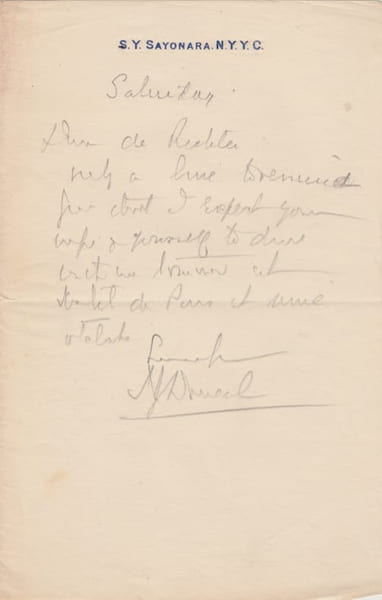
Lettre autographe au crayon signée à Charles de Richter,
1931 S.Y.Sayonara -,1p.
steam yacht 'Sayonara'- provenance archives Charles de Richter - RICHTER (Charles de). Remise de 20% pour toutes commandes supérieures à 200 €

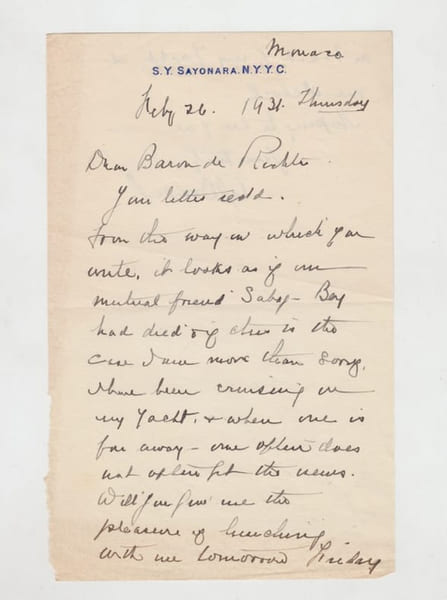
Lettre autographe signée à Charles de Richter,
1931 S.Y.Sayonara - Monaco 1931,2p.
steam yacht 'Sayonara'- provenance archives Charles de Richter - RICHTER (Charles de). Remise de 20% pour toutes commandes supérieures à 200 €


Enchantements et réalités. Poésies suivies de poèmes en prose. I. L'Enclos de volupté anciennement les Erotiques. II. Auseuil des choses. III. le jardin de la vie. IV. Poèmes en prose.
1909 Tananarive, Madagascar, Imprimerie du Progrès, 1909; in-12 broché de (6) -187pp.; couverture beige imprimée en noir. Envoi autographe signé de l'auteur " à mon camarade et compatriote Jules Amirault de Châteauroux" . Exemplaire n°66, numéroté à la main par l'auteur sous la dédicace.
L'auteur est originaire de La Châtre, il a dédié certains de ses poèmes à des auteurs berrichons, Hector de Corlay, "A George Sand Pour la Cité berrichonne de la Châtre ma ville natale", Gabriel Nigond,etc., il a ajouté à la main une précision pour le poème Diptyque .I. La Rose " (1) Musique de Charles Denis". ( CO1/CH1)

Petit Missel de l'ame sans voile. Avec une préface de G. F. G et des lettres d'Edmond Rostand.. et d'Emile Boutroux...1ère édition.
1920 Tananarive, Imprimerie Typo-Litho Lavigne, 1920 ; in-12° broché, couverture jaune imprimée en rouge et noir au 1er plat, en noir au dos; 249pp. ( titre en noir et rouge).
Envoi autographe signé de l'auteur à "Georges Legendre..." daté de la Chatre ( Indre) 25 mars 1924. Recueil de poésies dont plusieurs sont consacrées au Berri, à l'Indre, évoquant ses auteurs célèbres : Latouche, George Sand, Lapaire, des Gachons, Rollinat, de Corlaix, etc..., à la Châtre ( vile natale du poète), et d'autres aux souvenirs d'Egypte, de Madagascar, etc... (C01)
Lumière d'épouvante.
Paris, Editions Denoël, 1956. In-12, broché, non coupé, 182 pp.


Édition originale. Exemplaire du S.P. (Il n'a été tiré que 15 exemplaires numérotés). Envoi autographe de l'auteur à Germaine BEAUMONT.
Lettre Autographe militaire signée d'André.
Lettre Autographe militaire signée d'André (Antoine Joseph Maurice). Avec notice biographique.Rapport du 8 février 1830. Police de la Garde.Le marquis Antoine Joseph Maurice d'André (1788-1860) est un général et sénateur français.Il est le fils d'Antoine Balthazar Joachim d'André, ancien député de la noblesse de Provence aux États généraux.Né à Aix-en-Provence (Bouches-du-Rhône), le 20 janvier 1788, il suit son père en émigration, et est élevé à l'école militaire de Vienne. Il entre dans la cavalerie autrichienne comme cadet en 1800.Il est lieutenant dans le régiment des chevau-légers de l'Empereur d'Autriche lorsqu'en 1809 un décret de Napoléon Ier, daté de Schönbrunn, rappelle dans les armées françaises les officiers nés Français qui servaient à l'étranger. Obtempérant à cet ordre, le jeune d'André rentre en France et participe aux campagnes de la Grande Armée comme officier de chasseurs à cheval. Fait chef d'escadron de gendarmerie en 1814, il suit Louis XVIII à Gand lors des Cent-Jours. Il sert comme grand prévôt de l'armée lors de l'expédition d'Espagne en 1823. Colonel de la gendarmerie d'élite lors de la Révolution de Juillet, il reste fidèle à Charles X jusqu'à la dernière extrémité. Promu maréchal de camp le 11 août 1830 et créé baron par lettres patentes du 7 décembre 1830, mais licencié avec ses hommes par le nouveau régime, il n'est rappelé à l'activité qu'en 1837. Il est ensuite successivement employé comme commandant militaire des départements du Jura puis des Ardennes. Promu général de division le 14 avril 1844, il sert comme inspecteur de la gendarmerie puis comme chef de la 5e division militaire et gouverneur de Strasbourg. Le Second Empire le nomme sénateur en 1852.Le général d'André décède le 7 janvier 1860 à Paris. Il était Grand officier de la Légion d'honneur.LAS 1 page pliée. Format in-4°(30x20). Très bon état.

Apprenez à connaître et à élever les bonnes volailles d'antan. Poules, canards, oies, dindons, pintades.
Editions Rustica Paris 1993 In-8 carré ( 245 X 200 mm ) de 141 pages, cartonnage illustré en couleurs. Très nombreuses photographies en couleurs dans et hors-texte. Edition originale. Très bel exemplaire enrichi d'un bel envoi autographe signé de l'auteur à Jean-Pierre COFFE. De la bibliothèque de Jean-Pierre COFFE avec son timbre humide.


Bribes poétiques.
Port-au-Prince Imprimerie H. Chauvet 1900 1 vol. relié in-16, bradel demi-toile verte, 171 pp. Edition originale de ce recueil de poèmes par un barbier italien établi en Haïti (Max Bissainthe, Dictionnaire de bibliographie haïtienne). Tirage unique à 200 exemplaires numérotés, celui-ci bien complet du portrait-charge en frontispice et enrichi d'un envoi de l'auteur sous forme de quatrain. Epidermures et petites mouillures au dos de la reliure, mors un peu fragilisé. Sinon état convenable. Rare.
Déclenchements.
Genève, Naville & Cie, 1932. In-8 broché de 104 p.


Aphorismes, illustrés de nombreux dessins de Gustave François. Avec un envoi autographe signé de l'auteur et de l'artiste, ainsi qu'un (joli) dessin original de ce dernier sur garde.
[Typographie d'Edouard Huder] - ANDRE, Stéphane, de Pionsat (Puy-de-Dôme), Elève de l'Ecole du Service de Santé Militaire
Reference : 48765
(1867)
Des Fractures de l'Olécrane. Thèse présentée à la Faculté de Médecine de Strasbourg, soutenue le 15 janvier 1868 [ Edition originale - Livre dédicacé par l'auteur ]
1 vol. in-4 br., Typographie de G. Silbermann, Strasbourg, 1867, 39 pp.


Bon état (petite mouill. sur couv. en queue). Envoi de l'auteur au Docteur Ducourneau. L'Ecole Impériale du Service de Santé Militaire de Strasbourg fut instituée 1856 par Napoléon III et formera près de 1054 médecins pendant ses 14 années de fonctionnement. Les conditions de travail devaient y être difficile, car nombre d'élèves évoquent une vraie souffrance.
L'aéroport Charles-de-Gaulle. Le Module d'échanges. [ exemplaire dédicacé ]
1 vol. in-folio relié pleine toile éditeur sous jaquette illustrée, coll. Les Cahiers de Projets, Aéroports de Paris, 1994, 125 pp.


Exceptionnel exemplaire, dédicacé par l'architecte Paul Andreu (1938-2018) au grand mathématicien et philosophe français René Thom. Honoré par la Médaille Fields en 1958, le mathématicien français René Thom (1923 - 2002) est le célèbre fondateur de la théorie des catastrophes. Quant à l'auteur, Polytechnicien, ingénieur des Ponts et Chaussées et archtiecte, il est connu particulièrement pour les nombreux aéroports dont il a conçu les plans. Bon exemplaire.
Photographie signée par le cosmonaute Andrian Grigorievitch Nikolaïev
s. n. | s. l. 1971 | 10.5 x 13 cm | Une photographie
Photographie originale en noir et blanc, tirée à 50 exemplaires numérotés, représentant Andrian Grigorievitch Nikolaïev lors de sa venue en Suisse en juillet 1971. Bel exemplaire. Tampons imprimés au verso du cliché identifiant le cosmonaute, sa date de venue en Suisse ; comportant également la numérotation du cliché (10/50) et mentionnant le nom de la "Boutique russe" à Genève. Signature manuscrite d'Andrian Grigorievitch Nikolaïev au feutre bleu en angle inférieur gauche du cliché. Andrian Grigorievitch Nikolaïev a fait partie du tout premier groupe de cosmonautes soviétiquessélectionnés enmars 1960, il est le troisième cosmonaute à se rendre dans l'espace. Sa venue en Suisse s'effectua après la réussite du programme spatial soviétique Soyouz 9 auquel participèrent Andrian Grigorievitch Nikolaïev et Vitali Sevastyanov. Provenance : du fonds du grand collectionneur d'autographes suisse Claude Armand. - Photographies et détails sur www.Edition-Originale.com -
Rapport à M. le Ministre du Commerce et de l'Industrie sur l'Alcool à l'Exposition de Genève de 1896 et sur les conséquences du monopole de l'alcool en Suisse au point de vue commercial [ Edition originale - Livre dédicacé par l'auteur ].
1 vol. grand in-8 br. sous couverture rempliée, Librairie Guillaumin et Cie, Éditeurs du Journal des Économistes, Paris, 1897, 272 pp. Rappel du titre complet : Rapport à M. le Ministre du Commerce et de l'Industrie sur l'Alcool à l'Exposition de Genève de 1896 et sur les conséquences du monopole de l'alcool en Suisse au point de vue commercial


Mention autographe "Hommage de l'auteur" non signée en garde. Bon état (un trait de plume au second plat, bon exemplaire par ailleurs).
LA FONTAINE DIVINE
1927 Edition des CAHIERS DU SUD 1927 br.- 363p.-envoi aut.auteur à Victor CHABRIER..


Curieux roman qui se déroule à Divonne. Le manuscrit fut transmis pendant 50 ans avec interdiction de le lire. Au bout de ce délais, Fortuné Andrieu nous livre l'histoire d'amour qui enflamma Robert de Fos, comte d'Olbie et Charlotte de Raccomigi, comtesse Cannero. Remise de 20% pour toutes commandes supérieures à 200 €
Messages imaginaires.
Paris Seghers, coll. "Poésie 53" 1953 1 vol. broché plaquette in-12, agrafée, couverture à rabats en couleurs sur fond crème, 39 pp. Edition originale. Envoi de l'auteur à G.-E. Clancier. Dos et couverture légèrement jaunis, sinon bon état.
Les Oubliés. Le poète romantique Justin Maurice.
Paris, Lechevalier, Villeneuve-sur-Lot, Imprimerie Ve Ed. Chabrié et fils, 1890 ; brochure garnd in-8°, couverture belue imprimée en noir au 1er plat et dos; 47pp.(1)f.Couverture un peu défraichie, dos passé, avec petits manques en tête et pied.Envoi autographe signé de l' auteur.
Le poète agenais Pierre-Justin Maurice naquit aux Douzils, commune du Passage-d'Agen, le 19 juin 1810. (GrG)
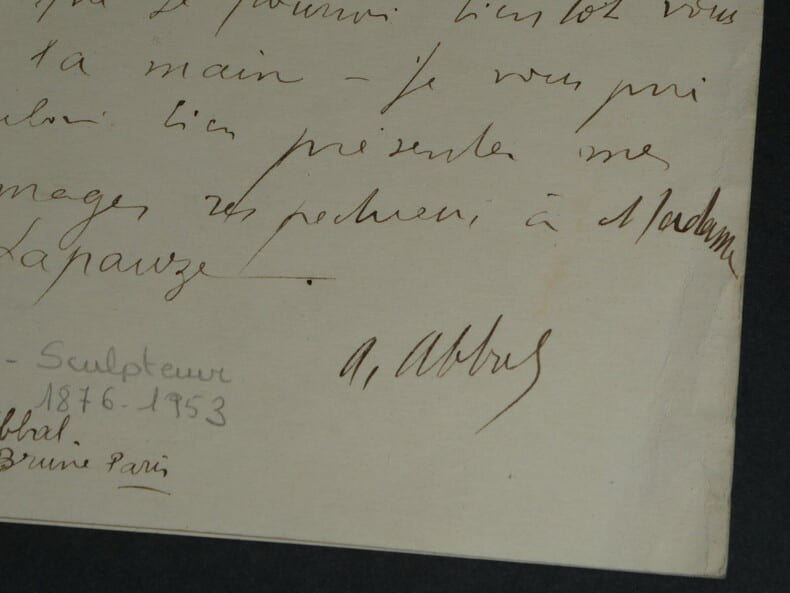
André Abbal Lettre autographe signée à Henry Lapauze [victorieux de votre mal]
André Abbal Lettre autographe signée à Henry Lapauze [victorieux de votre mal] Sculpteur Lettre autographe signée du Sculpteur André Abbal, non datée, adressée à Henry Lapauze, sur un double feuillet. "Cher Monsieur et ami, J'ai appris par les journaux que vous avez subi une opération j'espère ardemment que vous serez victorieux de votre mal, et que je pourrai bientôt vous serrer la main. Je vous prie de vouloir bien présenter mes hommages respectueux à Madame Henry Lapauze." Dimensions : 14 x 18 cm. État : Voir photos pour plus de détails. Nombre de pages : 1 page André ABBAL André Joseph Géraud Abbal né le 16 novembre 1876 à Montech et mort le 20 juin 1953 à Carbonne est un sculpteur français. Il doit sa renommée pour ses sculptures en pierre en taille directe. Wikipédia Henry LAPAUZE Charles Lapause, dit Henry Lapauze, né à Montauban le 31 janvier 1867 et mort à Paris le 9 avril 1925, est conservateur du Palais des Beaux-arts de la Ville de Paris et critique d'art. Wikipédia Contactez-nous Lettres autographes, vieux papiers, livres anciens, photographies, gravures, timbres... Nous expertisons et/ou rachetons dans toute la France vos lettres, collections de lettres et livres anciens. Paiement Sont acceptés les paiements par eBay, par PayPal, par virement ou par chèque. Envoi Envoi soigné dans un emballage rigide et étanche sous trois jours. Prévoir les délais postaux habituels en plus. Retour Satisfait ou remboursé. Si vous n'êtes pas entièrement satisfait, retour à la charge du vendeur pour l'Europe. À la charge de l'acheteur pour le reste du monde.


André Abbal [Sculpteur] - Lettre autographe signée à H. Lapauze - 1914
André Abbal [Sculpteur] - Lettre autographe signée à H. Lapauze - 1914 Dimensions : 11 x 17,7 cm. État : Voir photos pour plus de détails. Nombre de pages : 2 pages André ABBAL André Joseph Géraud Abbal né le 16 novembre 1876 à Montech et mort le 20 juin 1953 à Carbonne est un sculpteur français. Il doit sa renommée pour ses sculptures en pierre en taille directe. Henry LAPAUZE Charles Lapause, dit Henry Lapauze, né à Montauban le 31 janvier 1867 et mort à Paris le 9 avril 1925, est conservateur du Palais des Bea.
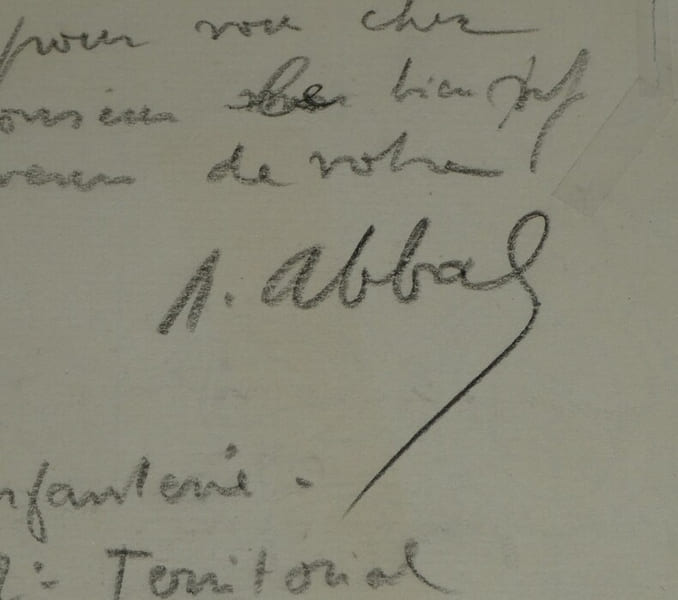


"je suis certain maintenant que mon Tarn et Garonne ne reviendra pas à l'atelier..." Lettre autographe signée à propos de l'une de ses oeuvres
Paris s. d. [ca 1941] | 14 x 15.50 cm | une page sur un double feuillet
Lettre autographe signée du sculpteur André Abbal adressée,13 lignes à l'encre noire sur un feuillet double. Trace de pliure inhérente à l'envoi postal. Le sculpteur évoque ses différentes productions :"je suis certain maintenant que mon Tarn et Garonne ne reviendra pas à l'atelier. Tranquille de ce côté je vais travailler ferme à d'autres choses qui m'intéressent beaucoup..." André Abbal, élève d'Alexandre Falguière, est réputé pour ses sculptures en pierre en taille directe. - Photographies et détails sur www.Edition-Originale.com -
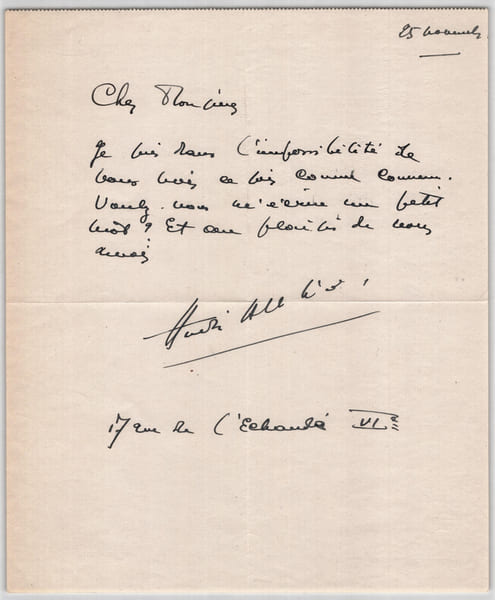
André Allard l'Olivier - Poète - LETTRE AUTOGRAPHE SIGNÉE
André Allard l'Olivier - LETTRE AUTOGRAPHE SIGNÉE Peintre Datée du 25 décembre (année non précisée), cette lettre manuscrite témoigne du quotidien et des échanges épistolaires d'André Allard l'Olivier, poète. Dimensions : 25.4 x 21 cm État : Voir photos et description pour plus de détails. Nombre de pages : 1 André Allard l'Olivier André Allard l'Olivier né le 3 décembre 1913 à Paris et mort le 23 mars 1985 à Luxembourg est un poète et écrivain belge.