 Write to the booksellers
16 books for « zeeman p »Edit
-
Type
Book (15)
Maps (1)
-
Century
17th (1)
19th (4)
20th (5)
-
Topics
Geographical maps (1)
Greek (1)
Latin (1)
Magazine (1)
Medicine (2)
Nobiliary heraldry (1)
Physics (5)
Poetry (1)
Russia (1)
Tea (1)
-
Countries
Belgium (5)
Denmark (4)
France (6)
Netherlands (1)
-
Syndicate
ILAB (7)
SLAM (3)
The Effect of Magnetization on the Nature of light Emitted by a Substance. - [THE ZEEMAN-EFFECT - NOBEL PRIZE IN PHYSICS 1902]
London, Macmillan & Co, 1896-97. Royal8vo. Bound in contemporary half calf with gilt lettering to spine. In ""Nature"", Vol. 55, November 1896 - April 1897. Bookplates to front free end-papers and library stamp to title page. Minor wear to extremities, otherwise very fine and clean. P. 347. [Entire volume: XL, 624 pp.].
First English edition of this landmark paper in which the Zeeman-effect was first announced. It is one of the most important and influential discoveries made in the later half of the 19th century. ""The Zeemann effect not only opened a new world of facts which interest the physicist, the chemist, and even the astronomer, but the study also contributed - to an extent much greater than the study of the Stark effect - to the conceptual development of quantum theory"" (Jammer). Together with Lorenz, Zeeman was awarded the Nobel Prize in Physics for ""the extraordinary service they rendered by their researches into the influence of magnetism upon radiation phenomena"". ""The last experiment performed by Michael Faraday was an unsuccessful attempt to observe the influence of a magnetic field on the spectral lines of sodium. More than 30 years later, Pieter Zeeman took up the challenge and observed a broadening of the lines, which was soon recognized to be the splitting that we know as the Zeeman effect. Zeeman's account of the discovery, translated for Nature from the Proceedings of the Physical Society of Berlin, includes an interpretation based on Hendrik Lorentz's idea of ""small molecular elements charged with electricity"", and a rough calculation of the charge to mass ratio of these ""ions""."" (Nature Physics Portal).""Zeeman is best remembered for his observations in 1896 of the mageto-optic phenomenon that almost immediately was named the Zeeman effect. His experimental discovery was not fortuitous, but the fruition of theoretical views that had motivated attempts over a span of thirty-five years to detect some such interaction between magnetism and light. Zeeman's initial observations were beautifully comprehended by H.A.Lorentz' electromagnetic theory, which also served to guide Zeeman in the very early refinement and extension of his discovery. As a result Zeeman and Lorentz shared the 1902 Nobel Prize for physics in recognition of their accomplishment and of the promise, since overwhelmingly fulfilled, of the Zeeman effect for contributing to the understanding of spectra and the particulate structure of matter."" (DSB).

The Effect of Magnetization on the Nature of light Emitted by a Substance. - [THE ZEEMAN-EFFECT - NOBEL PRIZE IN PHYSICS 1902]
London, Macmillan & Co, 1896-97. Royal8vo. Bound in later half cloth with gilt lettering to spine. In ""Nature"", Vol. 55, November 1896 - April 1897. Bookplates to front free end-papers and library stamp to title page. Minor wear to extremities, otherwise very fine and clean. P. 347. [Entire volume: XL, 624 pp.].
First English edition of this landmark paper in which the Zeeman-effect was first announced. It is one of the most important and influential discoveries made in the later half of the 19th century. ""The Zeemann effect not only opened a new world of facts which interest the physicist, the chemist, and even the astronomer, but the study also contributed - to an extent much greater than the study of the Stark effect - to the conceptual development of quantum theory"" (Jammer). Together with Lorenz, Zeeman was awarded the Nobel Prize in Physics for ""the extraordinary service they rendered by their researches into the influence of magnetism upon radiation phenomena"". ""The last experiment performed by Michael Faraday was an unsuccessful attempt to observe the influence of a magnetic field on the spectral lines of sodium. More than 30 years later, Pieter Zeeman took up the challenge and observed a broadening of the lines, which was soon recognized to be the splitting that we know as the Zeeman effect. Zeeman's account of the discovery, translated for Nature from the Proceedings of the Physical Society of Berlin, includes an interpretation based on Hendrik Lorentz's idea of ""small molecular elements charged with electricity"", and a rough calculation of the charge to mass ratio of these ""ions""."" (Nature Physics Portal).""Zeeman is best remembered for his observations in 1896 of the mageto-optic phenomenon that almost immediately was named the Zeeman effect. His experimental discovery was not fortuitous, but the fruition of theoretical views that had motivated attempts over a span of thirty-five years to detect some such interaction between magnetism and light. Zeeman's initial observations were beautifully comprehended by H.A.Lorentz' electromagnetic theory, which also served to guide Zeeman in the very early refinement and extension of his discovery. As a result Zeeman and Lorentz shared the 1902 Nobel Prize for physics in recognition of their accomplishment and of the promise, since overwhelmingly fulfilled, of the Zeeman effect for contributing to the understanding of spectra and the particulate structure of matter."" (DSB).
Lignes doubles et triples dans le spectre, produites sous l'influence d'un champ magnetique exterieur.
(Paris, Gauthier-Villars), 1897. 4to. No wrappers. In: ""Comptes Rendus Hebdomadaires des Séances de L'Academie des Sciences"", Tome 124, No 25. Pp. (1407-) 1486. (Entire issue offered). Zeeman's paper: pp. 1444-1445.
First French version of this importent paper in which Zeeman observed for the first time the splitting of the spectral lines into doublets and triplets. Here we have the first appearance of a charged particle much lighter than an atom, the first glimpse at the electron.""In the spring of 1897, after his move to the University of Amsterdam, Zeeman resolved a magnetically ""broadened"" spectral line into the triplet of distinct polarized components that the Lorentz theory predicted for a sufficiently intense magnetic field. This in a very real sense was the peak of the Zeeman-Lorentz investigation of the Zeeman effect.""(DSB).
Recent progress in Magneto-Optics
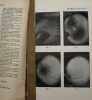
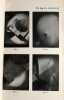
London, William Clownes and sons, 1908, in-8, de 12 pages et 8 planches, Broché, sans couverture, Rare tiré à part portant un envoi de l'auteur, Pieter Zeeman (1865-1943), à Jean Becquerel (1878-1953). Le physicien néerlandais et le physicien français étaient en correspondance dans les années 1910-1930. Zeeman, spécialiste reconnu de magnéto-optique, révéla à Leyde que le champ magnétique modifie le processus d'émission de la lumière : cette contribution, d'abord nommée "phénomène de Zeeman", est désormais connue comme "l'effet Zeeman". Couverture rigide
Bon de 12 pages et 8 planches

On the Influence of Magnetism on the Nature of the Light Emitted by a Substance
London, Taylor & Francis, Mars 1897, in-8, pp. 226 à 239 (6 numéros en 1 volume, 468 pp, 3 pl.), Broché, couverture imprimée de l'éditeur (2nd plat et dos factices), Traduction anglaise des deux articles originaux de Pieter Zeeman (1865-1943) et de l'Appendice correspondant, présentés en octobre 1896 à l'Académie royale des sciences d'Amsterdam et publiée en néerlandais dans comptes-rendus de cette société*. La version anglaise a paru simultanément dans les Communications from the Physical Laboratory of the University of Leiden (n° 33). C'est dans cet article que Zeeman décrit la découverte du phénomène électro-magnétique qui lui vaudra le Prix Nobel de physique en 1902, conjointement avec Lorentz, et que l'on a nommé, en son honneur, l'effet Zeeman: ces travaux ont permis de confirmer la théorie électromagnétique de la lumière que Faraday avait pressentie. Ce volume du Philosophical Magazine, comportant les numéros 260 à 265 de Janvier-Juin 1897 contient, en outre : Lord Rayleigh; "On the passage of the electic waves throught tubes..."; "(...) through apertures in plane screen"; "On the measurement of alternatate currents by mean of a obliquely situated galvanometer needle..." Rutherford; "On the electrification of gases exposed to Röntgen rays..." etc. Les trois planches finales, représentant des ondes circulaires à la surface du mercure, illustrent l'article de J.H. Vincent, "On the photography of ripples". Cachets de l'Institut catholique de Paris, titre manuscrit au dos et étiquette en pied. Dos cassé. En l'état. DSB XIV, p. 597-599. Poggendorff, 4. Band, 1682. *"Invloed eener magnetisatie op de aard van het door een stof uitgezonden licht". Koninklijk Akademie van Wetenschappen te Amsterdam. 1897, 5. Couverture rigide
Bon pp. 226 à 239 (6 numéros en
"ZEEMAN, PIETER (+) R. SISSINGH. - THE KERR-EFFECT INVESTIGATED, THE PHD THESIS.
Reference : 44752
(1894)
Mesures relatives au Phénomène de Kerr, dans la Réflexion polaire sur le Fer, le Cobalt et le Nickel se rapportant en particulier à la Différence de Phase Magnéto-Optique de Sissingh. (Mémoire couronné par la Société Hollandaise des Sciences à Harlem)...
Harlem, Les Heritieres Loosjes, 1894. Lex8vo. Orig. printed wrappers. Wrapper frayed at edges loosing some small pieces. A faint stamp on frontwrapper. In ""Archives Néerlandaises des Science Exactes et Naturelles. Redigée par J. Bosscha"", Tome XXVII. (Entire volume offered). VIII,438 pp. and 7 lithographed plates. Zeeman's paper: pp. 252-302. Sissingh's paper: pp. 173-251. Uncut and unopened.
First edition of Zeeman's PhD by which he furthermore won the gold medal of the Netherlands Scientific Society of Haarlem in 1892 .In 1902 Lorentz and Zeeman shared the Nobel Prize in physics.
Verhandelingen op 25 Mei 1935 Aangeboden aan Prof. Dr. P. Zeeman.
Martinus Nijhoff - 1935 - Science physics gld - 423 pp.tres bon etat
Ray A5*
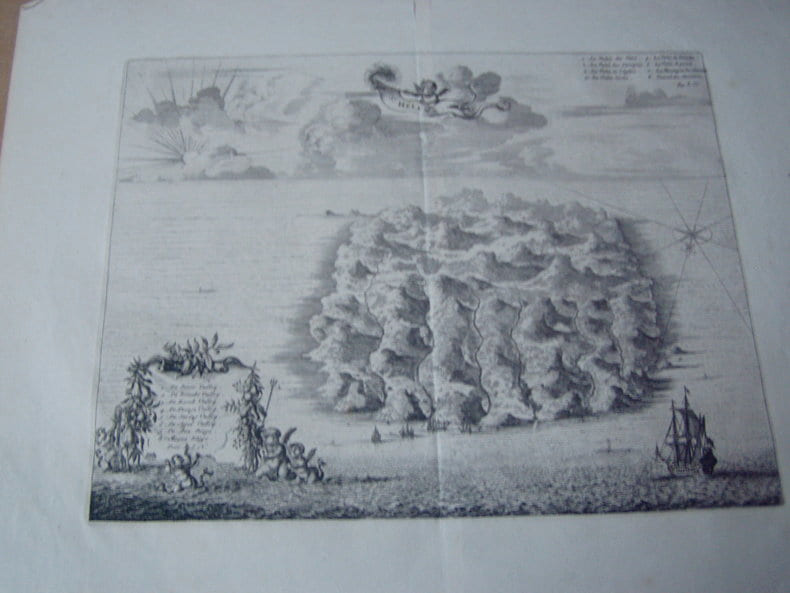
carte vue Ile Sainte Helene, amsterdam 1686
1686 extrait de Description de l'Afrique, contenant les noms, la situation et les confins de toutes ses parties, leurs rivières, leurs villes et leurs habitations, leurs plantes et leurs animaux, les moeurs, les coutumes, la langue, les richesses, la religion et le gouvernement de ses peuples. Avec des cartes des Etats, des provinces et des villes, et des figures en taille-douce qui représentant les habits et les principales cérémonies des habitants, les plantes et les animaux les moins connus] Amsterdam : Wolfgang, Waesberg, Boom, 1686.
reproduit : http://gallica.bnf.fr/ark:/12148/bpt6k104385v/f533.itemCarte de Sainte-Hélène,1670 :http://www.lautresaintehelene.com/autre-sainte-helene-lieux-ile.html Remise de 20% pour toutes commandes supérieures à 200 €
Handleiding bij het oogheelkundig onderzoek
Leiden, S.C.Van Doesburgh 1921 viii + 277pp., 4de herziene en vermeerderde druk door W.P.C. Zeeman, linnen band, in de reeks "Leerboek der oogheelkunde" deel I, 26cm.
De plaats van de wil in de philosophie van Plotinus.
Arnhem, v.Loghum Slaterus, 1946.
20,243 p. Wrs. 24 cm (Diss.)(Sl. worn)
The Simpsons - Collection d' Images Autocollantes De Springfield
The Simpsons brochure Couverture Illustrée 1999 42 pagesen format 23 - 30 cm - images autocollantes au complet
Bon État
Familiewapens (wetenswaardigheden, hoe kom ik er aan?, het tekenen en schilderen)
s.l., s.d. 48pp.geïll., gecart., 22cm., goed, G85593
The later poetry of Osip Mandelstam. Text and Context
Amsterdam, Rodopi 1988 xvii + 179pp. + frontispiece, 23cm., text in English, Doctoral Dissertation (Universiteit van Amsterdam, the Netherlands), softcover, stamp at verso of title page, text is clean and bright, T112505
ATLAS DER GEHELE AARDE, IN 48 KARTEN EN VELE BIJKAARTEN
P.Noordhoff. 1954. In-4. Relié. Bon état, Couv. convenable, Dos frotté, Intérieur frais. 48 pages de cartes en couleur. Texte en néerlandais. Ouvrage légèrement déformé. Scotchs en guise de protège-coins.. . . . Classification Dewey : 490-Autres langues
Tweeëndertigste Druk. Classification Dewey : 490-Autres langues
Handleiding bij het oogheelkundig onderzoek.
1921 (4th ed.) [8], 277 p., 116 (2 col.) figs & pls, publisher's cloth (outer ends spine worn). Ex libris J.G.Y. de Jong.
Het dorpsleven van de Langedijk vroeger en nu....
Hoorn, Uitgevers-maatschappij West-Friesland, 1971, in-8°, 272 pp, groen-linnen uitgeversband, zonder stofwikkel. Rug licht verkleurd, maar verder goed exemplaar, binnenin zonder stempels of vlekken.

