Write to the booksellers
58 books for « weyl h »Edit
-
Century
19th (4)
20th (28)
21st (2)
-
Countries
Belgium (2)
Denmark (12)
France (42)
Switzerland (1)
United Kingdom (1)
-
Syndicate
ILAB (26)
NVVA (1)
SLACES (1)
SLAM (12)
Topics
- Alsace (6)
- Army (1)
- Bordeaux (1)
- Bordeaux henry (1)
- Chemistry (1)
- Economics (1)
- First edition (1)
- Franche comte (1)
- Hebraic literature (2)
- Hermeticism (2)
- Judaism (judaica) (9)
- Law (3)
- Literature (1)
- Magre maurice (1)
- Mathematics (7)
- Mechanics (1)
- Navy (2)
- Philosophy (3)
- Physics (8)
- Poetry (1)
- Political sciences (1)
- Psychology (1)
- Raphael (8)
- Review (2)
- Sciences (2)
- Sciences & technique (1)
- Sociology (1)
- Sokol (1)
- Symbolism (3)
- Various (1)
- War (1)
- Woods & woods’ price lists (1)
Quantenmechanik und Gruppentheorie. - [EARLY ANALYSIS OF THE FOUNDATIONS OF QUANTUM MECHANICS]
Berlin, Julius Springer, 1927. 8vo. In contemporary half cloth with gilt lettering to spine. In ""Zeitschrift für Fhysik"", vol. 46. Entire volume offered. Library stamp to title page. Pp. 1-46. [Entire volume: VII, (1), 902 pp.].
First printing of Weyl's exceedingly important paper which initially did not attract much attention but ""its repercussion turned out to be remarkably strong in the long range"". (Scholz, Weyl Entering the ’New’ Quantum Mechanics Discourse , p. 14). In it Weyl put forth an analysis of the foundations of quantum mechanics.""Weyl's (1927) paper, referred to by Yang above, is entitled Quantenmechanik und Gruppentheorie (Quantum Mechanics and Group Theory). In it, Weyl provides an analysis of the foundations of quantum mechanics and he emphasizes the fundamental role Lie groups play in that theory. Weyl begins the paper by raising two questions: (1) how do I arrive at the self-adjoint operators, which represent a given quantity of a physical system whose constitution is known, and (2), what is the physical interpretation of these operators and which physical consequences can be derived from them? Weyl suggests that while the second question has been answered by von Neumann, the first question has not yet received a satisfactory answer, and Weyl proposes to provide one with the help of group theory."" (SEP)Weyl’s approach to quantization was so general that for decades to come it did not attract much attention of physicists. At the beginning it even attracted very few successor investigations inside mathematics and was not noticed in the foundation of QM discourse, which was exclusively shaped by the Hilbert and von Neumann view until the 1950s. Although the immediate reception of Weyl’s early contributions to QM until about 1927, in particular his (Weyl 1927), was very sparse, its repercussion turned out to be remarkably strong in the long range:""1. A first and immediate next step was made by Marshall Stone and John von Neumann. They both took up Weyl’s statement of a uniquely determined structure of irreducible unitary ray representations. The result of this work is (for finite n) the now famous Stone/von Neumann representation theorem.2. A second line of repercussions may be seen in that part of the work of E. Wigner and V. Bargmann, which dealt with unitary and semi-unitary ray representations. In particular Wigner’s now famous work (at the time among physicists completely neglected) on the irreducible unitary ray representations of the Poincar´e group (Wigner 1939) looks like a next step beyond Weyl’s non-relativistic quantum kinematics from 1927. 3. A third impact is clearly to be seen in George Mackeys’s work. Mackey expressedly took up Weyl’s perspective (Mackey 1949) and developed it into a broader program for the study of irreducible unitary representations of group extensions.4.Finally, Weyl quantization was taken up by mathematical physicists from the later 1960s onwards with the rise of deformation quantization (Pool 1966). Here the starting point was the idea to translate the operator product introduced by Weyl’s own quantization.The last two points lead straight into very recent developments of mathematical physics."" (Scholz, Weyl Entering the ’New’ Quantum Mechanics Discourse).

Über die Konvergenz von Reihen, die nach Orthogonalfunktionen fortschreiten.
Leipzig, B.G. Teubner, 1909. 8vo. Original printed wrappers, no backstrip and a small nick to front wrapper. In ""Mathematische Annalen. Begründet durch Alfred Clebsch und Carl Neumann. 67 Band. 2. Heft."" Entire issue offered. Internally very fine and clean. [Weyl:] Pp. 225-45. [Entire issue: Pp. 145-280].
First printing of Weyl's paper on the convergence of series which continue as orthogonal functions. ""Very few of Weyl's 150 published books and papers-even those chiefly of an expository character-lack an original idea or afresh viewpoint. The influence of his works and of his teaching was considerable: he proved by his example that an ""abstract"" approach to mathematics is perfectly compatible with ""hard"" analysis and, in fact, can be one of the most powerful tools when properly applied."" (DSB)
La Marine Militaire 1888-1889
E. Plon Nourrit et Cie imprimeurs-éditeurs 1889 in12. 1889. Broché. Ouvrage de référence sur la marine militaire française pour les années 1888-1889 rédigé par Émile Weyl officier de marine et ancien élève de l'École Navale. Publié par Plon en 1889 il traite de la flotte de guerre et des arsenaux
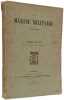
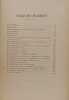
Bon état Pages tachées quelques rousseurs bonne reliure
Über gewöhnliche Differentialgleichungen mit Singularitäten und die zugehörigen Entwicklungen willkürlicher Funktionen. - [FIRST DESCRIPTION OF ESSENTIAL SPECTRUM]
Leipzig, B.G. Teubner, 1910. 8vo. Original printed wrappers, no backstrip and a small nick to front wrapper. In ""Mathematische Annalen. Begründet durch Alfred Clebsch und Carl Neumann. 68. Band. 2. Heft.""Entire issue offered. Internally very fine and clean. [Weyl:] Pp. 220-69. [Entire issue: Pp. 145-304].
First printing of Weyl's important paper in which he created the topic of essential spectrum.In mathematics, the essential spectrum is a certain subset of its spectrum, defined by a condition of the type that says, ""fails badly to be invertible"".
Eine Neue Erweiterung der Relativitätstheorie [Weyl] (+) Experimenteller Nachweis der Schwereänderung, die ein auf normal geformter Erdoberfläche in östlicher oder westlicker Richtung bewegter Körper durch diese Bewegung erleidet [Eötvös].
Leipzig, Ambrosius Barth, 1919. 8vo. In contemporary half cloth with gilt lettering to spine. In ""Annalen der Physik"", Vierte Folge, Band 59. Entire volume offered. Hinges weak a library labels pasted on the pasted down front free end paper. Stamp to title page, othrewise a fine copy. Pp. 101-133"" Pp. 743-752. [Entire volume: VII, (1), 760 pp.].
First printing of WEYL ambitious paper in which he used the Stoney units, named after the Irish physicist George Johnstone Stoney, to unify quantum processes and gravity thereby seeking to create a ""Unified Field Theory"". The paper appears to have inspired Dirac's fascination with the large number hypothesis.Also contain in this volume is the first appearance of EÖTVÖS' important paper in which he explains the eastward deflection of falling objects. In the paper, he also describes a device with which the effect can be demonstrated experimentally.The Eötvös effect is the change in perceived gravitational force caused by the change in centrifugal acceleration resulting from eastbound or westbound velocity. When moving eastbound, the object's angular velocity is increased (in addition to the earth's rotation), and thus the centrifugal force also increases, causing a perceived reduction in gravitational force. This phenomenon had been observed in the early 20th century on research ships on which gravity was measured" they noticed that measurements of g yielded smaller values when the ship went eastward, and larger ones when they went westward. These observations are mentioned by Eötvös in a paper in which he provides the explanation of the effect.
Quantenmechanik und Gruppentheorie.
Berlin, Julius Springer, 1928. 8vo. Contemp. hcloth. Gilt lettering to spine. In: Zeitschrift für Physik, Vol. 46. VII,902 pp. (Entire volume offered). Weyl's paper: pp. 1-46. Clean and fine.
First printing of the paper in which Weyl developed the concept of continous groups by using matrix representations in dealing with the mathematical formalism of quantum theory.
Georges Rodenbach / Henry Bordeaux / Claire Sidon / Yvanohé Rambosson / Marc Legrand / Vicomte de Colleville / Henri Degron / Maurice Magre / Stuart Merril / André Ibels / Jean des Bois / Fernand Weyl / Jacques Yvel [Jacques des Gachons]
Reference : 17221
Le livre des légendes. Fascicule 7 / 8 2ème année Juillet / Août 1895
. Paris, 1895, plaquette in-8 carré, couverture illustrée en noir, 1f.-pp.171-218-1f. Quatre planches hors-texte dont deux en couleurs. (La fin d'Ophélie par Andhré des Gachons et Au Balcon par Elie Clavel) et deux en noir par Paul Berthon et Léonce de Joncière). Textes de Georges Rodenbach / Henry Bordeaux / Claire Sidon / Yvanohé Rambosson / Marc Legrand / Vicomte de Colleville / Henri Degron / Maurice Magre / Stuart Merril / André Ibels / Jean des Bois / Fernand Weyl / Jacques Yvel. Le livre des légendes, publié en 10 fascicules en 1895, sous la direction de Jacques des Gachons fait suite à l'Album des légendes, publié en 1893-1894. Cette publication réunissait poètes et prosateurs symbolistes, illustrateurs fin-de-siècle et Art Nouveau. Le fil de brochage est brisé. Infimes rousseurs sur quelques marges.


[Revue La Plume, Collectif dont] Paul Masson, Charles Buet, Achille Segard, Fernand Weyl, Jean Grave, etc.,
Reference : 021505
La Plume - n°142 du 15 mars 1895.
[Revue La Plume, Collectif dont] Paul Masson, Charles Buet, Achille Segard, Fernand Weyl, Jean Grave, etc., La Plume - n°142 du 15 mars 1895. Paris, 1895. In-8, paginé 123 à 140. Fameuse revue Fin-de-Siècle publiant essentiellement de l'inédit, ici avec la couverture d'Eugène Grasset. Hors-texte d'Hermann-Paul (compris dans la pagination). Broché. Couvertures détachées, couverture arrière manquante. [V]
![La Plume - n°142 du 15 mars 1895.. [Revue La Plume, Collectif dont] Paul Masson, Charles Buet, Achille Segard, Fernand Weyl, Jean Grave, etc.,](https://static.livre-rare-book.com/pictures/JNL/021505_1_thumb.jpg)
![La Plume - n°142 du 15 mars 1895.. [Revue La Plume, Collectif dont] Paul Masson, Charles Buet, Achille Segard, Fernand Weyl, Jean Grave, etc.,](https://static.livre-rare-book.com/pictures/JNL/021505_2_thumb.jpg)
![La Plume - n°142 du 15 mars 1895.. [Revue La Plume, Collectif dont] Paul Masson, Charles Buet, Achille Segard, Fernand Weyl, Jean Grave, etc.,](https://static.livre-rare-book.com/pictures/JNL/021505_3_thumb.jpg)

[Revue La Plume, Collectif dont] Paul Masson, Charles Buet, Achille Segard, Fernand Weyl, Jean Grave, etc.,
Reference : 021506
La Plume - n°142 du 15 mars 1895.
[Revue La Plume, Collectif dont] Paul Masson, Charles Buet, Achille Segard, Fernand Weyl, Jean Grave, etc., La Plume - n°142 du 15 mars 1895. Paris, 1895. In-8, paginé 123 à 140. Fameuse revue Fin-de-Siècle publiant essentiellement de l'inédit, ici avec la couverture d'Eugène Grasset. Hors-texte d'Hermann-Paul (compris dans la pagination). Broché. Couvertures détachées. [VI]
![La Plume - n°142 du 15 mars 1895.. [Revue La Plume, Collectif dont] Paul Masson, Charles Buet, Achille Segard, Fernand Weyl, Jean Grave, etc.,](https://static.livre-rare-book.com/pictures/JNL/021506_1_thumb.jpg)
![La Plume - n°142 du 15 mars 1895.. [Revue La Plume, Collectif dont] Paul Masson, Charles Buet, Achille Segard, Fernand Weyl, Jean Grave, etc.,](https://static.livre-rare-book.com/pictures/JNL/021506_2_thumb.jpg)
![La Plume - n°142 du 15 mars 1895.. [Revue La Plume, Collectif dont] Paul Masson, Charles Buet, Achille Segard, Fernand Weyl, Jean Grave, etc.,](https://static.livre-rare-book.com/pictures/JNL/021506_3_thumb.jpg)
Se libérer de Maastricht : Pour une Europe des peuples Weyl Monique et R
Le Temps des Cerises LIVRE COMME NEUF.
Merci de nous contacter à l'avance si vous souhaitez consulter une référence dans notre boutique à Authon-du-Perche.
Fernand Nozi¿re. La Vie amoureuse de Ninon de Lenclos
E. Flammarion Broch D'occasion tat correct 01/01/1928 185 pages
Temps, espace, matière. Leçons sur la théorie de la relativité. Traduites sur la quatrième édition allemande par G. Juvet et R. Leroy -- PREMIERE EDITION FRANCAISE
P., Blanchard, 1922, un volume in 8, broché, couverture imprimée (légèrement défraîchie), 8pp., 290pp.
---- PREMIERE EDITION FRANCAIS ---- "H. Weyl, the most universal mathematicians of his generation, had an important role in the development of mathematical physics, the field to which his most famous books, Raum, Zeit und Materie (1918), on the theory of relativity, and Gruppentheorie und Quantenmechanik, are devoted". (DSB XIV pp. 281/285)**5283/M6DE-CAV/F4(3)
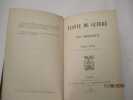
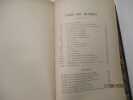
Marine - La flotte de guerre et les arsenaux par Emile Weyl.
1894 PARIS, Librairie Plon, E. Plon, Nourrit & Cie - 1894 - Edition Originale - In-12 - Reliure 1/2 chagrin, daté en pied - Dos à nerfs & à filets dorés - Titre doré - Plats & gardes marbrés - 250 pages - léger accroc au 4 ème plat, sinon Très bel exemplaire, très frais - Réf. 48276

Cnformément à nos conditions générales de vente :Les frais de port sont affichés à titre indicatif. Il se peut que nous devions vous contacter pour vous informer du coût de laffranchissement supplémentaire en fonction du poids et du nombre de livres, surtout pour les envois internationaux Cependant vu l'augmentation des tarifs postaux à l'internationale, nous pouvons expédier les ouvrages en point relais MONDIAL RELAY pour les pays suivants : Allemagne, Autriche, Belgique, Espagne, Italie, Luxembourg, Pays-Bas, Pologne, et Portugal. Merci de nous indiquer en retour le point relais choisi ainsi que votre numéro de téléphone mobile & adresse Courriel pour assurer le suivi du colis.N'hésitez pas à nous interroger.In accordance with our general terms and conditions of sale:Shipping costs are displayed for informational purposes only. We may need to contact you to inform you of the additional postage costs depending on the weight and number of books, especially for international shipments.However, given the increase in international postal rates, we can ship books via Mondial Relay to the following countries: Germany, Austria, Belgium, Spain, Italy, Luxembourg, Netherlands, Poland, and Portugal. Please provide us with your chosen Mondial Relay point, as well as your mobile phone number and email address to ensure package tracking.Please feel free to contact us with any questions
Die Idee der Riemannschen Fläche. (Mathematische Vorlesungen an der Universitat Göttingen, no. V).
Leipzig und Berlin, B.G. Teubner, 1913. Orig. green printed wrappers. Frontwrapper nearly loose but without loss. Backstrip faded. Very small nicks to spineends. IX,(1),169,(1) pp. + Publishers catalogue. Textillustrations. Internally clean and fine.
Scarce first edition. As privatdozent Hermann Weyl had given a course on Riemann's theory of functions" but instead of following his predecessors in their constant appeal to intuition for the definition and properties of Riemann surfaces, he set out to give to their theory the same kind of axiomatic and rigorous treatment that Hilbert had given to Euclidean geometry. Using Hilbert's idea of defining neighborhoods by a system of axioms, and influenced by Brouwer's clever application of Poincare's simplicial methods (which had just been published), he gave the first rigorous definition of a complex manifold of dimension 1 and a throughout treatment (without any appeal to intuition) of all the questions regarding orientation, homology, and fundamental groups of these manifolds. ""Die Idee der Riemannschen Fläche"" (1913) immediately became a classic and inspired all later developments of the theory of differential and complex manifolds.(J.Dieudonne in DSB).
Über gewöhnliche Differentialgleichungen mit Singularitäten und die zugehörigen Entwicklungen willkürlicher Funktionen. - [FIRST DESCRIPTION OF ESSENTIAL SPECTRUM]
Leipzig, B.G. Teubner, 1910. 8vo. Without wrappers. Extracted from ""Mathematische Annalen. Begründet 1868 durch Alfred Clebsch und Carl Neumann. 68. Band"". Pp. 220-69.
First printing of Weyl's important paper in which he created the topic of essential spectrum.In mathematics, the essential spectrum is a certain subset of its spectrum, defined by a condition of the type that says, ""fails badly to be invertible"".
Quantenmechanik und Gruppentheorie.
Berlin, Julius Springer, 1928. 8vo. Bound in contemporary half cloth with gilt lettering, In ""Zeitschrift für Physik"", Band 46, 1928. Entire issue offered. Two stamps to title page, otherwise fine. Pp. 1-46. [Entire volume: VII, 902 pp].
First printing of the paper in which Weyl developed the concept of continous groups by using matrix representations in dealing with the mathematical formalism of quantum theory.
Zur Gravitationstheorie.
Leipzig, Ambrosius Barth, 1917. 8vo. In full black cloth with gilt lettering to spine. In ""Annalen der Physik"", Vierte Folge, Band 54. Entire volume offered. Library labels to front end papers and stamp to title page, otherwise fine and clean. Pp. 117-145. [Entire volume: (2), 626, VIII pp. + 3 plates.].
First appearance of Weyl's first paper on gravitation and Einstein's theory of relativity.
A Byzantine Masterpiece Recovered, the Thirteenth-Century Murals of Lysi, Cyprus
Carr, Annemarie Weyl: A Byzantine Masterpiece Recovered, the Thirteenth-Century Murals of Lysi, Cyprus. Austin: University of Texas Press, 1991. 157pp with 23 colour plates and 83 monochrome illustrations. Cloth, 28.5x22.5cms. A detailed study of these murals and their reconstruction and restoration, situating the paintings in their historical and artistic context.
A detailed study of these murals and their reconstruction and restoration, situating the paintings in their historical and artistic context
"Juis en Alsace, culture, société, histoire. Collection : ""Franco-Judaïca""."
Toulouse, Edouard Privat, 1977. 18 x 24, 458 pp., 36 planches, reliure d'édition + jaquette, très bon état.
"Préface de Bernhard Blumenkranz; postface de Jacques Schwartz."
The classical groups, their invariants and representations.
Princeton University Press 1997 Pinceton University Press, Princeton Landmarks in Mathematics, 1997, 320p., broché, environ 23x15cm. Une étiquette de librairie sur le second plat, coins des plats un peu cornés, haut du dos légèrement émoussé, bon état pour le reste et intérieur bien propre.
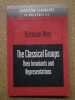

En anglais. Merci de nous contacter à l'avance si vous souhaitez consulter une référence au sein de notre librairie.
Regards nouveaux sur les juifs d'alsace
Istra 1980 308 pages in8. 1980. Broché. 308 pages. Couverture usagée Intérieur bon

Bon Etat
La marine militaire 1888-1889
Plon 1889 271 pages in8. 1889. Relié. 271 pages. Livre contenant des tampons et étiquettes de bibliothèque de garnison reliure usagée dos manquant intérieur bon

Etat Passable
Les grandes manoeuvres de l'escadre française
Paul okkendorff 1886 142 pages in8. 1886. Relié. 142 pages. Livre contenant des tampons et étiquettes de bibliothèque de garnison reliure usagée intérieur bon
Etat Correct
Symétrie et mathématique moderne
Illustrations in texte en noir et blancChapitre I : Sur la symétrie bilatérale Chapitre II : Les symétries de translation, de rotation et les symétrie associées Chapitre III : La symétrie ornementale Chapitre IV : Les cristaux et l'idée mathématique générale de symétrieAppendices : A - Détermination de tous les groupes finis de rotations propres dans l'espace à trois dimensions B - Inclusion des rotations impropres
Paris, Flammarion, Nouvelle bibliothèque scientifique, 1964 - In-8°, 151 pp, broché, cartonnage souple éditeur, imprimé et illustréEdition française
Regards nouveaux sur les juifs d'Alsace.
Librairie Istra France 1980 In-8 ( 230 X 170 mm ) de 453 pages, cartonnage illustrée. Illustrations dans et hors-texte. Bel exemplaire.